

Hunter Is OUT. Anderson Is Questionable. Clowney Has Houston's Biggest Job.
GOATIFYHouston's defensive line had just delivered a statement: eight sacks in a 44–22 victory over the Los Angeles Chargers. Six days later, the Texans are preparing for Cleveland without Danielle Hunter, one of the players who makes their pressure packages work. A hamstring problem that limited Hunter at Thursday's practice kept him out on Friday. The team has ruled him out of Sunday's game against the Browns.
The timing is complicated even beyond that single absence. Will Anderson Jr., the other cornerstone on the edge, is questionable with an ankle issue. Houston has lost starting linebacker Azeez Al-Shaair for the matchup, too. What looked like an opportunity for a surging pass rush to exploit a struggling Cleveland protection unit has become a test of whether the Texans can produce the same disruption with a reshuffled front.
Jadeveon Clowney now carries the clearest individual assignment. The veteran has been effective in smaller doses, but a part-time rusher is about to be asked to handle a starter's workload. Whether Anderson can play, how well Clowney holds up on early downs and how the offense protects the defense will shape a game Houston badly needs at 3–5.
Hunter's absence changes more than the sack total
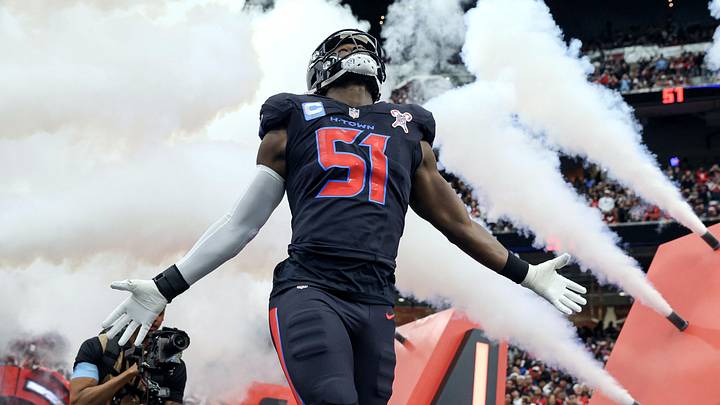
Hunter has started every Houston game since joining the Texans in 2024. He played all 17 regular-season contests in each of his first two seasons with the club and was available for all eight games this year before the injury. That kind of continuity matters to a defensive staff. When a coordinator designs third-down pressures, an edge player who can beat a tackle without extra help makes the entire call sheet more flexible.
This season's numbers do not tell the whole story, but they establish how much is being removed from the lineup. Hunter has 19 total tackles, three tackles for loss and four sacks through eight games. His sack total is lower than Anderson's 9.5, but blockers must account for both sides. When two accomplished rushers threaten simultaneously, a quarterback has fewer obvious places to escape and a protection cannot slide toward both edges at once.
The loss creates two separate problems. The first is production: someone must replace the pressures and run-game disruption Hunter usually creates. The second is alignment. The Browns can adjust their protection if they no longer need to plan for his usual matchup, especially if Anderson is limited or inactive. Houston might respond with more movement, inside pressure or carefully timed blitzes, but each option asks different things of the linebackers and secondary.
Anderson's ankle designation therefore matters almost as much as Hunter's ruled-out status. With Anderson available, Cleveland would still face an elite edge threat and Houston could move help toward the other side of the front. Without a fully effective Anderson, the Texans would have to manufacture pressure rather than assume it will arrive naturally. A questionable designation is not a guarantee that Anderson will miss the game, so the active list on Sunday will be a decisive piece of information.
GOATIFY
GOATIFY NFL
Explore GOATIFY NFL gear as Houston reshapes its front without Danielle Hunter.


The eight-sack eruption against the Chargers offered a glimpse of the defense at its most aggressive, not a promise that the same total can be repeated every week. Houston has 29 sacks across eight games, and the wider pattern is more relevant than one explosive afternoon: this front creates opportunities for the coverage unit by forcing hurried decisions. Losing a reliable starter immediately after that performance makes the balance harder to maintain.
There is also an early-down dimension. Edge defenders do more than chase passers. They must set the boundary of the rushing lane, prevent easy cutbacks and avoid opening space by attacking too far upfield. If Hunter's replacement struggles against the run, Cleveland could reduce the number of obvious passing situations in which Houston's pass-rush advantage is most valuable. The Texans need a complete defensive end, not merely someone who can deliver one highlight sack.
Clowney's promotion is a stamina and run-defense test
Clowney has not needed a full starter's snap count to matter this season. Across six appearances, he has contributed 12 tackles, four tackles for loss and 3.5 sacks while playing about 37 percent of Houston's defensive snaps. His two sacks in the win over the Chargers showed why a veteran can remain dangerous even when his weekly role is carefully controlled.
A part-time assignment makes it easier to deploy a player in specific situations. Coaches can preserve his legs, choose favorable matchups and concentrate his rushes against tired offensive linemen. Starting opposite Anderson, or becoming the primary edge option if Anderson cannot go, changes that equation. He may have to defend the run on first down, race to the quarterback on third down, and do it again after the next series without the usual rest.
An increase toward the snap load Hunter normally carries is a plausible scenario rather than a confirmed game plan. One report suggested Clowney could approach 70 percent of the defensive plays, but Houston has not locked that number in. The real issue is how much the extra work affects his effectiveness. If he wins early but fades in the fourth quarter, Cleveland could find the time and field position it could not manufacture against the Texans' full-strength front.
His experience helps. Clowney knows the demands of an outside linebacker or defensive end who must protect an edge before he can attack a quarterback. On run plays, patience can be as important as penetration: squeeze the gap, force the back into help and resist a cutback opening. On passes, he can win with power as well as speed, pushing the tackle toward the quarterback rather than depending on a wide arc every snap.
GOATIFY
GOATIFY NFL
Shop GOATIFY NFL styles as C.J. Stroud and Houston try to ease the pressure on their defense.
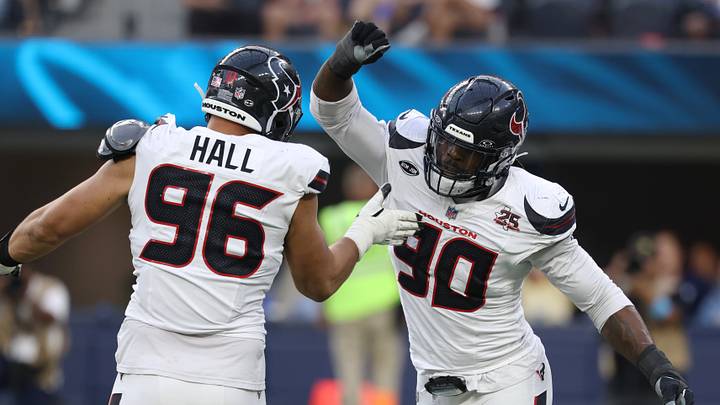
Logan Hall becomes important in this calculation as well. Clowney and Hall celebrated a sack together in Los Angeles, a reminder that Houston's next wave of linemen is more than a list of emergency replacements. Hall can absorb snaps, provide fresh legs and allow the Texans to keep a credible rush on the field while Clowney catches his breath. That rotation would be especially valuable if Anderson's ankle restricts him.
There is a tactical trade-off for Cleveland. The Browns have allowed 38 sacks through their first eight games, a figure that underlines why Houston still has chances to disrupt the backfield. But knowing the Texans are short-handed, Cleveland could shorten passing concepts, rely on extra protection or use runs and screens to slow the rush. Clowney's best game would therefore include several plays that never appear on a sack leaderboard: controlling an outside shoulder, forcing an inside run toward teammates, making a quarterback reset his feet or drawing an extra blocker that frees another Texan.
The standard should not be whether Clowney duplicates every Hunter statistic. Their assignments, playing time and the opposition's plan will differ. The better measure is whether the defensive front remains difficult to block across four quarters. Three or four decisive pressures spread across the afternoon can change drives, but so can a disciplined run stop on second-and-short. This is precisely the kind of game in which those quieter contributions count.
The Texans need Stroud's offense to protect a thinner defense

A defensive injury is easier to manage when the offense gives that defense breathing room. Houston's 44-point outing against Los Angeles was the model: C.J. Stroud drove an explosive scoring performance while the defense turned pressure into drive-killing plays. The Texans do not need the same score in Cleveland, but they do need drives that prevent an undermanned front from spending most of the afternoon on the field.
The lineup questions extend far beyond Hunter. The Texans also ruled out linebacker Azeez Al-Shaair with a groin issue, wide receiver Marvin Harrison Jr. with a hamstring injury, tight end Brevin Jordan with finger and foot issues, and guard Keylan Rutledge with neck and shoulder problems. Different units are being asked to redistribute work at the same time. That raises the cost of communication errors and penalties that would be relatively easy to absorb at full strength.
Al-Shaair's absence is particularly important against the run. Linebackers make the defensive front's work count by fitting the correct gap after a lineman forces a ball carrier sideways. If Houston's replacement at middle linebacker takes a false step, an otherwise well-set edge can still surrender an efficient run. Henry To'oTo'o is among the players who could be asked to take on different responsibilities, and the coordination with Clowney and Hall will be worth watching from the first series.
GOATIFY
GOATIFY NFL
Shop GOATIFY NFL and American football shirts, hoodies and stickers.
On offense, Houston must decide how to replace Harrison's vertical and intermediate-route involvement without turning every drive into a collection of low-percentage throws. The best response is not necessarily throwing deeper. A quick passing rhythm can force Cleveland to defend the width of the field, and a usable rushing game can keep Stroud from taking unnecessary hits behind an altered line. Tight-end and guard absences may make a conservative protection plan attractive, even if it reduces the number of receivers in a route.
The backfield offers some encouraging news. Woody Marks returned to full practice and carries no injury designation, while David Montgomery is questionable because of a groin problem. Houston may not know Montgomery's actual availability until nearer kickoff. If the Texans can generate reliable four- and five-yard gains without exposing Stroud to a stream of obvious passing downs, they can make their defensive personnel shortage less severe.
Cleveland's protection trouble is the most obvious opportunity for the defense. Thirty-eight sacks allowed is not merely a number for a pregame graphic: it suggests there will be chances to win against individual blockers even without Hunter. Yet a struggling line can still improve its situation by throwing the ball quickly or running away from the strongest defender. Houston has to force long drives, put the Browns behind schedule and make them attempt the types of passes that allow Clowney to attack.
At 3–5, the Texans cannot afford to treat this matchup as a comfortable bridge to healthier weeks. Their latest win gave them momentum, not a cushion in the AFC standings. A second consecutive victory would build on the breakthrough against Los Angeles and give Houston a better position as the schedule advances. A loss would underline how fragile one spectacular defensive performance can be when the lineup changes a few days later.
The uncertainty makes Sunday's inactive list unusually consequential. If Anderson plays effectively, Houston can still threaten both tackles and ask Clowney to fill Hunter's familiar side. If he is limited, the Texans will need more interior disruption and greater discipline behind the rush. Either way, the offense's role remains the same: avoid giveaways, keep Cleveland from stealing short fields and limit the possessions in which a reduced defensive rotation must survive.
The names on Houston's injury report make Clowney the obvious player to track, but the game is not a one-man examination. His first series will show whether he can hold his run fit; his final series may show whether the heavier workload has taken a toll. Anderson's availability, Hall's support and the linebackers' communication will matter just as much as the sack total.
Hunter's absence breaks a remarkable run of availability and makes an already important road game less predictable. Houston proved against the Chargers that it can overwhelm an offensive line. Cleveland will now find out whether the Texans can remain relentless when one of the main engines of that rush is missing.
GOATIFY
GOATIFY NFL
Shop GOATIFY NFL shirts, hoodies and football fan accessories.


















