Carrick's Five-Minute Ultimatum — Will Bruno Keep the Armband?
GOATIFYMichael Carrick did not wait for the first question. At Manchester United's Friday press conference, the head coach spent five minutes and 27 seconds telling reporters what the club should stand for, why its recent performances had fallen short and why he still believed he could put things right. It was an unusually public appeal for unity from a manager whose next result could carry enormous consequences.
United arrive at Sunday's home game against Bournemouth after seven matches without a win in all competitions. Wednesday's 4–1 Champions League defeat at Como intensified scrutiny of Carrick, while captain Bruno Fernandes openly challenged the team's approach to pressing. With United starting the weekend 13th in the Premier League and only two victories from their first 11 matches of the season, words about standards are being measured against a very unforgiving scoreboard.
Carrick accepted responsibility, invoked the club's history, refused to confirm whether Fernandes would retain his captaincy and promised to absorb pressure rather than pass it down to his players. The question now is whether that leadership can produce a recognisably different Manchester United by Sunday afternoon.
Five minutes, 27 seconds: Carrick tries to reset United's standards
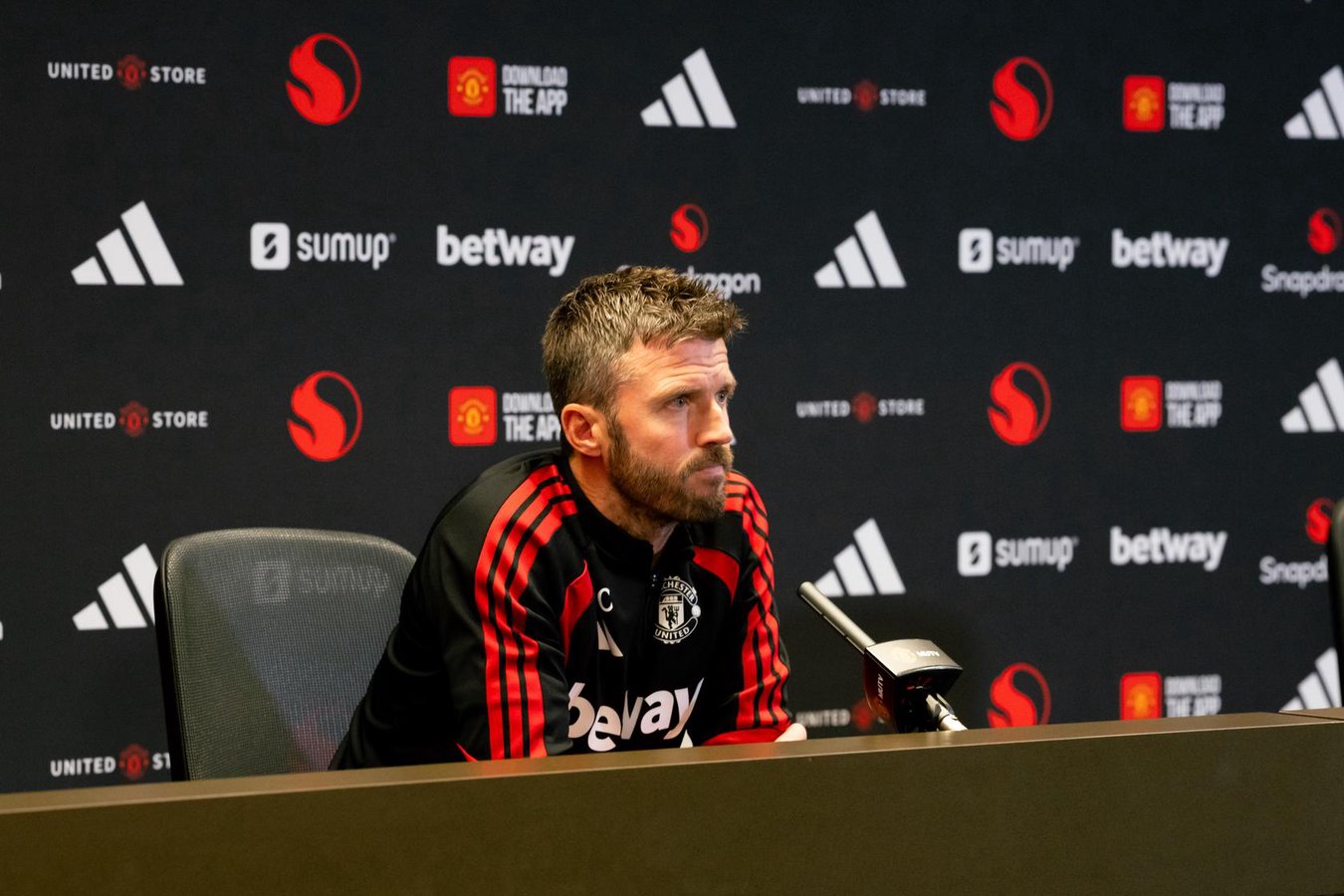
The unusual feature of Carrick's appearance was not simply its length. He began with a prepared statement before anyone asked about his future, making the club's identity the first subject of the afternoon. The coach acknowledged that the team had lost some of the intensity and purpose that carried it through a much stronger period earlier in his tenure. Rather than promise an immediate tactical miracle, he framed the problem as a failure to meet the everyday demands of representing United.
He drew on figures who had defined the club across generations: Ryan Giggs and Wayne Rooney as examples of accomplished players who subordinated individual status to the team, Sir Alex Ferguson as a manager who demanded standards, and Sir Matt Busby and Sir Bobby Charlton as symbols of resilience after the Munich air disaster. That history was not presented as proof that United deserve to win now. Carrick argued the opposite: the badge creates obligations, not an entitlement to results.
It was also a pointed message to a dressing room whose disagreements have become public. Carrick said he believed his players shared the required commitment, but warned that those who did not belonged elsewhere. He insisted that he remained fully capable of reversing the slump and acknowledged conversations with club officials. His most memorable image was the promise to hold an umbrella so others could stay dry while he took the rain. It is an appealing description of managerial responsibility, especially when players are receiving criticism from every direction.
But the metaphor carries a practical test. Taking the heat means making uncomfortable decisions about selection, pressing, training intensity and the roles of senior players. It cannot mean protecting poor performances from scrutiny. A manager can absorb public pressure while still demanding greater accountability behind closed doors. Carrick's speech will matter if it marks that kind of reset; if United again look passive, the intervention may instead be remembered as a last attempt to regain control of the story.

Fernandes' captaincy question exposes a deeper disagreement

The confrontation that sharpened Carrick's Friday appearance began in Italy. After United were beaten 4–1 by Como, Fernandes questioned the decision not to press the hosts man-to-man. His complaint was tactical, but because it came from the captain in public, it also raised a leadership issue. When the manager and his most influential player describe the same failure differently, supporters naturally wonder whether the dressing room still believes in the plan.
Carrick did not announce a punishment, a captaincy change or a decision to drop Fernandes. Asked whether those options were possible, he said the interests of the team and the wider squad would guide him. That is deliberately different from promising the midfielder immunity. It also stops short of confirming any sanction. Reports that United are inclined not to punish Fernandes should not be mistaken for a formal declaration from Carrick at the microphone.
There is a football question beneath the personal tension. A high press can reduce the time an opponent has to build attacks, but it depends on the front line, midfield and defence moving together. If the first player sprints forward while teammates remain deep, the spaces behind him become easier to exploit. Sitting off can be equally damaging if the team fails to close passing lanes and protect the central areas. Fernandes' preference for more aggressive pressure may be reasonable in certain phases; Carrick's concern about the collective work required to execute it is not automatically an excuse.
The immediate challenge is to convert that disagreement into a coherent instruction. Who triggers the press? How far does the back line advance? What happens when the first challenge is beaten? Those details matter more than whether one side wins an argument on television. Fernandes remains a major creative influence, and removing him could reduce the team's attacking invention at a time when confidence is already fragile. Keeping him without resolving the tactical conflict would be another risk.
Carrick denied that the squad had split into factions. Sunday's team sheet and the way the players respond to mistakes will offer a more useful test of that claim than any carefully phrased press-conference answer.

The Como defeat showed why slogans alone will not repair United

United's collapse at Como was not a narrow defeat that could be explained away by one unlucky bounce. The Italian side won 4–1, extending the English club's winless run to seven games and leaving its manager facing questions about both the plan and the players' commitment to it. The scoreboard alone cannot diagnose every structural fault, but it does make the scale of the problem impossible to dismiss.
There are two dangers when a team is this short of confidence. The first is indecision without the ball: attackers hesitate to press, midfielders cannot decide whether to follow runners, and defenders retreat because they no longer trust the protection in front of them. The second is forcing the issue too quickly after winning possession, which can hand the ball straight back and start another defensive sequence. United have to recover a shared understanding of risk before any change in formation can have lasting value.
Carrick's public appeal to effort should therefore be accompanied by simpler, repeatable patterns. One clear pressing trigger is more useful than five players making separate guesses. A stable rest-defence structure can help protect counterattacks even when the full-backs advance. In possession, the midfield must offer reliable passing options so Fernandes and the forwards are not asked to create something spectacular from every touch. These are tactical priorities, not claims about a secret training-ground plan.
The unrest has also reached beyond the pitch. Defender Lisandro Martínez had publicly criticised sporting director Jason Wilcox's recruitment, while speculation around Carrick's replacement has grown. Those issues do not excuse the performance against Como, but they make a recovery more complicated: a coach attempting to restore discipline needs players to trust the plan and a club hierarchy willing to back decisions it believes are right.
The irony is that Carrick has already demonstrated he can generate a response from this group. His earlier spell helped United finish third last season and return to the Champions League. The present task is different, because opponents have had time to adapt and a losing run changes how every instruction is received. His speech asked United to remember what they represent. The next training sessions must show how they intend to play.
Bournemouth is a test of decisions, not another speech

United host Bournemouth on Sunday, October 25, with Carrick still in charge. That is the confirmed position; everything beyond the fixture remains uncertain. Reports have linked several managers with the role should United decide to change direction. Eddie Howe has been identified as a preferred option for director of football Jason Wilcox, while Antonio Conte has denied that he is in advanced negotiations to take over. Such reports describe possibilities, not an appointment or a settled succession plan.
That distinction matters because a manager can lose his authority long before he formally loses his job. If every poor result is treated as a referendum on who might replace him, players may begin to think beyond the immediate instructions. Carrick's insistence that the squad is not divided was an attempt to shut down that uncertainty. A strong performance against Bournemouth would give the claim substance, even if it would not erase deeper questions about recruitment, balance and consistency.
The match offers several visible checkpoints. United must decide whether to pressure Bournemouth's build-up aggressively or defend in a more compact shape, then commit to that choice collectively. Their central midfield needs to close the spaces that become exposed when the first press is bypassed. The forwards need support close enough to sustain attacks rather than chase isolated long balls. And if Fernandes starts, the relationship between his freedom to create and his responsibilities without possession must be obvious from the opening minutes.
There is also a psychological dimension. United's supporters have heard promises about identity and work rate through several managerial eras. They will respond more readily to players winning second balls, recovering quickly after turnovers and continuing to attack after a setback than to another declaration of belief. Those are observable behaviours, not abstract values. Carrick's pledge to shoulder the criticism is meaningful only if his team gives fans something concrete to defend.
A win would not prove that the coach has solved everything. A draw would not, by itself, reveal what the board intends. But another disjointed performance would strengthen the case that the problem runs deeper than a difficult week. Carrick has asked to be judged on his ability to lead United back toward its standards. Bournemouth is the first immediate opportunity to demonstrate that his words can be translated into decisions on the pitch.
Carrick's five-minute statement did something unusual: it stripped away the easy language of entitlement and put responsibility back on the people currently representing Manchester United, starting with the head coach himself. His warning about standards, his refusal to give an unconditional answer on Fernandes and his willingness to take the pressure all point toward difficult choices rather than an effortless revival.
But the distance between a compelling press conference and a credible team remains substantial. United have seven winless matches to overcome, a tactical disagreement to resolve and a Bournemouth game that will be examined for every sign of change. The next chapter of Carrick's tenure will not be written by the umbrella metaphor. It will be written by the organisation, courage and consistency his players show once the ball starts moving.