Du Plessis Cuts 45 Pounds — Now He Wants a Second UFC Belt
GOATIFYDricus du Plessis has two ambitions, and they cannot happen in the order that sounds most exciting. The former UFC middleweight champion wants his 185-pound title back first. Only then does he intend to test himself at 205 pounds, where he believes a second championship is possible. What makes that plan more than an ordinary champion's wish list is his description of the weight he currently sheds to compete.
In a new interview published October 19, the South African said his cut to middleweight can reach 45 pounds from his normal weight outside camp. That is roughly 20 kilograms. It is an extraordinary difference to manage repeatedly, even for a fighter with an experienced team, and it changes how to read his interest in light heavyweight. This is not simply about chasing another belt. It is also about whether his size, recovery and best performances might eventually fit a different division.
There is an immediate complication: du Plessis is not the middleweight champion today. His loss to Khamzat Chimaev in 2025 exposed a wrestling problem, and a strong return against Kamaru Usman in July 2026 did not automatically restore his title shot. His next decision has to balance a realistic route through a crowded 185-pound division with the physical appeal of fighting 20 pounds heavier.
The Usman win rebuilt his case for another middleweight title run

The clearest evidence that du Plessis still belongs near the middleweight title picture came on July 18 in Oklahoma City. Facing former welterweight champion Kamaru Usman in a five-round main event, he won a unanimous decision with scorecards of 50-45 and 49-46 twice. That was an important result because the fight asked him to answer a specific question left by his defeat to Chimaev: could an accomplished wrestler control him long enough to take away his offense?
Against Usman, du Plessis kept much of the action where he wanted it. He varied his attacks, made Usman reset repeatedly and defended the attempts to turn the contest into a prolonged wrestling match. His striking did not need a spectacular finish to be effective. He showed that he could win extended stretches through positioning, pace and disciplined shot selection rather than relying on the chaotic exchanges that have sometimes defined his reputation.
The distinction matters. A dominant victory over one experienced wrestler does not prove that every defensive problem exposed by Chimaev has disappeared. Usman was moving up from his established welterweight division, and the matchup presented different timing, entries and control threats. Yet the win supplied meaningful evidence that du Plessis and his coaches had responded to the previous setback instead of merely promising improvements.
That is how the fighter himself framed it. He spoke about the satisfaction of testing changes made in training after a painful defeat and discovering that the work held up in a real contest. The comment is more revealing than a generic promise to return stronger. His team needed to demonstrate that their answers would survive five rounds against a recognizable opponent with elite credentials.
Du Plessis also emerged from the July bout with some minor injuries, according to his latest account, but now says he is ready to compete again. The timing leaves a matchmaking question rather than a recovery mystery. He has rebuilt momentum, but one successful comeback does not erase the division's other contenders. A second victory over a highly ranked middleweight could make his championship case much harder to dismiss. It would also test whether the technical improvements from Oklahoma City are repeatable against a different kind of opponent.
For now, the most practical part of his two-division plan is not moving up. It is winning the next fight at the weight where he already knows he can become champion.
The 45-pound cut makes a move to 205 more than a fantasy

Du Plessis's most striking new detail was his description of the cut. He said he sheds about 45 pounds to make the 185-pound middleweight limit, and sometimes more when comparing his normal out-of-camp weight with fight week. The number is his own account rather than an independently measured weigh-in series, but it offers useful context for why a move to 205 pounds appeals to him.
A 45-pound reduction is not the same as losing 45 pounds of fat. Fighters can change body mass through a combination of longer-term diet, training, glycogen depletion and short-term water manipulation. Those methods have different effects on performance and health. Without his precise schedule and measurements, nobody outside the camp can know how much of du Plessis's reported change happens during the final days. It would be misleading to treat the entire figure as an overnight dehydration number.
The competitive question is straightforward: how much of the energy spent reaching 185 could instead support training and recovery at 205? Light heavyweight is 20 pounds above middleweight, so a future move would reduce the size of the cut if his normal body weight remained similar. It would not necessarily remove weight management entirely, and it would introduce opponents who are generally larger and can bring a different level of clinch strength and punching power.
Du Plessis believes he has the frame for that test. He has long been a physically imposing middleweight, comfortable pressuring opponents and forcing exchanges that reward strength as well as timing. The question at 205 would be whether that physicality remains an advantage when the person across from him has spent an entire career building for a bigger weight class. Some fighters gain speed and durability by moving up; others discover that their best weapons lose relative force. Neither outcome is guaranteed.
His comments also showed an awareness of the trade-off. He did not describe extreme cutting as harmless. Instead, he acknowledged that the process is difficult and that his team has spent years refining it. That is an important difference between saying a move might suit him and suggesting that moving up is medically necessary. Only his own health professionals and camp can assess his individual situation.
For fans, the temptation is to skip directly to dream matchups at light heavyweight. Du Plessis is resisting that sequence. He wants to reclaim the middleweight belt, establish that his recovery from the Chimaev loss was real and only then investigate whether a bigger division offers the next chapter of his career.

The title path is crowded — and Chimaev's lesson still matters
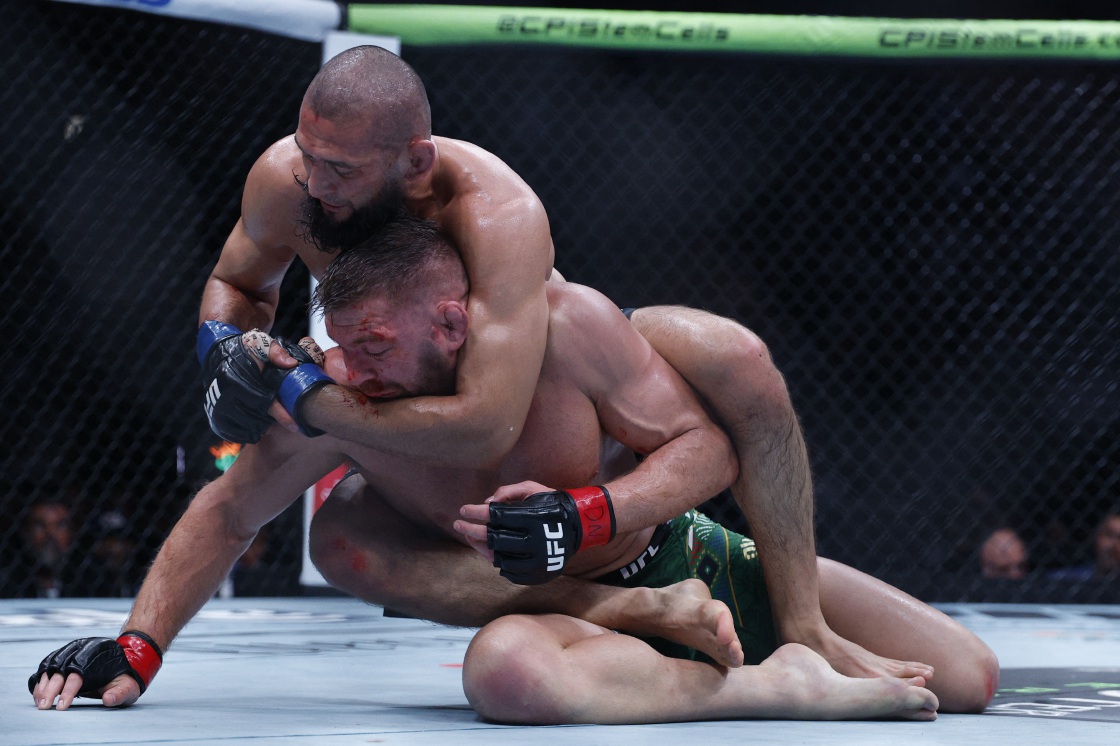
The middleweight championship landscape is more complicated than a direct rematch with the man who took du Plessis's belt. Khamzat Chimaev beat him at UFC 319 in August 2025, repeatedly using grappling control to produce a lopsided decision. The performance was decisive enough that du Plessis could not plausibly present the defeat as a judging controversy or a single unlucky exchange. He had to improve the part of his game that the champion had targeted.
But Chimaev did not remain champion. Sean Strickland reclaimed the belt in May 2026, and du Plessis has already beaten Strickland twice. That history gives the South African a compelling promotional argument, but past head-to-head results are not an automatic right to the next title fight. The division also contains contenders building their own claims, and the UFC must weigh recent form, scheduling and competitive merit.
Du Plessis has said he wants the toughest available opponent rather than an easy route back into contention. That attitude is useful if it leads to a meaningful eliminator. It is less useful if a risky booking delays his chance while other contenders move ahead. His management must find the point where ambition and leverage meet: an opponent strong enough to prove that he is ready, but a timetable that does not leave him waiting indefinitely.
The Chimaev fight also explains why a future move to light heavyweight should not be confused with a retreat from middleweight. Du Plessis is not proposing to abandon the unfinished business that defines his current career. He is trying to settle it before creating a new challenge. The July win over Usman was a credible first step because it addressed the most visible weakness from his championship loss, but the next test must show whether those improvements translate against the division's leading specialists.
At 205 pounds, the questions would change again. Du Plessis would have to establish his speed against bigger opponents, find out whether his wrestling defense remains reliable in heavier clinches and learn whether his striking power carries over. Winning a second belt would require far more than being naturally large for middleweight. It would require earning position in a new ranking and then beating the best available light heavyweight.
That is why his plan has a sensible internal order even if the headline is about two championships. First prove the rebound, then reclaim the title, then make the move. Each step would produce new evidence about the fighter he has become.

Du Plessis has already shown that a brutal title loss does not have to end a championship career. His five-round victory over Usman restored credibility to the technical work he says followed the Chimaev defeat. His admission about cutting roughly 45 pounds now adds a second dimension to the story: how long does an athlete with his frame want to keep competing at 185?
The most interesting part is not the hypothetical opponent at 205. It is the decision he must make before that move becomes realistic. Another high-level middleweight win could put a familiar former champion back in the title discussion. A loss could change both the timetable and the logic of staying at the lower weight. For the moment, du Plessis is treating the second belt as a destination, not a shortcut.