

Posey Joins the Hall Ballot. Utley's 59.1% Is the Number to Watch.
GOATIFYThe 2027 Baseball Hall of Fame ballot is officially out, and the two most intriguing names are heading into the election from opposite directions. Buster Posey is arriving for the first time, carrying three World Series rings and a career that made a short, extraordinary peak feel like a full baseball era. Chase Utley is returning with momentum, but his 59.1 percent showing in the previous vote still leaves a substantial gap to Cooperstown's 75 percent threshold.
The ballot announced on November 16, 2026 features 27 candidates: 14 newcomers and 13 returnees. Jon Lester, Jake Arrieta, Andrew Miller and Pablo Sandoval give the first-year group several very different kinds of championship pedigree. Returning candidates range from Félix Hernández and Andy Pettitte to Alex Rodriguez and Omar Vizquel, whose tenth and final appearance creates its own deadline. This is not a simple popularity contest or a prediction that every famous name will receive a plaque. It is a test of how writers evaluate peak performance, durability, position, postseason impact and changing attitudes across ballot cycles.
No one has been elected on this ballot yet. Writers must return their ballots by December 31; the results are scheduled for January 19, 2027. Before any vote is counted, the tension is clear: a catcher with a compact, brilliant résumé joins a second baseman whose support has been growing toward the line that actually matters.
Posey's case asks voters to value a catcher's peak, not just his totals

Start with the part of Buster Posey's career that traditional counting-stat debates tend to miss: he played the most demanding everyday position on the field. A catcher's value is not contained in the same neat box as a corner outfielder's offensive totals. Calling pitches, handling a staff and absorbing the physical costs of the job affect both how a team functions and how long a player can keep performing at his best. That does not automatically make every star catcher a Hall of Famer. It changes the lens through which his production should be judged.
Posey finished his major-league career with a .302 batting average and exactly 1,500 hits, figures that look relatively modest beside the enormous totals accumulated by some first-ballot inductees. But he was also a seven-time All-Star, won five Silver Slugger awards and a Gold Glove, and captured the 2012 National League MVP award. His league-leading .336 average that season was not merely a hot streak attached to a winning roster. It was top-tier offensive production from the player tasked with the Giants' pitching operation.
The championships matter, too, provided voters resist using rings as a shortcut. San Francisco won the World Series in 2010, 2012 and 2014 with Posey as a central figure. Those titles offer evidence of his place on elite teams across multiple seasons; they do not erase the need to judge his individual contribution. He won Rookie of the Year in 2010 and MVP in 2012, an unusual combination of immediate impact and later offensive peak. For a catcher, maintaining that level of influence while managing the daily demands of the position is the strongest argument in his favor.
GOATIFY
GOATIFY Baseball
Whether you followed the Giants' titles or love the game's all-time arguments, explore GOATIFY's Baseball fan collection.

Gold Baseball GOAT Sweatshirt
Rep baseball’s greatest with a gold GOAT graphic sweatshirt.
Shop Now ↗
White Baseball GOAT Dad Hat
A white baseball GOAT design for ballpark days and everyday fan style.
Shop Now ↗


White Baseball GOAT Sticker
A white baseball GOAT decal for your bottle, laptop or game-day gear.
Shop Now ↗There is an honest counterargument. Posey's 12-season career did not produce the massive hit or home-run milestones that make some candidacies easy to summarize. A voter focused on longevity or cumulative production could prefer a slower-burning résumé with more seasons of excellence. The other side would answer that a player should not be penalized twice for the physical demands of catching: once through the toll that limits his career, and again when his final totals are compared with positions carrying different workloads.
Posey now serves as San Francisco's president of baseball operations, a reminder that his relationship with the game continued after his playing career. His current executive role is not itself a reason to elect him for his playing years. The question is whether a high-impact catching peak, historic team success and exceptional offensive efficiency outweigh the shorter statistical runway. If writers embrace that framework, Posey has a credible first-ballot argument. Credible, however, is not the same thing as already elected.
Lester, Arrieta and the problem with using October as a voting shortcut
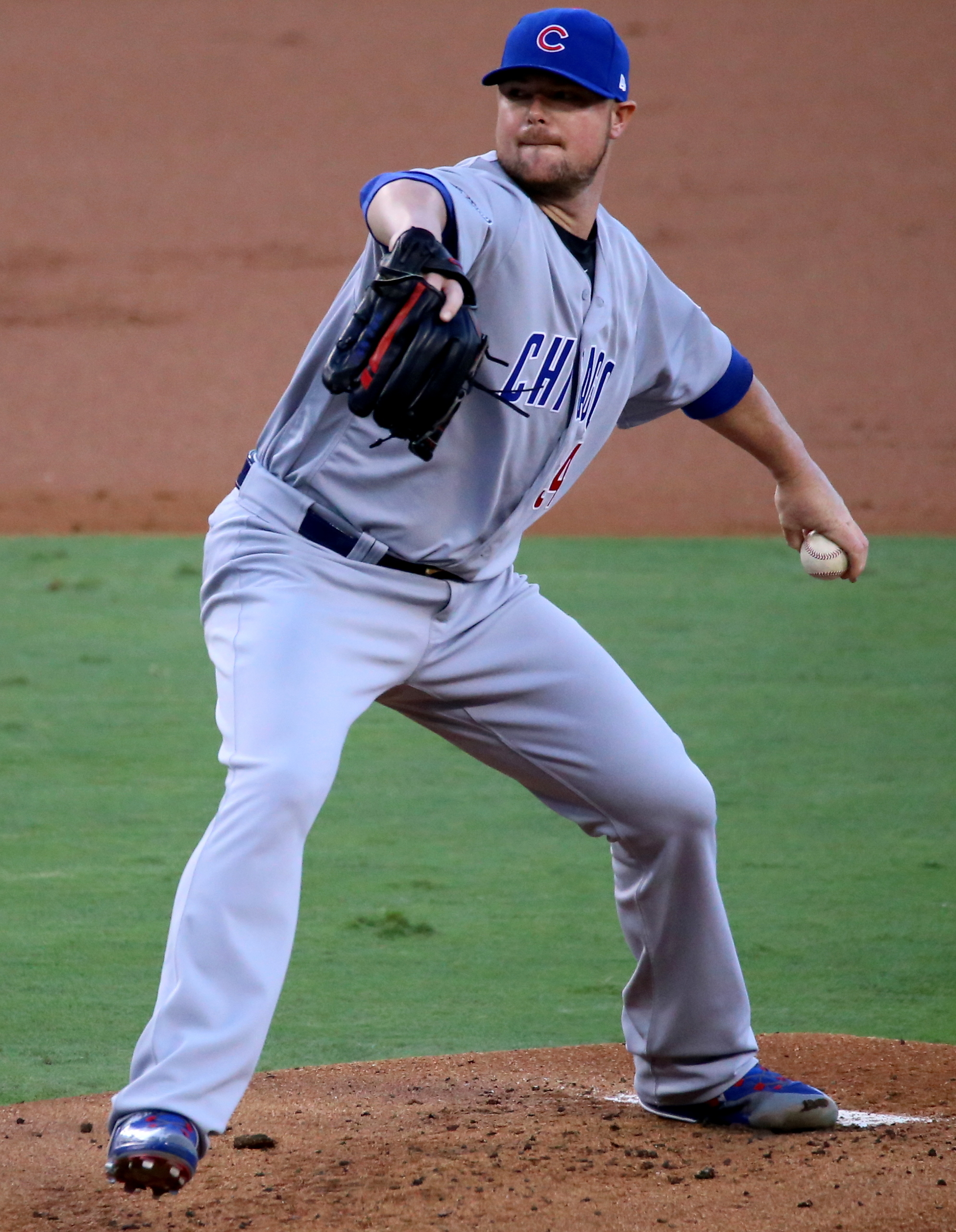
Jon Lester arrives with a completely different résumé. The left-hander won 200 regular-season games across 16 seasons and finished with a 3.66 ERA. He earned five All-Star selections, threw a no-hitter in 2008 and won World Series titles with Boston in 2007 and 2013 and Chicago in 2016. That is a persuasive mixture of durability, high-end performance and meaningful games, even in an era when pitcher wins became a less useful standalone measure of quality.
Lester's postseason performance is where the story becomes especially compelling. Across 35 and two-thirds World Series innings, he went 4–1 with a 1.77 ERA. He was also the National League Championship Series MVP for the Cubs in 2016, a season whose significance is impossible to separate from Chicago ending a 108-year championship drought. His 2008 no-hitter for the Red Sox carried personal meaning as well, coming less than two years after chemotherapy treatment for lymphoma. The accomplishments build a memorable career narrative, but the Hall still asks voters to weigh the entire body of work.
Jake Arrieta illustrates why the evaluation cannot stop at the number of famous October highlights. He was the NL Cy Young winner in 2015, when he posted 22 wins, and went 18–8 with a 3.10 ERA for the title-winning Cubs the following year. He also pitched two no-hitters in a span of less than eight months. Few pitchers reach a peak that dramatic. The difficult part of his candidacy is deciding whether that spectacular stretch compensates for a career that did not sustain the same dominance over as many seasons as some traditional pitching inductees.
Andrew Miller creates another kind of test. His dominance as a reliever does not resemble a starter's workload. In the 2016 American League Championship Series, he threw seven and two-thirds scoreless innings with 14 strikeouts and no walks, taking MVP honors. His career postseason ERA was 0.93 across 29 appearances. Modern bullpen roles make that impact real, but using a short series as the entire standard would distort the Hall's purpose. Writers have to decide how to compare elite leverage innings with the volume provided by rotation anchors.
GOATIFY
GOATIFY Baseball
Remember October's biggest baseball moments with GOATIFY's shirts, hoodies, caps and stickers for MLB fans.


White Baseball GOAT Sweatshirt
Rep baseball’s greatest with a white GOAT graphic sweatshirt.
Shop Now ↗

Gold Baseball GOAT Dad Hat
A gold baseball GOAT design for ballpark days and everyday fan style.
Shop Now ↗And then there is Pablo Sandoval, Posey's Giants teammate, whose three home runs in a single game of the 2012 World Series made him a permanent part of baseball's October montage. He hit .500 in that Series and won MVP. He belongs in this first-time group as a remarkable postseason performer, not because one extraordinary night automatically answers a career-long Hall question. Lester, Arrieta, Miller and Sandoval make the same point in four ways: October should strengthen a complete Hall argument, not substitute for one.
Utley is closer than the newcomers, but 59.1 percent is still a long climb

Chase Utley has the most useful numerical starting point in the field of returning candidates. He drew 259 votes, or 59.1 percent, in the preceding election. That made him the only unsuccessful candidate listed on more than half of the ballots. The number signifies broad support, not a near-certainty. Election requires 75 percent, meaning Utley still needs to improve by 15.9 percentage points if the electorate's size and composition are similar. Because the number of ballots can change, the precise additional votes cannot be known in advance.
The recent example of Carlos Beltrán and Andruw Jones shows what a successful finish looks like. Both cleared the threshold in the previous vote, with official results recording Beltrán at 84.2 percent and Jones at 78.4 percent. But those are outcomes, not a formula that automatically transfers to Utley. Writers can change their minds; new candidates can compete for attention; some ballots are already crowded. A player who begins the year above 50 percent has an opening, not an entitlement.
Utley's argument differs from Posey's in the way voters may reconstruct value. He was an impact second baseman on strong Phillies clubs and a key part of Philadelphia's 2008 championship team. A candidacy built on positional value, offensive contribution and sustained quality can look stronger in deeper analysis than in a quick scan of traditional milestones. That is precisely why the multi-year election process matters. The electorate may spend successive cycles reconsidering players whose value was never captured neatly by a single landmark number.
Other returning names complicate the conversation. Félix Hernández represents the great-peak-versus-longevity question for starting pitchers, while Andy Pettitte presents a contrasting case shaped by extensive service, prominent postseason experience and an entirely different historical debate. Alex Rodriguez brings enormous statistical production together with questions that make his candidacy unusually contentious. These stories do not all fit the same template, and it would be misleading to assume every voter treats them identically.
For Utley, the clearest benchmark is not whether fans call him underrated. It is whether enough writers who omitted him last time decide the full profile clears the Hall standard. The 2027 ballot will reveal whether 59.1 percent was a platform for continued growth or an early ceiling. His supporters can reasonably be optimistic about his trajectory while still recognizing that more than fifteen percentage points is a meaningful hurdle. The arithmetic is real; the prediction remains open.
Twenty-seven names, a ten-year limit and the deadlines that actually decide it

The field contains 27 players, but the ballot does not function like a tournament bracket. The writers may select multiple qualified candidates; one person's election does not require another to lose a place. Eligibility rules nevertheless create pressure. A candidate must appear on at least 75 percent of submitted ballots to be elected. A player who receives fewer than five percent of votes generally drops off the writers' ballot, while those who remain eligible have a maximum of ten years under this process.
GOATIFY
GOATIFY Baseball
Hall of Fame debates never stop at one candidate. See GOATIFY's Baseball designs for every kind of fan.


Gold Baseball GOAT Sticker
A gold baseball GOAT decal for your bottle, laptop or game-day gear.
Shop Now ↗
That last rule makes Omar Vizquel's position particularly stark. The 2027 election is his tenth and final year on the BBWAA ballot. There is no automatic extension for a famous name, a late surge of publicity or a close miss. If a player does not reach the threshold before his writers' eligibility expires, that specific route to Cooperstown ends, though different Hall selection processes may exist separately. Distinguishing those mechanisms prevents a misleading claim that falling off one ballot necessarily closes every conceivable future door.
Even the newcomers illustrate how much the Hall asks voters to compare. Ryan Zimmerman spent his entire 16-year career with Washington and contributed to the Nationals' 2019 championship. Kyle Seager finished his Seattle career with a 35-homer, 101-RBI season in 2021. Brett Gardner played all 14 of his years with the Yankees. Wade Davis, Joakim Soria and Ervin Santana offer very different pitching résumés. An impressive single-team association, a productive final season or a specialist peak can all be meaningful, but none is a substitute for considering an entire career and the standards historically applied to its role.
Félix Hernández belongs in that conversation as another Seattle name whose prime had a distinctive identity. The question is whether excellence at a pitcher's peak deserves more emphasis than a raw career total that pitchers in earlier generations accumulated under different usage patterns. Voters should not simply compare win counts across eras and declare the result. They also should not assume that a change in baseball strategy makes old statistics meaningless. Context matters, and consistency matters just as much.
The procedural calendar is now straightforward. Ballots must carry a December 31, 2026 postmark, and the election announcement is set for January 19, 2027 at 6 p.m. Induction Weekend follows July 23–26 in Cooperstown. The next seven weeks will bring plenty of public arguments about Posey, Utley, Lester and everyone else. Those debates are part of the sport's memory-making process, but they are not results. Until the count is announced, the 2027 class remains an open question—exactly the uncertainty that makes this first look at the ballot so compelling.
The names with the biggest headlines will not necessarily be the names with the same voting fortunes. Posey asks the writers to reward an exceptional catching peak and three championships. Lester tests the weight of a full rotation career made richer by October. Arrieta and Miller show how spectacular but differently shaped peaks complicate comparison. Utley has a more immediate mathematical challenge: moving from 59.1 percent to the 75 percent line.
The useful way to follow this race is to separate the résumé from the forecast. What each player accomplished is largely settled. How more than 400 eligible voters interpret those accomplishments is not. January 19 will answer who crosses the line, and the answer could be none, one or several. For now, the ballot has delivered the better question: what kind of baseball greatness do today's voters believe deserves a permanent place in Cooperstown?
GOATIFY
GOATIFY Baseball
Shop GOATIFY Baseball shirts, hoodies, caps and stickers for fans of the game and its greatest players.


White Baseball GOAT Dad Hat
A white baseball GOAT design for ballpark days and everyday fan style.
Shop Now ↗White Baseball GOAT Sticker
A white baseball GOAT decal for your bottle, laptop or game-day gear.
Shop Now ↗White Baseball GOAT Sweatshirt
Rep baseball’s greatest with a white GOAT graphic sweatshirt.
Shop Now ↗



















