

Giannis Finally Wins in Miami — Bam Breaks a Heat Record
GOATIFYMiami did not need a parade. It needed a win. After four straight losses to begin the Giannis Antetokounmpo era, the Heat finally broke through in Atlanta on October 28, beating the Hawks 129-117. The box score offered the kind of pairing Miami spent the summer imagining: Antetokounmpo and Bam Adebayo scored 24 points apiece, and Giannis swallowed 18 rebounds.
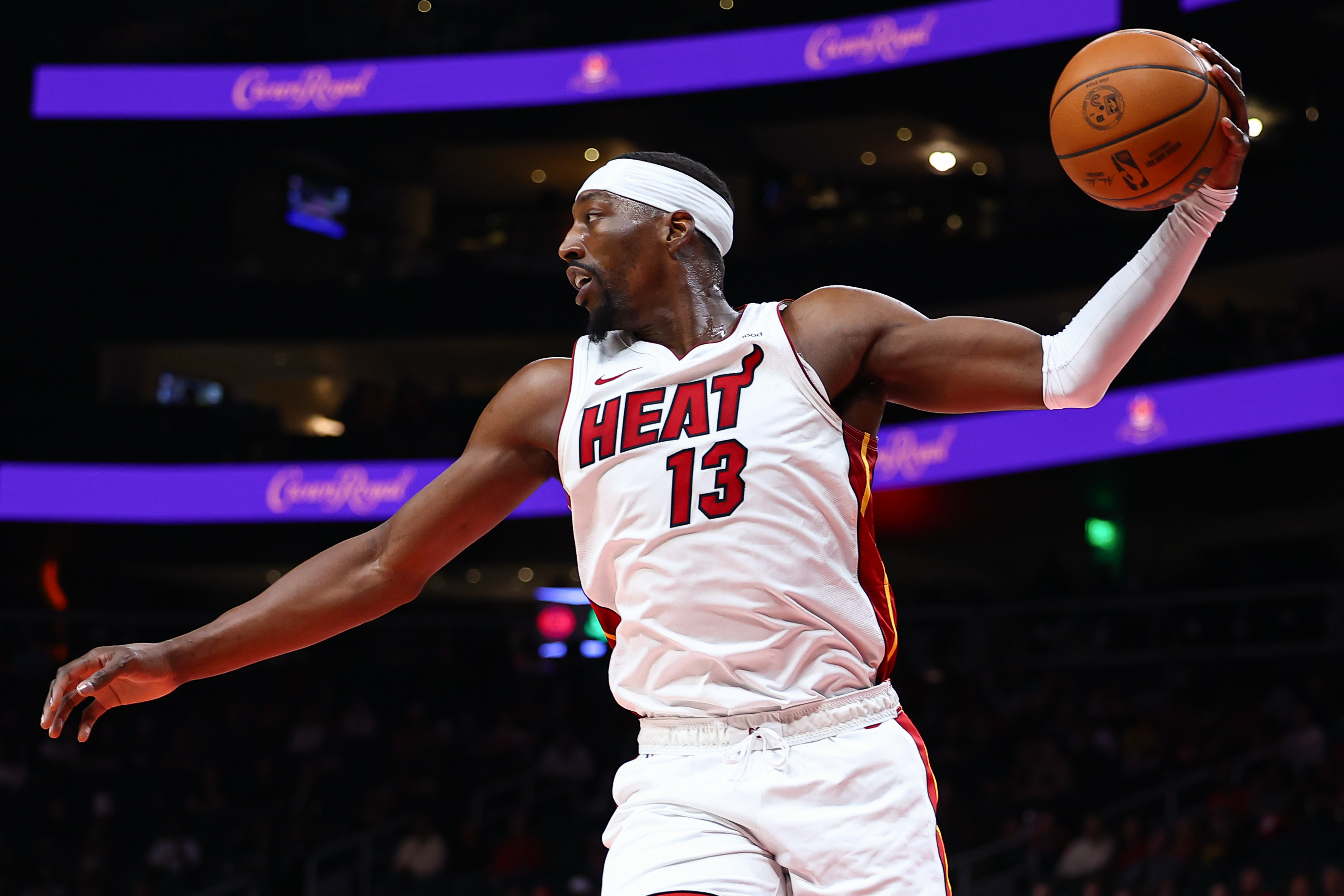
Yet the biggest number of the night belonged to Bam. His nine boards lifted him to 5,794 for Miami, passing Udonis Haslem's franchise record of 5,791. It was a fitting milestone for a team trying to blend a new superstar with an established identity. The franchise's long-serving center made history while its spectacular acquisition finally tasted victory in a Heat jersey.
The temptation is to declare the experiment fixed. That would be premature. The Hawks are struggling themselves, and one productive evening cannot erase Miami's four losses. But the win revealed what the Heat can look like when their size becomes an advantage rather than a spacing headache.
Giannis and Bam finally give Miami a winning formula
The first four games of Miami's season made the blockbuster trade look uncomfortable. Antetokounmpo arrived with MVP credentials, a championship pedigree and an enormous expectation: turn an ambitious roster into a contender immediately. Instead, the Heat opened 0-4, losing to Minnesota, Detroit, Charlotte and Dallas. Giannis was often productive, but the team looked far less convincing than the sum of its names. When a superstar scores heavily and the losses keep arriving, every possession becomes a referendum on roster construction.
Wednesday in Atlanta finally supplied a different opening chapter. Miami shot 15-for-23 in the first quarter, a blistering 65 percent, and led 34-25 after twelve minutes. The advantage reached 69-56 at halftime. The Heat did not rely on one extraordinary scoring burst from their new star; they repeatedly found high-value shots and kept Atlanta from dictating the shape of the game. The offense looked more deliberate and, crucially, less desperate.
Antetokounmpo finished with 24 points on 11-for-18 shooting, 18 rebounds, three assists, a steal and a block. Five of those rebounds came at the offensive end. That is a particularly revealing combination: Giannis did not have to monopolize the ball to dominate the contest. He could pressure the rim, collect missed shots and force Atlanta's front line into a physically exhausting night. The 18 boards were his best rebounding total of the young season.
Bam matched his new teammate's scoring with 24 points on 8-for-16 from the floor and 8-for-9 at the line. He also added nine rebounds, three assists and three steals. Adebayo's plus-22 was the strongest mark among Miami's starters, although a single-game plus-minus figure cannot isolate one player's contribution. The broader point is clearer: Miami got simultaneous production from both members of its huge frontcourt without requiring one to disappear into a purely supporting role.
Miami scored 70 points in the paint to Atlanta's 52, a staggering difference that explains the win more effectively than a glamorous highlight reel. The Heat also won the rebound battle 52-40. When two elite interior athletes play together, the theoretical advantage is obvious: missed shots become second chances, help defenders get punished, and opponents have fewer easy routes to the rim. Against Atlanta, that theoretical edge became an actual possession-by-possession problem.
The fourth quarter still supplied a warning. Atlanta cut a lead that had reached 18 points down to a manageable margin late. Giannis responded with four consecutive points, and Miami closed with an 11-5 push. That was the most useful moment of the evening for the new partnership: the Heat had created a cushion, watched it shrink, and finally answered instead of unraveling. It was not a flawless performance, but for a winless team, competence under pressure was progress.

Bam passes Haslem — and reminds Miami whose culture this is

Bam's franchise record deserves more than a line buried underneath the first Giannis victory. With nine rebounds against Atlanta, Adebayo reached 5,794 in his Miami career, moving past Udonis Haslem's previous standard of 5,791. The two men represent different eras and very different basketball skill sets, but the connection is powerful. Haslem became a symbol of the Heat's demanding culture; Adebayo has spent years carrying much of that same identity on the court.
Rebounding totals are not a perfect measure of greatness. Minutes, pace, lineup construction and the number of available misses all influence them. Adebayo's achievement nevertheless reflects the most difficult kind of consistency: returning year after year, absorbing physical contact, covering defensive mistakes and securing possessions that rarely receive the attention given to a spectacular dunk. A franchise record is built from thousands of ordinary battles that fans forget the next morning.
The timing makes it especially meaningful. Miami acquired Antetokounmpo in a massive summer deal, sending several young players and future draft assets to Milwaukee. The arrival of a global superstar could easily have turned Adebayo into an afterthought in the public conversation. Instead, the established Heat cornerstone delivered one of the night's defining performances. The story was not simply Giannis rescuing Miami. It was Bam helping the new era find its footing.
There is a tactical question beneath the celebration. Both players thrive close to the basket, both are dangerous as screeners, and neither is a traditional high-volume three-point specialist. Defenders can attempt to crowd the paint when the two share the floor. Miami's answer must be movement, cutting, fast decisions and accurate perimeter shooting from the supporting cast. Adebayo's ability to operate as a passer and short-roll decision-maker matters almost as much as his points and rebounds.
Against Atlanta, Bam showed how he can contribute without treating every touch as an isolation opportunity. He made half of his field-goal attempts, drew trips to the line and helped Miami turn physical superiority into points. His three steals reinforced the other side of the partnership: a mobile defensive big can disrupt passing lanes while Giannis provides length and recovery speed around the basket. That combination is far more valuable when the rest of the lineup stays connected.
The record also offers a useful reminder about continuity. Miami's championship aspirations are not built solely on its latest transaction. They depend on the players who have learned Spoelstra's standards, know how to survive ugly possessions and can translate star talent into repeatable habits. Adebayo's 5,794th career rebound did not magically solve the spacing questions. It did, however, show that the Heat's identity still has an owner.

Wiggins, Larsson and Mitchell make the stars playable

Miami's supporting cast deserves a significant share of the credit. Andrew Wiggins scored 18 points, making six of nine shots and four of seven three-pointers. Those four makes from deep mattered because Atlanta could not simply collapse on Antetokounmpo and Adebayo without consequence. A defender who leaves Wiggins to crowd the lane risks surrendering a clean perimeter look. The Heat need that exact trade-off to be uncomfortable for opponents.
Pelle Larsson provided a different kind of relief. His 17 points came with eight assists and six rebounds, an unusually well-rounded contribution for a player whose importance can disappear when the discussion focuses exclusively on Miami's two stars. Larsson's ability to keep the ball moving helps prevent possessions from turning into slow, predictable attacks. Miami needs players who can make the next pass without waiting for a superstar to tell them where to stand.
Davion Mitchell added ten points and ten assists with only two turnovers. The assist total is particularly important for a team that spent its opening losses looking for a reliable rhythm. A guard who gets the ball to the right teammate on time can improve the efficiency of both stars without increasing either player's workload. The Heat finished with 36 assists, a figure that points toward a more collective offensive approach than the early-season panic suggested.
The bench offered more than emergency minutes. Tim Hardaway Jr. scored 14 points, including a three-pointer that pushed Miami's advantage to 95-77 late in the third quarter. Bobby Portis Jr. contributed 11 points and nine rebounds, giving Spoelstra another physical option when the starting bigs needed a rest. These are the unglamorous contributions that allow a superstar-heavy team to keep a lead rather than repeatedly rebuilding it from scratch.
There is still a warning hidden inside the shooting numbers. Miami hit 11 of 29 threes, a respectable 37.9 percent, while Atlanta actually made 16 of 38 from beyond the arc. The Heat did not win because they suddenly became the league's most terrifying outside-shooting team. They won because their interior advantage was overwhelming and their supporting players converted enough opportunities to make that advantage sustainable for one evening.
The formula will not always be so comfortable. More disciplined opponents will rotate faster, force Giannis to make difficult passes and challenge Bam's catches away from the rim. Wiggins will not make four threes every night. Larsson and Mitchell will have quiet stretches. Miami therefore needs an offensive identity that works when the outside shots stop falling. Against Atlanta, the encouraging sign was not perfection; it was the existence of several ways to generate a good possession.

Atlanta's rally is a warning, not a reason to panic

Atlanta's perspective makes the result more complicated than a simple Heat revival. The Hawks entered with two victories followed by consecutive defeats, and the loss to Miami extended that skid to three. Their offense still produced 117 points, hardly a total associated with complete collapse. But the way those points arrived exposed a defensive problem: Miami repeatedly attacked the interior, and Atlanta could not make the Heat pay enough for that approach.
Rookie Kingston Flemings supplied a genuine bright spot with 23 points, five rebounds and five assists. Nickeil Alexander-Walker also scored 23, including five three-pointers. Their performances kept Atlanta competitive even as Miami's frontcourt controlled the glass. For Flemings, this was another reminder that a young guard can provide real offense without yet possessing the experience to control every phase of a game. The production was promising; the result remained frustrating.
Jalen Johnson finished with 12 points, 11 assists and nine rebounds, narrowly missing a triple-double. His four-for-twelve shooting underscored Atlanta's uneven night. Johnson's playmaking helped keep the Hawks connected, but Miami's defensive length and interior presence made efficient scoring difficult. The Hawks were chasing a deficit for most of the game, and their late surge could not fully undo the damage accumulated during Miami's dominant opening stretch.
Atlanta made its comeback interesting by cutting the margin to six late in the fourth quarter. That sequence is precisely why Miami should resist treating this win as a coronation. A team with serious championship ambitions cannot rely on a large third-quarter lead as a substitute for late-game execution. The Heat finally responded with Giannis scoring four straight points, but the brief wobble exposed the difference between beating a vulnerable opponent and consistently controlling elite ones.
The schedule now becomes a test for both clubs. Miami returns home to face Indiana on Friday, October 30, with a chance to turn its first victory into the beginning of a run. Atlanta hosts Cleveland on Thursday, October 29, in a home back-to-back complicated by the afternoon WNBA Finals game at State Farm Arena. Neither side has much time to dwell on Wednesday's result. One win does not establish a new hierarchy in the Eastern Conference.
Miami can reasonably take three conclusions from Atlanta: the Giannis-Bam pairing can dominate the interior, the supporting cast can create enough spacing and passing to help it work, and the team can withstand a late challenge. What it cannot claim is that all the structural problems are solved. The real verdict will come against healthier, more disciplined opponents who can force the Heat to win in ways other than overwhelming the paint. For now, 1-4 looks a lot better than 0-5.
Giannis finally has his first Heat win. Bam has the franchise rebounding record. Miami has a glimpse of an offense in which its two biggest stars can both be dangerous, and the supporting cast has proof that its contribution matters.
That is a meaningful night, not a championship declaration. The Heat still need to show they can defend the arc, maintain spacing and close games against better opposition. But after four defeats and a growing chorus of questions, Atlanta gave them something they had been missing: evidence on the court that the plan can work.



















