Podziemski Turned Curry Into a Lefty. His Shooting Changed for Real.
GOATIFYBrandin Podziemski did not spend his summer trying to become Stephen Curry. He spent part of it watching a version of Curry who does not exist: a left-handed one. The Golden State Warriors guard and his longtime trainer, Dustin VanLieu, digitally mirrored clips of the NBA's most influential shooter so Podziemski could study movement patterns that looked natural from his own dominant side. It sounds like an internet trick. For a 23-year-old trying to turn a promising role into permanent responsibility, it was a surprisingly precise basketball exercise.
The reveal comes at a revealing moment. Entering Golden State's November 11 road game in Houston, Podziemski had been averaging 16.8 points and 4.2 assists, with better than 40% three-point shooting on 6.9 attempts per contest. Those were early-season marks, not a finished verdict, but the change in volume mattered just as much as the accuracy. The Warriors had already invested in him with a five-year, $110 million extension. They now needed a guard who could support Curry without slowing possessions down by searching for the perfect shot.
The film experiment explains only part of that development. Alongside Curry's footwork, Podziemski studied Jalen Brunson's manipulation of defenders and took a direct challenge from Warriors assistant Anthony Vereen to attempt more threes. The interesting story is how those three lessons fit together: find the right space, get to the shot faster, and resist the temptation to turn every advantage into something complicated.
Why a left-handed Steph Curry suddenly made sense
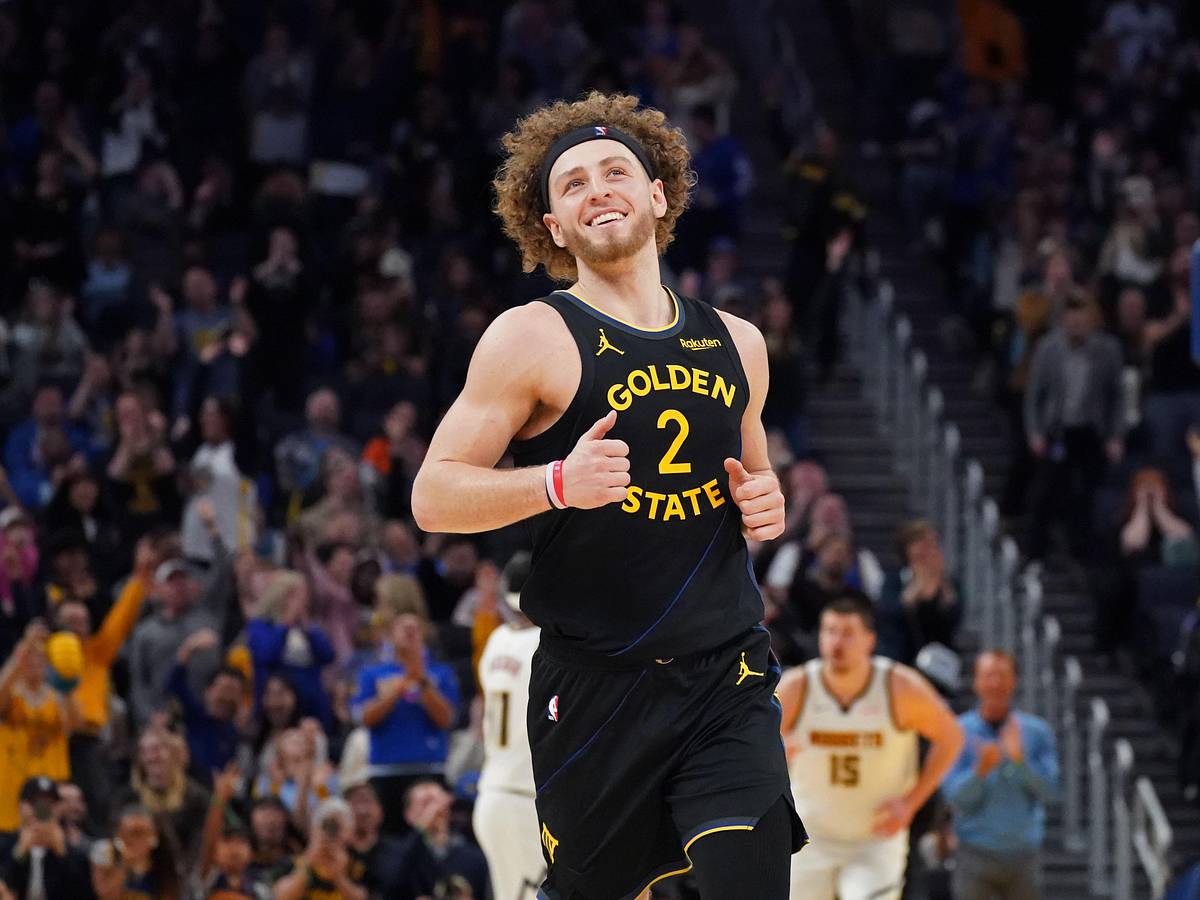
Video study is ordinary NBA homework. The remarkable part of this case was not whose tape Podziemski chose; almost every perimeter player can learn something from Curry. It was the decision to change what that tape looked like before studying it. Curry shoots right-handed. Podziemski shoots left-handed. Mirror the video and the same dribble combinations, body angles and steps suddenly appear from the side Podziemski would actually use. That removes a translation problem a lefty encounters when watching a right-handed model.
A standard highlight can show where a player went. The mirrored version makes the sequence easier to imagine doing yourself. Which foot lands when the ball comes out of a screen? How does the dribble turn into space without an extra pause? What does a quick relocation look like from the same shoulder and hip orientation? Those are the questions that make the edit more useful than a clever optical illusion. It is not about matching Curry's individual talent; it is about isolating repeatable decisions and movements from an elite example.
The pair paid particular attention to Golden State's 2022 championship run. Curry's 43-point performance in Game 4 against Boston and his 34-point Game 6 offered much richer material than a collection of open spot-up jumpers. In a Finals environment, help defenders are loaded early, every inch matters and defenders know the threat before the ball arrives. Podziemski could study how a shot was created under pressure, then compare it with his own habits. Those clips supplied different angles on the same basic problem: how to make an advantage last just long enough to release the ball.
One point that stood out involved the popular description of Curry's jumper as a single fluid motion. Podziemski came away concentrating on two linked phases: bringing the ball into position and sending it toward the basket. The distinction sounds technical, but it creates a concrete training question. Are those phases efficient enough that the defense cannot reset between them? A fraction of hesitation can allow a closing defender to reach the shooting pocket. Efficiency matters more than copying the cosmetic appearance of Curry's release.
GOATIFY
GOATIFY Basketball
Podziemski's mirrored-Curry study is all about finding new angles on Warriors basketball. Explore the GOATIFY Basketball collection for fan gear inspired by the sport's stars.

Stephen Curry G.O.A.T. - Steph Curry Greatest Sticker
Add basketball personality to your favourite gear.
Shop Now ↗

Stephen Curry G.O.A.T. - Steph Curry Greatest Tee
A basketball fan design for everyday wear.
Shop Now ↗
Michael Jordan – Chicago Bulls Greatest of Hoodie
A basketball fan design for everyday wear.
Shop Now ↗
Stephen Curry G.O.A.T. - Steph Curry Greatest Mug
Add basketball personality to your coffee break.
Shop Now ↗
Kobe Bryant – The GOAT Mamba Crewneck Sweatshirt
A basketball fan design for everyday wear.
Shop Now ↗That emphasis also helps explain why the footage covered more than shooting. Curry can threaten the three, curl into the lane, shift direction and finish with unusual touch despite operating among taller athletes. A guard with Podziemski's physical profile needs more than a standstill jumper. He needs reliable answers when an opponent closes out aggressively, takes away one hand or sends a second defender. Watching the transition from one option to another may matter more than memorizing a particular dribble move.
VanLieu was not a new trainer recruited for a flashy project. Podziemski reached out to him in 2022 while at Santa Clara after hearing him discuss defensive skill development. Their work continued after Golden State drafted him. That history matters: a trainer who knows a player's baseline can compare the new visual model with years of habits, instead of prescribing a move based solely on how it looks in a clip. The mirror exercise sits inside a longer process of identifying a specific limitation, testing a solution and checking how it survives contact with an NBA defender.
Curry himself did not initially know the experiment was happening. When he later saw the left-handed rendering, the surprise quickly gave way to recognition that studying footwork from the same dominant side could be useful. That response should not be mistaken for an endorsement of perfect imitation. Curry's rare balance, range and creativity cannot be copied wholesale. The valuable part is the idea that a young teammate can extract principles from an all-time great while still developing a shot and decision-making identity of his own.
The shot chart changed before the stat line caught up
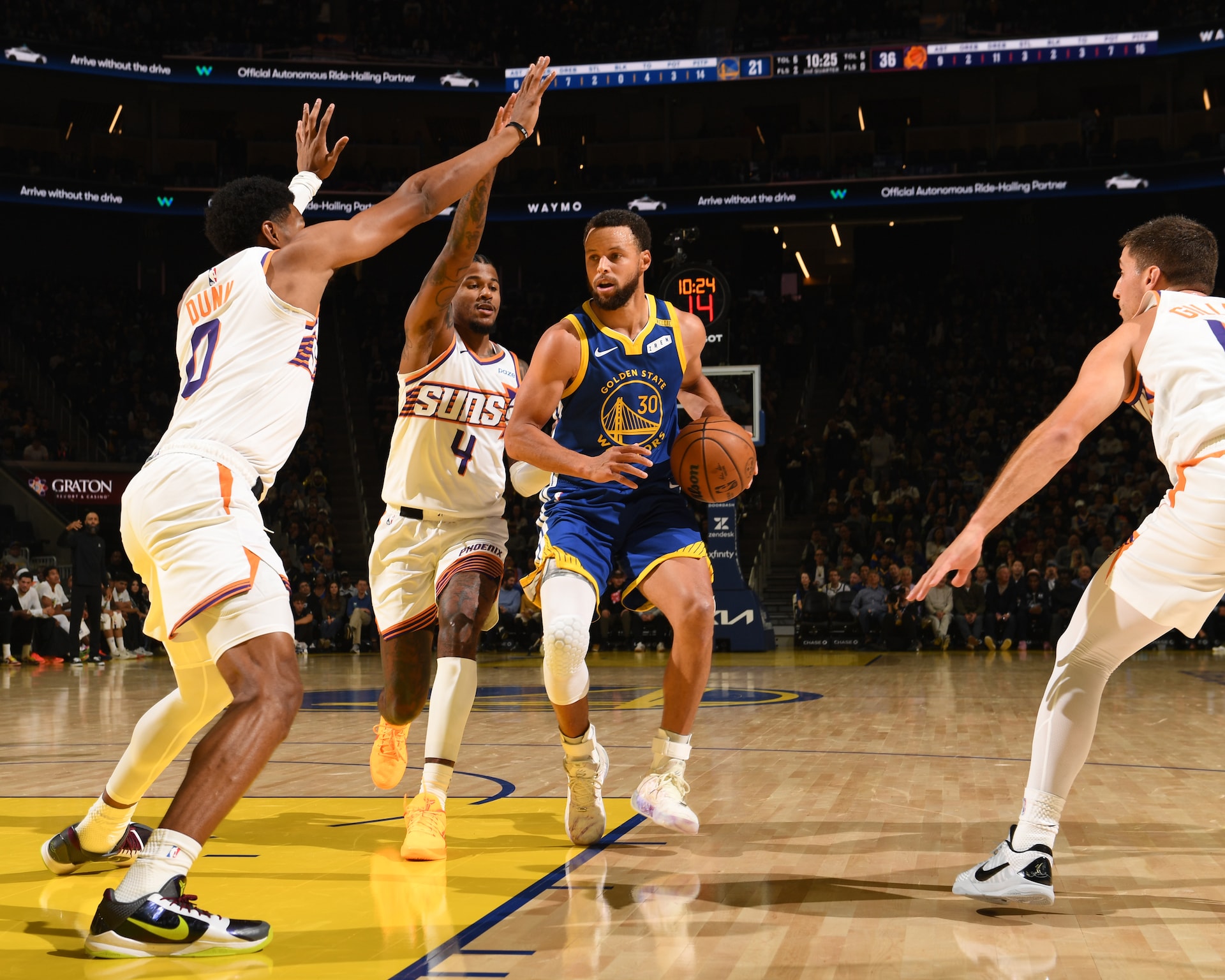
Mirrored footage helps explain how Podziemski wants to move. Another offseason lesson explains which shots he is increasingly willing to take. The seed came from a conversation with assistant coach Anthony Vereen in January, after Golden State had played back-to-back games in Minnesota. Podziemski asked how to reach another level. Rather than pointing him toward a bigger package of contested midrange shots, Vereen compared him with productive guards who score without towering over defenders or relying on spectacular vertical athleticism.
The reference group included Payton Pritchard, Tyler Herro, Desmond Bane and Devin Booker. Their styles are not identical, and Booker is a considerably more decorated scorer, but the comparison highlighted a pattern: these players are comfortable creating and taking three-pointers in volume. A great percentage on a tiny number of attempts will not necessarily distort a defense. Opponents must believe the shot is coming quickly and often enough to affect how they guard screens, handoffs and kick-outs.
Podziemski's numbers trace the progression. He attempted 3.2 threes per game in his rookie season and 4.8 in his second, nudging that figure to 5.0 the following year. Through his first ten games of the 2026-27 campaign, he had climbed to 6.9 attempts. That is nearly two additional tries per game relative to his prior season. If the quality of those attempts holds, the extra volume changes the value of each possession even before factoring in the points those makes produce.
It is tempting to declare the mirror experiment a proven cause of better shooting. That would put far more weight on a small sample than it can carry. The increase in opportunities might reflect coaching trust, lineup combinations, confidence, offseason repetition or the way opponents are covering Golden State. The interesting evidence is that several changes appear to be pointing in the same direction: more threes, fewer difficult detours into the lane, quicker choices and less time spent holding the ball while a defense closes its gaps.
GOATIFY
GOATIFY Basketball
More threes, smarter spacing and a bigger role in Golden State: shop basketball-inspired GOATIFY designs while the Warriors test a fresh backcourt approach.

Stephen Curry GOAT Shooting Threes Pullover Hoodie
A basketball fan design for everyday wear.
Shop Now ↗

Basketball Stephen Curry GOAT Champion Trophy Sticker
Add basketball personality to your favourite gear.
Shop Now ↗


Basketball Stephen Curry GOAT Champion Muscle Tank
A basketball fan design for everyday wear.
Shop Now ↗Steve Kerr's assessment gets to that distinction. He has emphasized a healthier distribution of attempts: attack the rim when the lane is available, shoot from behind the arc when the shot presents itself, and avoid unnecessary hook shots or floating attempts in traffic. That is a shot-selection story, not merely a mechanical one. Podziemski does not have to become a higher-usage isolation star to help a team built around Curry. He has to make the defensive cost of leaving him open immediate and consistent.
Curry's own observations point to decision speed. When Podziemski sees a closeout, he has increasingly used a pump fake followed by a sideways move into a three rather than driving directly into a crowd. That choice makes sense in the geometry of Golden State's offense. Defenders are already occupied with Curry's movement, the ball can reverse quickly and an extra dribble can erase the slight advantage the system created. The best response is often the first good one, not a search for an extraordinary finish.
There is also a team-level trade-off. More three-point attempts can produce occasional cold stretches and invite critics to overreact to a single off night. But keeping that threat alive stretches opponents' rotations and provides a cleaner outlet when Curry is trapped or denied the ball. An efficient Podziemski jumper can make life easier for the star beside him, even when the possession ends without either player's name dominating the highlights. That complementary value is exactly what Golden State needs from a trusted second guard.
As of the November 11 report, the Warriors were carrying an eight-game winning streak into a trip to Houston. The broader team success does not prove every part of one player's development plan worked, but it provides a meaningful testing ground. Podziemski is no longer getting occasional low-pressure possessions at the margins. With a larger contract and an established role, the real measure is whether these better choices survive scouting adjustments, physical defenses and the inevitable weeks when the outside shot stops falling.
Brunson’s footwork and a $110 million test
Not every useful reference required video manipulation. Podziemski also studied Jalen Brunson, a genuinely left-handed guard whose signature advantages are patience, timing and disguise. Brunson had just led New York to an NBA championship, repeatedly finding answers against defenders with more reach and speed. His work in crowded spaces provided an intriguing companion to Curry's open-floor movement. Both players create opportunities before the shot, but they solve that problem in noticeably different ways.
Brunson's 2026 Finals were especially instructive because San Antonio had unusual defensive length. Even after negotiating perimeter defenders such as Stephon Castle, Dylan Harper, De'Aaron Fox and Devin Vassell, he faced the presence of Victor Wembanyama near the rim. The challenge was not simply beating the first man. It was controlling pace in tight quarters, encouraging a defender to lean the wrong way and making a choice before the second layer of help could close off an escape route.
Podziemski has described studying the changes in Brunson's speed and the way he deceives a defender without necessarily being the faster athlete. The advantage is subtle: slow down just enough for the defender to commit, then accelerate into the opening that commitment created. It can be used to win a driving angle, draw a foul or create a passing window. For a guard who cannot routinely jump over shot blockers, mastering those smaller interactions can be more dependable than hunting a spectacular finish.
GOATIFY
GOATIFY Basketball
Brunson's patience and Curry's creativity show two ways a guard can change a game. Browse GOATIFY Basketball fan gear inspired by NBA stars and the culture around them.

Crying LeBron – NBA Basketball Pullover Game Hoodie
A basketball fan design for everyday wear.
Shop Now ↗

Pau Gasol G.O.A.T. - Basketball Decal Sticker
Add basketball personality to your favourite gear.
Shop Now ↗


Some of the adaptation appeared quickly. Against Phoenix on November 2, Podziemski worked along the baseline against Devin Booker, moving past him for an up-and-under finish. On another possession, he used sudden deceleration to draw contact from Suns center Khaman Maluach. Those are individual examples rather than proof of an entirely new offensive identity, but they help make the study tangible. A Brunson-inspired pause can be as useful as a Curry-inspired burst into an open three, provided the guard recognizes which situation he is facing.
The larger lesson is that building a player does not require choosing a single idol. Curry offers an extreme model of spacing, off-ball relocation and fast release. Brunson offers a different toolkit for possessions that deteriorate into physical one-on-one contests. Pritchard, Herro, Bane and Booker help clarify the importance of three-point appetite. Podziemski can select the practical portions from each without pretending their strengths or team roles are interchangeable. That is a more realistic development model than the promise of copying a superstar's signature move.
It also requires discipline about what not to borrow. A crowded Brunson-style drive is less valuable if a clean catch-and-shoot three was available two seconds earlier. A Curry-like sidestep can become a bad shot if a defender has already recovered. The correct hierarchy depends on game context: take the efficient opportunity, force a defense to respect the next option and keep the ball moving when an advantage disappears. What separates clever film study from empty imitation is knowing when the borrowed move actually improves a possession.
That distinction matters now that Golden State has made a financial commitment. The five-year, $110 million extension gives Podziemski security but raises the standard from interesting young contributor to consistently influential starter-level player. It is not enough to string together attractive games while defenses are still learning his habits. He will need to preserve his shooting confidence, continue defending and rebounding in a competitive backcourt, and contribute when Curry either rests or draws extra attention.
There is a cultural dimension, too. Podziemski's visible admiration for Curry has sometimes drawn jokes and criticism, including discussion of his mannerisms on court. But the meaningful question is not whether a young teammate resembles a franchise icon in a clip. It is whether his choices make the Warriors more difficult to guard. The mirrored footage, Brunson's subtle pacing and Vereen's demand for more threes all point toward the same practical objective: turn observation into efficient NBA decisions that teammates can trust.
Left-handed Curry makes for a memorable visual. The more meaningful change is that Podziemski has started to connect a player's footwork with the choices that make it useful. Through November 11, his expanded three-point volume and improving decision-making offered encouraging clues. They did not guarantee the percentages would last all winter, and neither a video edit nor a summer workout can account for every change in a developing guard.
Golden State's long-term bet is that he can keep refining the ordinary possessions: a catch turned into an immediate three, a closeout attacked without drifting into traffic, a patient change of speed that draws a foul instead of a forced floater. The $110 million commitment makes those small decisions matter on a much bigger stage. Podziemski does not need to be a left-handed Stephen Curry. He needs to be the strongest possible version of himself next to the real one.
GOATIFY
GOATIFY Basketball
Shop GOATIFY basketball shirts, hoodies and stickers.

Basketball Alien Wemby UFO Abduction Design Tank
A basketball fan design for everyday wear.
Shop Now ↗
LeBron Photobomb – NBA Basketball Crewneck Sweatshirt
A basketball fan design for everyday wear.
Shop Now ↗


Anthony Edwards G.O.A.T. - Basketball Decal Sticker
Add basketball personality to your favourite gear.
Shop Now ↗
Shrequille O'Neal - Shaquille O'Neal as Shrek Tank
A basketball fan design for everyday wear.
Shop Now ↗