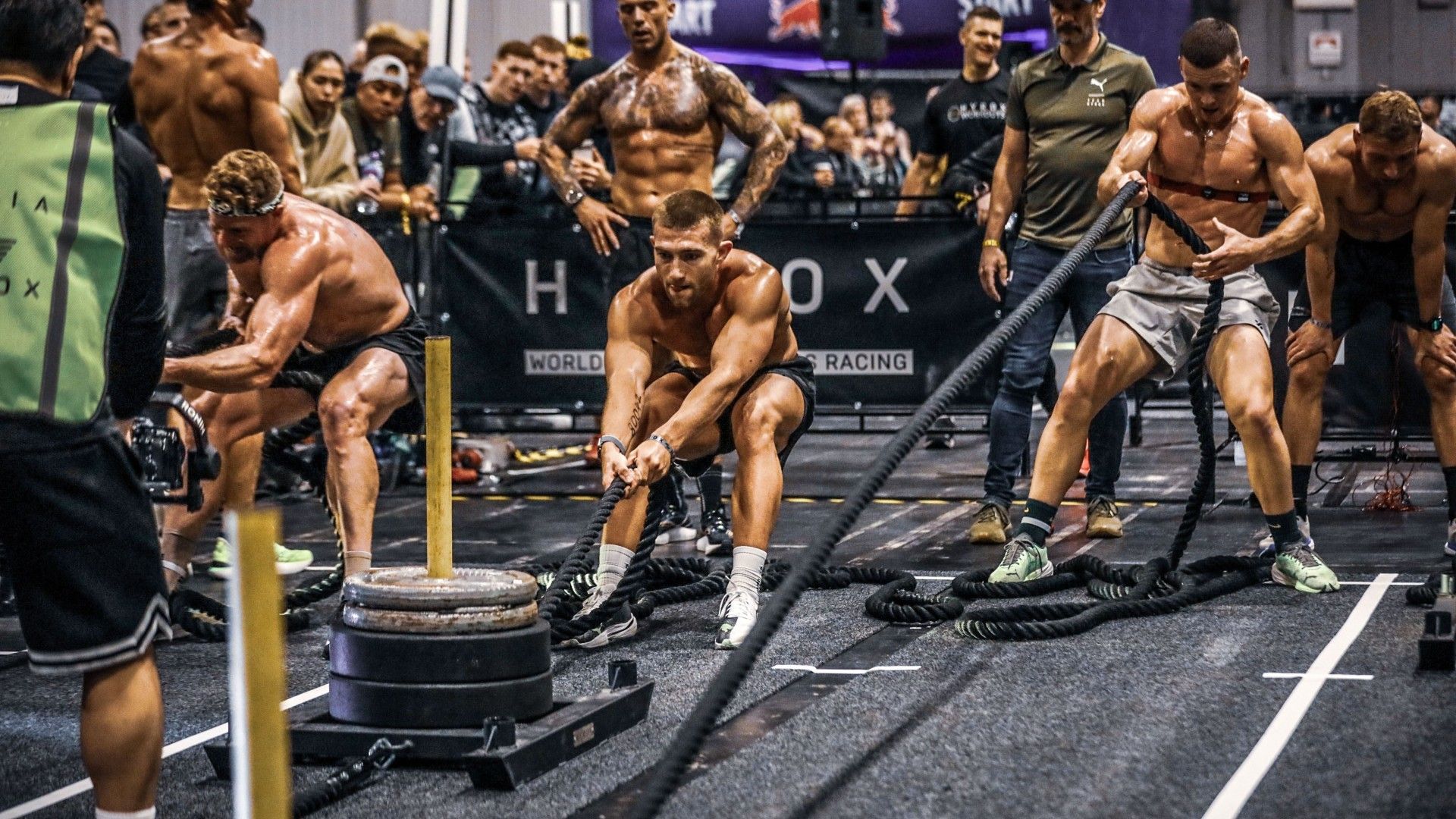
HYROX Roxzone Strategy: Faster Transitions Without Extra Fitness
UPLIFT IRON CLUBHYROX rewards fitness, but it also punishes hesitation. You can spend months improving your 1 km pace, sled strength and wall balls, then quietly hand time back by walking the transition area, searching for the next station or treating every finish line like permission to stop moving.
That is why the Roxzone deserves its own race plan. The official format is simple on paper: eight 1 km runs alternated with eight workout stations. In practice, every one of those changes from running to work—and back to running—creates an opportunity to lose momentum.
The useful part is that transition speed does not require a bigger engine. You still need enough fitness to race well, but a cleaner Roxzone is largely an execution problem: know where you are going, arrive under control, touch the station with a plan, and leave before your brain starts negotiating for extra recovery.
What the HYROX Roxzone Actually Is — and Why It Matters

HYROX is eight rounds of a 1 km run followed by a workout station. The Roxzone is the central transition area that connects those pieces. You move through it to reach the station after a run and again when you leave the station for the next run.
That means transition behavior compounds across the race. Losing five or ten seconds once is irrelevant. Losing it repeatedly because you walk early, hesitate at signage, drift toward the wrong lane or pause after finishing a station is different.
Venue layouts vary, which is why absolute Roxzone benchmarks are not perfectly portable from one race to another. A larger arena can simply require more travel. The more useful metric is your own split relative to your total race and to athletes around your finishing level.
The central idea stays constant: the clock does not care whether you are doing a workout station or looking for it. Every unnecessary second still belongs to your finish time.
This is also why transition gains can feel “free.” You are not asking your body to produce more watts or lift a heavier sled. You are removing indecision and dead movement from a race you were already capable of completing.

Fast Transitions Start Before You Enter the Roxzone

The easiest way to make the Roxzone slow is to arrive there already cooked. If you sprint the final 100 meters of every run simply because the station is visible, you can turn a small pacing error into a long walk, a water stop and a messy station start.
A cleaner strategy is to think one step ahead. During the final portion of the run, know which station is next and what the first action will be. If sled push is coming, you should already be thinking about your first body position. If the row is next, think about getting seated and setting the foot straps without turning the setup into a rest break.
This does not mean deliberately jogging slowly into every station. It means arriving at a speed you can carry through the transition. A controlled runner who keeps moving often beats the athlete who surges to the arch, stops, bends over, then walks.
Use a simple cue in training: finish the run ready to work, not ready to recover.
That cue changes pacing psychology. The kilometer is not over when the watch hits 1.00. It ends when you have successfully transferred into the next task.
Enter Heavy Stations With a First-Rep Plan

Sled push and sled pull make transition mistakes expensive because the work itself is demanding. Athletes often reach the lane, stare at the sled, adjust themselves twice and take several deep breaths before beginning.
Some recovery is unavoidable. The mistake is letting recovery happen without a decision.
Before race day, know your first-rep sequence. For a sled push that might be: hands on uprights, feet set, torso angle established, first drive. For sled pull: get to the rope, create space, set your stance and start the pulling pattern you practiced.
The point is not to rush technique. A sloppy first effort that burns your legs can cost more than it saves. The point is to remove all the movements that are neither recovery nor productive work.
Training this is simple. During simulation sessions, start a stopwatch as you finish a run segment and measure how long it takes before the first meaningful sled movement. Most athletes have never timed that gap. Once you measure it, it becomes obvious where hesitation lives.

Machine Stations Reward Setup Speed, Not Panic

The rower and SkiErg illustrate a different kind of transition loss. You may be physically ready to work but still waste time because the equipment setup feels unfamiliar under fatigue.
On the rower, repeatedly practicing how you sit, place your feet and secure the straps can make the entry automatic. The goal is not to create the tightest possible setup in history. It is to get a secure, repeatable position quickly enough that you can start rowing without multiple adjustments.
The same principle applies to grabbing SkiErg handles, establishing stance and starting at the output you planned rather than blasting the first ten pulls because adrenaline took over.
Equipment familiarity matters because cognitive load rises when you are tired. A task that feels trivial in a quiet gym can suddenly feel clumsy after a hard kilometer. Repetition turns that task into a routine.
Practice the first ten seconds of the station, not just the station itself. That is where race-specific efficiency lives.
Do Not Turn the Exit Into a Recovery Zone

Finishing a station creates a powerful temptation to stop. The sled ends, the farmer's carry gets dropped or the rower display reaches the target, and your brain immediately asks for a few seconds of nothing.
Those seconds are seductive because standing still feels easier than starting to run. But the best transition strategy is often not “run hard immediately.” It is simply “start moving immediately.”
Use the first part of the exit to reorganize. A controlled shuffle can let breathing settle while still moving you toward the run course. Once your rhythm returns, build back toward race pace.
This is particularly important late in the race. After lunges and wall balls, waiting until you feel ready to run can become a long delay. You may never feel ready. The skill is learning that you can begin moving while uncomfortable.
A simple race cue is move first, recover while moving. It does not mean ignoring dizziness or safety. It means distinguishing genuine physical distress from the normal desire to pause after hard work.

Carry and Wall-Ball Transitions Need Their Own Cues

The farmer's carry looks simple—pick up the implements and walk—but grip fatigue makes small delays grow quickly. Decide before you arrive whether your goal is an immediate pickup or one controlled breath followed by the pickup. What you want to avoid is standing over the handles without a plan.
After the carry, put the implements down where required and transition out decisively. Do not spend several extra seconds shaking out your hands unless you genuinely need it for safety.
Wall balls are different because they are the final station. There is no next 1 km run, but the entry still matters. Athletes can lose time before the first rep by adjusting position, checking the target and negotiating with themselves about set size.
Your wall-ball strategy should already be decided. If you know you perform better with planned breaks, use them. A smaller repeatable set structure can be faster than an oversized opening set followed by an uncontrolled collapse.
The larger lesson is that each station deserves one or two simple transition cues. Trying to remember a detailed paragraph while racing is useless. “One breath, pick up” is usable. “Sit, straps, pull” is usable. “Drop, turn, jog” is usable.
Practice Transitions When You Are Tired, Not Only When Fresh

You do not need to recreate a full HYROX every weekend to practice the Roxzone. In fact, doing full simulations too often can create more fatigue than skill.
Short transition blocks work well because they isolate the behavior you want to improve. For example:
- 400 m run → sled push entry → 10–20 m sled push → easy reset
- 400 m run → rower setup → 250 m row → immediate 200 m jog
- short farmer's carry → put down → immediate 200 m run
- 10–15 wall balls → turn and jog 100 m to practice moving after leg fatigue
The distance is not the point. The transition is. Time the gap between the end of one task and the beginning of the next, then try to make the movement cleaner without turning it reckless.
You can also rehearse venue-style decision making. Put equipment in different parts of the gym and force yourself to move directly from one station to another instead of standing beside everything. This adds a small navigation component.
Transition practice is low-hanging fruit because technique can improve quickly. A fitter engine takes months. Learning to stop wandering between stations can happen in a few sessions.

UIC Race-Day Roxzone Checklist

Do not make the race-day plan complicated. The more fatigued you become, the less useful elaborate instructions are.
- Before the start: understand the venue flow, station order and the direction you will enter and exit.
- During each run: know the next station before you reach the transition area.
- On entry: keep moving and use a rehearsed first-action cue.
- At equipment: set up once, correctly, instead of making repeated adjustments.
- On exit: begin moving before waiting to feel recovered.
- At aid: make planned choices rather than turning every pass into an automatic stop.
- After mistakes: reset immediately. One slow transition does not need to become three.
The best Roxzone is not frantic. Frantic athletes miss signs, rush setups and spike effort at the wrong time. The goal is controlled urgency: always know what the next useful action is, then do it.
That is why transition strategy is one of the cheapest performance upgrades in HYROX. You still have to build the running, sled strength, grip and wall-ball capacity. But once that fitness exists, cleaner execution helps you express more of it on the clock.