

Cink Beat Johnson by Two — Then Defended Both Schwab Trophies Again
GOATIFYA tournament trophy can be won in a weekend. A season-long title usually asks for months of answers. Stewart Cink collected both at Phoenix Country Club on Sunday, November 15, and then added a piece of history no player had previously managed: winning the Charles Schwab Cup Championship and the year-long Charles Schwab Cup in consecutive seasons. It was an emphatic finish, but not an effortless one.
Cink began the final round with a three-stroke advantage, watched his friend and season-long rival Zach Johnson creep within one, then found two birdies on the back nine when the race felt most uncomfortable. His closing 69 took him to 19-under 265, two shots clear of Johnson. The result also tied the pair at six victories apiece in 2026 and carried Cink past a new PGA Tour Champions single-season earnings milestone.
The final scoreboard makes the outcome look controlled. The sequence of pressure, missed chances and difficult recovery shots tells a more compelling story. Here is how Cink protected his lead, why Johnson was such a dangerous challenger, and what their duel says about one of the most fiercely contested senior-tour seasons in recent memory.
Two birdies and one difficult recovery decided Phoenix
Cink's final-round 69 was his least aggressive score of the four-day event. That is worth remembering because he had arrived at Sunday with a cushion built on rounds of 63, 65 and 68. Those first three days mattered enormously. By the time the last group went out, someone else needed to apply the pressure; Cink did not have to manufacture a record-breaking afternoon to remain in control.
The front nine threatened to change that calculation. Birdies at the first and fourth holes suggested a steady stroll to another trophy, but bogeys on six and nine canceled the early gains. Instead of pulling away, the defending champion found himself making the turn at even par for the day. The leader was no longer firing an endless stream of low numbers. That opened the door for a player who had spent the entire season proving he could win against experienced Champions Tour fields.
Johnson, playing in the group ahead, made a birdie at the tenth to reduce the deficit to a single stroke. At that stage every missed green, putt and recovery shot had consequences for two competitions at once: the 72-hole event and the season points race. Cink's response was not a sudden avalanche of scoring. He needed to prevent the tension from turning one uncertain hole into an extended slide.
The critical opening came at the 14th. Cink placed his approach around six feet from the hole and converted the putt for birdie. On the 15th, after missing the green, he recovered and saved par. Then the 16th produced the shot that will stand out from the finish. A drive heading right bounced off a cart path and settled beyond a tree, leaving a usable line toward the green. Cink played an awkward wedge across a bunker to roughly three feet and finished it for another birdie. A fortunate bounce provided the opportunity; the recovery swing and putt still had to be executed.
GOATIFY
GOATIFY Golf
Explore GOATIFY golf apparel and accessories while looking at the decisive closing-hole pressure.


Those two birdies transformed a narrow lead into a workable closing margin. With Johnson finishing at 17 under after a birdie at the last, Cink could complete his own 72 holes at 19 under. The final two-shot gap was exactly the sort of margin that feels comfortable once recorded and anything but comfortable when the champion is standing over a decisive recovery shot.
Why Zach Johnson came closer than a runner-up finish suggests

The simplest description of Sunday is that Cink beat Johnson by two. It misses why the duel had become the fitting conclusion to the year. Johnson had arrived on the over-50 circuit and immediately turned a rookie campaign into a six-victory season. His first year was not just promising. It forced the reigning points champion to keep winning to preserve his place at the top of the standings.
Johnson started the final day three behind Cink, level with Scott Hend for second. His Saturday 64 had already changed the shape of the weekend. It took a large gap and made the last round a contest rather than a ceremonial procession. When Cink bogeyed twice on the front side and Johnson made birdies at the seventh and tenth, the pressure became visible on the live leaderboard. One more conversion could have put the two men level.
That conversion nearly arrived more than once. Johnson had a birdie opportunity at the 13th but could not make it. A fine tee shot at the par-three 15th gave him another makeable look, and that putt also stayed out. The margins were tiny, especially when Cink began producing the kind of short-range birdie chances that turned the momentum back his way. This is why a final score of 68 for Johnson was not enough: he played bogey-free golf, but bogey-free is not synonymous with uncatchable when the leader can still make two late birdies.
Johnson closed with a birdie after getting up and down from a bunker at the par-five 18th. His 17-under 267 would have been a winning number in many season finales. Here it was a second-place finish, a reminder that golf's ranking of a round is relative to the field rather than a verdict on how well that round was played. He did not need to collapse for Cink to win, and he did not collapse.
There is another reason the contest deserves more than a line in a results roundup. These are longtime friends, not strangers engaged in a manufactured rivalry. Cink's win therefore finished a competitive season that still had mutual regard at its center. Johnson could recognize the quality of Cink's closing shots while knowing just how close he came to changing the outcome himself. If the 2026 Champions season needed a dramatic final act, it got one from the two players who had set the standard all year.
GOATIFY
GOATIFY Golf
The Zach Johnson challenge is a good reason to browse GOATIFY's golf collection for fans of the game.
The back-to-back double is different from defending one trophy
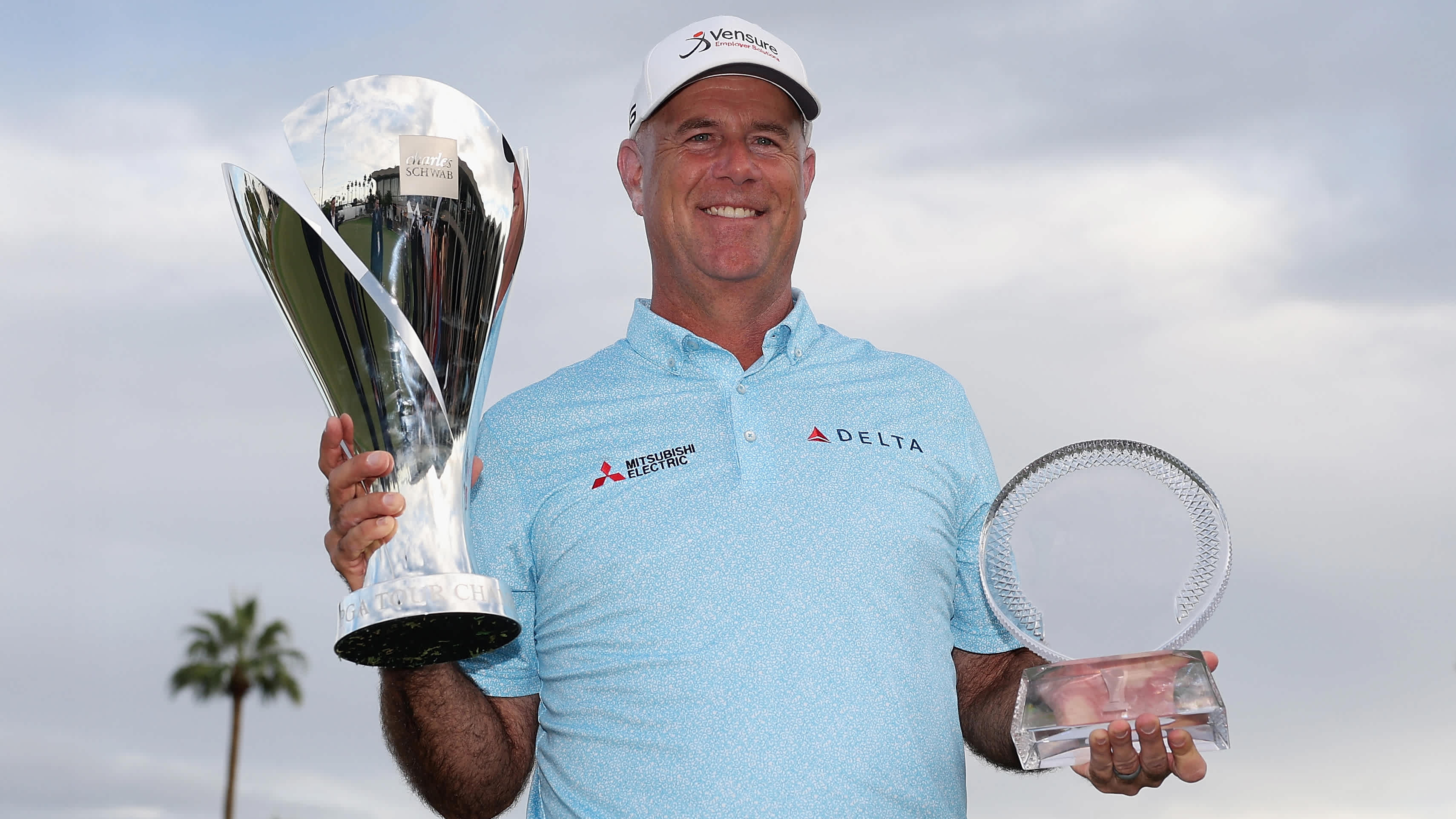
Cink successfully defended two different things in Phoenix. The Charles Schwab Cup Championship is the tournament: four rounds, one leaderboard, one winner. The Charles Schwab Cup itself is the season-long competition: results accumulated across the calendar, with the finale providing the last opportunity for the leading players to alter the outcome. A golfer can take one title without claiming the other, and the distinction matters when measuring the achievement.
In 2025, Cink won both the Phoenix event and the season trophy. That had happened before in a single season, with Tom Watson, Tom Lehman and Kevin Sutherland among the predecessors. Returning in 2026 and repeating the entire double, rather than merely defending the tournament or staying on top of points, made his Sunday different. Golfweek described him as the first player to win both trophies in consecutive years. That is the historical claim, not a suggestion that no other player has ever defended the Cup itself.
The trophy photograph accompanying this section shows Cink's 2025 celebration, the first half of the achievement. The distinction is intentional. It was the prior year's triumph that created the possibility of doing something genuinely new in 2026. Repeating requires more than remembering how to play Phoenix Country Club. It means staying ahead of a changing field through the intervening season and arriving at the championship with the points title still within reach.
The list of back-to-back winners of the season-long Charles Schwab Cup is already short. Cink joins Tom Lehman and Bernhard Langer in that category. The consecutive event-and-season combination is narrower still. Where that distinction becomes particularly impressive is in the identity of the runner-up: Johnson's six-win debut meant Cink did not retain control because the rest of the field failed to produce a serious rival.
The 2026 title was not decided merely by arithmetic before the weekend began. Johnson was the only other player who could take the overall Cup entering Phoenix, and his Saturday charge made the championship meaningful deep into Sunday. Cink had held the season-long lead throughout the year, yet he still needed to deliver when someone finally got close enough to force the issue. The double defense therefore combines the two qualities that season-ending awards sometimes separate: durability over months and execution under final-day pressure.
Six wins, $4.4 million and a season that kept its promises

The money record supplies a separate way to understand Cink's 2026. His $528,000 first-place check took his PGA Tour Champions season earnings to $4,399,265 from 21 starts. That made him the first player on the tour to cross $4 million in official earnings in a single season. It is tempting to treat that number as the headline, but it is better read as the financial consequence of an extraordinary run of results rather than the reason the final victory mattered.
The six-win total is the clearer competitive signal. Cink began the 2026 season with a win at the Mitsubishi Electric Championship at Hualalai in Hawaii. His other victories before Phoenix included the Hoag Classic, Senior PGA Championship, Regions Tradition and Boeing Classic. He therefore entered the finale with five and left it with six, exactly matching Johnson's total. The names on that list also show why his season cannot be reduced to one comfortable course or one hot stretch: the wins came in several places, including senior major championships.
GOATIFY
GOATIFY Golf
Cink's back-to-back titles speak to golf history; browse GOATIFY golf gear for fellow fans.
The shape of the Phoenix scoring itself was a neat miniature of the broader year. Cink opened with 63 and followed with 65, producing a 128 total after 36 holes and an advantage so large that his closest pursuers needed an exceptional weekend just to make the final day uncomfortable. Johnson answered with 64 on Saturday. Cink then played a more measured 69 on Sunday and used late birdies rather than uninterrupted dominance to finish the job. A great season is not necessarily a series of perfect rounds; sometimes it is the ability to prevent an ordinary round from becoming a losing one.
The final leaderboard had more movement than the title contest alone. Rory Sabbatini closed with a 64, while Retief Goosen finished with 67 and Freddie Jacobson with 68; the three shared third place at 14 under. Hend had been one of the nearest challengers entering the final day but did not remain in the top-three tie. The wider field matters because it reflects the depth of scoring behind the duel. Several players produced strong Sunday cards, and none could put the required pressure on Cink across all four rounds.
The $4.4 million milestone also needs careful context. It refers to PGA Tour Champions tournament earnings for the 2026 season, not an estimate of sponsorship income or personal wealth. The separate season-long Cup has its own award structure, and the figures should not be casually added together without knowing exactly what each ledger includes. The reliable conclusion is impressive enough: the tour's new single-season official earnings high and the sixth victory arrived in the same final event.
Cink now has a compelling answer to the question of how long a veteran can keep turning experience into elite performance. At 53, he combined early-season explosiveness with enough consistency to stay atop the points race and enough composure to outlast the other six-time winner when it mattered. Johnson's arrival made the standard higher, not lower. That is what gives the conclusion of 2026 weight beyond the trophies.
A two-shot victory usually produces one champion and one disappointed runner-up. This finish did more. It gave Stewart Cink his sixth victory of 2026, a record single-season earnings total and a second consecutive Charles Schwab Cup, while putting him alone in the event-and-season double-defense category. Zach Johnson's six-win rookie campaign gave the final round genuine jeopardy, and his 68 meant Cink had to beat a strong performance rather than wait for a mistake.
The scene that best explains the title is not a giant lead from Friday or the check presented at the end. It is the 16th hole on Sunday: a drive that needed some good fortune, an awkward shot that demanded execution, and a short birdie putt that Cink still had to make. After months of being chased, the season-long leader found precisely the shots required to finish first again.
GOATIFY
GOATIFY Golf
Shop GOATIFY golf shirts, hoodies and stickers.



















