Dylan Garand Was on Waivers Monday — Now He’s Making the Rangers Rethink Their Backup Plan
GOATIFYDylan Garand began the week outside the New York Rangers’ NHL roster. By Friday night, he had his first career shutout.
That is the kind of early-season swing that can change a depth-chart conversation quickly. Garand cleared waivers, reported to Hartford, found an apartment and practiced twice in the AHL before Joonas Korpisalo’s lower-body injury pulled him straight back into New York’s plans. In Detroit, with the Rangers playing their third game in four nights and the second half of a back-to-back, the 24-year-old stopped 22 shots in a 2-0 win over the Red Wings.
The shutout matters because it was not a meaningless emergency start. New York entered the season with Korpisalo positioned behind Igor Shesterkin, while Garand had to prove that his strong three-game NHL cameo last season was more than a small sample. One composed night does not settle the backup job, but it changes the burden of proof. The Rangers now have to ask whether the goalie they exposed to waivers is already capable of giving them something more valuable than a conventional veteran No. 2.
From waivers to a shutout in five days
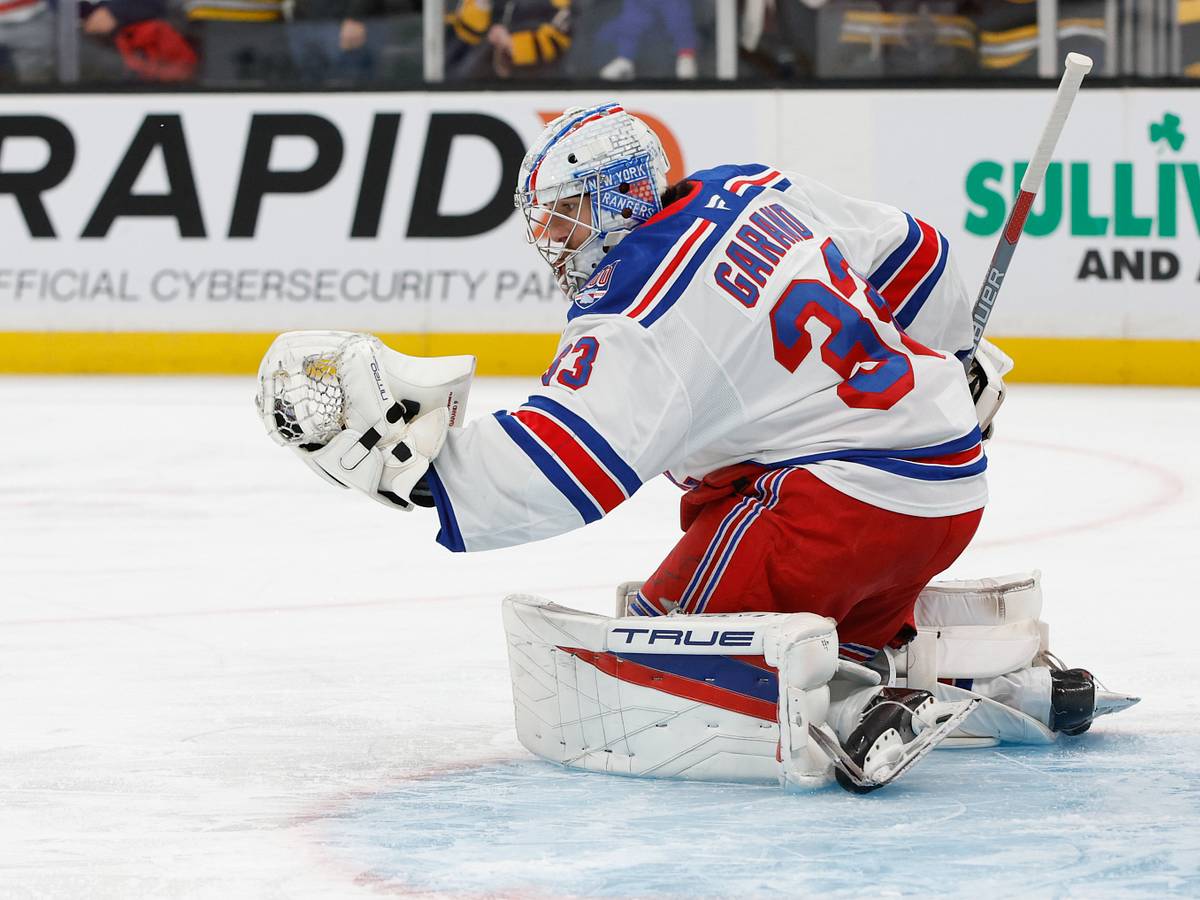
Garand’s path to Detroit makes the performance more revealing than the box score alone. He did not spend the week preparing as the scheduled starter. He was cut, placed on waivers, cleared, moved to Hartford and then returned when Korpisalo went on injured reserve. That sequence creates every excuse for a young goalie to look rushed or disconnected. Instead, Garand looked settled.
Detroit generated 20 shots through two periods, including a point-blank chance for J.T. Compher that Garand turned aside. The Red Wings hit a post in the first period and had stretches of territorial pressure, but Garand did not give them the goal that would have changed the emotional temperature of their home opener. By the third period, New York had tightened the game so completely that Detroit managed only two shots.
Garand also arrived with evidence that this was not entirely out of nowhere. He went 2-0-1 in three Rangers appearances late last season with a .948 save percentage. Four NHL starts remain a tiny sample, but the pattern is useful: when New York has put him in the net, he has looked comfortable enough to let the team play normally in front of him.
That is the first requirement for a backup. The Rangers do not need someone to challenge Shesterkin for the crease. They need a goalie who can absorb difficult schedule spots without forcing the skaters to protect him. Friday looked exactly like that.

The Rangers made the shutout possible without hiding their goalie
A shutout is never only a goalie statistic, and this one was a useful example. New York scored early on Sean Durzi’s power-play one-timer, then resisted the temptation to turn a one-goal road lead into a track meet. The Rangers defended the middle, survived Detroit’s stronger second-period push and kept the third period almost entirely under control.
Durzi’s goal was significant in its own right. It was his first as a Ranger after arriving in the Vincent Trocheck trade, and it came from the high slot after Gabe Perreault created the passing lane. That is the kind of secondary contribution New York needs from a retooled roster. The previous night, Shesterkin’s historic goalie goal dominated the headlines in a 5-1 win over Tampa Bay. Against Detroit, the useful story was less spectacular: another new piece contributed, a young forward helped create the opener and the team protected a narrow advantage.
The third period is the part Mike Sullivan should like most. Detroit was chasing the game in its own building, yet produced only two shots. Eeli Tolvanen eventually added the empty-netter, but New York did not need insurance because it never allowed the game to become frantic.
That structure matters for Garand’s evaluation. A backup who receives predictable defensive support can be judged on whether he makes the saves the system asks him to make. Garand did, including the handful of high-danger moments when Detroit threatened to turn pressure into momentum.
A cheap internal backup can create value beyond the crease

The Rangers already know where the majority of their goaltending investment belongs. Shesterkin is the franchise starter and one of the few goalies capable of stealing a playoff series. The more interesting roster question is how much certainty New York needs behind him.
Korpisalo was acquired to provide veteran insurance, and one injury does not erase that logic. But every credible start Garand produces makes the organization’s internal option more valuable. A young backup who can handle 20 to 25 starts, travel with the NHL club and remain comfortable in a secondary role can create flexibility that extends beyond goaltending. It can reduce the need to spend assets or cap space chasing veteran depth every summer.
There is also a development argument. Garand is 24, an age at which many goalies are still defining their NHL ceiling. Leaving him in the AHL guarantees starts, but it also delays the answer to the question New York actually needs solved: can he be trusted against NHL shooters when the schedule gets compressed?
Friday offered one positive answer. It should not become an overreaction. Korpisalo’s experience still matters, and Shesterkin’s workload has to be managed around performance and health rather than a development experiment. But the Rangers now have competition where they expected hierarchy. That is a good problem, particularly for a team that has reworked significant parts of its roster and needs inexpensive contributors to outperform their slots.

The next test is whether Garand can make this feel ordinary

The most dangerous response to a young goalie’s first shutout is to treat it as proof that the position has been solved. Goaltending samples are volatile, and Garand will eventually have a night when rebounds sit in worse places, screens arrive earlier and a clean-looking shot finds the corner. The Rangers should be evaluating what survives when the result is less perfect.
That means rebound control, reads through traffic, puck handling, communication and the ability to reset after allowing a bad goal. It also means seeing whether Sullivan can use Garand in ordinary schedule spots rather than only emergencies. If the coaching staff trusts him enough to give Shesterkin real rest, the roster value becomes tangible.
There is an important contrast with Detroit, too. The Red Wings entered their opener without Dylan Larkin and unsigned defenseman Simon Edvinsson, then spent much of the night searching for enough offense to break through. New York was also dealing with an absence in a key depth role, but its replacement became the story of the game. That is what organizational depth is supposed to look like.
Garand does not need another shutout to keep building his case. He needs starts that look boring: clean positioning, manageable rebounds, no panic after traffic, and enough saves for the Rangers’ skaters to decide the game. After the strangest week of his professional career, boring would be a very good next step.
There is also a broader roster-management lesson in the sequence. New York chose veteran certainty when it kept Korpisalo and exposed Garand to waivers. That was defensible, but clearing waivers does not mean Garand lacked value; it only means no other team was prepared to claim him under its own roster constraints that day. The Rangers were fortunate to keep the option alive. If he continues to perform, the organization gains leverage rather than losing it: Garand can push for NHL starts, Korpisalo can recover without being rushed, and Shesterkin can be protected from unnecessary workload.
For Sullivan, the practical goal should be to create a real sample before making a permanent judgment. Give Garand another difficult road start, a home start with expectations attached and a game after a long layoff. See how he responds when the Rangers are not defending as cleanly as they did in Detroit. The answer does not need to be spectacular. If his floor is stable enough that New York can trust him through ordinary mistakes, the club will have learned something far more useful than whether a rookie can catch lightning for one night.
That is a meaningful early-season advantage for New York.
Garand’s first NHL shutout is a milestone, but its larger value is what it forces New York to reconsider. Five days after the Rangers were willing to risk losing him on waivers, he delivered exactly the kind of performance a contender wants from a backup in a difficult schedule spot.
The Rangers should not rewrite the depth chart after one game. They should, however, keep the competition open. If Garand can turn emergency opportunity into repeatable NHL competence, New York may already have the solution behind Shesterkin in its own system. That would make Friday’s 2-0 win more than a nice early-season story. It would make it the night the Rangers discovered that their goaltending depth was stronger than they thought.