

Erosa Gets Dropped, Scores 91-Second KO — Then Retires With $100K
GOATIFYJulian Erosa had already decided how his fighting career would end. He would make one last walk to the Octagon, face JeongYeong Lee at UFC Vegas 123 on October 31, and leave professional MMA behind whatever the result. What he could not plan was the extraordinary 91 seconds that followed.
The 37-year-old featherweight was hurt almost immediately, fought through an early scramble, and then knocked Lee out with a right hand before the opening round had reached its midpoint. By the end of the night, he had a 32-13 professional record, a $100,000 performance bonus and the kind of farewell most fighters never get. The knockout was spectacular. The choice to walk away despite it may be the more important part of the story.
From Early Disaster to a Knockout in 91 Seconds
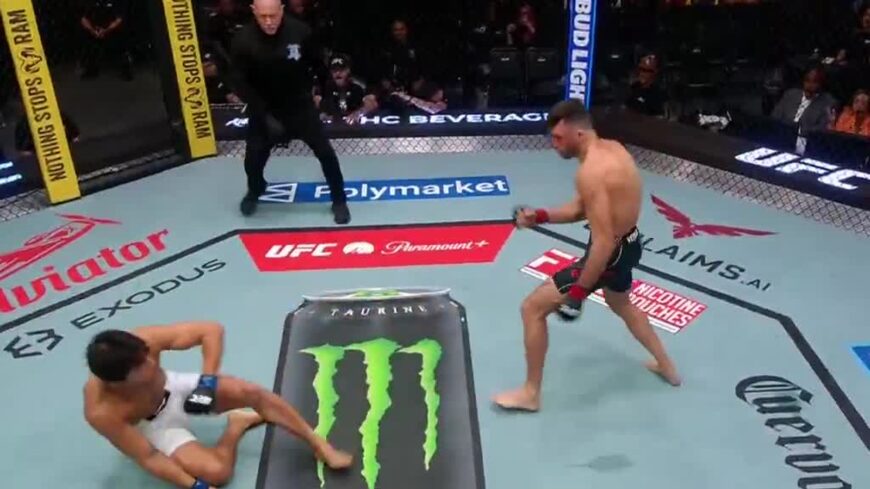
Lee did not behave like a man interested in giving a veteran a ceremonial send-off. He came out aggressively after the glove touch, connected hard and put Erosa on the floor in the opening exchanges. There was a scramble and a submission threat, leaving the retiring fighter in precisely the situation that can turn a planned celebration into an uncomfortable final memory. The fact that this was his last fight offered no protection once the cage door closed.
Erosa had to make several decisions in rapid succession. The first was simply to survive. He defended while hurt, avoided being trapped in the early grappling exchange and eventually created enough separation to get upright. Lee still had momentum and kept attacking. The younger fighter had the opportunity to press the advantage, but an early knockdown is not the same as a completed finish, particularly against a veteran accustomed to chaotic exchanges.
The next phase was not a long tactical reset. Erosa found his feet and started answering instead of merely retreating. He used a brief clinch and the space that followed to recover his bearings, then stood his ground as both fighters committed to punches. When the opening appeared, Erosa delivered a heavy right hand that sent Lee to the canvas. He followed with strikes on the ground, and the referee stopped the contest at 1:31 of Round 1.
That sequence is what makes the result so compelling. The same 91 seconds contained the apparent beginning of a disastrous retirement night and the definitive end of the fight. Erosa was not cruising toward a points victory or managing a safe lead. He was forced to solve a dangerous problem under pressure, then punished an opening with the finishing instincts that had defined so many of his best performances.
It would be too simple to call the turnaround luck, just as it would be too much to pretend Erosa was never in danger. Lee landed meaningful offense and threatened to spoil the occasion. Erosa survived it and capitalized on a decisive moment. Both parts matter. A comeback knockout loses its meaning when the trouble that preceded it is edited out, and the trouble does not diminish the quality of the eventual finish.
The official result is a first-round knockout by punches. There was no judges' decision, no extended recovery between rounds and no need for a rematch to establish who won on Halloween night. For Lee, the opening success only makes the reversal more frustrating. For Erosa, it produced an ending that could have been taken away by a single earlier exchange.

Three UFC Stints Made Erosa More Than a One-Night Story

The finish matters more when viewed against the career that came before it. Erosa turned professional in 2010 and spent years working toward and then fighting to retain a place in the UFC. His first promotional appearance came in 2015, but his career at the highest level was not one uninterrupted rise. He returned through different routes and ultimately competed across three separate UFC stints, a path that demands unusual persistence.
He also appeared on The Ultimate Fighter and Dana White's Contender Series, two very different opportunities to show that he belonged. The number of appearances and comeback attempts is not merely a trivia item. In a sport where roster places are scarce and defeats can quickly change a fighter's prospects, returning after being released requires fresh results, renewed belief and the willingness to start climbing again.
Erosa's style was part of both the attraction and the risk. He was comfortable fighting in scrambles, taking chances and hunting submissions when the exchanges turned messy. That approach made him dangerous from positions that looked unfavorable, but it also exposed him to heavy counters and knockout losses. His career was rarely a neat story of perfect defense and calculated control. It was a long argument for staying dangerous even when the fight appeared to be slipping away.
The 2024 stretch offered particularly clear evidence. He submitted Ricardo Ramos with a guillotine in March after being badly hurt, then secured another first-round guillotine against Christian Rodriguez in July. Those victories were not carbon copies of Saturday's knockout, but they shared a familiar theme: Erosa finding an opportunity in a contest that did not necessarily begin on his terms.
Across his professional record, the final tally of 32 victories included 13 knockouts and 14 submissions. That balance is revealing. He was not a specialist who needed one exact kind of exchange to win. His submission threat and willingness to trade created multiple routes to a finish, sometimes within the same round. The loss column, meanwhile, shows how much punishment and disappointment accompanied that ambition.
That history explains why his final knockout resonated beyond the preliminaries. Plenty of fighters produce an exciting finish. Far fewer do it after a decade and a half of professional competition, several promotional chapters and repeated moments when a career could have ended much less memorably. Erosa's final performance felt like a compressed version of the wider journey: trouble, survival, aggression and a sudden victory.

A Final Run, Then a Retirement Decision He Would Not Reverse

His final two seasons were another reminder that MMA careers rarely end in a straight line. Erosa stopped Darren Elkins in the first round at UFC 314 in April 2025, adding to a sequence of finishes that had restored momentum. But defeats followed: a decision loss to Melquizael Costa in May 2025 and a first-round knockout loss to Lerryan Douglas in March 2026. By the time the Lee matchup arrived, the 37-year-old had experienced both the exhilaration of a resurgence and the consequences of a demanding sport.
Those defeats did not force the retirement announcement after Saturday's result. Erosa had already said that the Halloween bout would be his last, win, lose or draw. That distinction matters because a knockout victory can be a powerful temptation to postpone an exit. A fighter who wins dramatically often hears that he still has something left to prove, that another opponent or one final payday is waiting. Erosa had chosen his endpoint before he knew whether the night would bring applause or disappointment.
His explanation centered on a change in priorities after becoming a father. Competition had once occupied the central place in his life. Now his son and the desire to remain healthy and present for his family mattered more. He spoke about wanting to retain the mental and physical well-being to see his child grow older and eventually meet the next generation. The statement was not a claim that every fighter should retire at the same age. It was a personal calculation about what mattered most after years of risk.
The demands behind that calculation are easy to overlook when the public sees only fight night. Training camps bring weeks of hard sparring, weight management, injury risk and family disruption before the athlete ever reaches the arena. Winning a bout does not erase those accumulated costs. A spectacular finish may improve a fighter's market value without changing the reasons he wanted to stop in the first place.
Erosa's stated plans included returning to Washington with his family and helping with the family farm. The image is a sharp contrast to the lights of the Octagon, but it is consistent with the way he described his future. The next chapter is not about negotiating a ranking position or searching for a new opponent. It is about building a daily life that does not depend on absorbing and delivering punches for a living.
Retirement announcements in combat sports can be reversible, and nobody can predict another person's decisions forever. For now, however, the evidence is unusually clear: Erosa publicly committed to one final fight before the bell, explained why he wanted to leave, won, and then followed through with a farewell inside the cage. His victory was a conclusion, not an announced comeback campaign.

The $100,000 Bonus Was the Extra — the Goodbye Was the Prize

The knockout was not the only reward. Erosa was named one of the UFC Vegas 123 Performance of the Night winners and received a $100,000 bonus. Tom Nolan, Joe Kropschot and Lucia Szabová also received performance awards on the Halloween card. For an athlete making his final appearance, the extra payment is a meaningful financial send-off, but it is the circumstances of the win that give the bonus its emotional weight.
After the stoppage, Erosa laid down his gloves in the Octagon, a familiar but powerful gesture when a fighter genuinely intends to close a career. His wife and child were there to share the moment. The scene connected the public spectacle of a violent comeback with the private reason he had chosen to leave. He could enjoy one last triumph without making the triumph an excuse to keep taking the same risks.
His final professional record stands at 32 wins and 13 losses, with 19 UFC bouts spread across three stints. Those figures do not resemble an undefeated champion's immaculate résumé, and that is precisely why the story connects. Erosa built a long career through persistence, reinvention and the acceptance that the sport could be unforgiving. He was exciting partly because he was willing to operate in positions where the outcome could change in an instant.
Saturday's finish also leaves a lesson about the difference between ending well and ending at the perfect time. There is no universal formula for deciding when a fighter has had enough. One athlete might still be pursuing a title, another might need to secure a final contract, and a third might recognize that the costs of continuing have begun to outweigh the benefits. Erosa's decision is notable because he appeared prepared to accept either a win or a loss without moving the goalposts.
The $100,000 award, the knockout highlight and the roar of the crowd will remain part of the official record. Yet the defining detail may be that Erosa was able to celebrate with the people for whom he wanted to retire. On a night when the first punch seemed capable of ruining the occasion, he recovered, produced the final knockout of his career and left on his own terms.
There is no need to manufacture a future opponent or a speculative comeback to make the ending bigger. The final fight already supplied enough drama. Erosa was knocked down, stood back up, ended the contest in 91 seconds and said goodbye. That is a complete sports story, and a rare one.
Julian Erosa's farewell was not a flawless performance. It was better suited to the career he actually had: a fight full of danger, an unlikely recovery and a finish that rewarded his refusal to panic. JeongYeong Lee nearly spoiled the night, but Erosa found the right hand that made the result official at 1:31 of the first round.
The $100,000 bonus makes the ending sweeter. The more lasting victory is that the 37-year-old can step away having made the decision before the result, rather than allowing one more win to decide for him. For a fighter who had to earn his way back into the UFC more than once, leaving the cage by choice is a remarkable final act.

















