

Both Hit 135. The Real Harrison–Nunes Fight Is Against Time.
GOATIFYKayla Harrison and Amanda Nunes stood on the scales at the same number Friday: 135 pounds each. For a UFC 334 title fight that spent years moving from a hypothetical superfight to a delayed booking, that small piece of certainty matters. Harrison has made the women's bantamweight limit after a serious neck operation. Nunes has made it after more than three years away from the cage. Saturday night at Madison Square Garden, the weigh-in will be a footnote; everything that happens after the opening bell will test whether either woman's best version has returned.
The matchup has an unusually clean strategic contrast. Harrison's route begins in the clinch, where Olympic-level judo and punishing top control can make even an experienced champion uncomfortable. Nunes has the more proven stand-up finishing weapons and the career résumé that made her the benchmark for women's mixed martial arts. Neither advantage is enough by itself. The question is whether the grappler can repeatedly close distance without eating heavy shots, and whether the striker can create enough space without getting driven against the fence.
Both athletes already have more than a title to their names. Harrison is defending a UFC championship she won in June 2025, while Nunes is attempting to reclaim a crown she relinquished when she retired in 2023. The former American Top Team teammates have known one another for years. That history adds tension, but the physical and tactical problems are what will decide their first actual meeting.
Harrison's Best Weapon Is the Clinch Nunes Must Avoid

Harrison's entire career has been built around the ability to make a fight happen on her terms. The two-time Olympic judo gold medalist has spent years converting the balance, leverage and grip fighting of that sport into a mixed-martial-arts system. Her opponent can know the shot is coming and still struggle to defend it. Unlike a wrestler who must shoot from several feet away, Harrison can create takedowns after a collar tie, body lock or extended hand-fighting exchange. The most dangerous moment is often the instant the other fighter believes she has achieved a neutral clinch.
Her championship-winning submission against Julianna Peña at UFC 316 showed the system at work. Harrison did not need a spectacular flying attack or a frantic exchange. She established control, imposed her weight, made Peña defend successive positional threats and found a kimura. That particular finish is useful evidence of her submission ability, but it is not the only way she wins. Even without a tap, an extended top-control spell can win a round, sap an opponent's legs and make the next stand-up exchange less comfortable.
Against Nunes, though, getting the first grip may be harder than it was against Harrison's recent opponents. Nunes is an accomplished mixed-martial-arts grappler with strong balance and extensive experience wrestling against elite opposition. Harrison will need to disguise her entries behind credible strikes, create contact before Nunes can turn away, and resist the temptation to chase a throw that gives up position. One failed takedown attempt is not automatically a disaster; two minutes of repeated failed attempts, with punches received during each separation, could change the whole fight.
The cage becomes Harrison's friend if she can make Nunes retreat in straight lines. A defensive fighter whose back reaches the fence loses some of the space needed to circle away from a body lock. Harrison can then connect her hands, change the angle of her hips and force Nunes to choose between an overhook, a whizzer or defending the outside trip. These are tiny exchanges that rarely look dramatic at full speed, yet they could determine how much of each round is spent on the mat.
GOATIFY
GOATIFY UFC & MMA
Harrison's Olympic judo is central to the UFC 334 matchup. Browse GOATIFY UFC and MMA fight-fan apparel.


MMA GOAT Gold Middle Finger Fight Crewneck Sweatshirt
A MMA fan design for everyday wear.
Shop Now ↗Her strength at 135 pounds is part of that equation. Harrison competed at a substantially heavier weight in international judo and later at lightweight in the PFL, so arriving at UFC bantamweight required an enormous adjustment. Friday's official number confirms that she met the limit; it does not tell us how effectively she will recover after the cut. Her physical force in the clinch has historically been obvious, but the best signal on Saturday will be what happens after the first defended takedown. Can she reset, scramble and attack again without losing her posture?
The obvious risk is the passage between those clinch opportunities. Harrison is not helpless on the feet, yet her striking serves the grappling. Her combinations can be functional rather than fluid, and she does not possess Nunes's track record of ending a fight with a single clean connection. If she advances predictably with a straight-line entry or stays at punching range to prove a point, the advantage shifts toward the returning former champion.
That makes Harrison's ideal opening round quite specific: occupy the lead hand, push Nunes toward the fence, secure upper-body contact, make her carry weight and deny long resets. A submission would be a statement, but a round of disciplined control would serve the same strategic purpose. If Nunes cannot get her feet free early, every succeeding minute risks turning into a battle against pressure rather than a test of who punches harder.
Nunes Needs Space, Power and One More Smart Adjustment
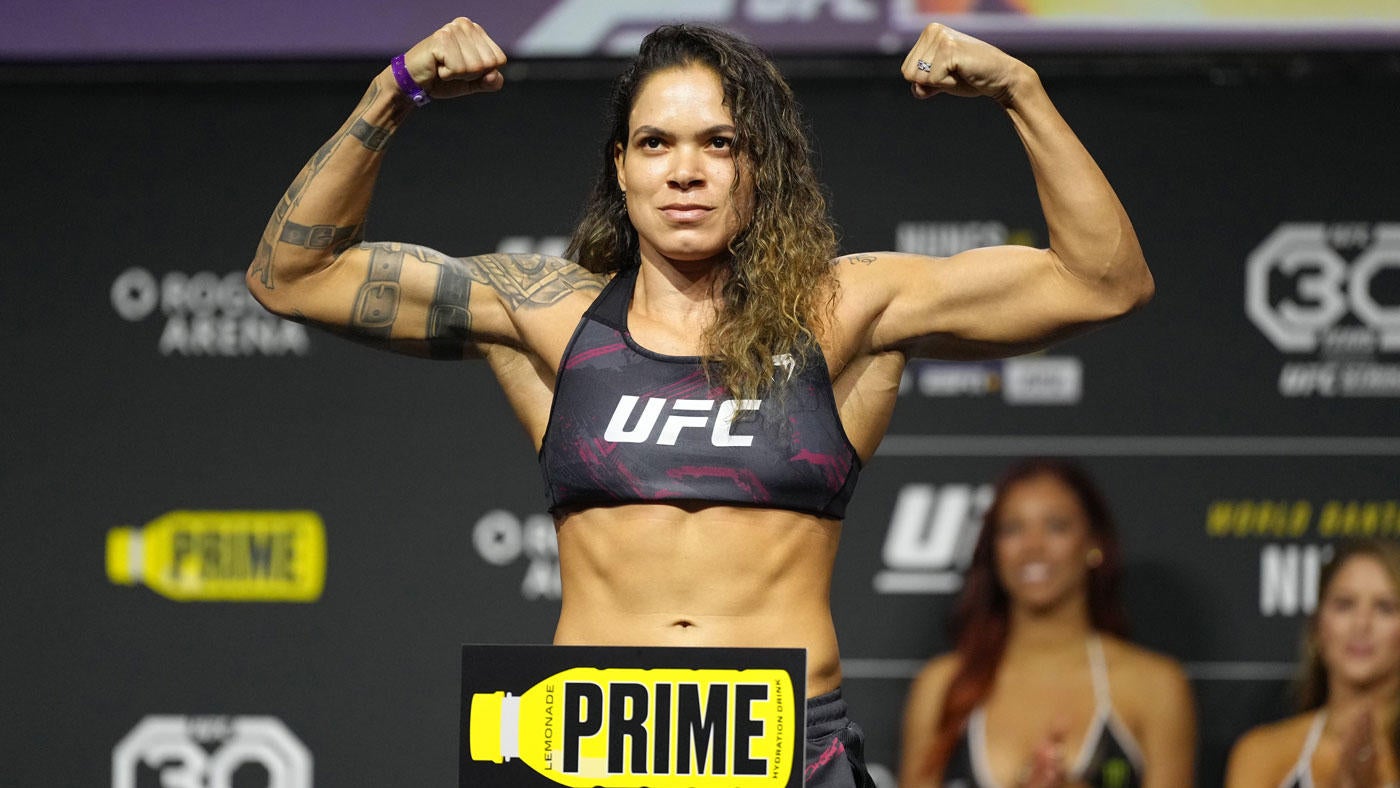
Nunes built her reputation on an ability to hurt opponents in phases where they normally felt secure. She stopped some of the most celebrated fighters in women's MMA, held championships at bantamweight and featherweight, and finished her first career with 11 UFC title-fight victories. Calling her the greatest woman in MMA is a judgment, not a measurable statistic, but there is no dispute about the breadth of her championship record.
Her path to regaining the 135-pound belt is not to copy Harrison's grappling. Nunes has won fights through takedowns and top position, and her defensive wrestling could be vital here. But voluntarily playing a prolonged scramble game against a double Olympic judo champion asks for trouble. Even if Nunes lands on top, the scramble required to stay there can give Harrison the kind of leg, arm or hip connection that starts another exchange.
Distance management is more valuable. Nunes needs to make Harrison enter through a corridor of hard, correctly timed punches. A jab can interrupt the first step, a short straight shot can punish the head position, and a hook on the exit can deter another immediate entry. Her best sequences need not be long combinations. Two committed punches followed by an angle away from the fence may be more useful than planting her feet to exchange six.
The details matter because Harrison cannot be treated as an ordinary striker who will stand still and trade. If Nunes throws an enormous rear hand without recovering her stance, Harrison may duck under it or crash into her hips. If she throws high kicks without securing distance, the champion can catch the leg and convert the reaction into a takedown. Nunes has the power advantage in the striking exchanges, but only if those exchanges stay exchanges rather than turning into unplanned grappling.
Nunes has demonstrated that she can solve a technical problem over time. Julianna Peña beat her in a major upset in December 2021, partly by disrupting Nunes's rhythm with straightforward pressure and a jab. Their rematch in July 2022 told a different story: Nunes switched much of her approach, worked effectively from southpaw and restored her control over the contest. The lesson is not that one stance magically beats Harrison. It is that Nunes has a history of changing the terms of a fight rather than repeating the same failed sequence.
GOATIFY
GOATIFY UFC & MMA
From the Lioness's striking legacy to modern fight-night culture, explore GOATIFY MMA and UFC fan styles.

Rogainz Joe Rogan UFC MMA Martial Arts Sticker
Add MMA personality to your favourite gear.
Shop Now ↗


UFC GOAT Gold Middle Finger Fight Decal Sticker
Add MMA personality to your favourite gear.
Shop Now ↗
Her June 2023 win over Irene Aldana offers a further reference point, though not a guarantee of what will appear in New York. Nunes controlled the scoring across five rounds and was comfortable alternating measured offense with defensive responsibility. She did not need to gamble constantly to secure a clear decision. That patience could be essential against Harrison: an overeager Nunes risks creating the clinch, while a composed Nunes can make every attempted entry costly without giving up the center.
Body work has a plausible role as well. Repeated punches to the body might discourage a clinch-heavy fighter from squeezing and re-entering at full speed, especially after a demanding weight cut. But there is a trade-off. Dropping the hands or sitting down on body shots puts the attacker closer to a takedown, so the idea works best off feints, lateral movement and moments when Harrison has already been made to miss. This is a calculated pressure strategy, not a promise that a few body punches will suddenly empty an elite athlete's gas tank.
The clearest positive early sign for Nunes would be a sequence in which Harrison reaches the fence, tries to secure a body lock, and comes away empty without gaining meaningful control. That tells us Nunes has her footwork, balance and timing. The clearest danger would be accepting a static clinch for long stretches. She can survive a bad position and still be the more dangerous puncher, but she may struggle to establish that threat if the rounds keep disappearing along the cage.
Seventeen Months vs. Forty-One: The Comebacks Could Override the Matchup

The hardest part of projecting this fight is separating evidence from reputation. Harrison has not competed since June 2025, a layoff of roughly 17 months. She underwent neck surgery after the first planned Nunes bout was delayed. Nunes has not fought since she beat Aldana and retired in June 2023, an absence of approximately 41 months. Those are not ordinary training layoffs. They introduce uncertainty about speed, endurance, confidence and the decision-making that only exists under live pressure.
For Harrison, the concern is not whether she remembers her judo. The movements that made her an Olympic champion are deeply ingrained. The question is whether a repaired neck will tolerate the forces of a championship fight: hard collisions on entry, defending a crossface, fighting for underhooks and landing awkwardly in a scramble. None of those actions can be truly replicated by drilling with cooperative partners. Harrison says she is prepared to compete; fans should not mistake a fighter's confidence or a medical clearance for evidence that every physical variable has returned to its previous level.
Nunes presents a different mystery. The former champion is returning at 38 after stepping away from the grind of camps and title defenses. Rest may have relieved accumulated fatigue, and the Harrison challenge may have restored the competitive urgency that had diminished before her retirement. It may also prove that timing cannot be maintained merely by sparring. The distance between seeing a shoulder twitch and reacting to a real punch is small enough to decide a round. We will only know which version is present when someone starts making her work.
The official weigh-ins remove one narrow uncertainty. Both competitors registered 135.0 pounds on November 13, an especially noteworthy number for Harrison after her move down from heavier categories. Yet a successful weigh-in does not measure rehydration, the quality of the cut or performance under exhaustion. Nor does it erase concerns about Harrison's neck. It simply confirms that the UFC can proceed with the title matchup as booked, barring an unexpected later development.
GOATIFY
GOATIFY UFC & MMA
Ahead of the Harrison–Nunes title fight, find GOATIFY UFC tees, hoodies and fight accessories.

UFC GOAT Gold Middle Finger Fight Decal Sticker
Add MMA personality to your favourite gear.
Shop Now ↗There is also a psychological complication that can produce two very different fights. Harrison and Nunes once shared a gym at American Top Team, and the prospect of fighting each other has been discussed since 2021. In that span, Nunes lost to Peña, won the rematch, retired, and then watched Harrison claim the division's championship. They have spent years preparing for a person they know well, but the athlete who eventually steps into the cage may not behave like the one each remembers from training.
Imagine the first scenario: Harrison feels strong, her neck holds up, and her timing in the clinch is as sharp as it was during her title win. Nunes may still land the best punches of the fight, but she will need to avoid long stretches underneath the champion. A repeated clinch-and-top-control pattern could give Harrison a decision or open a late submission. That is the route in which the defending champion makes the fight physically repetitive until Nunes has fewer and fewer chances to demonstrate her striking edge.
The second scenario is Nunes returning with the timing and explosiveness that shaped her title reign. If she keeps her back off the fence, makes Harrison reset after failed shots and places the heavier punch in each exchange, the challenger can bank rounds or force a stoppage. That possibility becomes greater if Harrison is hesitant to commit through contact, whether because of physical limitations or because an early counter changes her willingness to enter.
The least predictable scenario is that neither fighter looks quite like her previous peak. Harrison might still grind out takedowns but have trouble sustaining pressure, while Nunes could land powerful individual shots without the volume or reflexes to convert those moments into a finish. In that version, the bout might be decided by small bursts of activity and the judges' interpretation of effective offense rather than by a dramatic demonstration of superiority.
The first ninety seconds will offer more actionable information than weeks of promotional footage. Watch Harrison's feet after she throws: does she step into balanced contact or reach with her head low? Watch Nunes's first retreat: does she angle away, or does she end up standing square to the fence? Then watch the second scramble rather than the first. One successful defense can happen through athletic instinct; repeating it after carrying a strong opponent is a different measurement.
A cautious lean toward Nunes is defensible because her striking can create immediate consequences and she has demonstrated championship adaptability. But it should not be presented as a certainty, and a specific round-three knockout is a prediction, not a fact waiting to be filed. Harrison has a more direct route to winning minutes if she controls the clinch, and the health variables make the apparent gap between their best historical performances unreliable. The better answer is to identify the conditions that make each win plausible and test them against the first round.
UFC 334 is positioned to settle a conversation that began when these two were still associated with the same gym. On the eve of the fight, the only definitive outcome is procedural: Kayla Harrison and Amanda Nunes each hit 135 pounds, and the title bout remains on course. The sporting question is much bigger. Can Harrison make the cage a place where elite judo overrules power, and can Nunes turn distance and timing into the kind of fight that built her legacy?
Watch the space between the first punch and the first clinch. If Harrison bridges it safely and forces Nunes to wrestle, the champion can accumulate control and threaten submissions. If Nunes repeatedly breaks that sequence and punishes every re-entry, the challenger's punching becomes the dominant weapon. After neck surgery for one fighter and a three-plus-year absence for the other, the sharpest prediction is a conditional one. Saturday will show which champion-level skills have survived the waiting.
GOATIFY
GOATIFY UFC & MMA
Shop GOATIFY UFC and MMA shirts, hoodies and fight fan gear.
MMA GOAT Gold Middle Finger Fight Crewneck Sweatshirt
A MMA fan design for everyday wear.
Shop Now ↗


















