Giannis and Bam Scored 74. Davion's 17 Assists Told the Bigger Story.
GOATIFYGiannis Antetokounmpo and Bam Adebayo each scored 37 points, and the Miami Heat beat Cleveland 133-121 on Friday, November 13. Seventy-four points from two frontcourt stars is an obvious headline. The more revealing number might be 17: that is how many assists Davion Mitchell delivered while committing only one turnover. Miami did not simply feed its stars and hope they produced something extraordinary. It found a repeatable route to good shots against an opponent that wanted the paint sealed shut.
The win also carried NBA Cup consequences. Miami moved to 2-0 in East Group B, while Cleveland fell to 1-1. Adebayo added 14 rebounds, Mitchell scored 22, and rookie Ryan Conwell contributed 20 off the bench. Yet the most important part of the night was how those performances fit together: the frontcourt generated defensive dilemmas, the point guard recognized them, and a young shooter helped make the weak side expensive to ignore.
That matters because Miami's new-look roster has not always made scoring look easy this season. A pair of MVP-level finishing threats is not automatically a coherent half-court offense. Against Cleveland, the Heat showed what the system can look like when matchups, screening angles, passing timing and timely perimeter shooting finally connect. The result was historic individual production, but it was built on more than isolation talent.
Cleveland Couldn't Guard Two Frontcourt Stars With One Big Defender
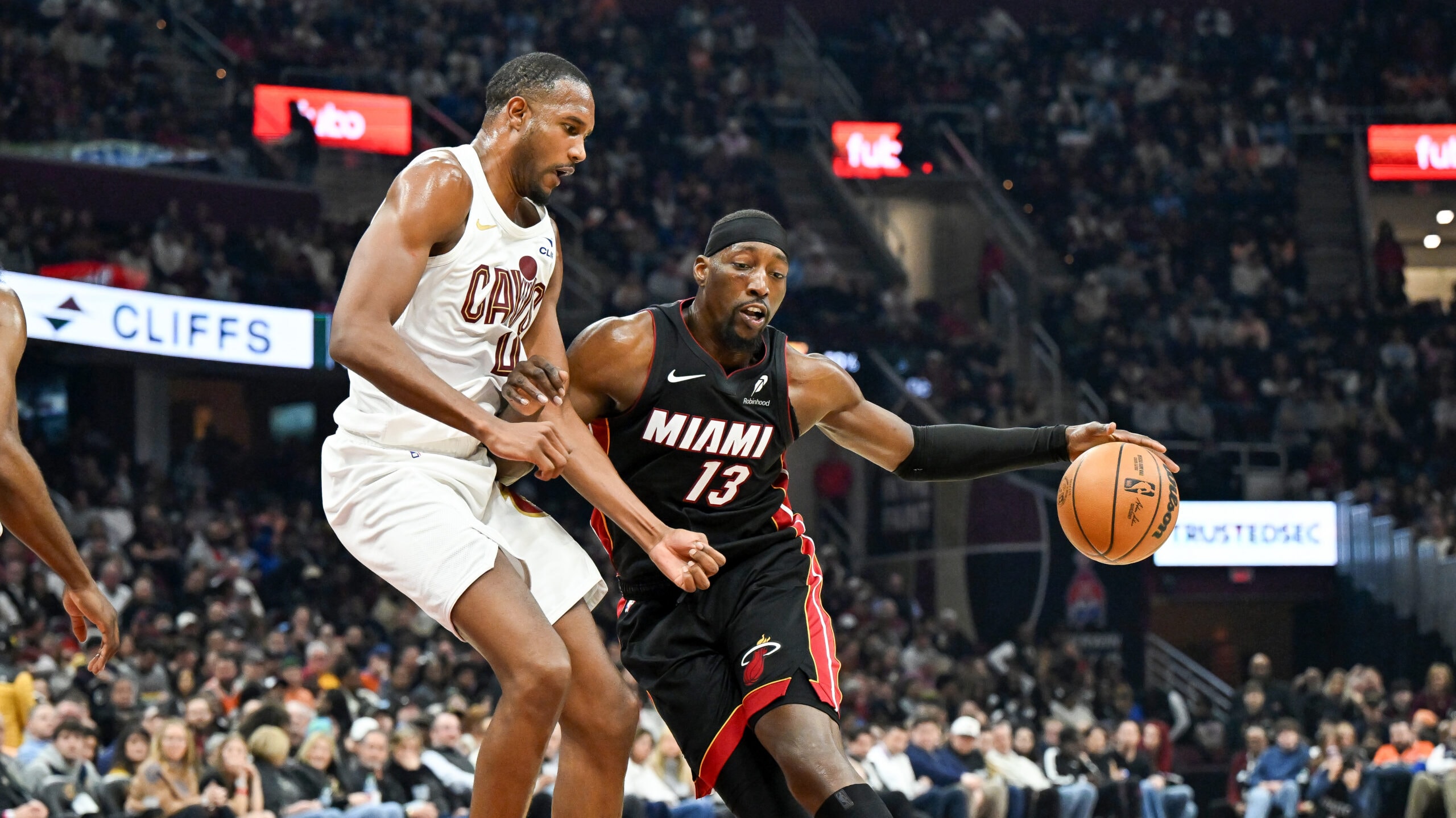
Cleveland entered the night without Evan Mobley, who was dealing with a sprained left big toe, and also missed Sam Merrill. Miami was short-handed too: Klay Thompson sat out with an ankle sprain, and Pelle Larsson was unavailable because of illness. Those absences changed the tactical starting point. The Cavaliers still had Jarrett Allen, but they could not assign one natural, high-level big defender to Giannis and another to Bam on every possession. Miami spent much of the game asking Cleveland to identify which mismatch it was willing to live with.
When Allen matched up with Antetokounmpo, Adebayo could attack smaller or less mobile defenders. When Cleveland shifted its size toward Bam, Giannis gained favorable downhill angles. Neither player needed the ball on every possession for that stress to build. Simply setting a screen or slipping into the lane forced the next defender to move, opening a window for a direct pass or a quick decision before the help rotated back.
That explains why this was more than two stars collecting points in separate turns. Miami experimented with actions involving the two bigs together, including moments when one screened for the other. Such possessions are awkward to defend because most teams organize their coverages around a guard using a screen and a big protecting the basket. An Antetokounmpo-Adebayo action asks a smaller defender to navigate an unusual collision while Cleveland's last line of defense tries to cover an enormous amount of ground.
The Cavaliers were hardly helpless. Donovan Mitchell and James Harden initially drove Cleveland's offense from the perimeter, and Tyrese Proctor supplied timely shooting from the bench. Miami led only 29-27 after one quarter, then went cold enough to enter halftime trailing 57-54. Harden's difficult three at the second-quarter buzzer gave Cleveland the lead even though the Heat had already produced repeated advantages inside. The scoreboard was a reminder that a favorable matchup does not eliminate the value of timely three-point shooting.
In the third quarter, Miami answered with 38 points. The Heat kept seeking early paint touches and got Antetokounmpo moving toward the basket before the defense could build its full wall. Davion Mitchell found him on lobs, a connection that had not always been a routine feature of Miami's early-season offense. Cleveland kept responding with perimeter makes and short runs, but it also kept allowing Miami to reach the interior of its defense without making the Heat exhaust the shot clock.
GOATIFY
GOATIFY Basketball
Shop GOATIFY basketball styles as Miami's frontcourt duo forces defenses to rethink every matchup.

LeBron James G.O.A.T. - Greatest of All Sweatshirt
A basketball fan design for everyday wear.
Shop Now ↗

LeBron James G.O.A.T. - Greatest of All Sticker
Add basketball personality to your favourite gear.
Shop Now ↗


LeBron James – LeGOAT Streetwear Pullover Gift Hoodie
A basketball fan design for everyday wear.
Shop Now ↗Adebayo's closing stretch was particularly instructive. Against lineups with Thomas Bryant involved, he did not wait for one perfect post-up. He worked the middle, created comfortable catch points, attacked his own matchup and kept the defense reacting. The Heat scored 41 fourth-quarter points after entering the period ahead only 92-91, transforming a contest with twelve lead changes into a double-digit victory.
Historically, Miami had seen two players reach at least 37 points in the same game only once before: LeBron James and Dwyane Wade did it in 2013. That comparison is meaningful as a rare single-game milestone, not proof this roster has already matched those championship-era teams. What Friday showed is more specific and more useful: when both of Miami's stars can take advantage of the opponent's personnel and the timing of the passes, the Heat can get high-value offense from two different parts of the frontcourt without sacrificing flow.
Davion Mitchell's 17 Assists Were the Answer to Cleveland's Drop Coverage

Davion Mitchell's line — 22 points, 17 assists and one turnover — captures the distinction between a hot scoring night and a system working. The assists tied his career high, and his playmaking did not depend on repeatedly forcing deep drives into traffic. Cleveland's preferred response to Miami's ball screens often placed its big defender well below the level of the pick, trying to remove the rim from the conversation. That drop coverage created a different opening: the space between the first defender and the big protecting the basket.
Mitchell used it with pocket passes. A pocket pass is not simply a short delivery to a rolling teammate; its value comes from arriving before the help can shrink the lane. When the on-ball defender trails the screen and the center waits near the paint, the passer can place the ball at the foul line or slightly below it. Adebayo can rise into a mid-range jumper, attack with a bounce or immediately redirect the ball. Giannis can catch with momentum, where one step often changes the entire possession.
Many defenders are comfortable allowing a conventional jump-shooting center to take those catches. This Miami lineup forces a harder calculation. Adebayo is a credible scorer from the upper paint, and Antetokounmpo has too much length, balance and finishing power to let him gather the ball freely. In the Cleveland game, the two bigs combined to make 12 of 17 non-rim two-point attempts, according to the Heat's breakdown. That is not a level of shooting Miami can responsibly assume will appear every night, but the locations were generated by a recognizable offensive process.
The advantage also compounds. If Cleveland stays back in drop coverage, Mitchell can keep feeding the open middle. If the big steps forward, Giannis gains a lane behind him. If the weak-side defender rotates early to cover that lane, Miami can turn the ball toward a spot-up shooter. The point guard's job is to make the correct choice quickly rather than turn each possession into a personal scoring audition. Seventeen assists against one giveaway is unusually convincing evidence that Mitchell mostly made those decisions well.
Miami finished with 37 team assists and nine turnovers while shooting 52.3 percent from the floor. Cleveland registered 28 assists and nine turnovers. The Heat's ball movement did not just help the two stars: it prevented their usage from swallowing up the touches of everyone else. There were possessions where a big set the screen, one guard attacked the gap, another guard lifted into a shooting window and the ball arrived before Cleveland had recovered.
GOATIFY
GOATIFY Basketball
Browse GOATIFY Basketball designs while Davion Mitchell's passing reveals Miami's new offensive blueprint.


Kobe Bryant – Young Kobe No. 8 Sticker
Add basketball personality to your favourite gear.
Shop Now ↗
Donovan Mitchell G.O.A.T. - Cleveland Sweatshirt
A basketball fan design for everyday wear.
Shop Now ↗
Dwyane Wade G.O.A.T. - Basketball Muscle Shirt Tank
A basketball fan design for everyday wear.
Shop Now ↗

Victor Wembanyama Alien Wemby NBA Basketball Mug
Add basketball personality to your coffee break.
Shop Now ↗The numbers around the scoring duo are equally striking. Antetokounmpo and Adebayo combined for 74 points on 39 field-goal attempts, and the official NBA highlights credited the pair with 28 made baskets from those 39 attempts. Those are spectacular efficiency figures, yet they should be treated as the output of one game rather than a new permanent baseline. When contested mid-range attempts stop falling, Miami will still have to manufacture paint touches and free throws without relying on a jump-shooting exception.
Mitchell is central to that next test. He is not a high-volume pull-up shooting superstar who forces a defender to chase every screen over the top. Opponents have good reasons to retreat and protect the rim. Miami's counter is to make that retreat costly through a steady stream of accurate passes and timely second actions. It is a different sort of leverage from the one Giannis creates with his own drives, and it gives the Heat a way to make their two-star offense feel like five connected players rather than two separate offenses.
Friday's 17-assist performance will be difficult to duplicate numerically. What matters more is whether Mitchell's decisions remain clear when his teammates miss shots or a healthy opponent switches more aggressively. A point guard can make the right pass and receive no assist. Over time, the sturdier indicator will be how often Miami creates an advantage before the defense is set, and how seldom its organizer gives away an otherwise productive possession.
Conwell's 20 Points Helped, but Miami Still Has to Fix the Other End
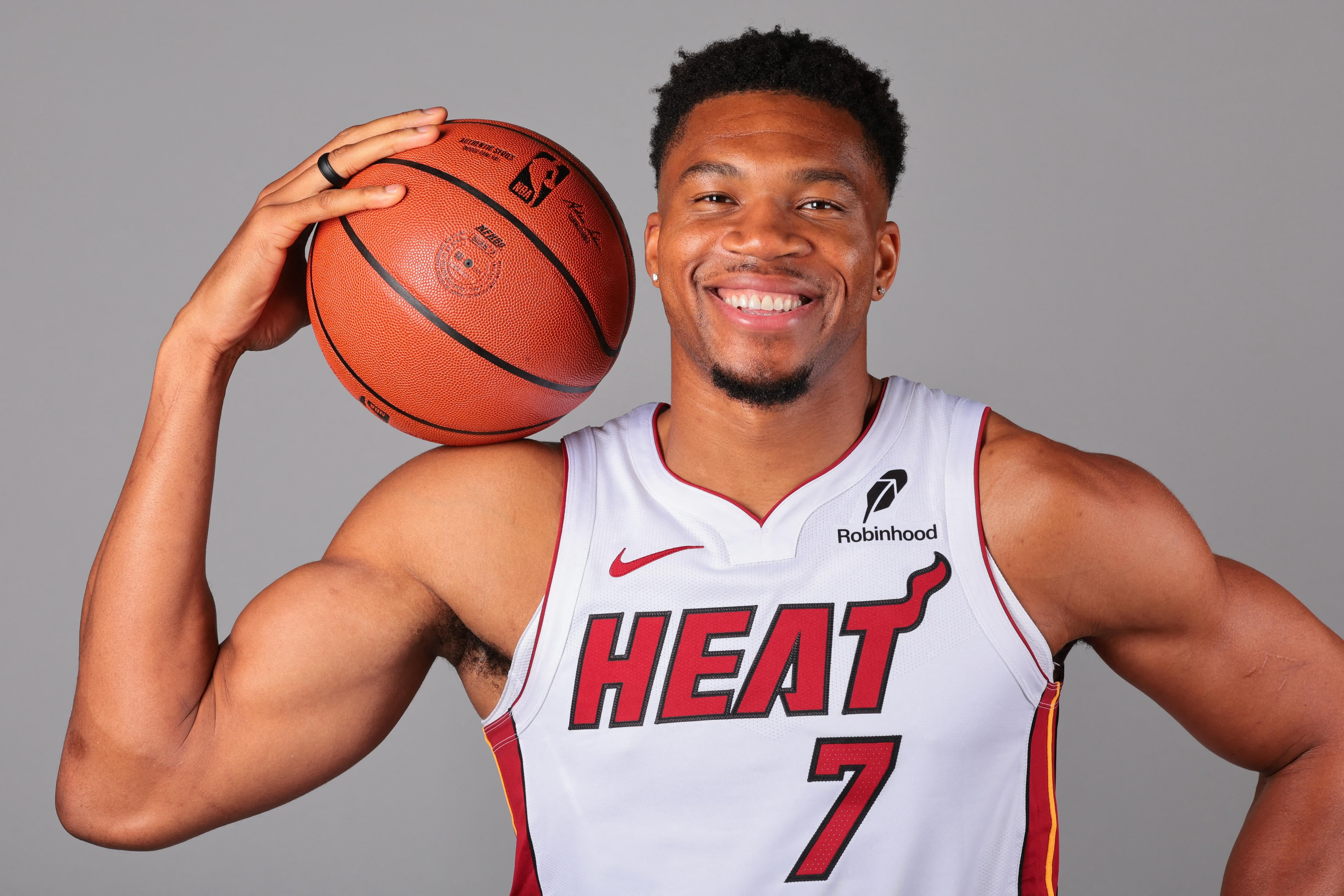
Ryan Conwell's 20-point contribution would have been a major subplot even without the frontcourt fireworks. The rookie reached that total on 12 shots and hit four threes in nine attempts. The Heat did not ask him to match Giannis' physical scoring or Adebayo's post touches. They needed someone who could punish a defense for turning its head toward the two biggest threats on the floor, then offer enough energy at the other end to remain in the rotation.
That is the difference between a promising shooting prospect and an immediately useful NBA role player. If Conwell only waits at the arc, Cleveland can try to recover to him late and live with some contested attempts. If he cuts, relocates and applies pressure to opposing ballhandlers, he changes where the defense must spend its attention. Miami played him for 32 minutes, a significant vote of trust for a rookie in a closely contested Cup game against a talented conference opponent.
Conwell's perimeter attempts mattered because Cleveland could not ignore the basket. The Heat won the points-in-the-paint battle 56-40 and collected 13 offensive rebounds to the Cavaliers' seven. Those extra possessions became a 21-4 edge in second-chance points. Such margins reduce the pressure to win a pure jump-shooting contest: a missed attempt can still end with another Miami touch, and a help defender who overcommits can surrender a putback or a short interior pass.
The defensive story requires more restraint. Cleveland scored 121 points, hit difficult perimeter shots and produced multiple runs. Miami's own analysis pegged the Cavaliers' offensive rating at 123.5 for the night, so describing this as a dominant defensive display would be misleading. Harden and Donovan Mitchell combined to keep Cleveland's offense dangerous, while Proctor's shooting repeatedly punished delayed rotations. The Heat leaned on zone looks at different stages to disrupt Cleveland's rhythm, but the success was uneven enough that the team still needed its offense to keep setting the pace.
GOATIFY
GOATIFY Basketball
Discover GOATIFY basketball gear as Conwell's development and NBA Cup stakes raise the heat in Miami.

Dwyane Wade G.O.A.T. - Basketball Casual Top Tee
A basketball fan design for everyday wear.
Shop Now ↗
LeBron James – Miami Heat GOAT Crewneck Sweatshirt
A basketball fan design for everyday wear.
Shop Now ↗

Dwyane Wade G.O.A.T. - Basketball Decal Sticker
Add basketball personality to your favourite gear.
Shop Now ↗

LeBron James G.O.A.T. - Greatest of All Hoodie
A basketball fan design for everyday wear.
Shop Now ↗Zone defense can create a useful temporary question for a team accustomed to attacking individual matchups. Cleveland had to recognize the open zones and move the ball into them, while Miami's guards had to cover ground on the outside before the next shooter caught the ball. Adebayo, in the middle, could deter direct attacks without being isolated in every screen action. But zones do not erase skilled shooters or prevent offensive rebounds automatically. In a different game, the same coverage could be punished by quick high-post decisions and extra passes.
The fourth quarter was where Miami's offense made the outcome less dependent on getting every stop. After Cleveland had erased several earlier leads, the Heat's combination of Adebayo's short-range attack, the returning pressure of Antetokounmpo and additional spacing allowed them to find reliable answers. A close game entering the final twelve minutes became a 133-121 win because Miami scored 41 in that quarter. The formula is exciting, but it also leaves Erik Spoelstra a clear challenge: make the defensive possessions less costly so the offense does not need extraordinary output every time.
The matchup has an important injury caveat. Mobley's absence removed one of Cleveland's most versatile interior defenders; the Cavaliers can construct a different assignment map when he is available. Miami, meanwhile, managed without Thompson and Larsson, so its own shooting and rotation options were not fully represented either. This was a meaningful result, not a definitive playoff simulation. It showed how one set of lineups could be pulled apart, but future meetings may demand new counters.
On the Cup table, the victory left Miami 2-0 in East Group B with group trips to Philadelphia and New York still on its schedule at the time of the win. Cleveland slipped to 1-1 and lost flexibility in the race for a knockout place. The point differential also mattered in a competition where tiebreakers can reward teams for continuing to score late rather than simply running out the clock. Those stakes help explain why both teams were still competing for possessions and margins well after the winner was becoming clear.
For Miami, the longer-term question is how much of Friday's offense travels. Seventy-four points from the bigs is exceptional. A rookie shooting four threes is helpful. The lasting sign would be the architecture: screening that forces decisions, a lead guard who reads the response, strong offensive rebounding and enough defensive discipline to convert those points into wins without needing to outscore opponents in every quarter.
Miami's 133-121 win will be remembered for the rare symmetry of two 37-point performances and the James-Wade comparison. It deserves that attention. Giannis and Bam were spectacular, especially once the Heat isolated favorable matchups and began converting from the middle of the floor.
But the repeatable story belongs to the connective pieces. Davion Mitchell supplied 17 assists against one turnover, Ryan Conwell gave Miami valuable shooting and pressure, and the team produced 37 assists while winning the interior and second-chance battles. That is how a pair of dominant players becomes the centerpiece of an offense rather than the entire offense.
Whether the Heat can keep finding those answers against healthier frontcourts, different pick-and-roll coverages and colder shooting nights will decide far more than one NBA Cup result. Friday supplied a convincing proof of concept. The next challenge is making that logic survive when the spectacular numbers do not.
GOATIFY
GOATIFY Basketball
Shop GOATIFY basketball shirts, hoodies and stickers.


Michael Jordan - GOAT Chicago Bulls Basketball Sweatshirt
A basketball fan design for everyday wear.
Shop Now ↗
Austin Reaves G.O.A.T. - Basketball Decal Sticker
Add basketball personality to your favourite gear.
Shop Now ↗
Jayson Tatum G.O.A.T. - Basketball - Greatest Hoodie
A basketball fan design for everyday wear.
Shop Now ↗
LaMelo Ball G.O.A.T. - Basketball Muscle Shirt Tank
A basketball fan design for everyday wear.
Shop Now ↗
Fat Luka Doncic Los Angeles Lakers NBA Mug
Add basketball personality to your coffee break.
Shop Now ↗