

Charlotte Hit 23 Threes. Then Its Rebounding Saved the Lead.
GOATIFYCharlotte had every reason to be cautious about its offense. The Hornets entered Monday night's November 9 meeting with Cleveland on a six-game losing streak and had made only 28.8% of their three-point attempts to that point in the season, one of the weakest marks in the NBA. Three starters were unavailable. Across the court stood a Cavaliers team featuring Donovan Mitchell, James Harden, Evan Mobley and Jarrett Allen. Nothing about that setup suggested an easy night.
Instead, Charlotte beat Cleveland 124-112 by making 23 of 46 threes, a 50% eruption that helped turn a one-point first-quarter advantage into a lead of 33 in the third. Grayson Allen scored 27, Naz Reid supplied 25 points and 13 rebounds, and a rotating cast of Hornets contributed long-range offense. Yet the final score conceals the strangest part of the game: the Cavaliers dragged that huge margin down to eight, forcing Charlotte to win a very different contest in the closing minutes.
The decisive ingredient was not another shooting burst. It was Ryan Kalkbrenner's work on the offensive glass. His career-high 15 rebounds included 10 at the offensive end, and two late extra possessions helped steady a team that looked capable of letting a monumental advantage slip. The story of Charlotte's win is therefore less about one hot shooting night than about how a thin rotation found two ways to score when only one was working.
Twenty-three threes turned a one-point edge into a rout
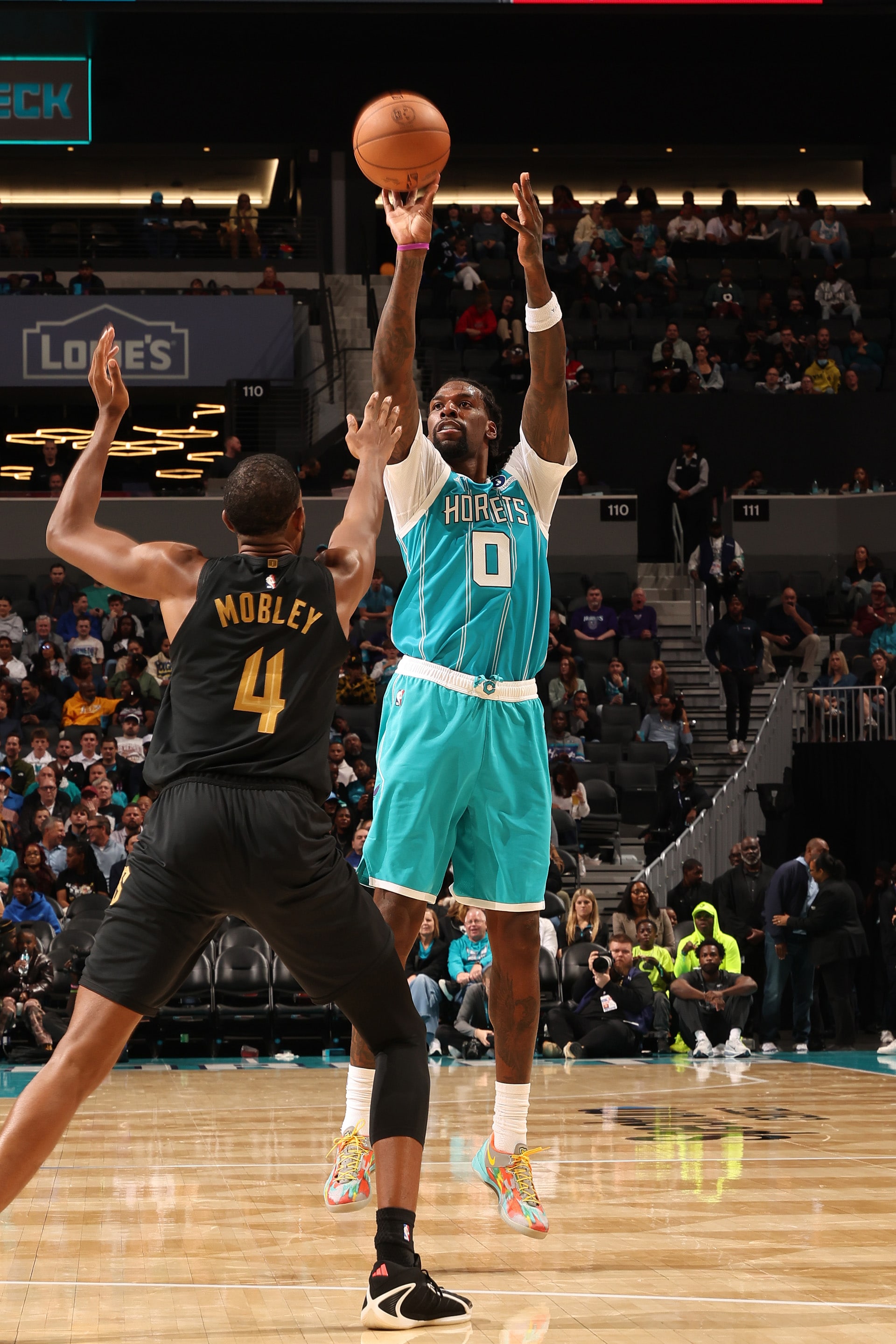
Naz Reid gave Charlotte a warning sign that this was not going to resemble the previous six games. He scored 15 points in the opening quarter and made Cleveland account for him both inside and behind the arc. The Hornets finished those 12 minutes ahead only 29-28, but the early production mattered: a team that had struggled to convert open jumpers finally had an aggressive scoring platform rather than spending the first period chasing a deficit.
Grayson Allen took that platform and widened it. He went 8-for-14 from the floor, 6-for-12 from three, and added six assists to his 27 points. Reid hit four threes of his own while finishing with 25 points, 13 boards and four assists. Their partnership was more than the familiar story of two shooters catching fire. Reid's range made it harder for Cleveland's front line to park near the rim, and Allen's combination of outside shooting and passing punished defensive adjustments that arrived a step late.
The second quarter changed the shape of the game. Charlotte made 14 of 24 field-goal attempts in that period, including seven of 12 beyond the arc, to lead 69-53 at halftime. A 40-point quarter against a Cavaliers lineup with established scoring names is not merely impressive because of the volume; it meant Cleveland could not comfortably play its preferred rhythm. Every empty trip threatened to turn into a two-possession problem.
Charlotte's final long-range line was startling precisely because the early-season baseline was so poor. The Hornets were shooting 28.8% from three entering the contest, but finished at 50% on high volume. They made seven more threes than their previous season high of 16. A team can occasionally shoot far above expectation, of course, and one game cannot erase a month of concerns. What separated this performance from a simple statistical outlier was the number of people involved and the quality of the ball movement behind it.
The Hornets assisted on 29 of 44 made field goals, their season high to that point. That suggests possessions were regularly ending with an available teammate rather than the offense depending on contested individual shots. Charlotte also got to its spots early in possessions, which kept Cleveland from settling into a stable defensive matchup on every trip. An offense built on movement can survive a cooler individual night better than an offense built on one player taking progressively harder attempts.
By the middle of the third, the advantage had reached 33. The hosts had gone from barely leading after one quarter to an apparent runaway against a team with much more recognizable headline talent. There was a real lesson in the explosion, but also a warning: the same reliance on three-point volume that creates a giant lead can make an offense vulnerable when the makes stop. The fourth quarter would test whether Charlotte had another answer.
GOATIFY
GOATIFY Basketball
Charlotte's unexpected 23 three-pointers have NBA fans talking — find basketball shirts, hoodies and stickers in GOATIFY Basketball.

Alperen Sengun G.O.A.T. - Houston Rockets Hoodie
A basketball fan design for everyday wear.
Shop Now ↗
Ja Morant G.O.A.T. - Basketball - Memphis Sweatshirt
A basketball fan design for everyday wear.
Shop Now ↗
Kobe Bryant Mamba G.O.A.T. - Basketball Decal Sticker
Add basketball personality to your favourite gear.
Shop Now ↗
Anthony Edwards G.O.A.T. - Basketball Muscle Tank
A basketball fan design for everyday wear.
Shop Now ↗
Jayson Tatum G.O.A.T. - Basketball Casual Top Tee
A basketball fan design for everyday wear.
Shop Now ↗
Magic Johnson G.O.A.T. - Basketball - Greatest Sweatshirt
A basketball fan design for everyday wear.
Shop Now ↗Without three starters, Charlotte found a different rotation
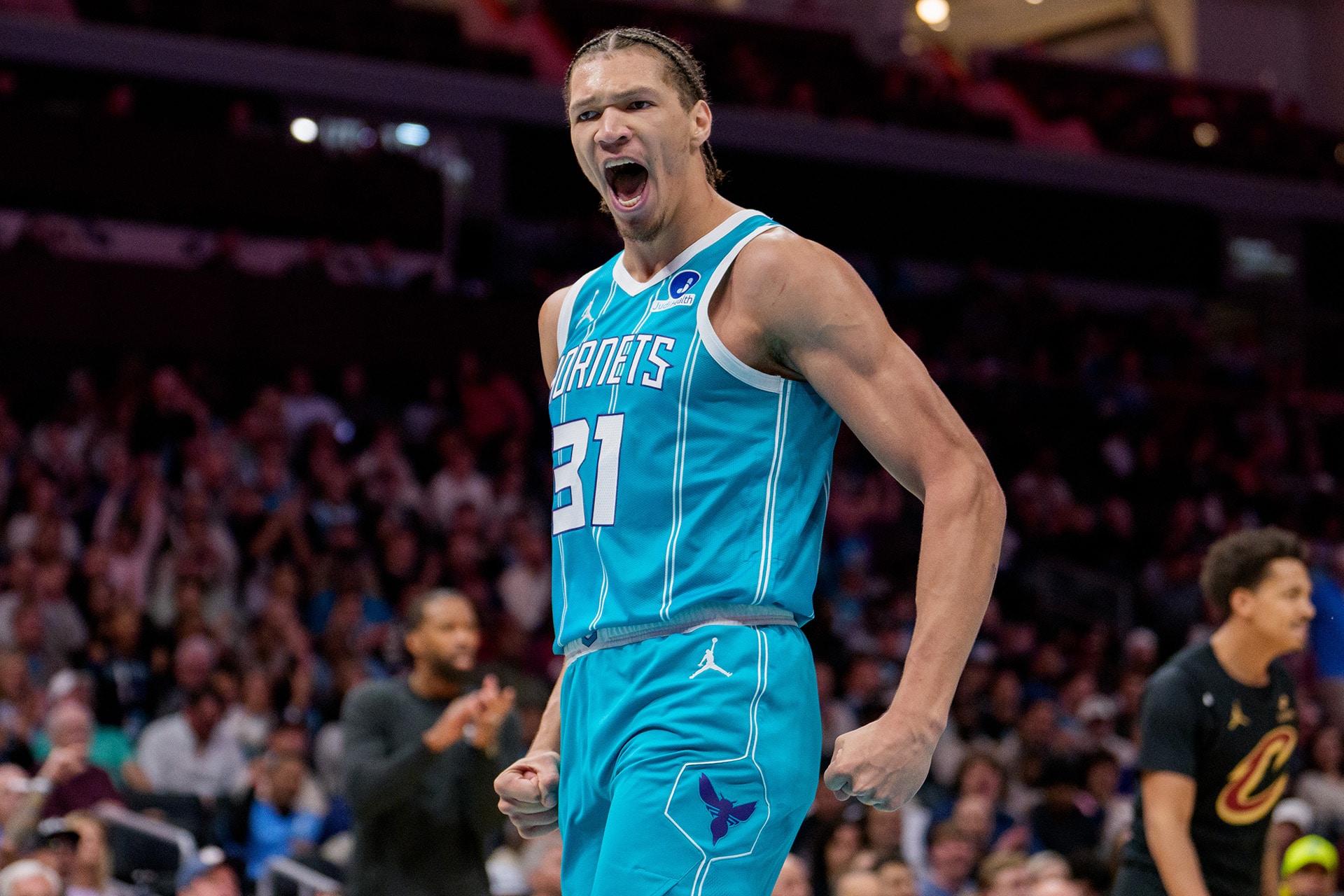
This was not Charlotte at full strength. Brandon Miller was sidelined with a hip strain, Kon Knueppel had a hamstring issue, and Moussa Diabaté was missing with a quadriceps problem. The Hornets were also without additional rotational depth. For Charles Lee, that meant shifting responsibilities across a lineup that could not count on its usual offensive balance or center rotation.
Tidjane Salaün made the greatest argument for treating that disruption as an opportunity. Every one of his 14 points came in the second quarter, when Charlotte transformed a tight contest into a 16-point halftime lead. He shot four of six overall and three of four from deep, providing the kind of burst a depleted team rarely knows it has until the game begins. The value was not simply the extra points. His confidence stretched the floor while Allen and Reid were already forcing Cleveland to respect multiple scoring threats.
Sion James added 11 points and hit three of six three-point attempts, including three important makes during Charlotte's third-quarter separation. Coby White did not have an efficient shooting night, going 3-for-12 overall and scoreless on four three-point tries, but his nine assists helped keep other players supplied. That distinction is important. If Lee had needed every contributor to be a hot shooter, Charlotte would have been vulnerable almost immediately. Instead, White could still organize possessions while more efficient teammates finished them.
The team's bench numbers also showed how a promising possession can become several different options. Royce O'Neale scored 10 and would deliver a pivotal late three. Christian Anderson Jr. supplied nine points on three made long balls. Liam McNeeley was perfect on three field-goal attempts and scored eight. No single reserve needed to match Allen's 27. The collective spread kept Cleveland searching for the next weak link rather than attacking a predictable second unit.
There are reasonable limits to how much can be claimed from the night. A 50% three-point game does not prove that Charlotte has solved its shooting, especially when the club's season-to-date accuracy had been among the league's worst. And an injury-hit rotation may not repeat the same distribution once Miller, Knueppel and Diabaté return. The useful finding is narrower: Charlotte created quality looks without waiting for the absent starters, and several players who do not normally dominate the box score responded when asked to carry more.
Lee's emphasis after the game was not solely on made jumpers. The coach praised his players' defensive intensity and the commitment behind it, even while acknowledging that better shooting had finally arrived. That matters because defense and movement are the more repeatable habits. The shooting can swing violently from night to night; a group that keeps defending and passing has more paths to staying competitive when its jumpers return to an ordinary percentage.
GOATIFY
GOATIFY Basketball
Charlotte's patchwork rotation delivered a memorable win — explore the GOATIFY Basketball collection for more fan favourites.

LaMelo Ball G.O.A.T. - Basketball Decal Sticker
Add basketball personality to your favourite gear.
Shop Now ↗
Domantas Sabonis GOAT - Basketball - Greatest Sweatshirt
A basketball fan design for everyday wear.
Shop Now ↗
LaMelo Ball G.O.A.T. - Basketball Casual Top Tee
A basketball fan design for everyday wear.
Shop Now ↗

LaMelo Ball G.O.A.T. - Basketball - Greatest Hoodie
A basketball fan design for everyday wear.
Shop Now ↗
LeBron James G.O.A.T. - Greatest of All Mug
Add basketball personality to your coffee break.
Shop Now ↗Kalkbrenner's ten offensive boards stopped the comeback
Charlotte's largest lead was 33, but Cleveland did not let the final quarter become ceremonial. The Cavaliers' reserves brought urgency, while the Hornets' shooting cooled sharply. Charlotte managed only 17 fourth-quarter points after putting up 40 in the second and 38 in the third. Cleveland scored 32 in the last period and, in one stretch spanning late in the third into the fourth, assembled a 43-18 push that changed the atmosphere from comfortable celebration to genuine danger.
With roughly four minutes remaining, the margin had fallen to 118-110. Cleveland had trimmed the gap to eight even though Kenny Atkinson kept his reserves on the floor throughout the fourth. Rookie Meleek Thomas ultimately led the Cavaliers with 18 points, including four threes, and supplied the clearest sign that their bench had more energy than the starters had shown. James Harden and Donovan Mitchell had only 11 points apiece; neither played in the fourth, and the two combined for 22 points on seven makes in 20 field-goal attempts.
The seemingly contradictory numbers explain why Charlotte needed a second route to victory. Cleveland shot 51.2% from the field, better than Charlotte's 47.3%, and produced more points in the paint. Yet the Cavaliers lost the rebounding battle 49-32. Charlotte grabbed 17 offensive rebounds to Cleveland's four, and its second-chance points advantage was 20-7. That is an enormous supply of additional opportunities, particularly for an offense capable of hitting threes after a miss and reset.
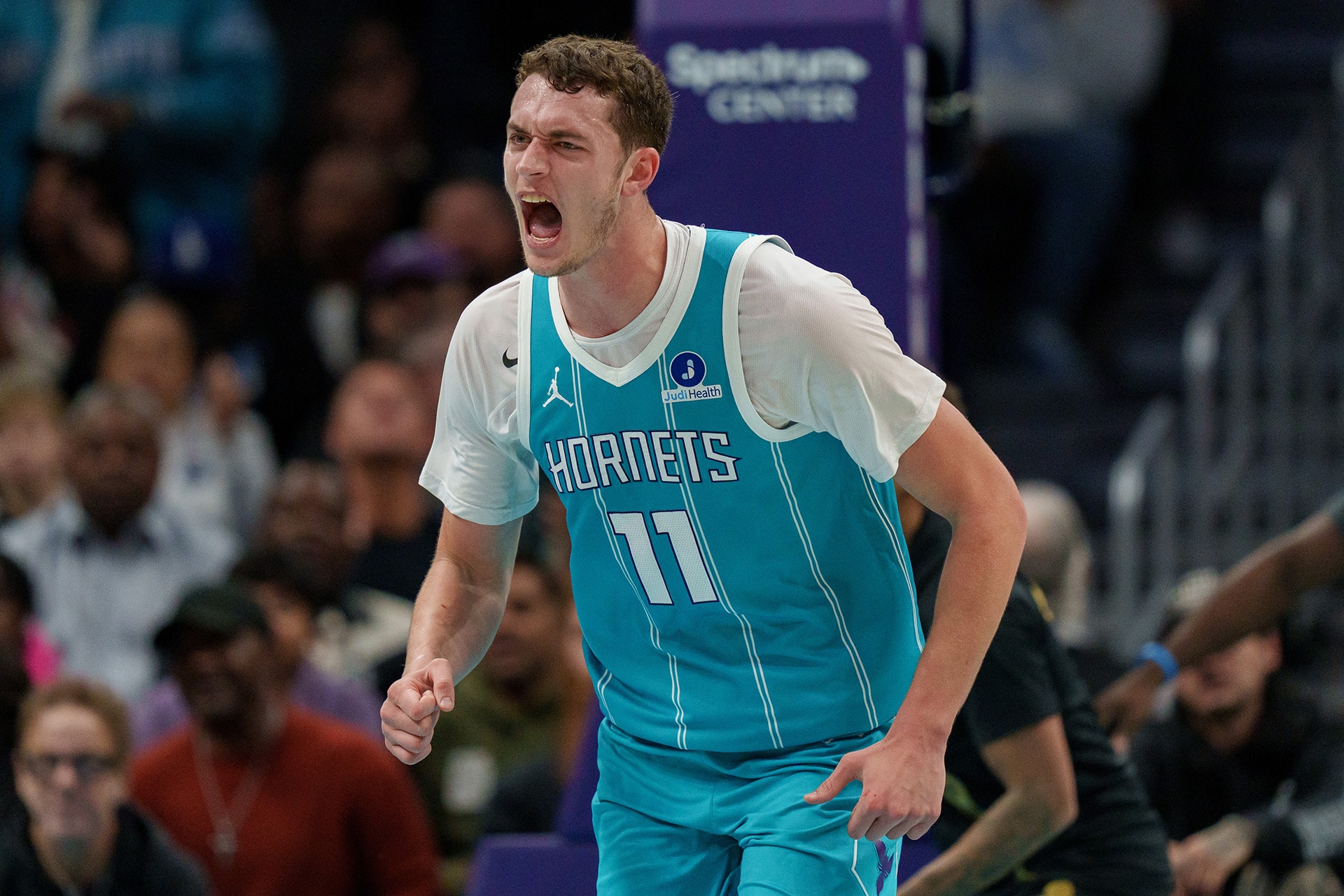
Ryan Kalkbrenner was the defining figure in that phase. Starting in the absence of Diabaté, he recorded eight points, three blocks and 15 rebounds, 10 of them offensive. The 10 offensive boards were a career high, and the figure stands out because Cleveland's entire team managed only four. It was a reminder that a center can influence a win without needing a double-figure scoring total. Kalkbrenner did not lead Charlotte in points or shooting highlights, but he made the other scorers' misses less costly.
At the moment Cleveland appeared to have found a route back, two of Kalkbrenner's offensive rebounds helped create five consecutive second-chance points. Charlotte reclaimed enough breathing room to stop the comeback becoming a final-minute possession-by-possession race. Royce O'Neale then made the right-wing three that pushed the advantage back to 13 with a little under three minutes left. Those plays did not look as spectacular as the long-range barrage that built the big lead; they were more important to ensuring it remained a win.
The mismatch on the glass also invites a sober question for Cleveland. Jarrett Allen and Evan Mobley collected just nine rebounds between them, with Mobley held to two. That was a difficult outcome for a team relying on two imposing interior players, especially with Charlotte missing its usual starting center. Cleveland can point to its bench response as encouraging, but the gap in extra possessions made the comeback much harder than the shot percentages alone suggest.
The next tests are immediate and different. Cleveland heads to New York for a Wednesday meeting with the Knicks, where controlling the backboards will be an obvious area of scrutiny. Charlotte opens a four-game trip Thursday in Phoenix. The Hornets do not need another 23-three night to take something useful from this victory. They need to carry over the willingness to share the ball, crash the glass and find scoring from players who were not first on the scouting report.
GOATIFY
GOATIFY Basketball
From Naz Reid's 25 points to Kalkbrenner's 10 offensive boards, this win belongs to the whole Hornets lineup — browse GOATIFY Basketball designs.

Damian Lillard G.O.A.T. - Basketball - Sweatshirt
A basketball fan design for everyday wear.
Shop Now ↗
Luka Doncic G.O.A.T. - Basketball - Greatest Hoodie
A basketball fan design for everyday wear.
Shop Now ↗

Fat Luka Doncic Los Angeles Lakers NBA Sticker
Add basketball personality to your favourite gear.
Shop Now ↗
Jalen Brunson – Captain Clutch Muscle Shirt Tank
A basketball fan design for everyday wear.
Shop Now ↗
Ja Morant Gun Suspension Memphis Grizzlies NBA Sticker
Add basketball personality to your favourite gear.
Shop Now ↗Charlotte's 124-112 win belongs in the category of improbable nights: 23 threes, a lead that reached 33, and a six-game losing streak finally ending despite three missing starters. Allen and Reid provided the headline numbers, and Salaün showed why a deeper rotation can matter even when the injury list is long. But Kalkbrenner's 10 offensive rebounds are the detail that makes the result more interesting than a shooting story.
The Hornets were nearly punished for assuming their early explosion had settled everything. Cleveland's fourth-quarter surge exposed how quickly the rhythm can reverse. Charlotte answered with effort, extra possessions and one timely shot rather than simply hoping its three-point percentage would rebound. It was one win, not proof of a repaired season. Still, it supplied a blueprint worth testing on the road: use movement to create the first chance, and make sure the possession does not end when that chance misses.



















