

Libaak Won a World Cup With Augsburger. Now They Face Off in Dubai's Final.
GOATIFYTwo years ago, Tino Libaak and Leo Augsburger stood together on a world championship court and delivered the point Argentina needed to beat Spain. On Sunday in Dubai they will be on opposite sides of the net. It is an extraordinary turn for two players whose partnership supplied one of padel's defining national-team moments.
Libaak, now 21, reached his first Premier Padel final on Saturday, November 14, partnering Gonzalo “Gonza” Alfonso to beat Javi Garrido and Juan Ignacio De Pascual 6–1, 6–4. Their reward is a Dubai P1 title match against Juan Lebrón and Augsburger, who advanced with a 6–4, 6–2 semifinal victory. The scorelines look comfortable, but the backstory makes this anything but an ordinary final.
There is also a practical prize beyond Sunday's trophy. A run that began as an exciting partnership only months ago has brought both Argentinians closer to the 16-player field at Barcelona's year-end Finals. Here is what changed in Dubai, why the matchup is more dangerous for the favorites than the seed numbers suggest, and what remains at stake.
A 6–1 first set, then one break when it mattered

The immediate story is simpler than the history: the No. 10 seeds played the sharpest match of their week when they needed it most. Garrido and De Pascual arrived in Saturday's semifinal with an impressive list of victims. They had beaten fifth seeds Mike Yanguas and Coki Nieto in a tight three-set round of 16, then removed third seeds Franco Stupaczuk and Jon Sanz 6–1, 7–5. De Pascual had reached his first Premier Padel semifinal, and Garrido's difficult season had suddenly produced a late surge.
Those results made this a genuine test rather than a ceremonial semifinal. Garrido and De Pascual had beaten established pairs by defending stubbornly and taking chances to attack. Yet the opening set against Libaak and Alfonso lasted only seven games. The Argentinians raced to a 6–1 lead, forcing their opponents to solve problems from deep in the court instead of allowing them to choose the direction of rallies.
Libaak's work at the net was central. Reporting from the match described his effective volleys and overhead aggression, while Alfonso helped make the exchanges uncomfortable for the opposing pair. One attempt to change the pattern was to direct more high balls toward Alfonso. It did not deliver sustained relief: the Argentinians repeatedly reclaimed initiative, leaving Garrido and De Pascual defending from positions they had hoped to escape.
There is an important distinction between pressure and pure shot-making. A spectacular smash wins a highlight; repeatable court position makes a straight-sets semifinal possible. The first set suggested Libaak and Alfonso were not simply hitting harder. They were giving their rivals fewer sequences in which to build a controlled attack. That is the sort of difference hidden behind an apparently one-sided 6–1.
The second set offered a more serious examination. Garrido raised his level and defended more effectively; De Pascual found greater consistency and the teams remained close through 4–4. The contest might have moved toward a tie-break, but the Argentinian pair earned the critical late break. With a chance to serve out the match, they held their nerve rather than letting a tougher period undo the first-set advantage.
GOATIFY
GOATIFY Padel
A clinical 6–1, 6–4 semifinal gave Libaak and Alfonso their shot at the Dubai title. Explore GOATIFY's dedicated Padel-filtered fan collection.


The final score was 6–1, 6–4 in roughly an hour—an unusually efficient finish for two pairs that had fought through demanding previous rounds. That efficiency matters before a title match: Libaak and Alfonso will arrive having spent less energy on Saturday than they did in their three-set quarterfinal against Jairo Bautista and Lucas Bergamini, which required a deciding tie-break.
Garrido and De Pascual should not disappear from the story as footnotes. Their defeat does not erase two significant upsets or De Pascual's first semifinal appearance. It establishes how much more convincing Libaak and Alfonso were on the day. The surprise pair's run ended; another ostensibly unfancied partnership took the final berth.
A world-title partner is now the man he must beat

What makes the Dubai men's final unusually personal is not an invented feud. It is a shared achievement. At the 2024 FIP World Cup in Doha, Libaak and Augsburger played together for Argentina and won the decisive point against Spain. They were younger players entrusted with a title-defining moment, and they delivered. It was a powerful image of two Argentinian prospects arriving on the international stage together.
By November 2026 their career paths have separated. Libaak plays with Alfonso, the creative left-side player whose strengths complement the younger man's speed and attacking instincts. Augsburger now lines up alongside Spain's Juan Lebrón, a former world No. 1 with the experience to manage the pressure of a Premier Padel final. The same two Argentinians who once combined their skills will now be trying to read and defeat one another's patterns.
Libaak and Alfonso already have evidence that the matchup is manageable. They met Lebrón and Augsburger at Madrid P1 in September and won 7–6, 7–5. That was not a random exhibition result: it came in the round of 16 of a major tour event. Their control of important late games mattered more than any suggestion that the higher-ranked pair simply played badly.
They met again at the Kuwait Major in October. This time Lebrón and Augsburger won the opening set 6–4. Libaak and Alfonso stayed with them, overturned the contest 7–5 in the second and completed the comeback 6–1 in the decider. Two matches, two wins for the lower-seeded pair; one through two close sets, the other through a recovery after falling behind.
Those head-to-head scores cannot guarantee a third victory. A final changes the rhythm of a day, and Lebrón brings considerably more title-match experience. Still, the record means the No. 10 seeds are not entering the championship match with only hope or momentum. They have beaten this exact partnership twice under tour conditions. Lebrón and Augsburger know that any early advantage could be challenged.
There is an extra twist in the most recent World Cup. Argentina fell to Spain in the 2026 team final, with Libaak and Alfonso involved in the deciding defeat. Augsburger, once Libaak's partner in the championship-winning point of 2024, is also part of the evolving Argentinian national-team story. The 2024 triumph remains a shared fact; Sunday's Dubai final is a different test, with different teammates, two years of development and a title on the line.
GOATIFY
GOATIFY Padel
From a 2024 World Cup title together to a 2026 Premier Padel final against each other: discover GOATIFY's Padel fan apparel.
Rather than treating the former teammates as opponents who suddenly know everything about one another, the more useful question is how each has adapted. Libaak's ability to take the ball early can keep pressure on Lebrón; Augsburger's reach and power threaten any short ball. Alfonso's variation may change where the ball travels. That is analysis based on their established styles, not a claim that any specific tactic has already been chosen for the final.
Dubai is worth more than a trophy to the Barcelona chase

For Libaak, this is his first Premier Padel final. For Alfonso, it is his third individual appearance in a tour final: he reached the 2025 Gijón and Cancún finals alongside Tolito Aguirre. That correction matters because some headlines have treated Saturday as a first final for both men. It is a first for their current partnership and for Libaak personally, but Alfonso arrives with memories of previous attempts at this level.
Their progress has not been linear or confined to one unexpectedly open draw. They paired up in 2026 and captured two FIP Silver titles together, at Porto Sant'Elpidio in August and Budapest in September. Those trophies are valuable evidence that a fresh combination can win consecutive matches, but they are not Premier Padel titles. The distinction explains why a Dubai P1 breakthrough is a substantial next step.
The higher-level results gradually followed. Quarterfinal appearances in Rotterdam, Düsseldorf and Milan, followed by a Kuwait Major semifinal, gave the partnership a more reliable baseline. In Dubai they first came through a difficult three-set quarterfinal against Bautista and Bergamini, 4–6, 6–3, 7–6, before the efficient win over Garrido and De Pascual. There is a pattern here: the pair can survive adversity but also dictate a match when the opportunity comes.
The payoff reaches the season-ending Premier Padel Finals in Barcelona. The Finals select the top 16 players by the relevant FIP Race. According to Premier Padel's Saturday update, the Dubai final already guarantees each Argentinian at least 600 points; Alfonso has moved into the provisional qualifying positions while Libaak is reported to be about 70 points short. Those are point-in-time calculations, not a promise of qualification: later events and other players' results can move the cut line.
There is still the Mexico Major and another FIP opportunity before the year-end field is settled. Winning in Dubai would add more points and could alter how aggressively the pair must approach the remaining calendar. Reaching the final has already changed the arithmetic. The result against Lebrón and Augsburger could change the level of pressure on each player over the next fortnight.
The favorites have an opportunity of their own. Lebrón and Augsburger beat the surprise Italian–Argentinian pairing of Flavio Abbate and Franco Dal Bianco 6–4, 6–2 on Saturday. Abbate was the first Italian to reach a Premier Padel P1 semifinal, and his partnership had become one of the tournament's stories. The more experienced No. 2 seeds halted that run before it could produce another upset.
Lebrón and Augsburger have reached several finals together in 2026 and lifted a title in Brussels. With leading pair Coello and Tapia absent from the Dubai draw, Sunday offers a rare chance to win a final without those world No. 1s across the net. But the familiar alternative is not necessarily easier: Libaak and Alfonso have already beaten them twice. Dubai presents a genuine collision between the favorite's experience and the challenger pair's specific matchup success.
GOATIFY
GOATIFY Padel
Alfonso and Libaak are chasing both a Dubai trophy and year-end Finals places. Browse the Padel collection for fans of the sport.
The women's final adds another former-partner subplot
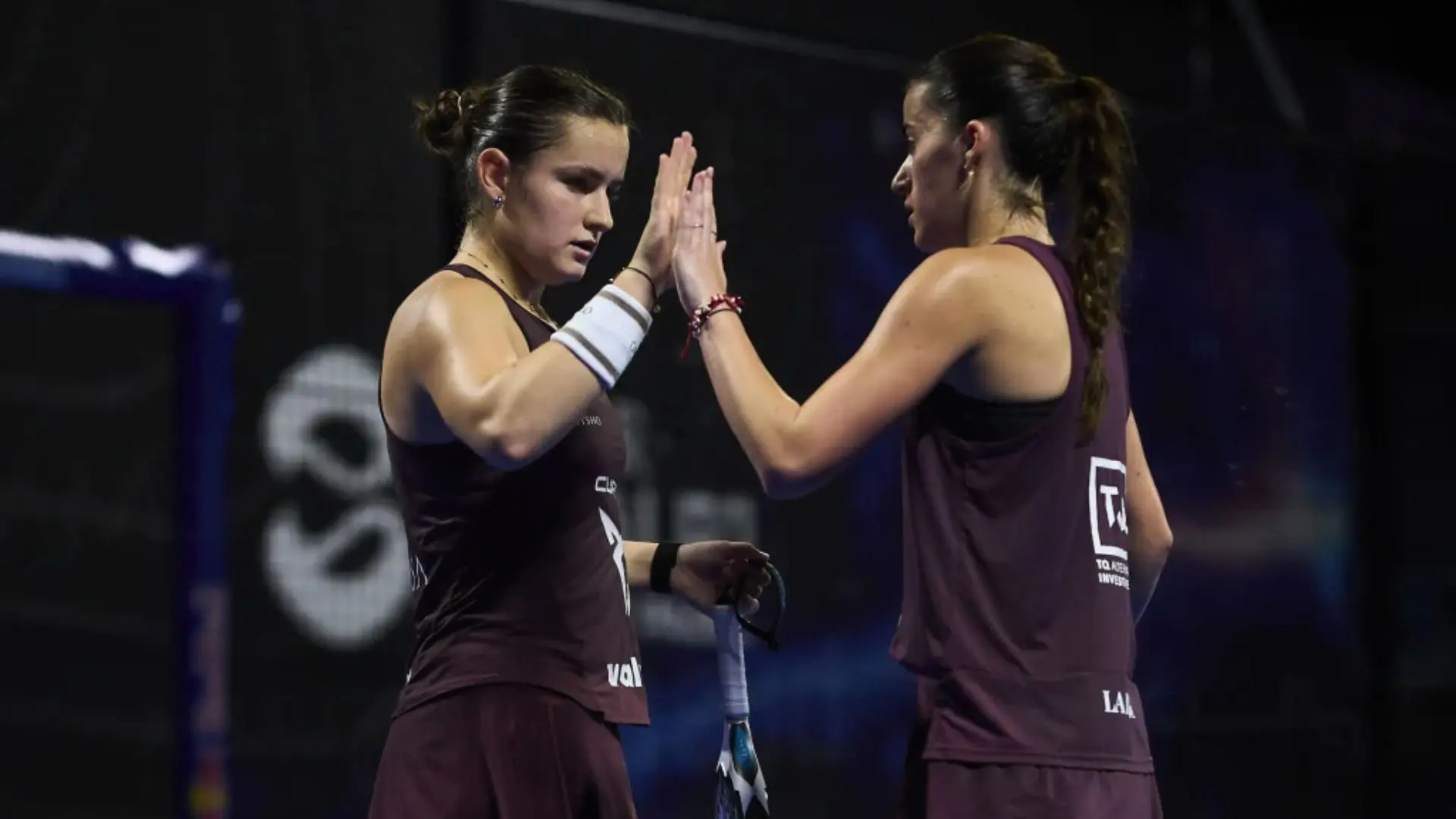
The men's story may dominate headlines, but Dubai's women's final offers a different variation on the same theme: success with one partner followed by a direct contest against her. Bea González will seek a third consecutive Dubai P1 title. She won in 2024 with Delfi Brea and in 2025 with Claudia Fernández. On Sunday Fernández will be on the opposite side of the net, partnering the young Martina Calvo.
González and current partner Paula Josemaría booked their place with a 6–4, 7–5 semifinal win over Ari Sánchez and Andrea Ustero on Saturday. That score also ended an uncomfortable recent run in the matchup. Josemaría and González were not simply favored on reputation; they had to reverse a head-to-head trend that had become a defining feature of the late season.
Fernández and Calvo reached the final more emphatically, beating Tamara Icardo and Claudia Jensen 6–3, 6–1. Icardo and Jensen had delivered one of the tournament's most consequential shocks by eliminating top-ranked Gemma Triay and Delfi Brea in the quarterfinals. The semifinal showed that a breakthrough upset does not automatically translate into a title run. Fernández and Calvo stopped it.
Those results also matter for the rankings and season narrative. Josemaría and González have been chasing the leading pair through 2026; Sunday's title would be another milestone for their partnership. Fernández and Calvo, by contrast, are trying to convert their run of strong late-season performances into a third tour title together after victories in London and Düsseldorf. Neither pair can secure the trophy through the other's past achievements.
According to the official FIP order of play, the women's final is scheduled to start at 6 p.m. Dubai time on Sunday, November 15, with the men's final listed for not before 8 p.m. local time. Actual start times can shift with match duration or tournament changes. This article is a pre-final analysis, not a report of either final's result.
That is the distinctive shape of Dubai's concluding day: two doubles finals, two stories about old partnerships, and several different reasons to care about the outcomes. Libaak and Augsburger were world-title partners; González and Fernández were Dubai champions together. Each must now treat a familiar face as the opponent between them and a new trophy.
By the end of Sunday, one pair will be holding the Dubai P1 trophy, but the result will not erase the bigger story. Libaak has broken through to his first Premier Padel final; Alfonso has found a partner with whom his unusual path to the top level makes competitive sense; and Augsburger now has to beat the man beside whom he once won Argentina a world title.
The men's final is scheduled for not before 8 p.m. Dubai time on November 15, 2026, after the women's championship match. Until those finals are played, the title and the last part of the ranking equation are undecided. The verified results already explain why this Dubai weekend matters.
GOATIFY
GOATIFY Padel
Shop GOATIFY padel products from the Padel-filtered collection scope.


















