

Wawrinka's Last Backhand Goes Wide — Basel Gives Stan His Goodbye
GOATIFYStan Wawrinka's last shot as a professional tennis player was the stroke that made him famous. His one-handed backhand flew wide, Jiri Lehecka had won 7-5, 7-6(2), and 9,200 spectators in Basel rose to applaud a player whose greatest victories came against the giants of his generation. At 41, after a career stretching back to 2002, the three-time Grand Slam champion had finally reached the ending he had chosen.
The result on October 27 was a first-round defeat at the Swiss Indoors. The occasion was much bigger. Wawrinka had spent his final season saying goodbye without surrendering his competitive instincts, and his last match offered both: flashes of the backhand that changed major finals and the stubborn resistance of an opponent determined to win. The score records a loss; the night told a more complicated story.
The Last Backhand: 9,200 Fans Watch Wawrinka's Final Point

There was no mystery about where Wawrinka wanted his career to finish. Basel had hosted him through the early stages of his rise, through his Grand Slam years and through the more demanding seasons when victories became harder to collect. His 19th appearance was planned as the last. Yet knowing the destination did not make the final moments predictable. The Swiss veteran still had to face a seeded opponent who had every sporting reason to ruin the farewell.
The St. Jakobshalle crowd greeted Wawrinka with a standing ovation before the first ball. Applause returned during introductions and again as the contest tightened. At 3-2 in the opening set, music briefly gave the evening the feel of a celebration, but the match itself was fiercely competitive. Wawrinka served with purpose, found familiar angles on his backhand and refused to play as though the audience had bought tickets to a ceremony rather than a tournament.
The last point arrived at approximately 11:01 p.m. local time. After nearly two hours of play, a backhand missed its target and Lehecka completed a straight-sets victory. For a player whose single-handed backhand had so often produced the decisive blow, the symmetry was almost unbearably neat. It would be tempting to treat that miss as a verdict on the end of his career. It was only one stroke in a match in which the 41-year-old remained capable of testing a leading younger professional.
Wawrinka had announced in December 2025 that 2026 would be his final season, so this was not a sudden injury-forced exit. The announcement gave supporters time to watch him one last time in Australia, Paris and elsewhere. That long farewell also placed a peculiar pressure on each tournament: every appearance carried the possibility of becoming a final memory. In Basel, the uncertainty was removed. This was the designated finish, whatever the scoreboard said.
After match point, the spectators did not behave as though their evening had been spoiled. They stood, applauded and chanted their thanks while Wawrinka acknowledged the stands and the people who had accompanied him. The crowd had witnessed his 985th tour-level singles match, according to the Swiss tournament's account. The number conveys endurance; the sustained ovation conveys what that endurance meant to the people watching.
Tennis endings are usually dictated by the next opponent, the next draw or a body that refuses to cooperate. Wawrinka was fortunate enough to choose a final stage and competitive enough to make the farewell a real match. The last backhand went out. The emotional significance of everything before it remained intact.

Lehecka Had to Beat a Legend and an Entire Arena

Lehecka's job was less sentimental than Wawrinka's. The Czech, 24, arrived as the eighth seed and a player ranked around No. 21 in the world. He had already reached significant finals in 2026, including Miami and Tokyo, and his combination of a heavy serve and forceful forehand made him a dangerous indoor opponent. Facing a retiring champion in a packed Swiss arena was emotionally unusual, but it did not alter his responsibility to compete.
The opening set offered Wawrinka only a narrow route through. He served well enough to stay close, but Lehecka protected his own delivery and saved the two break points the Swiss created at 1-1. Those opportunities mattered because Wawrinka did not have many more chances to impose himself on return. With the scoreboard moving toward a tiebreak, Lehecka struck at 5-5, earned the crucial break and served out the set 7-5.
That sequence explains why the defeat was not simply a story about age. Wawrinka was still able to put the ball in awkward places and hold serve for long stretches. The difference was that Lehecka managed the few moments in which the match could turn. A player in his mid-twenties does not automatically beat a 41-year-old champion; he still needs to find the right shot under pressure, especially with an entire building willing his opponent forward.
The second set carried the greatest possibility of a final twist. Wawrinka reached 5-4 and 30-30 on Lehecka's serve, two points from forcing a deciding set. The crowd responded with a wave of noise and expectation. One short burst of clean returning could have prolonged his career by another set, perhaps even another match. Lehecka resisted, held and kept the contest on his own terms.
The eventual tiebreak was more decisive than the games that preceded it. Lehecka took it 7-2, closing a match that had been competitive on serve but increasingly unforgiving at the important moments. Wawrinka's occasional spectacular backhands were reminders of what he could still do. Lehecka's ability to survive them and keep winning the next point was the difference between admiration and advancement.
There is a useful distinction between winning a farewell match and playing the villain in someone else's story. Lehecka did neither for show. He respected the moment while playing the match honestly, and that gave Wawrinka's final performance its sporting credibility. A ceremonial victory would have been hollow. A genuine contest against a strong contemporary opponent made the goodbye more meaningful, even in defeat.
Three Grand Slams, Three World No. 1 Victims: Stan's Defining Legacy

Wawrinka's career cannot be reduced to his place in a ranking table. He reached world No. 3, collected 16 tour-level singles titles and spent much of his prime competing in the same era as Roger Federer, Rafael Nadal and Novak Djokovic. Those three names dominated the biggest tournaments for years. Wawrinka still found a way to take three major trophies, and the opponents he defeated in the finals make the achievement especially striking.
The breakthrough came at the 2014 Australian Open. Wawrinka defeated Nadal in the final, capturing his first Grand Slam title at an age when many observers had already formed a settled opinion of his ceiling. His career had been successful before Melbourne, but that result changed the scale of his ambitions. He had demonstrated that a player outside the sport's dominant trio could win the highest-stakes matches rather than merely trouble the favorites.
At Roland Garros in 2015, Wawrinka beat Djokovic in the final with the sort of bold baseline hitting that made his backhand one of tennis's most recognizable weapons. Djokovic was the world's leading player and an overwhelming presence across the season, but Wawrinka's ability to redirect the ball and strike through the court upset the expected hierarchy. It was not simply that he hit hard. He found enough depth and conviction to keep attacking when defensive tennis would have seemed safer.
The 2016 US Open completed the extraordinary three-title sequence. Djokovic was again the opponent in the final, and Wawrinka again emerged as champion. Winning one major against a member of the Big Three could be described as a breakthrough. Winning three majors across three different surfaces and defeating the world No. 1 in each final established a more durable reputation: when his game peaked, he could defeat almost anyone in a championship match.
The backhand became the signature image of that reputation, but his achievements were broader. He partnered Federer to Olympic doubles gold in Beijing in 2008 and contributed to Switzerland's first Davis Cup triumph in 2014. He also won the Monte-Carlo Masters in 2014 by defeating Federer in the final. Those victories showed a player who could succeed alongside his celebrated compatriot and, on the right day, defeat him.
His long collaboration with coach Magnus Norman helped turn enormous shot-making talent into a more complete championship identity. The trophies were not the result of an uninterrupted run of dominance, and Wawrinka never needed to pretend otherwise. His career included injuries, surgery, difficult returns and seasons spent rebuilding outside the spotlight. That uneven path is part of why the three major titles remain so impressive: they were earned in the narrow windows when preparation, belief and execution aligned.

Basel Never Gave Wawrinka a Trophy — It Gave Him Something Else
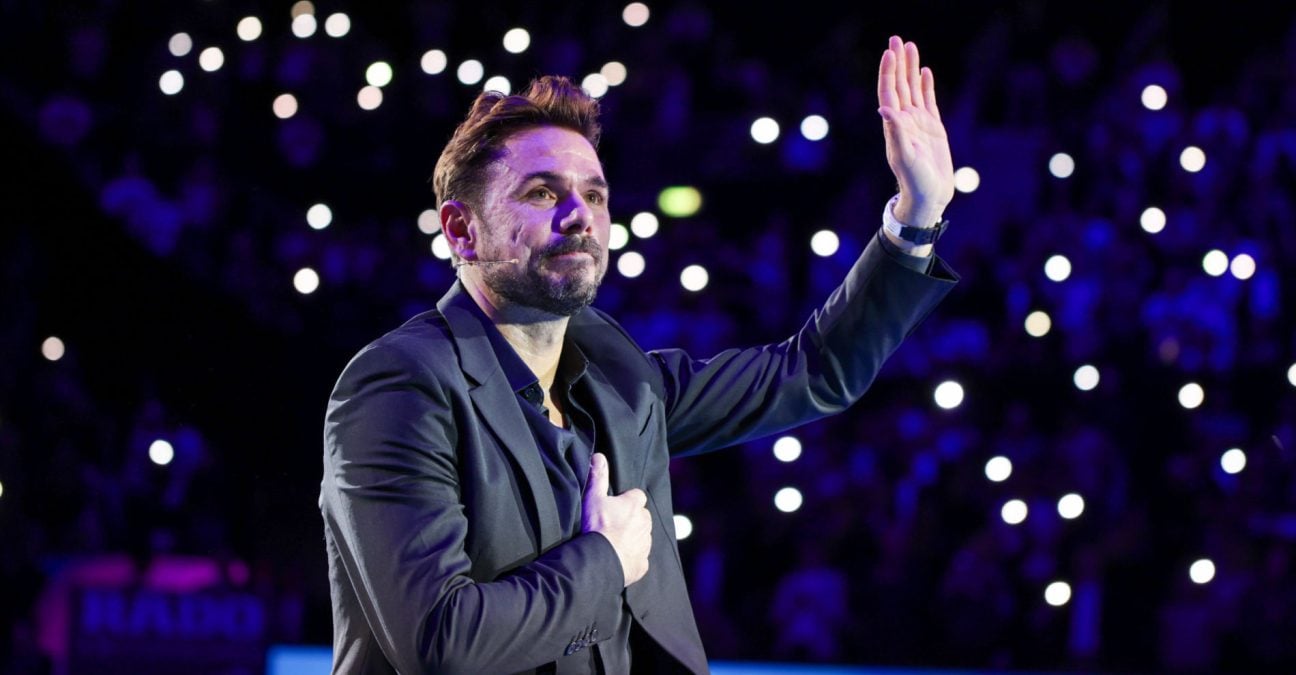
Basel was an obvious choice for the last tournament and an unusual one if the decision were based on trophies. Wawrinka never won the Swiss Indoors singles title. His best results there were semifinal appearances in 2006 and 2011, and he endured numerous early defeats. The record is hardly the résumé of a home-court specialist. Yet the relationship between an athlete and a tournament can outlast the simple accounting of wins and losses.
The Swiss Indoors organizers built a farewell around that relationship. The celebrations began before the match, with tributes that reached beyond the results of a single season. Federer, Djokovic and other familiar figures sent messages, and the occasion gave Wawrinka an opportunity to acknowledge family, friends, staff and supporters. The tribute did not erase the competitive match waiting for him. It gave the audience a chance to express its appreciation while he was still an active player.
Wawrinka's own reflections have been notable for their mixture of gratitude and sadness. He has spoken about the privilege of finishing at home and the difficulty of walking away from the sensations that competition provided. It is possible to feel certain about retirement and still mourn the routines, tension and intensity of a life spent chasing wins. That contradiction was visible in Basel: the competitor kept fighting on court while the person behind the athlete knew this would be the last time.
The setting also helped explain his popularity. Wawrinka did not construct his reputation around effortless dominance. He made mistakes, lost important matches and continued returning to work. Supporters recognized the gap between the brilliant champion capable of beating Djokovic in a major final and the veteran who sometimes had to grind through qualifying draws and lower-profile events. His willingness to keep competing after his peak gave fans more than a collection of highlight reels.
A December exhibition in Geneva may still offer spectators another opportunity to see him with a racket, but that is different from a tour-level match with ranking points and elimination at stake. The Basel defeat is the end of his professional competitive career, not necessarily the last time he will hit a tennis ball in public. That distinction matters when describing what happened on October 27: the chapter that closed was the one defined by official tournament competition.
There will be debates about where Wawrinka ranks among the greats of his era. Sixteen titles cannot match the vast collections of the Big Three, and he did not spend years at world No. 1. But the scale of his most important wins, his longevity and his distinctive attacking game make a strong case for a legacy larger than the raw totals. Basel's standing ovation was not a substitute for a missing trophy. It was recognition that his career had given the crowd something no single title could capture.

The final scoreboard in Basel will always read Lehecka 7-5, 7-6(2). It will never convey the sound of the crowd, the significance of Wawrinka's last backhand or the years of work that allowed him to play one more serious match at 41. He ended his career the way he had built it: trying to win, refusing to reduce the sport to a farewell performance.
Three Grand Slam titles, an Olympic gold medal, a Davis Cup triumph and a signature shot that defined a generation of tennis are enough to stand on their own. Wawrinka did not need a victory in Basel to validate any of them. The match was the final chapter; the career was the story.
Shop GOATIFY tennis products from the Tennis-filtered collection scope.

















