

Wembanyama's 43 and Six Blocks Save Spurs After Wolves' 16–0 Shock
GOATIFYVictor Wembanyama did not merely score 43 points against Minnesota. He made the Timberwolves account for him at both ends of the floor, turning a game San Antonio nearly surrendered into a 121-111 victory on Halloween night. Six blocked shots, seven rebounds and four assists sat alongside his season-high scoring total. Every time the visitors found a way back, the Spurs still had a seven-foot-four answer.
The scoreboard was far less comfortable than the final margin suggests. Minnesota took a one-point lead into halftime, survived an early third-quarter response and cut a fourth-quarter deficit to four. The Spurs eventually secured their fourth consecutive victory, improving to 4-2, but this was not a spotless performance or a simple procession for their franchise player.
That tension makes the result interesting beyond a 43-point headline. San Antonio's guards supplied essential creation, Minnesota's depleted rotation refused to disappear, and Wembanyama's rim protection kept shaping decisions even when he was not touching the ball.
Forty-three points and six blocks: Wembanyama controlled both ends
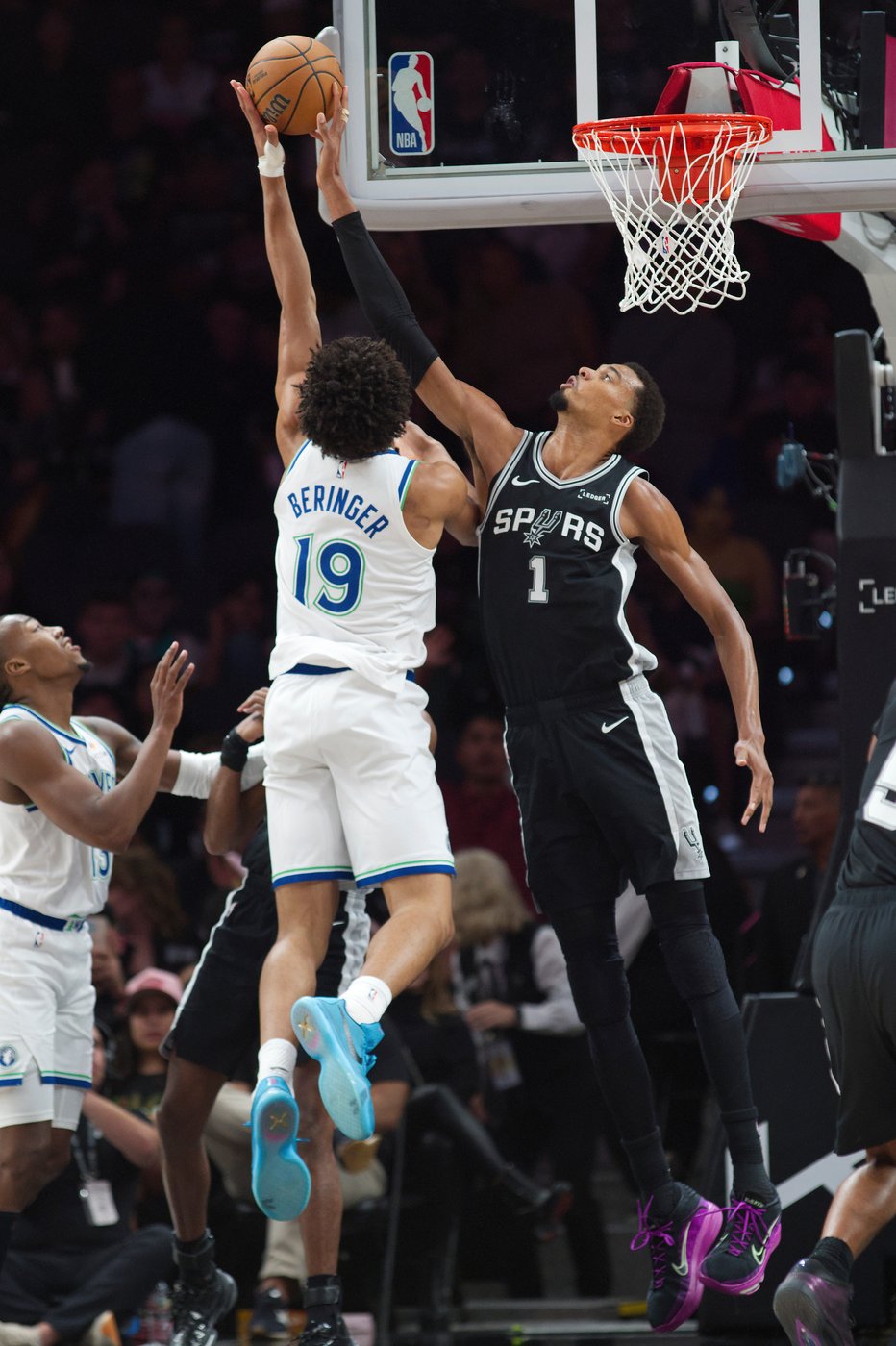
Wembanyama's scoring line was immense without being artificially efficient. He took 34 shots, made 17, hit three of eight three-pointers and went six of nine at the foul line. Those numbers describe a player asked to manufacture a large share of San Antonio's offense rather than someone simply benefiting from a run of uncontested finishes. He attacked from different spots, kept shooting when Minnesota crowded the interior and still found ways to punish defenders who tried to play him as a conventional center.
The six blocks mattered just as much to the shape of the contest. A blocked shot can erase a layup, but against a defender with Wembanyama's reach it also changes the attempts that never appear in a box score. Opponents have to decide whether to challenge him, float a difficult shot over him or send the ball elsewhere. Minnesota had productive stretches in the paint despite his presence, yet the constant need to make that choice is one of the reasons his defensive impact cannot be reduced to a single total.
His most memorable sequence connected both halves of his game. Wembanyama rejected a Jonathan Kuminga three-point attempt, ran the floor and finished with a two-handed dunk to reach 40 points. The sequence was a useful shorthand for his unusual value: a player protecting the basket and the perimeter while remaining a transition threat on the next possession. It was not an isolated highlight pasted onto an otherwise ordinary night; it reflected the pressure San Antonio applied whenever he could turn a stop into an attack.
The late three-pointer that pushed the Spurs ahead 118-107 with 2:40 remaining was a different sort of statement. Minnesota had already demonstrated that a double-digit deficit could shrink quickly, so another decisive score was more valuable than an impressive final tally. Wembanyama gave San Antonio breathing room at precisely the point when the visitors needed consecutive empty possessions from the hosts.
His 43 points also put this performance in perspective within his own career. It was his tenth 40-point regular-season game and his eleventh across regular-season and postseason play. That is a remarkable collection for a young center whose defense alone would make him a foundational player. The more consequential question is whether San Antonio can keep using his offensive range without turning every close finish into a demand for another extraordinary individual night.

Harper's 25 and Fox's 22 kept San Antonio from becoming a one-man team
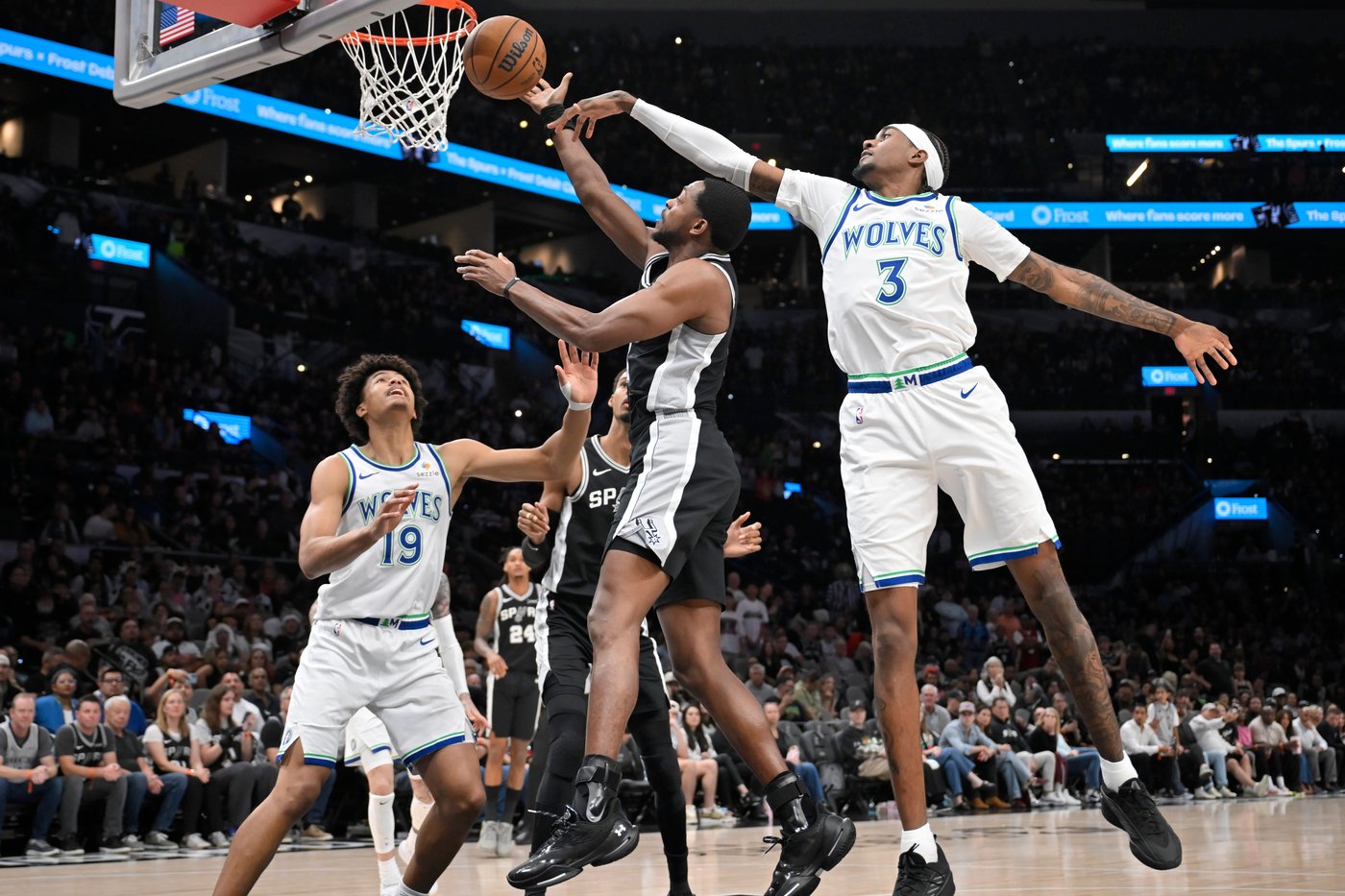
Forty-three points tend to swallow the rest of a winning box score, but Dylan Harper and De'Aaron Fox supplied much of the structure around Wembanyama. Harper finished with 25 points, seven rebounds and six assists. Fox added 22 points, eight rebounds and seven assists. Together they gave San Antonio two more players capable of making the defense react instead of waiting for its center to create every advantage.
Harper's night was particularly valuable because his contribution crossed several categories. He was not just a secondary scorer collecting easy points after the defense collapsed. His seven rebounds helped finish possessions, while six assists gave the Spurs another route into their offense. A young guard who can score and distribute in the same game changes the way opponents load up on Wembanyama, especially when a possession starts with the ball in Harper's hands rather than at the elbow.
Fox offered a different balance. His speed and decision-making can force the first defensive rotation before Wembanyama even receives the ball. His 22 points mattered, but seven assists and eight rebounds show why he cannot be evaluated only as the second or third name in the scoring column. San Antonio needs him to create pace, find teammates and prevent long stretches of static possessions when the first action is denied.
The partnership is still imperfect. Minnesota turned five San Antonio turnovers into ten points in the second quarter and punished several stretches when the Spurs' ball movement became hurried. San Antonio finished with 15 turnovers, enough to keep a short-handed opponent in a game it might otherwise have controlled. A talented collection of creators is not automatically an organized offense, and the gap between the two can be visible even during a victory.
That is why the guard contributions are more encouraging than the raw combined scoring figure. If Harper can continue to create his own looks while Fox organizes the attack, Wembanyama does not need to operate as a 43-point emergency solution every night. San Antonio's ceiling is higher when opponents must defend three independent threats and when those threats make each other more efficient rather than simply taking turns.
The Spurs also received useful minutes from the rest of their rotation, including Julian Champagnie's 12 points. The supporting cast did not dominate the headlines, and it did not need to. Its job was to keep the game manageable during the stretches when Minnesota made a serious push and to give Wembanyama a team capable of converting his defense into sustained momentum.

A 16–0 Minnesota run nearly rewrote the game before the Spurs found the finish
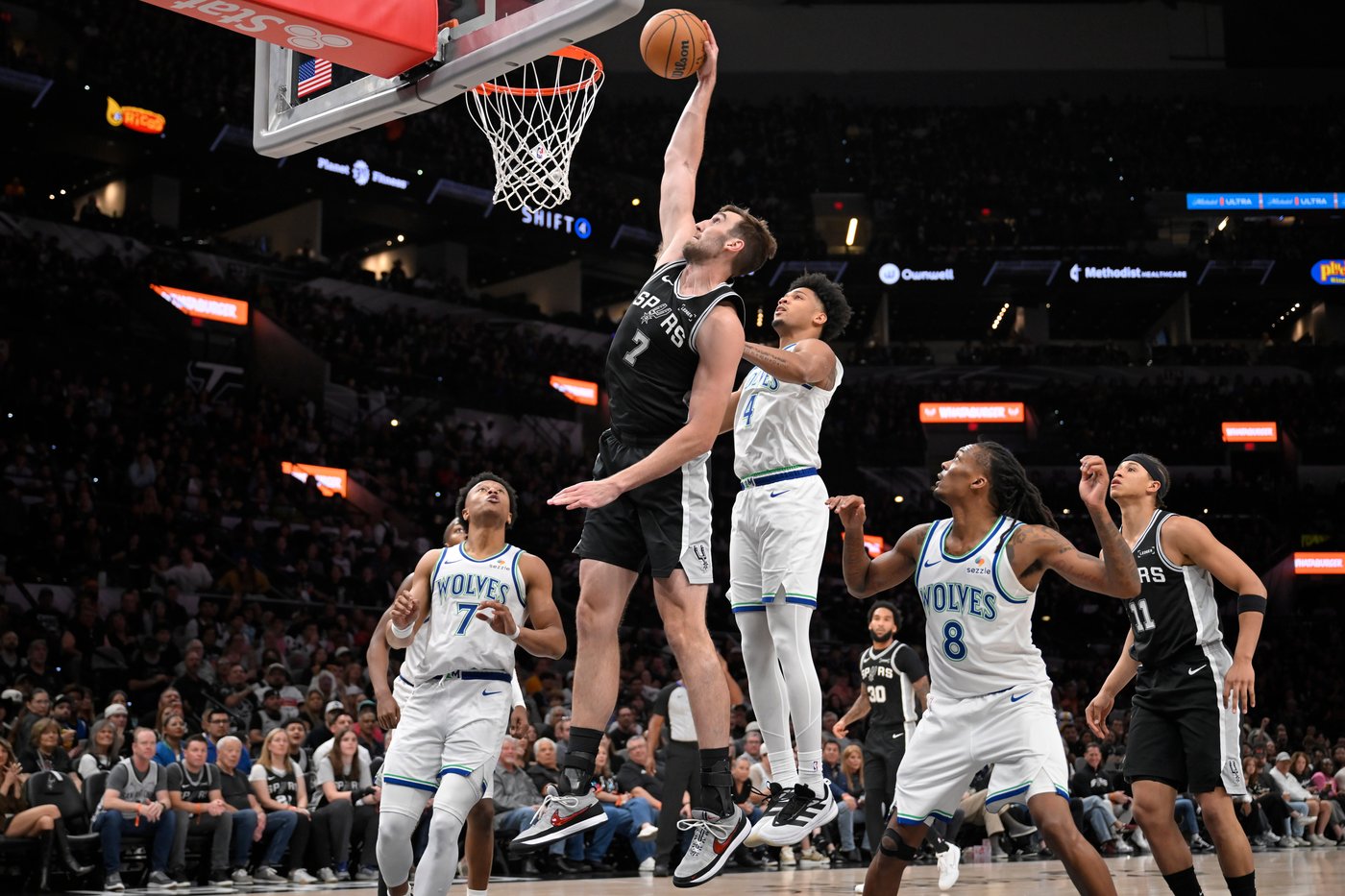
The final score suggests San Antonio kept Minnesota at arm's length. The quarter-by-quarter story says otherwise. The Spurs led 34-28 after the first period and expanded their margin to 46-35 early in the second. At that point, they looked ready to impose their size and talent on a visiting team missing several important players. Instead, the Timberwolves answered with 16 consecutive points and moved in front 51-46.
That sequence exposed the danger of treating a weakened opponent as a predictable one. Minnesota created pressure through activity, capitalized on mistakes and found points without needing one player to match Wembanyama basket for basket. Ayo Dosunmu and Jonathan Kuminga helped fuel the turnaround, while the Spurs lost the rhythm that had given them an early double-digit advantage. The Wolves won the second quarter 33-26 and took a 61-60 lead into halftime.
Wembanyama's two late first-half three-pointers prevented the deficit from becoming larger. He had 24 points by the break, but the fact that San Antonio still trailed illustrated the difference between an outstanding individual half and a reliable team performance. Minnesota had found enough cracks to make the scoreboard uncomfortable despite the absence of its usual defensive anchor.
San Antonio began the second half with renewed purpose. A 13-4 run put the Spurs back in front, and Harper's emphatic dunk later stretched the lead to 73-65. Minnesota did not disappear. Kuminga's three-pointer helped the visitors close within five at 93-88 entering the final period, leaving both teams one good stretch away from controlling the finish.
The Spurs then produced the burst that ultimately decided the game. A 10-0 fourth-quarter run built a 101-88 advantage, with stops and transition opportunities allowing them to play faster. Yet even that was not the end of Minnesota's resistance. Jaden McDaniels' jumper cut the margin to four with 6:49 remaining, forcing San Antonio to execute rather than merely protect the clock.
From there the hosts steadied themselves. A short scoring response stopped the comeback, and Wembanyama's late three gave the scoreboard a more comfortable shape. San Antonio won the fourth quarter 28-23, but the important detail is that it had to win the game more than once: after the 16-0 collapse, after the third-quarter recovery and after Minnesota's final charge.
The lesson is not that every contender must dominate all 48 minutes. It is that a good team must recognize when its control has vanished and still find a coherent response. San Antonio eventually did, but the number of swings shows there is plenty for the coaching staff to review before the next homestand test.

Minnesota's missing stars explain the disadvantage, not the resistance

Minnesota arrived in San Antonio without Anthony Edwards after knee surgery, Rudy Gobert because of back spasms and Donte DiVincenzo while he recovered from Achilles surgery. That is a significant loss of shot creation, defense and lineup continuity. Against a player as unusual as Wembanyama, the absence of Gobert was especially conspicuous. Minnesota had fewer established options for protecting the rim and matching the Spurs' size over a full game.
Yet the Timberwolves did not play like a team interested in excuses. Ayo Dosunmu scored 27 points and grabbed nine rebounds, leading the visitors in both categories. Jonathan Kuminga and Jaden McDaniels contributed 19 apiece, and the team repeatedly found ways to get back into the contest. Their 16-0 second-quarter run and late push within four were not ceremonial bursts. They were genuine attempts to steal a road game against an opponent with considerably more of its core available.
LaMelo Ball's foul trouble created another problem. He played a limited role, shot two of ten and eventually fouled out with 3:43 remaining. His ten points, eight rebounds and four assists were useful in places, but Minnesota needed consistent organization from its guards while San Antonio was changing the defensive picture. Losing a ballhandler to fouls reduces the options for attacking the next possession, especially late in a game when the margin is small.
The Wolves' effort also revealed the limits of depth when injuries stack up. Dosunmu can carry an important scoring burden, and McDaniels or Kuminga can swing stretches with athleticism and shotmaking. But replacing Edwards' offensive gravity and Gobert's defensive organization simultaneously is not a normal substitution exercise. It asks everyone else to move into a more demanding role and to keep making the right decisions under pressure.
San Antonio should be pleased with the result without pretending it was a complete test against Minnesota at full strength. The Spurs still allowed the visitors to dictate a long second-quarter stretch and nearly surrender a fourth-quarter lead. Minnesota, meanwhile, fell to 4-3 and has reason to believe its competitiveness can survive a difficult injury period if the healthy players maintain this level of aggression.
The immediate schedule gives both teams another measuring stick. The Spurs host Utah on Monday, while Minnesota returns home to face Milwaukee. For San Antonio, the challenge is to carry its four-game winning streak forward with cleaner possessions. For the Timberwolves, it is to turn a brave losing effort into a more stable rotation until the injured players can return. Neither task is solved by the final score alone.
The most exciting part of San Antonio's 121-111 win was not the final ten-point margin. It was the combination of a singular superstar performance and a supporting cast increasingly capable of helping him close difficult games. Wembanyama's 43 points and six blocks will travel far beyond the box score, but Harper's all-around contribution and Fox's control were essential to making those numbers count.
The Spurs have won four straight after an uneven start. That is meaningful momentum, not proof that every problem has disappeared. Minnesota's depleted roster still exposed loose possessions and defensive lapses. If San Antonio cleans up those stretches while preserving its three-pronged offensive creation, the win will look like another step in a more convincing rise rather than a night rescued by one extraordinary player.



















