

Celebrini and Smith Had Six Points. Nashville's Seven-Win Run Ended.
GOATIFYThe Nashville Predators arrived in San Jose with seven straight victories, one of the NHL's longest winning runs this season, and a chance to extend the streak against a Sharks team still trying to pull its record toward .500. Instead, they spent Sunday night chasing the puck, the score and two young San Jose forwards who kept finding each other. Macklin Celebrini and Will Smith each finished with a goal and two assists as the Sharks won 4–2 at SAP Center on November 15, 2026.
The final margin understates the early imbalance. San Jose led 2–0 after the opening period and 3–0 before Nashville finally answered. Ivar Stenberg provided both a spectacular setup for the first goal and a finish of his own. Collin Graf added the other early strike. Alex Nedeljkovic then supplied the protection a developing team needs when a more established opponent begins to push, turning aside 32 shots.
That combination matters more than the easy headline about a streak ending. This was not a game in which the Sharks stole two points with a lucky bounce and a goaltender standing on his head from the opening faceoff. San Jose generated its advantage through speed, aggressive reads and connected passing, then managed the uncomfortable moments that followed. For a club that entered the night below .500, it is a more useful template than an occasional dramatic comeback.
Nashville remains 11–5–5, with its seven-game surge proving that the underlying team can be dangerous. But its first loss of the trip exposed how quickly the cost of a sluggish start rises when the opponent's best players are already in full stride.
Smith and Stenberg turned the first period into a runway

San Jose's first goal began with an effort that never appears in a standard scoring summary. On the right wing, Ivar Stenberg threw himself into a pass, making the kind of reaching play that can either surrender possession or launch an attack. This one sent Will Smith free. Smith took the breakaway and beat Juuse Saros on the blocker side at 12:25 of the first period. The assist and the finish belonged to two different players, but the sequence showed a common instinct: keep the play alive long enough for speed to change the geometry.
There was nothing elaborate about the goal. Stenberg recognized that Nashville could be caught moving in the wrong direction, and Smith had the timing to convert open ice into a direct shot. For the Predators, the warning was not simply that a young forward could score on a breakaway. It was that routine transition situations were becoming dangerous before Nashville had its coverage set. The Sharks did not have to pass through five layers of defending to make a chance; they were reaching threatening areas almost immediately.
Collin Graf doubled the lead at 16:10. Mason Marchment worked behind the net and fed the puck into a scoring area, where Graf moved into position and fired. The shot took a deflection off Nashville defenseman Roman Josi and beat Saros. That bounce was favorable, but it came after San Jose had created a useful location for a shot. An opponent cannot control every ricochet when the puck is repeatedly arriving in the slot and around the crease.
GOATIFY
GOATIFY Hockey
San Jose's breakaway attack has hockey fans talking: explore GOATIFY's hockey apparel and fan designs.


The Sharks did not abandon the approach after intermission. At 4:45 of the second period, Celebrini carried the attack down the left side and involved Smith across the ice. Smith then found Stenberg beside the left post for a close-range finish. Saros was missing his stick as the play developed, leaving Nashville even more vulnerable. What began as one sharp first-period pass from Stenberg had become a two-point night for the newcomer and a three-goal margin for the home side.
The lesson is that San Jose's early lead had more than one source. Smith's finishing, Graf's willingness to attack inside ice and Stenberg's combination of effort and timing all contributed. Celebrini was central, but Nashville could not solve the game merely by locating number 71. The most encouraging Sharks development was how frequently another option became available once the first one had drawn attention.
Celebrini and Smith made the decisive goal look simple

By the third period, Nashville had at least made the score interesting. Nils Höglander had redirected an Adam Wilsby shot into the net late in the second, cutting the deficit to 3–1. A team riding seven consecutive wins could reasonably imagine one more comeback. Instead, the Sharks' two headline forwards connected again at 7:40 of the third to restore the three-goal cushion.
The sequence started with Celebrini spotting Smith on the right side of the attack. Rather than turning the first pass into an immediate shot, Smith returned the puck into the middle. Celebrini was moving into a dangerous lane and snapped the finish past Saros on the glove side. That is a small, almost ordinary-looking combination on video, but it requires both players to read the same possibility in a fraction of a second. The passer has to trust the receiver will continue into space; the receiver has to believe that the puck will come back instead of disappearing into a low-percentage attempt.
Celebrini's goal completed a one-goal, two-assist performance. Smith also finished with a goal and two assists. That gave the pair six combined points, though it would be a mistake to treat those six as six separate scoring plays; assists and goals can occur on the same possession. The more illuminating figure is that it was the eighth game in which both players registered at least three points, and San Jose was 6–0–2 across those eight outings.
The statistical significance extended beyond one productive partnership. Celebrini logged his 26th career three-point game, matching Dale Hawerchuk for fifth most by an NHL player before turning 21. The names above him on that historical list include Wayne Gretzky, Mario Lemieux, Sidney Crosby and Jimmy Carson. Such comparisons do not guarantee an identical career or make every 2026 game a historic occasion. They do tell us that his high-end offensive production has arrived far earlier than is typical for a young center.
The larger story is how San Jose uses that talent. Celebrini is capable of carrying a rush himself, but this night showed the value of letting Smith be more than a stationary recipient. When Smith can hold possession for one additional beat, or give a puck back into the middle rather than taking the first option, defenders face a second decision they have not yet made. Nashville's coverage was often reacting to the first pass while the Sharks were already preparing the next.
GOATIFY
GOATIFY Hockey
The Celebrini–Smith connection is worth celebrating with GOATIFY's NHL-themed shirts, hoodies and stickers.
San Jose will not get three-point nights from both players in every game. The useful takeaway is repeatable even when the shooting percentages cool: connected movement and fast decisions can create quality chances without requiring a spectacular solo move on every shift. That is the sort of offensive identity a young roster can build on.
Nedeljkovic kept Nashville's comeback from taking over
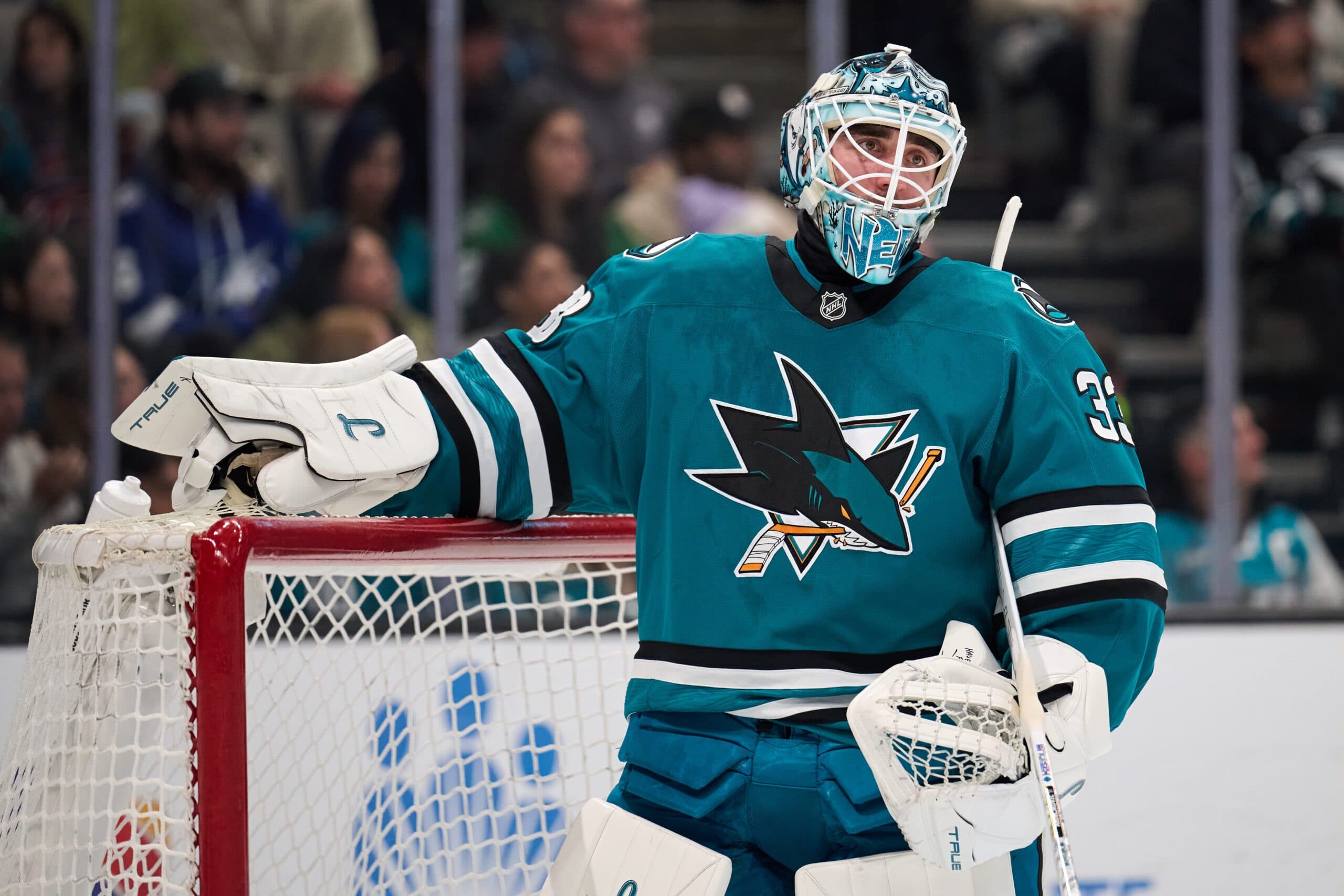
Three early goals can make a victory look routine after the fact. They do not eliminate the obligation to protect the lead, and Nashville did eventually make San Jose work for its margin. The Predators put 34 shots on Alex Nedeljkovic; he stopped 32 of them. Juuse Saros, at the other end, made 20 saves on 24 shots. Those totals should not be read as a complete territorial map, but they explain why San Jose still needed a real goaltending performance even after building the cushion.
Nashville's first reply arrived at 17:43 of the second period. Adam Wilsby sent the puck from the point toward traffic, and Nils Höglander changed its path near the crease. The deflection struck Nedeljkovic and slipped into the net. It was precisely the sort of play that can alter the emotional rhythm of a game: the trailing team receives a reward for sending bodies to difficult areas and begins believing that another shot can turn three goals into one.
Yet the Predators' growing pressure did not produce a full reversal. San Jose reached the second intermission up two, then watched Celebrini and Smith restore the three-goal difference in the third. That sequence matters because a successful goaltender is not required to make every save. He is required to give his team enough stability to execute the next good play. Nedeljkovic did that while Nashville was searching for a way back.
Steven Stamkos added a late power-play goal at 16:35 of the final period. A rebound came to the right of the San Jose net, and Stamkos drove a one-timer into the crease. The puck squeezed beneath Nedeljkovic and just crossed the line, cutting the margin to 4–2. Nashville continued to push, but there was too little time and too large a deficit left to repair the opening twenty-five minutes.
It would be unfair to frame the loss as simply Saros being outplayed by his counterpart. Several Nashville concessions came from exposed lanes, transition gaps or the quality of shots allowed from dangerous areas. Conversely, Nedeljkovic saw a large volume of work because the Predators found ways to create pressure after their disastrous start. Goalie save totals are outcomes of team defense and opponent opportunity, not independent grades.
For the Sharks, the encouraging combination was front-end invention and back-end resilience. The team could attack decisively when the game was open and still survive when its opponent settled in. A young offense without that second part can produce entertaining losses. On Sunday, a seasoned goalie made sure the attacking work translated into two standings points.
The streak ended; both teams now have a tougher consistency test

The Predators' seven-game winning streak was tied for the longest in the NHL this season, so one road defeat should not erase what preceded it. Nashville emerged from the night at 11–5–5, still carrying a substantial collection of early-season points. Its winning run demonstrated that the team could manufacture results over different opponents and situations. It did not mean every night would begin cleanly or every mistake would be rescued by a goalie, a power play or a late surge.
GOATIFY
GOATIFY Hockey
Between the pipes and in the stands, hockey nights are better with GOATIFY fan gear.
The players and coaches were notably critical of their opening period. Steven Stamkos described an effort that improved as the evening continued but began without the required urgency; Andrew Brunette focused on the same slow start and the opportunities handed to San Jose. Their concern is sensible. Going down two goals in a period, then three early in the next, forces a team to use its best energy simply to get back to even. When the opposition owns a player as capable as Celebrini, that chase also leaves defensive trade-offs.
There is a practical distinction between a broken streak and a broken formula. Nashville generated 34 shots and did bring the game back to 3–1 and 4–2. Those are evidence of a team that continued competing. The negative was how long it took to reach that level, and how much damage had already been done before it arrived. The next challenge is a road meeting with Minnesota on Tuesday, the final stop of the Predators' five-game trip. A cleaner opening stretch would address the most immediate weakness this game exposed.
San Jose's arithmetic tells a different story. The Sharks improved to 10–11–2 and recorded a second consecutive win, moving to 3–0–1 over their past four. Those are encouraging numbers, not a declaration that the broader rebuilding project is complete. A losing record remains a losing record, and maintaining the standard against different types of opponents will be harder than producing one eye-catching result against a team on a streak.
The coaching challenge for Ryan Warsofsky is to preserve the behaviors that created the lead. Fast puck movement and responsible pressure cannot be reserved for the first period of a home game. They have to survive fatigue, rough shifts, an opponent's tactical adjustment and the nights when a talented forward produces only one point instead of three. San Jose looked quick and coordinated on Sunday. The next step is making those adjectives ordinary rather than surprising.
There is also a smaller personnel question still unanswered. Sharks forward Kiefer Sherwood exited in the third period, and Warsofsky did not provide a postgame update. That is a status to monitor, not an invitation to diagnose an injury or assign a recovery timeline. For now, the confirmed story is what happened on the ice: a high-scoring young partnership broke open a game, and a more experienced opponent could not undo the early damage.
Nashville's seven-game streak ended because the Sharks did far more than wait for a mistake. Smith converted a Stenberg-created breakaway, Graf attacked a dangerous area, Stenberg finished a sweeping rush and Celebrini completed an elegant give-and-go. When Nashville eventually changed the momentum, Nedeljkovic's 32 saves kept the home side in control of the scoreboard.
The result is a reminder that individual star power is most dangerous when it turns into shared timing. Celebrini's 26th three-point game is an exceptional personal milestone; the six combined points he and Smith recorded are the headline. But the performance also required work from Stenberg, Graf, the supporting attackers and the goalkeeper who dealt with the late push.
For Nashville, the assignment is straightforward and uncomfortable: stop using the opening period to discover the intensity that was already required at puck drop. Seven consecutive wins remain valuable. Sunday showed how abruptly that run can end against a team whose young forwards are already moving at full speed.
GOATIFY
GOATIFY Hockey
Shop GOATIFY NHL and hockey shirts, hoodies and stickers.



















