Four First-Round Finishes, Four UFC Contracts — DWCS Week 9 Was a Recruitment Sprint
GOATIFYDana White’s Contender Series is built around a simple pressure test: winning is useful, but making the UFC believe it needs to see you again is the real assignment. Week 9 of Season 10 made that distinction unusually clear. Five winners left the Meta APEX on October 6, yet only four left with UFC contracts, and all four contract winners had finished their fights in the first round.
Alivia Bierley opened the card with a unanimous-decision win over Summer Onley, but White said the third round did not show enough urgency for a deal. Then the entire tone of the night changed. Mateus Soares needed 63 seconds to stop Ryuho Miyaguchi. Roque Conceição turned a slam into a triangle choke against Alexander Chavez. Salhahuddin Everett knocked out Ozzy Martin in 1:57. Preston LaGrange closed the show by stopping previously unbeaten Nell Ariano at 2:24.
The results made Week 9 feel less like a normal prospect card and more like a compressed explanation of what the Contender Series rewards. Soares brought speed and finishing instinct. Conceição showed adaptability under pressure. Everett delivered the night’s loudest emotional moment while protecting an unbeaten record. LaGrange followed the hardest act on the card and still produced an upset knockout. Four different routes led to the same destination: a UFC roster spot.
Four first-round finishes turned one audition night into four UFC contracts
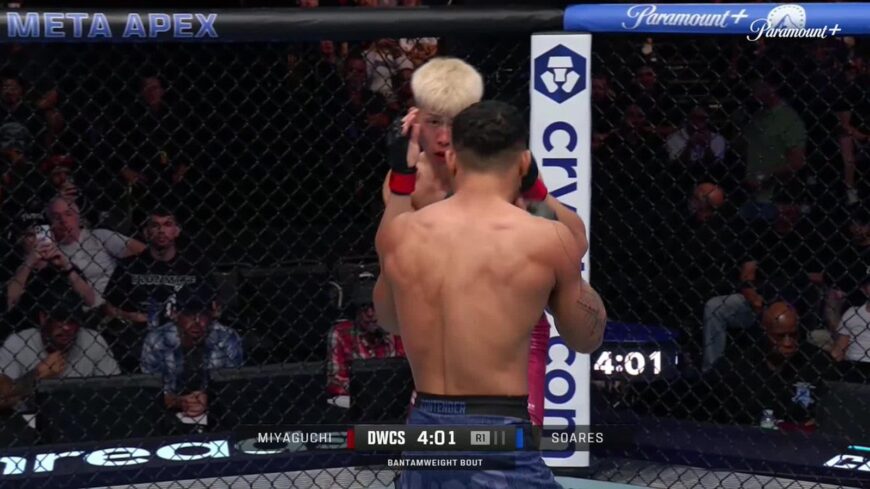
Soares set the standard immediately after the opening decision. The 22-year-old Brazilian entered with a reputation for finishing fights, and Miyaguchi was not an easy opponent to use as a showcase. The Japanese bantamweight arrived with seven wins in eight professional bouts and six knockouts, giving the matchup real two-way danger. Soares solved it before that danger could develop. He dropped Miyaguchi with a right hand and followed with punches until the stoppage at 1:03.
That finish pushed Soares to 12-2 and gave him ten career knockouts. More importantly, it showed exactly why a short audition can still reveal something meaningful. Soares did not simply overwhelm an overmatched opponent. He found the opening against another proven finisher, converted it immediately and gave the UFC a clean reason to move him into the bantamweight roster.
Conceição’s contract came from a very different kind of sequence. Alexander Chavez slammed him to the canvas during their flyweight fight, a moment that could easily have become the start of a bad position. Instead, Conceição stayed attached, locked up a triangle and forced the tap at 3:37. It was a particularly valuable performance because he had already experienced the other side of the Contender Series. His 2025 appearance ended in a first-round loss, so returning a year later and turning an opponent’s takedown into the submission that earned a contract gave the win more weight than a routine second audition.
The middle of the card then produced the story everyone inside the building seemed to be waiting for. Everett had worked behind the scenes for the UFC, first through security and later as White’s personal runner, while building a fighting career outside the office. He entered against Martin at 4-0 as a professional with four first-round finishes. Martin was also 4-0 and had stopped every professional opponent, so the personal connection to White did not remove the competitive risk.
Everett made the favoritism discussion largely irrelevant with the performance. He stayed composed in the early exchanges, pressured Martin toward the fence and finished the fight with a heavy punching combination at 1:57. The win moved him to 5-0 with five first-round stoppages. White acknowledged afterward that the crowd reaction was unusually loud even by APEX standards and called the contract life-changing. For Everett, the strange part is that joining the UFC roster also means changing his relationship with the company: the employee who handled errands for the promotion is now a welterweight the promotion has to match.
There is still a useful distinction between Everett’s story and Everett’s actual prospect profile. The backstory will make his debut easy to market, but five professional fights is a small résumé for a UFC welterweight. The promotion does not need to rush him because the contract itself is already the payoff to this chapter. His next challenge is proving that the same composure and finishing instinct translate when the opponent pool becomes deeper and more experienced.
LaGrange had the most awkward assignment of the night: follow Everett’s knockout after the building had already reached its emotional peak. He was also the betting underdog against Ariano, an unbeaten judoka who entered 6-0. Instead of letting the moment flatten the main event, LaGrange forced his own ending. He found the right hand during a first-round exchange and knocked Ariano out at 2:24, improving to 7-1 and securing the fourth contract.
That sequence matters because Contender Series cards can create a misleading idea that every finish is interchangeable. They are not. Soares showed fast offensive conversion. Conceição showed opportunistic grappling and resilience after being put in danger. Everett handled the pressure attached to an unusually personal storyline. LaGrange beat an unbeaten opponent as a sizable underdog after the crowd had already spent much of its energy. White gave all four contracts, but each fighter supplied a different argument.
Bierley’s decision win supplied the contrast. She beat Onley on the scorecards, but White said he did not see enough urgency in the final round to offer a contract. That can feel harsh in a sport where winning is supposed to be the first objective, yet it is consistent with what the Contender Series has become. This is not simply a feeder league with automatic promotion for every winner. It is an audition layered on top of a fight, and the promotion is evaluating whether a performance creates demand for the next appearance.
Week 9 therefore produced one of the clearest versions of the format. The four contracts did not come from hype packages or famous surnames. They came from four first-round finishes in four consecutive fights. The UFC now gets a 22-year-old knockout artist in Soares, a returning prospect who corrected a failed first audition in Conceição, an unbeaten welterweight with an unusually direct connection to the company in Everett, and an upset-minded light heavyweight in LaGrange.


None of those contracts guarantees a long UFC career. The jump from the Contender Series to the main roster is designed to expose weaknesses quickly, and all four newcomers will now face deeper divisions and more experienced opposition. But the purpose of the audition is not to prove a prospect is already a contender. It is to create enough evidence that the UFC wants the next test.
On October 6, Soares, Conceição, Everett and LaGrange did that in less than nine combined minutes of fight time. Week 9 started with a winner who did not get a deal and ended with four straight first-round finishes that did. As a snapshot of what the Contender Series rewards, it was almost too neat.