

Harrison Beat Nunes. The Women's P4P No. 1 Fight Just Split.
GOATIFYOne night at Madison Square Garden produced an undisputed result and a disputed answer. Kayla Harrison submitted Amanda Nunes in the fourth round of their UFC 334 bantamweight title fight on November 14, handing the returning great a defeat that instantly changed the conversation about women's mixed martial arts. Harrison won the fight, retained her belt and earned the biggest name on her résumé. The argument about who belongs at the top of the pound-for-pound rankings, however, is getting louder rather than disappearing.
On November 17, a five-person independent MMA rankings panel moved Harrison past Zhang Weili into second place, with Valentina Shevchenko still first. Another updated women's rankings list went the other way and placed Harrison at No. 1 above Shevchenko. That is not an administrative contradiction or a split championship. These are separate editorial judgments measuring the same athletes with different balances of recent achievement, career depth, strength of opposition and inactivity.
The timing makes the question especially difficult. Shevchenko's body of work remains exceptional, but she has not fought for nearly a year and relinquished her flyweight belt while dealing with injury. Harrison has the fresh, spectacular result, yet she is talking about recovery, weight cutting and the possibility that her most important night may also have been one of her last. The ranking is only the headline. The deeper story is the collision between proven longevity and a defining win in the present.
Two rankings, two No. 1s — and neither vote is automatic
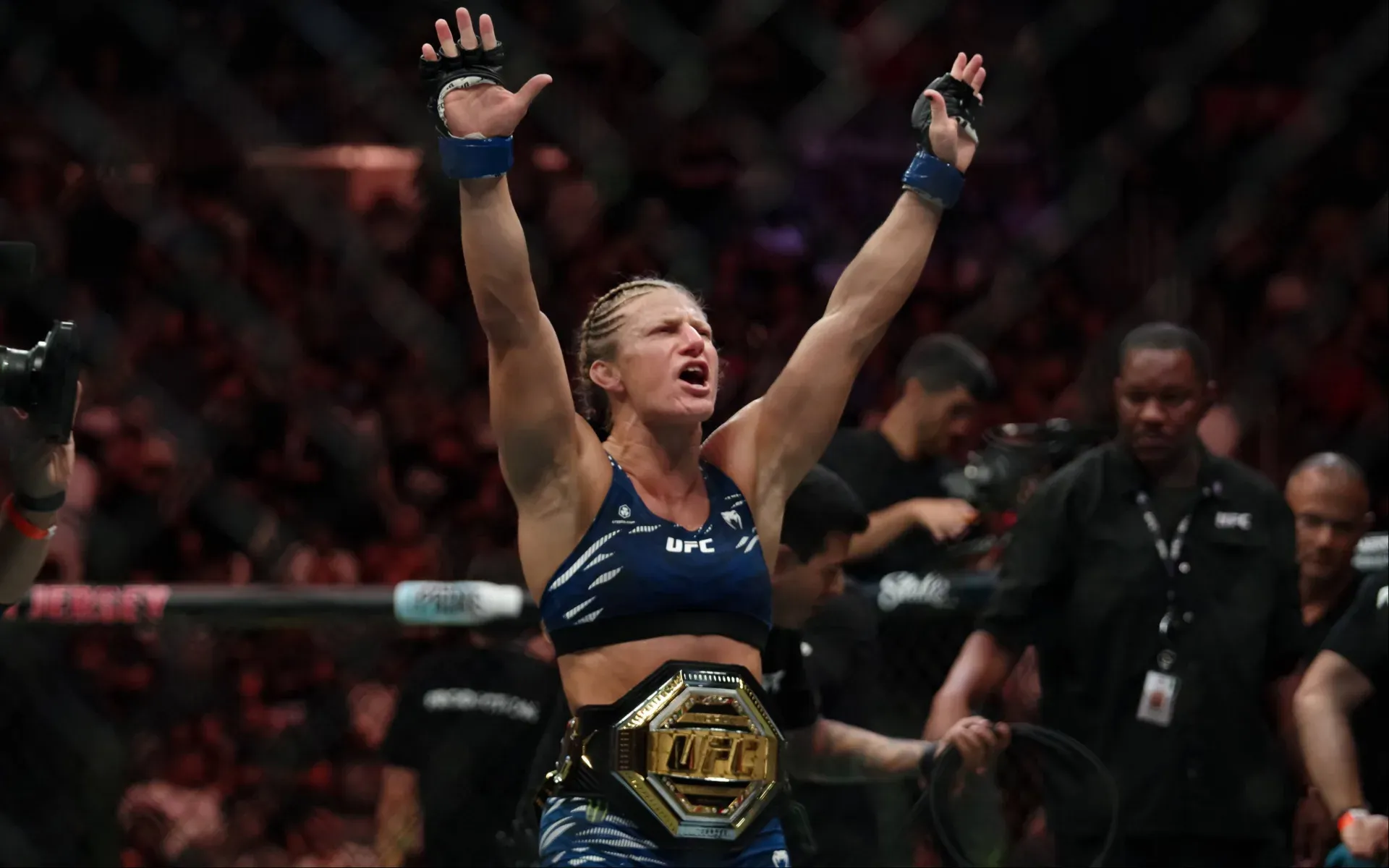
Start with the narrowest fact: Harrison is the reigning UFC women's bantamweight champion after a decisive submission of Nunes. No pound-for-pound list can take that belt away, and no five-person vote creates a new championship. P4P is an attempt to compare athletes who compete at different weights, without a common opponent or a shared scale that turns technique, opposition and results into an objective score. It is a useful conversation starter, not an official universal measurement.
The November 17 picture demonstrates the distinction. One independent MMA panel left Shevchenko at No. 1, elevated Harrison from third to second and moved Zhang Weili behind her. One of the panel's five voters already put Harrison first, showing that the disagreement was within the room as well as outside it. Meanwhile, a separate women's rankings table updated on November 17 listed Harrison first, Shevchenko second and Zhang third. Both orders are real, and neither should be passed off as the unanimous judgment of the entire sport.
The immediate-result argument belongs to Harrison. She fought at UFC 334, defended a world title, beat a former two-division champion and ended the match herself rather than relying on narrow scorecards. A submission over Amanda Nunes carries a different emotional weight from a routine defense against an unranked opponent. A ranking system that prioritizes who has just proved the most, against the highest-profile threat, can reasonably place that performance above the memory of an inactive champion's reign.
The career-depth argument belongs to Shevchenko. She has accumulated title-level wins, tactical adaptations and success across years that Harrison's comparatively short UFC run has not yet matched. Harrison arrived at the promotion with an extraordinary judo and PFL background, but a career outside the UFC and wins inside it are not interchangeable evidence when the question is which opponent pool has been most consistently conquered. This is precisely where reasonable voters can apply different weights without overlooking Saturday's result.
Strength of division complicates it further. Dominating bantamweight is demanding, but women's 135-pound depth has long been debated. Shevchenko and Zhang have spent more of their careers navigating different high-caliber styles in mature title races. That should not erase Harrison's accomplishment or punish her for fighting in the division that offers the belt she can realistically make. It does explain why a voter might ask for one more elite defense before reversing a long-standing hierarchy.
GOATIFY
GOATIFY UFC & MMA
Two legitimate rankings can disagree about supremacy. Explore GOATIFY UFC-inspired apparel for fans who love the debate.

MMA GOAT Gold Middle Finger Fight Crewneck Sweatshirt
A MMA fan design for everyday wear.
Shop Now ↗
Rogainz Joe Rogan UFC MMA Martial Arts Sticker
Add MMA personality to your favourite gear.
Shop Now ↗


There is also a temptation to treat No. 2 as a slight. It is not. Moving up a spot, collecting a first-place ballot and forcing a detailed comparison with Shevchenko is a significant endorsement. The numbers highlight something useful about this debate: Harrison's spectacular night closed the gap so fast that the next decision may depend less on what she just did than on whether either athlete is healthy enough to fight again. Until then, the fairest description is a split among independent rankings, not a settled coronation.
How the fourth-round choke changed Harrison's standing

A win over Nunes changes a résumé because the opponent's name stands for more than one title reign. The Brazilian became a two-division champion, defeated a remarkable collection of leading contenders and retired in 2023 with a strong claim to being the most accomplished woman in UFC history. Her return after more than three years was not an ordinary title defense for Harrison; it offered the kind of generational comparison that promoters spend years trying to arrange.
But the fight itself matters more than the marketing label. Nunes showed she could find striking moments against Harrison. At distance, her speed and accuracy kept the contest competitive, which is an important correction to the idea that she was simply overwhelmed in every phase. Harrison was the more reliable fighter when the distance collapsed and the grappling exchanges began. She repeatedly turned those sequences into control, forcing Nunes to work underneath rather than freely build her combinations.
That pattern tells a more interesting story than a highlight alone. Each decision to enter a clinch against an Olympic judo gold medalist creates a risk of a takedown and a prolonged defensive round. It can also sap the energy required to win the next stand-up exchange. Nunes had beaten elite wrestlers and grapplers in her prime, yet the mechanics of this particular matchup consistently favored Harrison once the fighters were tied together. Physical strength, leverage and positional patience were decisive assets.
The finish came 1 minute 29 seconds into round four, when Harrison secured a rear-naked choke. Before that final moment, she had used her grappling to force Nunes into a fight conducted on the champion's terms. The precise combination of leg control, ground position and back exposure mattered; the tap was the final consequence of an advantage that had been building over multiple rounds. It was not a lucky submission rescued from an otherwise losing fight.
Nor does a comeback defeat retrospectively devalue all of Nunes's earlier accomplishments. She was fighting after a long absence and against a contender whose physique, wrestling pressure and judo experience create unusually specific problems. Those circumstances should inform the evaluation of a single performance. They do not change the official result or the technical achievement of submitting a woman who has so rarely been controlled in championship competition.
Harrison's own context cuts the other way. This was her first fight since June 2025 following significant neck surgery earlier in 2026. That she returned to championship competition against an opponent with Nunes's reputation, completed the 135-pound weight cut and maintained her effectiveness into the fourth round gives the win extra credibility. It shows not merely that Harrison had a good night, but that her signature skills survived a demanding period of recovery.
Of course, one great victory cannot settle every hypothetical about a different weight class. Pound-for-pound is deliberately broader than a single matchup, and Nunes was not coming off a recent sequence of wins. Yet a panel that discounts this win because the challenger had been retired risks overlooking the exact thing it should value: a reigning champion defending under substantial physical pressure and finishing a historically dangerous opponent. Harrison's new position near the top is earned by the fight, not by publicity around it.
GOATIFY
GOATIFY UFC & MMA
Championship technique decides fights as surely as power. Find GOATIFY MMA shirts and accessories that celebrate both.


UFC GOAT Gold Middle Finger Fight Decal Sticker
Add MMA personality to your favourite gear.
Shop Now ↗Shevchenko's inactivity is the real complication

The best case for retaining Shevchenko at No. 1 begins with the long view. Across multiple championship runs, she proved she could manage range, counterattack, wrestle offensively and win difficult tactical contests even when opponents were prepared for her preferred patterns. Her performance against Zhang Weili in November 2025 gave that record a recent and formidable benchmark. Those wins do not disappear just because the calendar moves forward.
Yet calendars are part of sport. Shevchenko has not competed since that November 2025 appearance, and a subsequent injury forced her to relinquish the flyweight title in 2026. Her absence should not be presented as indifference to defending a belt or as evidence that another fighter would beat her. Medical recovery and competitive form are different questions. The rankings dispute is instead about how long an established body of work should protect an athlete from being overtaken by someone actively adding elite wins.
The independent panel that kept her first applies an 18-month inactivity removal rule, which is an eligibility boundary rather than a guarantee of placement. Shevchenko remains inside that window. An individual voter can still decide that nearly a year off diminishes the case for current supremacy. Another can decide that the evidence accumulated before the injury outweighs a single new result elsewhere. These judgments use the same facts and reach different conclusions because they prioritize time differently.
Imagine two questions asked separately. Who has built the superior all-around résumé over many years? Shevchenko has a substantial argument. Who has demonstrated the strongest recent result in the last several days? Harrison's submission of Nunes is difficult to top. Pound-for-pound lists usually try to answer both at once. That is why the precise wording of a ranking matters: a list of best current fighters is not identical to a ranking of greatest careers or even best talent when everyone is healthy.
Zhang Weili's position reinforces the issue. The same panel moved Harrison past Zhang, who has also spent a long stretch without a booked fight. It would be inconsistent to penalize only the challenger for a thin recent schedule while preserving someone else unconditionally, but it would be just as crude to erase a decorated champion at the first sign of a lengthy rehabilitation. The more defensible method is to apply one recency principle to everyone while keeping the quality of past opposition in view.
For the UFC divisions themselves, the picture has already moved. Shevchenko's vacated flyweight title is not the same thing as a pound-for-pound vote, and a ranking promotion cannot restore her belt. Separate records now identify Natália Silva atop the flyweight championship picture, while Harrison remains the women's bantamweight champion. The practical point is that title status, divisional ranking and cross-division editorial order operate on different mechanisms and should not be blended in one sweeping claim.
If Shevchenko returns to face a strong opponent and performs at her old level, she can make the ranking argument on fresh evidence rather than reputation alone. If her recovery stretches further, the case for leaving a more active champion above her will strengthen. Nobody needs to declare either woman's career finished to see the pressure building. The most meaningful next change may be a signed fight and a clean medical clearance, not another published table.
A 145-pound rematch sounds simple. Making it real is another matter

Amanda Nunes did not respond to the loss by walking quietly back into retirement. On November 16, she publicly accepted the idea of a second meeting with Harrison at 145 pounds. Harrison had floated the possibility of a featherweight rematch before UFC 334, and the promotion's leadership signaled interest in the pairing afterward. Those remarks explain why the idea has momentum. They do not amount to a signed bout agreement, a date, or confirmation that a previously dormant division has been fully revived.
GOATIFY
GOATIFY UFC & MMA
Great careers are built over years, not one list. Browse GOATIFY UFC fan gear while the Shevchenko question unfolds.

Rogainz Joe Rogan UFC MMA Martial Arts Sticker
Add MMA personality to your favourite gear.
Shop Now ↗MMA GOAT Gold Middle Finger Fight Crewneck Sweatshirt
A MMA fan design for everyday wear.
Shop Now ↗The proposed weight is not a trivial adjustment. At bantamweight, Harrison's cut to 135 pounds has been a recurring strain, and after the Nunes fight she acknowledged that she needed to think about her future. Fighting at 145 could ease that particular burden, but it would not erase the effects of a cervical injury, the demands of a new training camp or the pressure of preparing for the same rival twice. The sporting and medical considerations are real even when a rematch looks easy to promote.
The historical complication is the belt itself. Nunes was once champion at bantamweight and featherweight, but the UFC's women's 145-pound championship has not been contested since her 2021 defense against Megan Anderson. A rematch being discussed in the language of a featherweight title does not automatically reestablish a deep division with clear contender rankings. That is a separate organizational decision, and the details remain unconfirmed as of November 18.
There are also competitive reasons to slow the rush toward an automatic second fight. The first bout ended decisively on the ground. Nunes could attempt a radically different strategy built around footwork, longer exchanges and disciplined takedown avoidance, but there is no evidence yet that the basic wrestling matchup would reverse at a heavier limit. Harrison, meanwhile, would have to show she can repeat her grappling control while managing any changes in speed, endurance or opponent preparation.
The rematch is appealing because both names are historic, not because every division requires one. For the sport, a future championship plan should consider which available contenders have earned an opportunity at 135 and what kind of competitive ecosystem could realistically support 145. For fans, the important distinction is between an exciting hypothetical and an announced bout. Planning an entire calendar around a social-media response would be getting several steps ahead of the promotion.
Harrison's possible retirement is an equally important branch. She has two Olympic judo gold medals, success as a PFL champion and a UFC title defense against Nunes. A fighter who has reached such milestones can fairly decide her family, long-term health and quality of life are more important than one more ranking vote. That does not mean she has announced retirement. At the moment, her statements are about weighing options after a physically and emotionally difficult win.
Three plausible paths exist without any of them being booked: Harrison takes another bantamweight defense, negotiates a higher-weight rematch with Nunes, or steps away before either can happen. The ranking debate will look different in each scenario. Another decisive victory increases the case for Harrison at No. 1. A prolonged absence would invite the same recency scrutiny now applied to Shevchenko. And a retirement would transform the argument from current pound-for-pound standing into a legacy discussion.
The best answer to a subjective ranking is normally a fight. In this case, the next fight cannot be assumed, the weight class cannot be taken for granted and the incumbent No. 1 is also recovering. That uncertainty is precisely why the post-UFC 334 top spot is more contested than a simple win-loss headline suggests.
The women’s pound-for-pound debate has gained something more valuable than an easy consensus. Harrison delivered the fresh, defining result and now sits first on some lists, second on others. Shevchenko retains a compelling long-term case, but the clock continues to run on her absence. Zhang remains in the mix, while Nunes's 145-pound suggestion introduces a new set of questions that no ranking update can answer for the matchmakers.
There is no need to force one universal No. 1 where none exists. Harrison's fourth-round choke is established fact; the voting criteria are opinions. The next meaningful evidence will come from health, contracts, opponents and action inside the cage. Until those pieces are clearer, UFC 334 has not ended the argument. It has made it impossible to ignore.
GOATIFY
GOATIFY UFC & MMA
Shop GOATIFY UFC and MMA shirts, hoodies and fight-fan accessories for the next big night.
UFC GOAT Gold Middle Finger Fight Decal Sticker
Add MMA personality to your favourite gear.
Shop Now ↗


















