

Jon Jones Saw Topuria as His GOAT Heir — Then Gaethje Broke the Streak
GOATIFYJon Jones saw a fighter who might one day challenge his place in MMA history. That fighter was Ilia Topuria — until Justin Gaethje changed the conversation in four brutal rounds. In comments released October 21, Jones said he once regarded the undefeated, two-division champion as the first genuine threat to his standing in the greatest-of-all-time debate. The surprise was not that Jones respected Topuria's talent. It was how candidly he admitted to seeing a possible successor while also wanting his own records to endure.
Topuria's first professional defeat, a corner-stoppage loss to Gaethje at June's UFC Freedom 250, has made that assessment more complicated. Yet Jones has not abandoned his admiration. He praised Topuria's boxing, confidence and motivation, and said he understands that the former champion is taking recovery seriously. The important question now is not whether one loss erases a career. It is whether Topuria can turn the first major setback of his career into evidence of the adaptability that separates a great champion from an all-time one.
Jones saw a successor — and admitted why that mattered
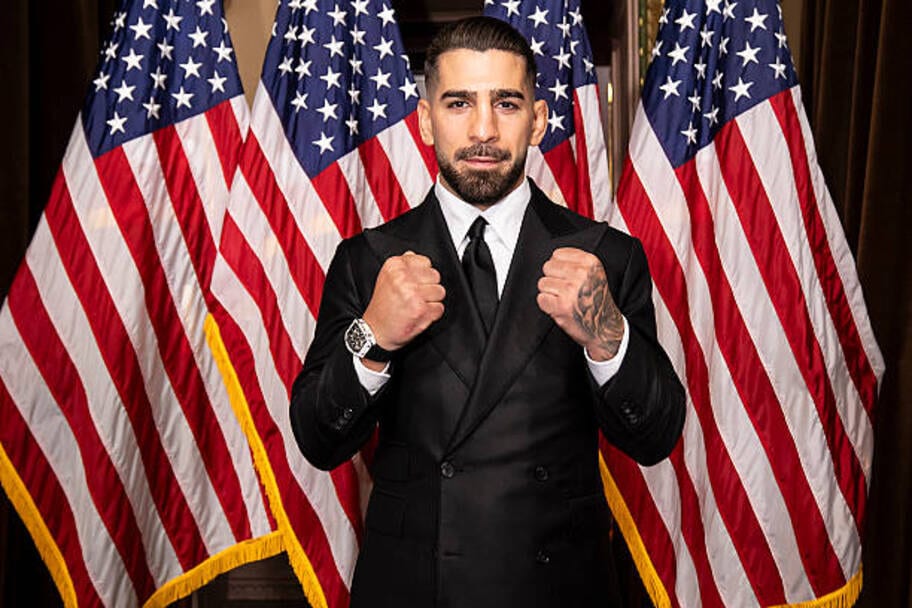
Jones did not frame Topuria as merely another explosive contender. In a recent interview, the former light-heavyweight and heavyweight champion recalled seeing the younger fighter as nearly unbeatable before the White House card. He said Topuria was the first athlete he seriously imagined threatening the informal greatest-of-all-time title that has followed Jones for much of his career. That is a striking endorsement from a man whose own résumé spans championship runs in two divisions, victories over multiple generations of elite opponents and a heavyweight title defense against Stipe Miocic.
What made the comments more revealing was the tension Jones described. He wants future athletes to surpass existing standards because that is how sport progresses. At the same time, he acknowledged a personal desire to protect the reputation he has built for his family. Those feelings are not mutually exclusive. A champion can admire a potential successor and still feel protective of the work that established the benchmark. Jones was unusually open about that competitive instinct, and the admission gives his praise more weight than a routine compliment at a press conference.
Jones also made clear that his interest in Topuria extends beyond statistics. He singled out the fighter's boxing, power, composure and self-belief, while admiring the fact that Topuria appears motivated by the craft rather than only financial necessity. None of those qualities disappeared when Gaethje won. A stoppage changes a record, not the technical foundation that produced years of success. It does, however, change the way opponents and fans evaluate the aura surrounding that foundation.
That distinction matters in a sport where legacy debates often swing on the latest result. Jones's assessment was based on a body of work, not one dramatic entrance or promotional slogan. His latest remarks are therefore less a withdrawal of support than a reminder that a potential successor still has to survive the kind of adversity the legends are eventually forced to confront.
Why Topuria looked ready to rewrite the record books

Before the Gaethje fight, Topuria had assembled the kind of championship résumé that invites ambitious comparisons. He entered UFC Freedom 250 with a 17-0 professional record and titles won in two weight classes. His breakthrough at featherweight included a knockout of Alexander Volkanovski, one of the division's defining champions. He followed it by becoming the first fighter to knock out Max Holloway, whose durability had long been treated as a nearly permanent feature of his career. Those were not carefully selected opponents at the edge of relevance. They were elite names with established championship credentials.
Then came the move to lightweight. In June 2025, Topuria stopped Charles Oliveira in the first round at UFC 317 to capture the vacant 155-pound title. The result suggested that his precise, compact boxing could carry its power into a larger division. He did not need a prolonged adjustment period or a succession of low-risk fights to make his case. He crossed a weight boundary and immediately delivered another defining finish. For someone like Jones, whose own career became a study in adapting skills to different physical challenges, that kind of jump was a persuasive signal.
Topuria's threat was never only about punching hard. He can pressure behind sharp combinations, control distance well enough to make counters dangerous, and draw on a submission background when exchanges hit the mat. More importantly, he seemed capable of applying those tools under the brightest lights without becoming tentative. Confidence helped him impose a rhythm on accomplished opponents who were accustomed to controlling their own fights. That combination of technique, finishing ability and competitive certainty made the unbeaten record feel earned rather than accidental.
Still, an undefeated record is a snapshot, not a guarantee. Topuria's victories showed that he could punish openings and seize opportunities against world-class opponents. They did not prove he would always have the answers when a durable rival survived the early danger and forced him to fight from an unfamiliar position. The next chapter of the story would expose precisely that unanswered question.

Gaethje found the limits of the invincible image

The White House main event did not unravel because Topuria suddenly forgot how to fight. It turned because Gaethje absorbed serious danger and kept solving problems. Topuria attacked the body effectively and hurt the challenger in the second round. For a stretch, the champion's combination of power and ground control appeared ready to preserve his unbeaten streak. Gaethje instead survived those moments, returned to his jab and right hand, and made the exchanges increasingly expensive for Topuria as the contest progressed.
By the third round, Gaethje's pressure and accurate punches had changed the physical condition of the fight. Topuria was visibly damaged around the face, and the momentum no longer belonged to the man who had been expected to dictate it. The fourth round still contained meaningful resistance from Topuria, including grappling exchanges, but his corner ultimately stopped the bout before the fifth could begin. The official result was a fourth-round technical knockout by corner stoppage, giving Gaethje the undisputed lightweight championship and handing Topuria his first professional loss.
That result matters tactically because it offered future opponents a different kind of blueprint. Topuria remains dangerous when he can set the pace and force a rival to react to his hands. Gaethje showed that surviving the initial threat, maintaining a functional jab and competing relentlessly in the later rounds can turn those strengths into a more complicated fight. It would be simplistic to claim that every contender can reproduce Gaethje's durability or his willingness to exchange under fire. The champion's performance was exceptional precisely because so few fighters can absorb that level of punishment and still respond coherently.
One defeat should not flatten Topuria's previous accomplishments, but neither should the manner of defeat be waved away as bad luck. He has technical questions to answer about pacing, defensive adjustments and how to reset when an opponent refuses to retreat. Those questions are the substance of the comeback. They are also why Jones's earlier belief in an invincible future is now an intriguing hypothesis rather than a conclusion already proved.
The comeback will say more about Topuria than the unbeaten streak

Jones did not suggest that Topuria's story was finished. Because the two fighters share a manager, he said he had heard encouraging things about the former champion's approach to recovery. That is a meaningful endorsement, but it is not a medical update, a return-date announcement or a guarantee of another title opportunity. Topuria's camp still has to make decisions about health, training and timing before the conversation moves from admiration to an actual booking. The most useful response to the defeat would be a complete recovery followed by the right competitive test, not a rushed attempt to repair an image.
Gaethje, meanwhile, owns the championship Topuria was expected to retain. The division cannot be treated as though the June result was a temporary inconvenience that matchmakers can simply erase. Arman Tsarukyan has a substantial contender's case, Charles Oliveira remains relevant after his own resurgence, and other lightweights have ambitions that do not pause for a former champion. A rematch could eventually be compelling, particularly given the drama of their first meeting, but it would need to make sense alongside the division's wider title picture. There is no confirmed immediate Jones-inspired comeback fight to circle on a calendar.
For Topuria, the next tactical test is likely to be more revealing than another fast knockout of a favorable opponent. Can he stay disciplined when a rival survives his first heavy exchanges? Can he preserve his defensive shape when the pace becomes uncomfortable? Can he adapt his boxing and grappling choices without losing the aggression that made him exceptional? These are answerable questions, and answering them would strengthen rather than diminish the case for his place among the greats. Some champions never encounter that problem until late in their careers; others are forced to solve it in public.
Jones's career offers a useful comparison in ambition, not an exact roadmap. Longevity, quality of opposition, title defenses and adaptation across different phases of a career all matter in an all-time discussion. Topuria already has extraordinary wins, but he needs another stretch of elite results before he can credibly challenge the sport's longest résumés. The first loss does not make that impossible. It simply changes the evidence required. If he returns with better answers, Jones's prediction may eventually look perceptive rather than premature.

Jones's admission that he once saw Topuria as a threat to his own GOAT standing says as much about the former champion's ceiling as it does about Jones's respect for greatness. Gaethje's win supplied the missing counterargument: potential, even when backed by spectacular victories, is not the same as an unbroken legacy.
Topuria has already shown he can beat champions. His next task is to show how he responds when a champion beats him. That response — not the old zero in his loss column — will determine how far the comparison with Jones can travel.

















