

Detroit Ended San Antonio's 12-Game Streak. The Paint Told the Story.
GOATIFYTwelve consecutive wins are supposed to make a team look inevitable. San Antonio had started to feel that way: a 12-game run, a 12-2 record and Victor Wembanyama operating as the problem opposing coaches could not solve. Detroit arrived short-handed, fell 14 points behind and still walked out of San Antonio on Tuesday, November 17, with a 105-93 victory. The Pistons did not merely win a close finish. They held the Spurs to 39 points across the second and third quarters, then kept them from mounting the kind of fourth-quarter response that had sustained their streak.
Cade Cunningham supplied 27 points, but the game cannot be explained as one star outscoring another. Daniss Jenkins scored 25, including 21 after halftime. Ausar Thompson filled the stat sheet with 14 points, 12 assists, nine rebounds and five steals. Detroit won the paint battle 60-44, produced 24 fast-break points to San Antonio's 15 and assisted on 31 baskets. Those are not separate trivia entries. Together they describe a team repeatedly deciding where the next possession would be played.
Wembanyama still finished with 25 points and 18 rebounds. The Spurs even held a 33-26 lead after one quarter and a double-digit advantage in the second. Their collapse therefore was not proof that their franchise player vanished or that a long winning streak was a mirage. It was a sharper, more useful question: what happens when a defensive team refuses to let one extraordinary player dictate every part of the game? Detroit offered a forceful answer, and the numbers explain how.
Detroit Erased 14 Points by Winning the Possession Battle
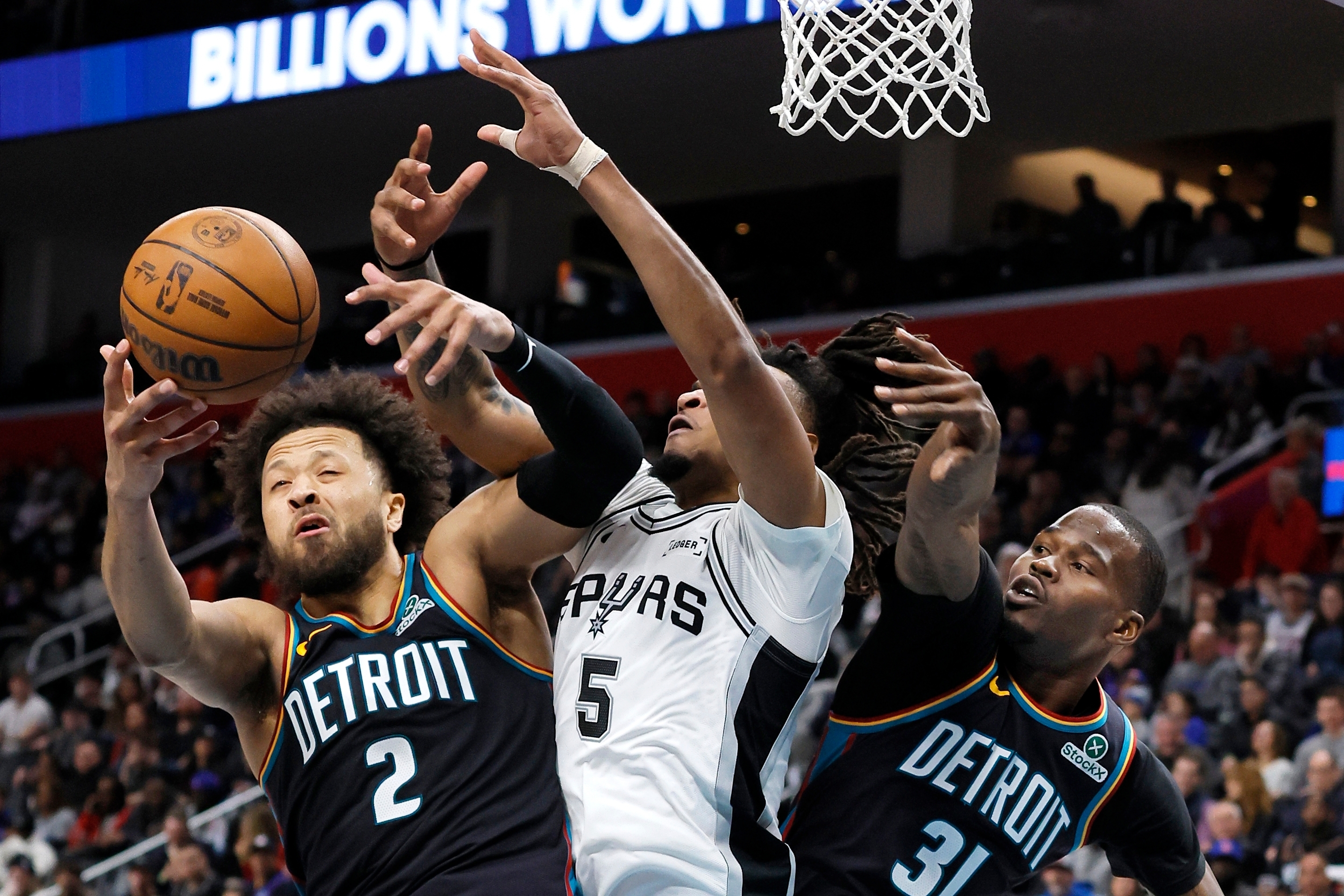
At the first break, San Antonio had 33 points and a seven-point lead. The Spurs had produced five first-quarter dunks, Wembanyama had already scored 10, and Detroit faced exactly the scenario that can discourage an opponent in that building: a fast, confident home team reaching the rim before the visitor can organize its defense. Early in the second quarter, that advantage reached 14. Had Detroit tried to erase it with a rush of contested outside shots, the game might have become a comfortable streak extension.
Instead, the Pistons made the comeback about the quality of possessions rather than the urgency of the scoreboard. They launched a 21-7 second-quarter run and closed the period by exploiting the minutes when Wembanyama was resting. The first-half split was unusually stark: San Antonio was plus-12 with him on the floor and minus-12 without him. That is not a complete statistical diagnosis of a rotation after only 24 minutes, and it does not establish that every Detroit score was caused by one particular matchup. It does tell us how concentrated the Spurs' early resistance had been.
Detroit took its first halftime lead, 55-54, then won the third quarter 23-18. Put those two periods together and the Pistons outscored San Antonio 52-39. It was the long middle stretch, not a miraculous last-minute shot, that reversed the game. The Pistons then finished with a 27-21 fourth quarter to make sure the comeback was not another temporary fluctuation. It was a sustained change in who could dictate the next shot.
The final shot chart is revealing even without pretending to assign every basket to a specific play call. Detroit scored 60 points in the paint against San Antonio's 44, despite Wembanyama's unusual reach and his presence around the basket. A team that can still create inside opportunities against that kind of back-line defender forces hard choices. Stay home at the rim and allow a guard room to organize; step toward the ball and expose a cutting lane; switch and risk a smaller defender facing an attacking wing. Detroit's success does not mean the Spurs selected the wrong answer every time. It means their answers stopped being sufficient for long enough to lose control.
GOATIFY
GOATIFY Basketball
Shop GOATIFY basketball shirts, hoodies and stickers.


Kobe Bryant – The GOAT Mamba Crewneck Sweatshirt
A basketball fan design for everyday wear.
Shop Now ↗


Dennis Rodman G.O.A.T. - Chicago Bulls Sticker
Add basketball personality to your favourite gear.
Shop Now ↗
Victor Wembanyama Alien Wemby NBA Basketball Mug
Add basketball personality to your coffee break.
Shop Now ↗Detroit also converted 45 of 91 field-goal attempts, 49.5%, while San Antonio made 37 of 89, 41.6%. Neither team's three-point numbers were glamorous: the Pistons went 6-for-25 and the Spurs 9-for-40. That makes the outcome harder to dismiss as a freak shooting night. A winning team actually made fewer threes and still scored 12 more points because it was more dependable closer to the basket and in the possessions between set plays.
The significance reaches past one November result. Long streaks can obscure how a club behaves when its preferred rhythm is interrupted. Detroit was already down, undersized by circumstance and playing away from home. It responded with a repeatable proposition: create more favorable interior possessions than the opponent, and make enough defensive stops that one great scorer cannot compensate.
Ausar Thompson Was the Glue Between Stops and Scores
There is a way to watch this Detroit win as a duel between Cunningham and Wembanyama. The box score gives that interpretation plenty to work with: 27 points for one star, 25 and 18 rebounds for the other. But Ausar Thompson is the player whose line best explains how the Pistons turned isolated defensive events into an entire style of play. Fourteen points, 12 assists, nine rebounds and five steals is a near triple-double with a defensive signature attached.
Five steals matter on their own because they remove a normal shot opportunity from an opponent. They matter even more when a player can turn the interruption into immediate offense. The Pistons won the fast-break scoring 24-15. Those nine extra transition points are not all attributable to Thompson, and it would be misleading to assign them to a single defender. Yet his combination of active hands, recovery speed and passing vision is precisely what makes that statistical gap plausible as a team identity rather than an accidental bounce.
The 12 assists may be the more surprising number to people who think of Thompson mainly as a defensive specialist. Detroit finished with 31 assists compared with San Antonio's 25, and Thompson accounted for more than a third of his team's total. His value was not confined to forcing the next error. Once he helped create a broken floor, he could make the next decision quickly enough to preserve its advantage. A steal that becomes a rushed, poorly spaced possession is an opportunity wasted. A steal that becomes an organized advantage is a different kind of defense.
Thompson also collected nine rebounds, five of them at the offensive end according to the game box score. Those second-chance opportunities keep pressure on an interior defense that is already being asked to protect a large area. Against a player like Wembanyama, it is easy to view every possession as a one-on-one attempt to finish over the biggest defender. Detroit's better answer was often to keep bodies moving, attack the rebound and make the possession continue even after the first look failed.
None of this requires claiming that Thompson personally shut down Wembanyama; the Spurs star scored 25 and collected 18 boards, which would be an excellent night against most opponents. Defensive success against a player that productive often means controlling what happens around him: limiting clean support, forcing the ball to move under pressure, and denying the easy transition opportunities that turn a star's good quarter into a team-wide scoring run.
Thompson gives Detroit flexibility because his line does not require an offense built entirely around his own shot. He can contribute by setting the tempo of the next defensive possession, finding an open teammate, collecting a miss and attacking a seam. That is why his numbers deserve to appear next to the headline scorers rather than below them. Detroit did not have to choose between playing disruptive defense and moving the ball intelligently. On this night its most disruptive wing helped do both.
GOATIFY
GOATIFY Basketball
Shop GOATIFY basketball shirts, hoodies and stickers.

Michael Jordan – Free Throw Line Dunk Sticker
Add basketball personality to your favourite gear.
Shop Now ↗
Crying LeBron – Emotional NBA Basketball Sweatshirt
A basketball fan design for everyday wear.
Shop Now ↗
Victor Wembanyama GOAT Basketball Pullover Hoodie
A basketball fan design for everyday wear.
Shop Now ↗


Daniss Jenkins Turned the Second Half Into Detroit's

Detroit's second-half scoring was not a one-man Cade Cunningham rescue mission. Jenkins scored 21 of his 25 points after the break, a distribution that turns an already productive night into something more important: he was the additional source of offense just when San Antonio had to decide where to send its defensive attention. Cunningham scored 27, but Detroit also had a guard whose best work came after the Spurs had already watched a first-half lead evaporate.
Jenkins shot 11-for-21 from the field, including 3-for-7 from three-point range, and added five assists. His 25 points were not the by-product of an unusually large diet of free throws; he did not need a free throw attempt to reach that total. That detail matters for how the game should be interpreted. The Pistons were not simply surviving through repeated trips to the line. They found enough workable attempts from the floor to keep scoring while denying San Antonio a sustained run back.
There is a broader roster story behind those numbers. Detroit was without Jalen Duren because of a strained right hamstring, Duncan Robinson because of a strained left quadriceps and Isaiah Joe because of a right hip contusion. Each absence changes a different piece of the normal rotation. Duren affects size and interior finishing; Robinson and Joe affect spacing and perimeter depth. A team that suddenly loses familiar options can become more predictable, particularly late in possessions when an opponent knows which star must finish the play.
Jenkins changed that calculation. He gave the Pistons a credible second scoring engine while Thompson created chances through activity and passing. Cunningham could remain the offensive reference point without being the only player who could make a defense react. Detroit's 31 assists suggest the ball did not stop every time it reached the most famous name on the roster, even as Cunningham's 27 points guaranteed that San Antonio could not ignore him.
It is tempting to use a performance like this to declare a new hierarchy, or to predict exactly how many minutes Jenkins should receive once every injured player returns. One game is not enough evidence for either conclusion. Role sustainability depends on lineup combinations, opponent matchups and whether his shooting and decision-making hold up when teams prepare specifically for him. The narrower but meaningful conclusion is supported right now: against a winning opponent, with major rotation pieces missing, Detroit found high-level offensive production from a player it could not afford to have disappear.
That distinction matters for the Pistons' ambitions. The best opponents in a long season will not allow Cunningham to solve every coverage with the same action. They will force the second creator to make decisions quickly. Jenkins' performance was an example of that demand being met rather than a guarantee that the problem has been permanently solved. It was still the difference between a spirited comeback and a victory that held through the final quarter.
Wembanyama Produced. San Antonio's Supporting Structure Didn't
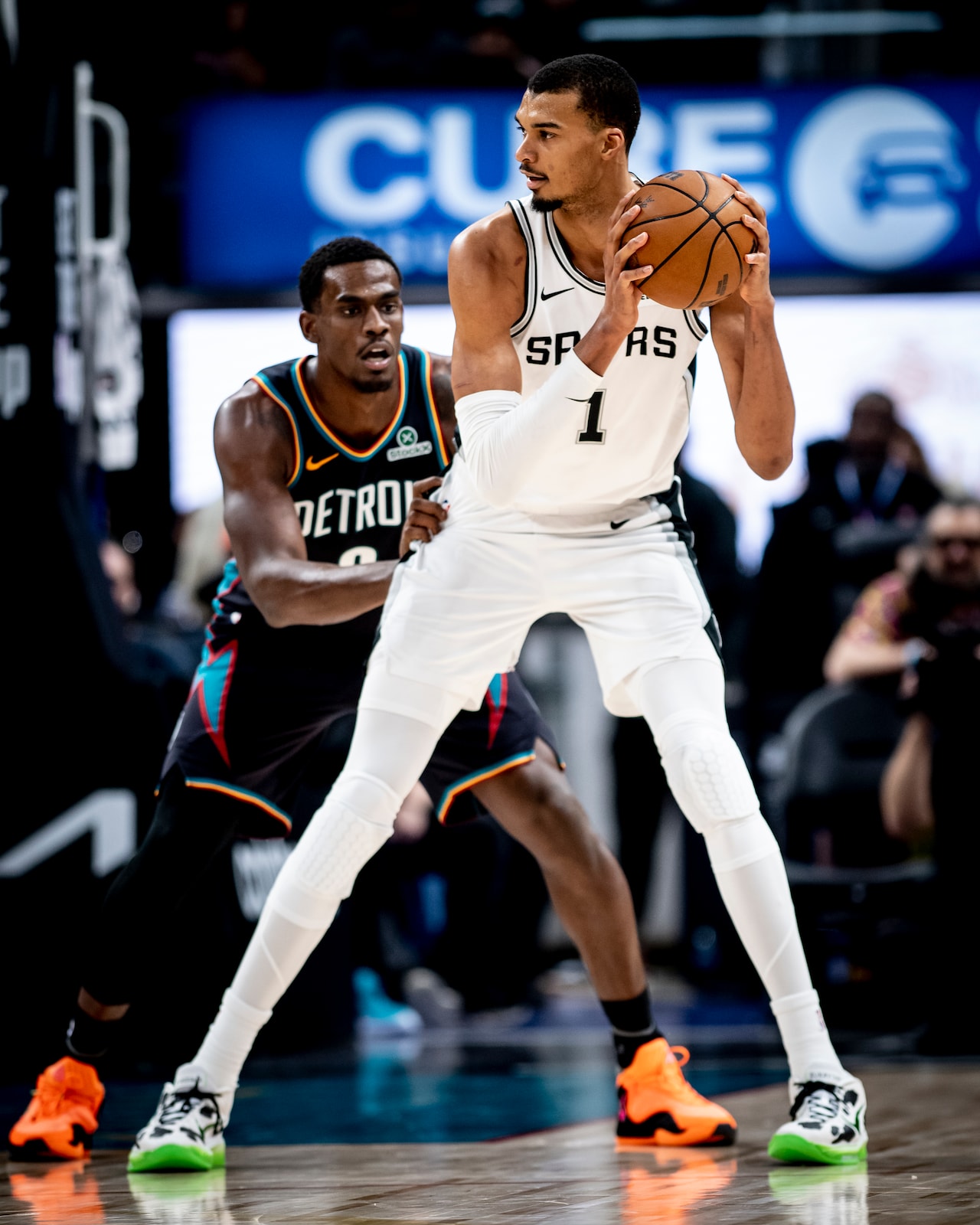
A 25-point, 18-rebound night is not evidence that Victor Wembanyama failed his team. He was already on 10 points in the first quarter and even improvised a spectacular self-assisted dunk off the backboard over Thompson's outstretched arm. Those moments are why San Antonio can look overwhelming when its offense is flowing. Even against a team committed to crowding the paint and contesting every advantage, the Spurs' center remained productive.
The problem was the space between his contributions. San Antonio scored 93 points as a team, shooting 41.6% from the field and 22.5% from deep on 40 three-point attempts. That is a lot of perimeter volume for nine made threes. One cold evening beyond the arc is not necessarily a structural weakness; any team can miss available shots. But the combination of missed jumpers, lost control of the interior scoring and extra Detroit transition chances made each empty trip more expensive.
GOATIFY
GOATIFY Basketball
Shop GOATIFY basketball shirts, hoodies and stickers.


Basketball Alien Wemby UFO Abduction Design Tank
A basketball fan design for everyday wear.
Shop Now ↗

Basketball Victor Wembanyama GOAT Sticker
Add basketball personality to your favourite gear.
Shop Now ↗
Basketball Victor Wembanyama Sci-Fi Alien Hoodie
A basketball fan design for everyday wear.
Shop Now ↗
Dylan Harper supplied 20 points, an important second scoring contribution in a game when other options did not consistently sustain the offense. His night also ended with a worrying moment: with 53 seconds left, his left foot slid from under him and he fell awkwardly. His condition was unknown in the immediate postgame reporting. It would be irresponsible to turn that uncertainty into a medical diagnosis or a speculative return date. What can be said is that San Antonio already had a difficult game to process without adding a clear question about a key guard's availability.
The team statistics distinguish the two clubs' styles on this particular night. Detroit assisted on 31 makes and lost the ball 11 times. San Antonio posted 25 assists and 15 turnovers. A four-turnover margin is not huge in isolation, yet alongside Detroit's five-steal performance from Thompson and its edge in fast-break points, it reinforces the sense that the visitors were more reliable in the possessions that determine momentum. The Spurs were not entirely disconnected offensively, but their mistakes became more consequential while their outside attempts failed to balance the interior deficit.
The streak itself still deserves context. Twelve wins in a row are hard to assemble in the NBA, and one defeat does not erase the habits that produced them. San Antonio entered Tuesday having turned a poor 0-2 start into a 12-2 record. Wembanyama remained a genuine two-way force, and Harper showed he could shoulder meaningful scoring responsibility. A serious team can lose to another serious team without revealing a fatal flaw.
What the result does reveal is a benchmark for the Spurs' next phase. Can they protect the paint without leaving so much work to one extraordinary defender? Can their ball handlers limit the live-ball mistakes that lead directly to fast breaks? Can the offense find efficient shots when an opponent does not panic after an early double-digit deficit? Those questions are more valuable than trying to assign blame for a 12-point loss. San Antonio hosts the Clippers next; Detroit visits New Orleans. The schedule offers both clubs an immediate chance to test whether this was a single-game swing or the beginning of an adjustment that lasts.
Detroit did not end a 12-game winning streak with a miracle shot. It did it by changing where the game was played. The Pistons attacked inside, assisted on 31 baskets, won the transition scoring and held San Antonio to 93 points despite Wembanyama's 25 and 18. Cunningham remained the biggest scoring name in a balanced effort, but Jenkins' second-half surge and Thompson's five steals and 12 assists are what made the outcome feel less dependent on one superstar's touch.
The Spurs can keep almost everything that was promising about their first 14 games and still take this defeat seriously. Their early 14-point lead did not protect them once Detroit's pressure became sustained, and their 9-for-40 three-point showing gave them too little margin for error. A contender's test is not whether its stars can deliver impressive box scores; it is whether the rest of the system survives a night when the other team has a better answer. On November 17, Detroit had the better answer.
That is also why this was more than a streak ending. San Antonio will have more nights when Wembanyama looks unstoppable. Detroit demonstrated it can beat one of them anyway, even without several regular rotation players. The statement was not that the Spurs are suddenly ordinary. It was that the Pistons may be a difficult problem for anyone who assumes a star advantage alone is enough.
GOATIFY
GOATIFY Basketball
Shop GOATIFY basketball shirts, hoodies and stickers.

Basketball Victor Wembanyama Space Jam Dunk Tee
A basketball fan design for everyday wear.
Shop Now ↗


Victor Wembanyama Alien Wemby NBA Basketball Sticker
Add basketball personality to your favourite gear.
Shop Now ↗
Wemby G.O.A.T. - Victor Wembanyama Basketball Mug
Add basketball personality to your coffee break.
Shop Now ↗















