

Gane Survived 48–47. Hokit Changed the Heavyweight Conversation.
GOATIFYCiryl Gane still owns the UFC heavyweight championship, but November 14 at Madison Square Garden did little to make the division feel settled. The French champion beat Josh Hokit by unanimous decision at UFC 334, with all three judges returning the same razor-thin score: 48–47. Hokit arrived unbeaten, barely a year into his UFC run, and spent much of the night making a much more experienced titleholder fight at a speed and distance he did not want.
There was a stark difference between the official verdict and the atmosphere inside the arena. Hokit, whose abrasive promotional persona had already turned the build-up into theater, pressed Gane with takedown attempts, unorthodox punches and exhausting clinch work. Gane absorbed the storm, found his cleanest work late and left with the belt. His challenger left with the first defeat of his professional career and a far stronger claim to being taken seriously at the top of the weight class.
UFC 334 was not solely a heavyweight story. Kayla Harrison also stopped Amanda Nunes by fourth-round rear-naked choke in a long-delayed women's bantamweight title defense. Together, those results produced two very different demonstrations of championship resilience: one titleholder survived on the cards, while the other forced a returning legend to submit.
Hokit Brought His Blaydes Pace Into a Five-Round Title Fight
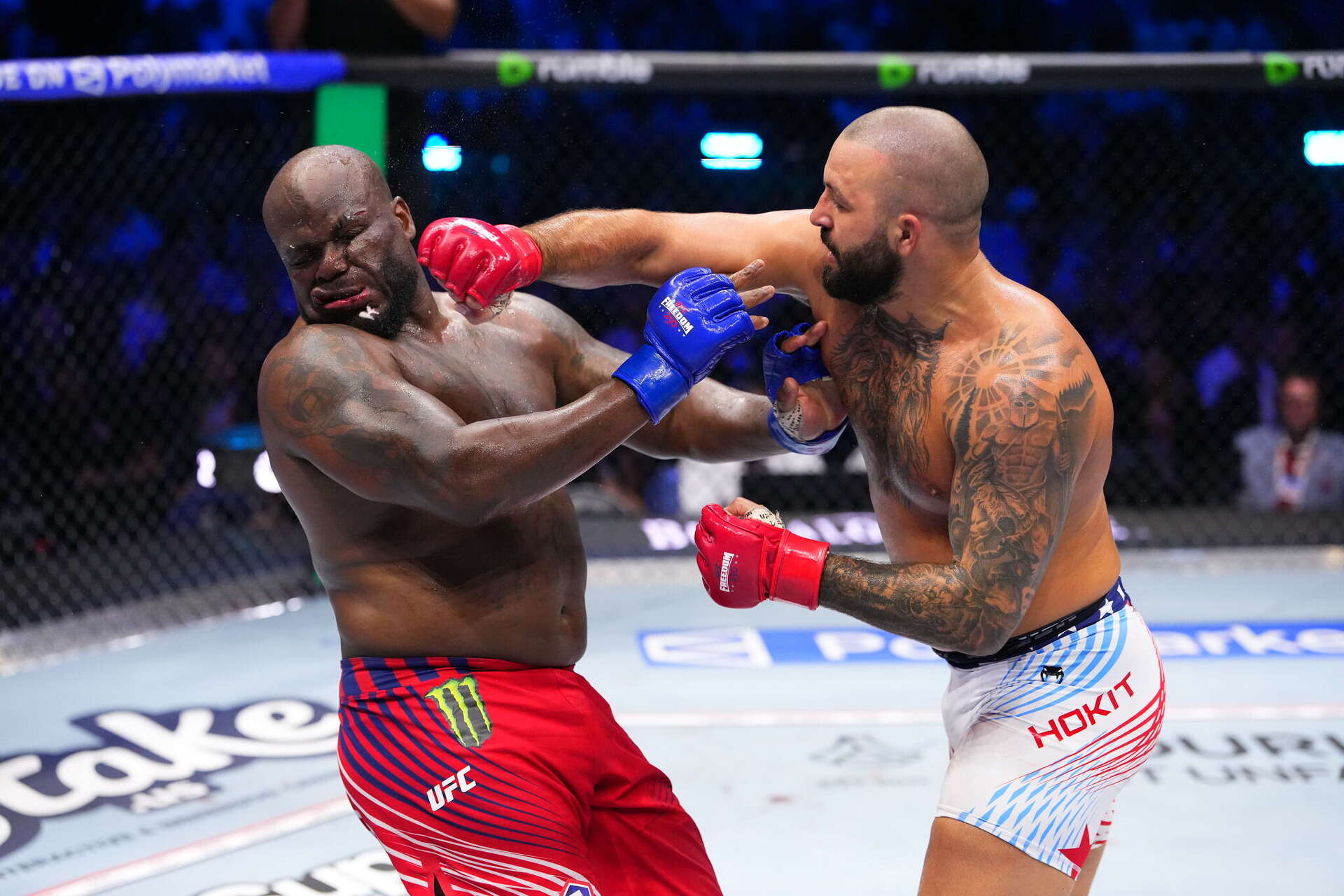
Before he made Gane defend the championship for a full 25 minutes, Hokit had established one particularly inconvenient reputation: he simply did not let heavyweight opponents rest. His April victory over Curtis Blaydes turned into a high-volume three-round war that seemed to ignore the usual limitations of the division. He followed it with a June stoppage of Derrick Lewis, having already moved from newcomer to top-tier challenger at an extraordinary pace. Those wins explained both the hype and the risk of promoting him straight into a championship main event.
At UFC 334, his plan was immediately recognizable. Hokit shot in within seconds of the opening bell, made Gane defend the level change and then refused to let the champion enjoy extended stretches at his preferred long range. Rather than allowing Gane to establish a rhythm with kicks and measured footwork, the challenger made every reset temporary. He chased with looping punches, closed the distance behind them and kept searching for a grip or a body lock even after Gane broke contact.
Gane did not simply stand there absorbing punches. The champion landed jabs and uppercuts, got back to his feet when dragged down and repeatedly forced Hokit to earn each new entry. The issue was the cost of doing so. A technically clean counter does not necessarily break the momentum of someone willing to walk through it. As Hokit crashed forward, Gane was often forced to strike on the retreat rather than plant his feet and build combinations. The challenger turned that discomfort into a weapon.
GOATIFY
GOATIFY UFC & MMA
Hokit's rise from the Blaydes brawl to title challenger showed how much a fighter's pressure can change a division. Explore GOATIFY UFC and MMA designs.


Rogainz Joe Rogan UFC MMA Martial Arts Sticker
Add MMA personality to your favourite gear.
Shop Now ↗
The physical exchanges became increasingly messy. Hokit landed heavy rights in the second round, briefly got to Gane's back in the third and used elbows and short punches when the action stalled against the fence. Both men were marked by the confrontation. Even when a takedown failed to establish long-lasting control, the scramble still made Gane work. That distinction matters: the value of a wrestling threat is not limited to the time an opponent spends on the canvas.
The American's antics added noise, but they were never the main reason the fight was competitive. His pressure had been effective against Blaydes and Lewis; now it was effective against the champion as well. The open question was whether Hokit could keep delivering that pace over five rounds, not merely the three rounds in which he had already proved so difficult to contain.
There was also a deliberate contrast between the two men. Gane's game is generally built around managing space, drawing reactions and choosing the moment for the clean strike. Hokit tried to remove the time needed for those decisions. A champion can be more technically polished in individual exchanges and still spend long stretches fighting someone else's kind of fight. That was the challenge Gane had to solve as the championship rounds arrived.
All Three Judges Had It 48–47 — and the Final Ten Minutes Changed Everything
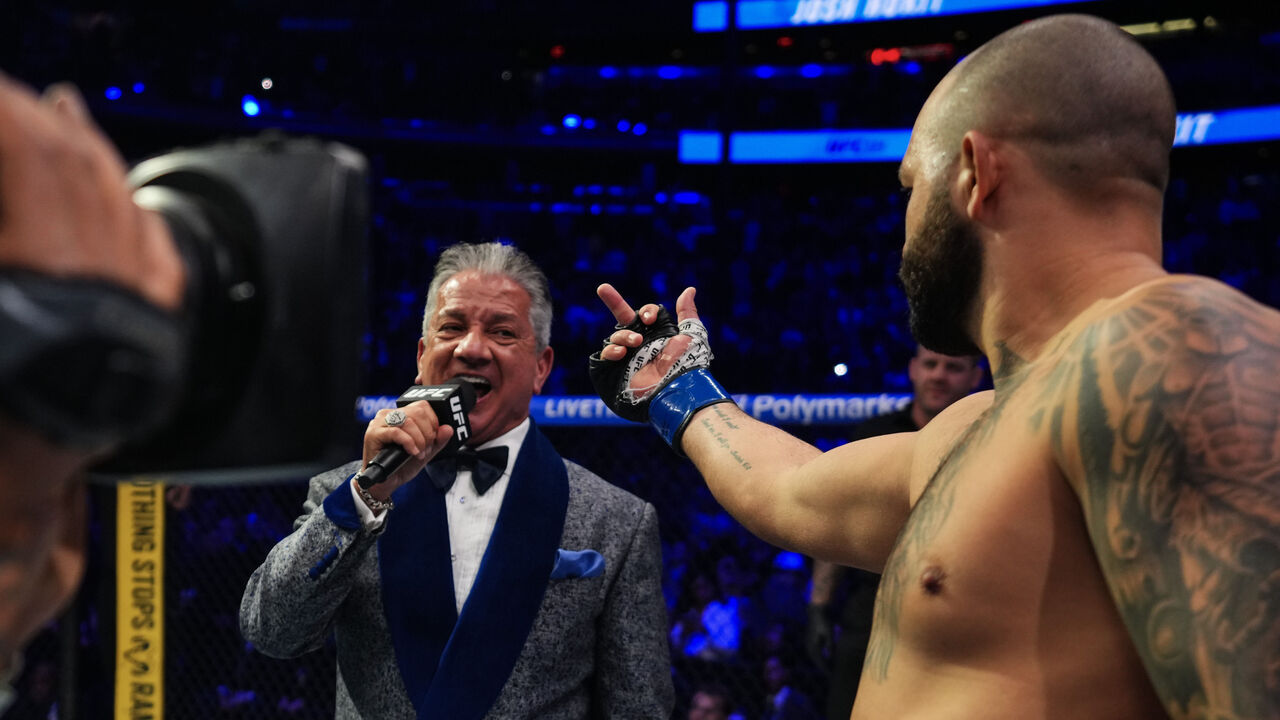
Three identical scorecards can look decisive until the numbers are read properly. A 48–47 result in a five-round contest is almost the opposite of a comfortable unanimous decision. It means each official awarded Gane three rounds and Hokit two. The judges did not agree on all the early-round details, but their cards converged at exactly the point that mattered: Gane won the fourth and fifth rounds on every scorecard.
That late consensus is the center of the result. Hokit had been ahead 29–28 after three rounds on all three official cards, although the officials differed about which early frames he had taken. His relentless attack had already created a real possibility of a title change. The final ten minutes were therefore not just a chance for Gane to make the fight look more respectable. They were a demand for the champion to reclaim control before it was too late.
Gane did so by changing the terms of contact. He started attacking the body more consistently with knees and short punches, particularly when Hokit was trying to close distance or hold him near the fence. The champion's uppercuts also became useful counters to the forward pressure. Instead of trying to match Hokit punch for punch in a frantic open exchange, Gane found ways to make the challenger pay for the energy each entry required.
By the fifth, Hokit's offense had lost some of its initial force. He still found hard right hands and still refused to abandon the pursuit, but his attempts to build pressure into sustained control were less productive. Gane scrambled out of an early takedown, landed straighter and cleaner blows at distance and increasingly dictated what happened after the two men separated. There was no dramatic knockdown or final-minute stoppage to simplify the judging; Gane had to win the smaller battles repeatedly.
GOATIFY
GOATIFY UFC & MMA
Gane's late-round adjustments decided three 48–47 scorecards. Browse GOATIFY fight-fan gear while reviewing the heavyweight title drama.


UFC GOAT Gold Middle Finger Fight Decal Sticker
Add MMA personality to your favourite gear.
Shop Now ↗

MMA GOAT Gold Middle Finger Fight Crewneck Sweatshirt
A MMA fan design for everyday wear.
Shop Now ↗
The striking output underlined how unusual the contest was for heavyweight. Event reporting credited Gane with 237 significant strikes landed, a record for a UFC heavyweight fighter, while the two men combined for 383. Those totals belong in the discussion because they challenge the lazy idea that a heavyweight title fight is always decided by a handful of isolated power shots. Hokit pushed an extraordinary pace, and Gane ultimately responded with an extraordinary volume of his own.
Yet the championship question should not be reduced to statistics. The champion retained against an opponent who was willing to attack his space, force defensive wrestling and test his cardio in ways that a more conventional striking contest might not. Gane's previous high-profile losses to Francis Ngannou and Jon Jones had already made his grappling defense a recurring topic. This performance did not erase those concerns, but it demonstrated that he can survive repeated entries, maintain composure and find answers late.
Gane entered as a champion whose route to the undisputed title was unusual. He stopped Alex Pereira for the interim belt in June before Tom Aspinall's ongoing eye problems led to the vacant-title situation that elevated Gane. After UFC 334, he can point to an actual championship defense rather than just a promotion in status. Hokit, meanwhile, goes to 10–1 with far more evidence that his style can trouble the best fighters in the division.
The fight earned another distinction beyond the title result: both athletes were reportedly sent to hospital afterward as a precaution, and their performance was recognized with Fight of the Night bonuses. That is an appropriate measure of the punishment and expenditure involved. The belt stayed in familiar hands, but the division learned that the challenger can carry a suffocating approach into the later rounds even against a champion known for movement and timing.
Harrison Submitted Nunes — and the Other Title Fight Had a Clearer Ending
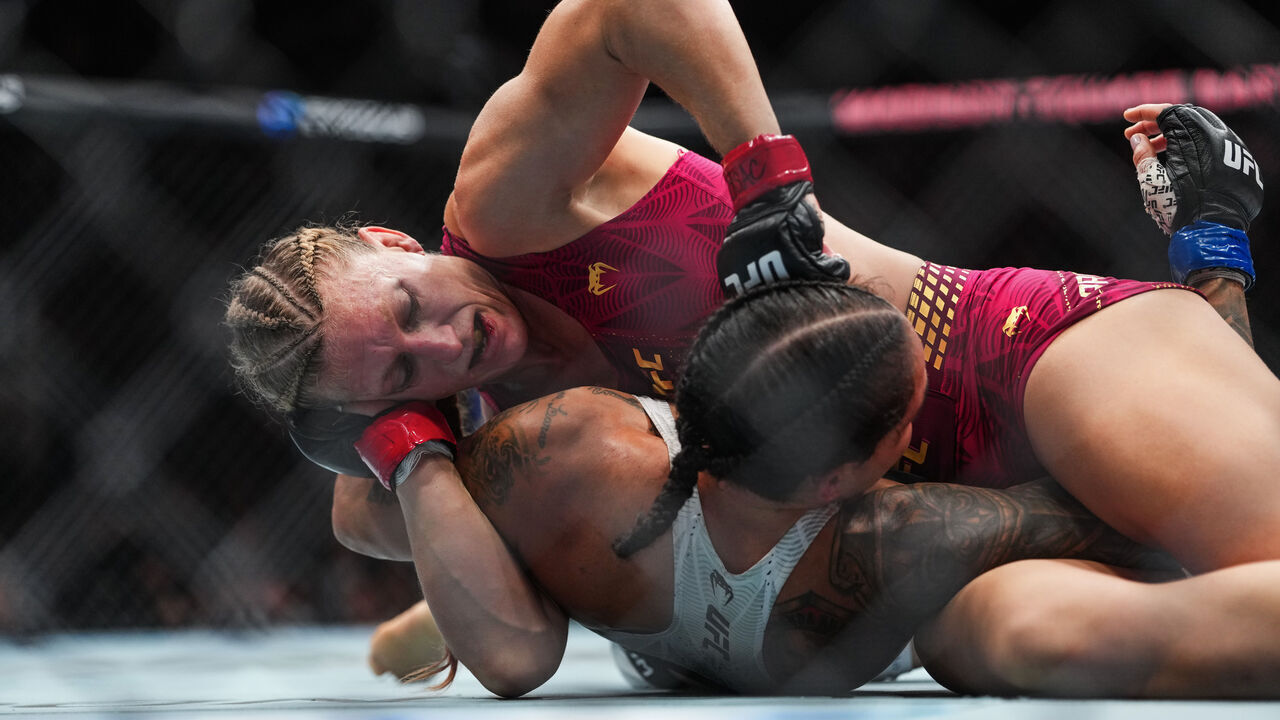
The co-main event offered a contrast that made the night richer than one close heavyweight decision. Kayla Harrison defended her women's bantamweight championship against Amanda Nunes, the former two-division champion returning after more than three years away. Unlike Gane, Harrison did not require the judges to interpret a difficult five-round fight. She ended the match herself with a rear-naked choke in the fourth round.
The significance began long before the finish. Harrison had not competed since winning the belt in June 2025, and a serious neck problem that required spinal fusion surgery in January 2026 had delayed this matchup. A lengthy layoff is difficult enough in elite combat sports; returning from neck surgery for a title defense against one of the sport's greatest fighters made the assignment more formidable. Nunes, for her part, was not returning for a routine tune-up. She had come back to challenge for a championship she once dominated.
The Brazilian did have moments of effectiveness with her striking, particularly before Harrison's grappling was fully established. But the fight repeatedly moved into the American's preferred territory. Harrison's background as a two-time Olympic judo gold medalist is not a guarantee of MMA success, where striking, cage work and submission awareness alter the equation. Here, however, she used clinch control and takedowns to dictate where long stretches of the contest took place.
GOATIFY
GOATIFY UFC & MMA
Harrison's grappling victory over Nunes made the UFC 334 co-main event unforgettable. Discover GOATIFY UFC and MMA apparel and accessories.

Nunes tried to work from top positions and to compete in transitions, but Harrison kept finding ways to recover, advance and make the exchanges costly. The champion applied pressure on the ground, landed short strikes and forced her opponent to keep defending instead of resetting to a cleaner striking contest. This was not a one-move finish produced out of nowhere. The fourth-round submission was the endpoint of accumulated positional advantages and repeated grappling engagements.
In the decisive sequence, Harrison caught a kick, brought Nunes down and moved quickly to take the back. Once the rear-naked choke was secured, the former champion tapped. Published reports differ slightly on the exact second of the stoppage, but not on the substance: it was a fourth-round submission and a successful first defense of Harrison's belt. For a fighter whose recent career had been interrupted by injury, that is an unmistakable sporting statement.
There is still an unresolved issue in the aftermath. Harrison described another difficult cut to the 135-pound limit and made clear that she has choices to make about her future. That means the division cannot simply assume its champion will accept the same weight-management demands indefinitely. Nunes, now 23–6 after this comeback defeat, has to decide whether another fight adds anything meaningful to a legacy built on championship wins across two divisions.
For now the division has an unequivocal competitive answer. Harrison beat the returning icon in the position most closely associated with her own athletic identity. The debate over historical greatness remains open to interpretation; the score of this particular fight does not. In a Madison Square Garden night where one belt survived by a single round on every card, the other was secured with the unmistakable finality of a tap.
UFC 334 left heavyweight with a champion, a newly credible contender and no obvious reason to pretend the matchup was easy. Gane's fourth- and fifth-round adjustment was the difference between retaining the belt and losing it. Hokit can review the first 15 minutes and see a path to another opportunity, but he will also have to answer the endurance question that separated an exceptional challenger from a champion.
Harrison's victory carries a different kind of weight. She survived a prolonged absence, took control of a landmark match with Nunes and kept the bantamweight belt through a submission rather than a close score. Whatever each woman chooses next, that outcome is now part of the division's defining history.
The Garden also hosted Stephen Thompson's farewell victory over Charles Radtke, an emotional reminder that the card was about careers as well as championship arithmetic. On one night, an undefeated heavyweight's record ended, an all-time great's comeback failed and a veteran took his final bow. Gane and Harrison left with their belts, but the stories around those belts changed dramatically.
GOATIFY
GOATIFY UFC & MMA
Shop GOATIFY UFC and MMA shirts, hoodies and fight fan gear.
UFC GOAT Gold Middle Finger Fight Decal Sticker
Add MMA personality to your favourite gear.
Shop Now ↗MMA GOAT Gold Middle Finger Fight Crewneck Sweatshirt
A MMA fan design for everyday wear.
Shop Now ↗


















