

Guo and Mladenovic Saved Six Match Points. Now the WTA Finals Get Serious.
GOATIFYSix match points saved. Two matches dragged back from the brink. One semifinal place that could easily have gone to a different team. Guo Hanyu and Kristina Mladenovic have turned survival into the defining story of the 2026 WTA Finals doubles event at Indian Wells, but escaping their round-robin group has only earned them a new examination against Sara Errani and Jasmine Paolini.
The last four were set on Friday after a pair of dramatic Group 1 finishes. Top seeds Gabriela Dabrowski and Luisa Stefani recovered from a set and break down to defeat Hsieh Su-wei and Jelena Ostapenko, extending their record to three wins from three. Then Guo and Mladenovic saved two match points against Elise Mertens and Zhang Shuai to clinch the remaining berth. Their earlier escape against Hsieh and Ostapenko had required four more.
That leaves a Saturday semifinal bracket with two very different arguments for the title: the top-seeded Canadians and Brazilians against reigning major champions Katerina Siniakova and Taylor Townsend, and the match-point survivors against the unbeaten Italian pair that was last to qualify for the season-ending event. The scores explain how they arrived here; the season-long patterns suggest what each matchup could become.
Six match points survived — and now an unbeaten Italian pair awaits
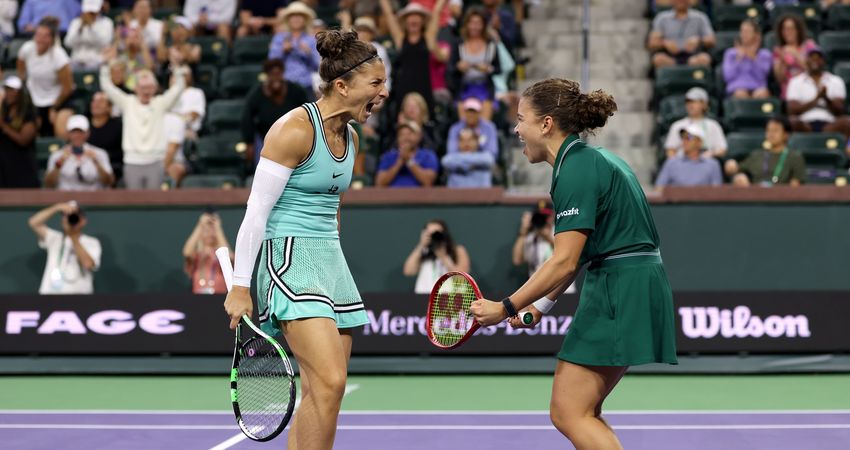
For much of Friday's last Group 1 doubles contest, Guo Hanyu and Kristina Mladenovic appeared to have run out of second chances. Elise Mertens and Zhang Shuai took the opening set in a tiebreak, only for Guo and Mladenovic to reset the match with a 6-3 second set. The place in the semifinals came down to a match tiebreak that reached the point at which one clean return, one missed volley or one nervously placed second serve could have ended their tournament.
Mertens and Zhang held two match points. Guo and Mladenovic survived both and eventually took the match 6-7(4), 6-3, [12-10]. The numbers are startling even before the earlier escape is added. Against Hsieh Su-wei and Jelena Ostapenko in their opening match, Guo and Mladenovic trailed 6-0 in the deciding match tiebreak, faced three match points at 9-6 and another at 10-9, yet somehow won it 12-10. Four saved that night and two on Friday make six potentially season-ending points rescued in just two group wins.
That was not merely a personal comeback. Dabrowski and Stefani's victory earlier on Friday had left Hsieh and Ostapenko needing Guo and Mladenovic to lose. The reverse result sent the third seeds through in second place at 2-1 and ended the fifth seeds' hopes. A best-of-ten match tiebreak is particularly unforgiving: it magnifies the effect of a first-return miss or a timid volley, but it can also swing quickly when the team behind stops protecting its score and starts playing the next ball with conviction. Guo and Mladenovic have shown they can function under precisely that pressure.
The semifinal asks something different. Sara Errani and Jasmine Paolini arrive unbeaten at 3-0, despite entering the field as the eighth and last pair to qualify. Their season did not always look as stable as the bracket now suggests. Paolini spent part of the year prioritizing singles before the pair renewed their partnership in the autumn, and the Tokyo title helped them secure a place in Indian Wells. Instead of treating that final qualification spot as a ceiling, they finished top of Group 2 and reached their first WTA Finals semifinal together after two earlier group-stage exits.
GOATIFY
GOATIFY Tennis
From six match points saved to the semifinal showdown, explore GOATIFY tennis apparel and fan gear.


They have met Guo and Mladenovic once this year: a match-tiebreak win for the Chinese-French pair in the Indian Wells quarterfinals. It is a useful psychological reference, but not a template. Errani's touch, angles and rapid decisions near the net give the Italians a way to shorten rallies without relying on raw pace; Paolini's court coverage can stretch opponents before the decisive ball. For Guo and Mladenovic, serving assertively and keeping the return deep will matter more than waiting for another late rescue. Their Wimbledon title and Mladenovic's two previous season-ending championships establish pedigree. They now need a semifinal performance that does not depend on being match point down first.
Dabrowski and Stefani went 3–0, but their final group match was anything but routine
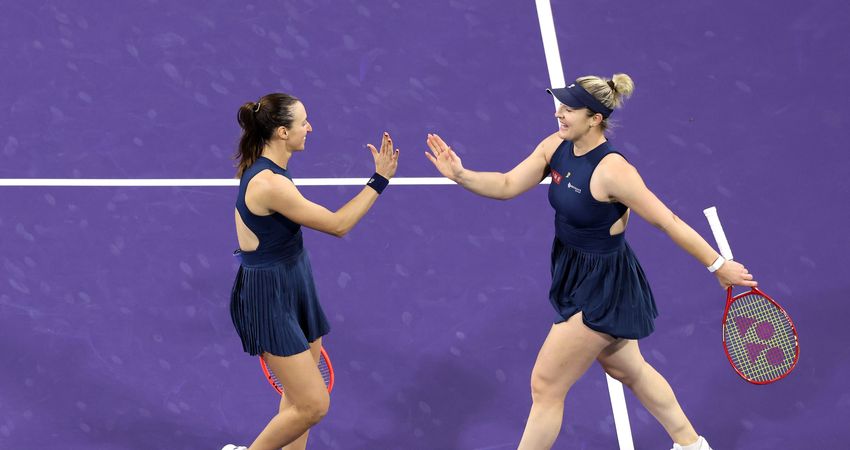
An unbeaten round-robin record can conceal a great deal of work. Gabriela Dabrowski and Luisa Stefani closed Group 1 at 3-0 by beating Hsieh Su-wei and Jelena Ostapenko 2-6, 7-6(2), [10-3]. The top seeds had lost the first set and fallen a break behind in the second. Their ability to extend the match into a tiebreak changed its entire emotional direction: once they won that set, the deciding ten-point contest became a demonstration of how quickly a partnership can reassert control.
The scoreline is important because it challenges the easy reading of the seedings. Dabrowski and Stefani have had the more consistent season, but consistency is not the same as cruising through every set. Hsieh's touch and unexpected racket angles can disrupt a conventional doubles rhythm. Ostapenko's power punishes short balls and tentative positioning. The top seeds had to protect their own service patterns, absorb changes of pace and stay decisive even after conceding the first set. They won the closing tiebreak 10-3, but getting there was the difficult part.
Their 2026 record helps explain why they could do it. Reunited this season after playing together earlier in their careers, the Canadian-Brazilian team collected six titles: Dubai, Strasbourg, Eastbourne, Sao Paulo, Beijing and Wuhan. Three came at WTA 1000 level, with the Beijing and Wuhan victories providing momentum late in the calendar. Their partnership had once been interrupted by a major injury to Stefani at the 2021 US Open, but the reunion has been built around continuity and shared decision-making rather than a quick experiment that happened to catch fire.
They have also confronted the fragility of a one-off championship match. At Wimbledon in July, Guo and Mladenovic beat them in the women's doubles final. At Indian Wells this week, Dabrowski and Stefani beat that same pair in the round robin, 7-6(5), 4-6, [10-5]. Those two results underline the fine margins at the highest level: a team can lose a Grand Slam final to one opponent and then take a major season-ending encounter from them without either outcome being a complete judgment of the matchup. The 3-0 group record is a legitimate achievement, not proof of immunity.
For Dabrowski, this is an eighth WTA Finals appearance and an opportunity to win another season-ending title after her 2024 success alongside Erin Routliffe. Stefani reached the final in 2025 with Timea Babos; this is their first Finals as a team. Both know the difference between collecting ranking points over months and solving an elite pair in a single afternoon. Their most persuasive advantage going into Saturday is not just the titles they have accumulated. It is that, when a match was moving away from them on Friday, they still found another route to the finish line.
Siniakova and Townsend have the head-to-head edge — and a different kind of pressure
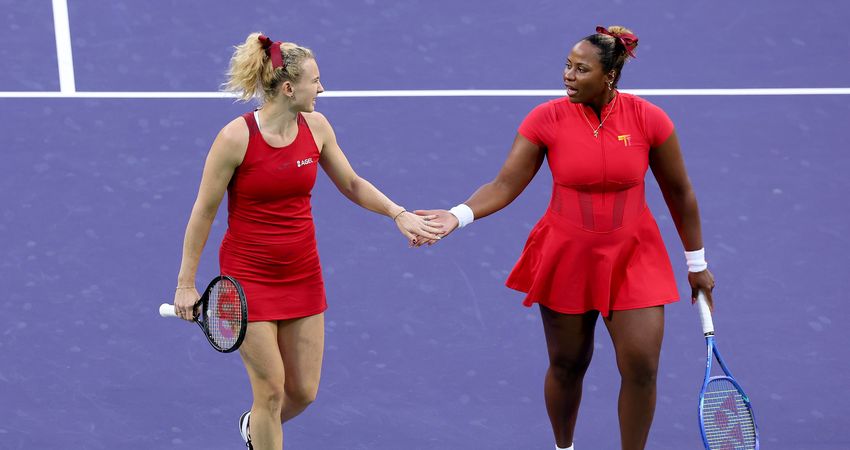
The other semifinal contains the event's clearest rematch narrative. Katerina Siniakova and Taylor Townsend, the second seeds, take on top seeds Dabrowski and Stefani. Their route out of Group 2 was less pristine: they finished 2-1, with the decisive win arriving when Cristina Bucsa and Nicole Melichar-Martinez retired because of injury while Siniakova and Townsend led 6-2, 4-2. A place in the last four is still a place earned through the round-robin format, but the final group score alone tells little about their readiness for the next match.
GOATIFY
GOATIFY Tennis
Follow the top seeds' comeback and the doubles title race with GOATIFY tennis styles.

Tennis GOAT Golden Racket & Ball Crewneck Sweatshirt
A tennis fan design for everyday wear.
Shop Now ↗

Tennis GOAT Golden Racket & Ball Decal Sticker
Add tennis personality to your favourite gear.
Shop Now ↗
The more revealing numbers are from earlier in 2026. Siniakova and Townsend have faced Dabrowski and Stefani twice and won both meetings. At Roland Garros they swept through the semifinal 6-0, 6-1, an unusually emphatic result between teams at this level. In Miami their semifinal was much tighter, but the Czech-American pair prevailed again in three sets. One result suggests a tactical mismatch; the other suggests that even when the match is competitive, they can find the last point. That is a significant advantage in preparation, though it does not decide a new contest in advance.
Their trophy cabinet is as strong as that history. Together they won Indian Wells, Miami, Madrid, Roland Garros and the US Open in 2026. Their Sunshine Double in March demonstrated hard-court command early in the season, and the two major titles showed the partnership had an answer on a much larger stage. Siniakova also secured a record sixth year-end No. 1 doubles ranking this week, with seven titles across her full season, five alongside Townsend and two alongside Zhang Shuai. Her place in the historical record is already established; what remains open is whether the partnership can convert its brilliance into a first year-end championship together.
The two have reached the WTA Finals semifinals in each of their three appearances as a team. They finished runners-up in 2024 and made the last four again in 2025. The obstacle this time is a pair that has won more titles together this season and entered the semifinals unbeaten. Dabrowski and Stefani can ask how much weight a June clay-court demolition should carry in November on a hard court. Siniakova and Townsend can point to Miami, another hard-court victory, as a more relevant reference. Neither argument replaces the need to hold serve, pressure second deliveries and win the first volley exchanges.
One subtle question is who gets to dictate the texture of rallies. Siniakova thrives when she can take returns early, close space and force opponents into awkward passes; Townsend's left-handed patterns can change the serving and returning angles without warning. Dabrowski and Stefani rely on coordinated movement and the willingness to vary positioning rather than become predictable. In a match between championship-tested duos, the tactical battle may be decided less by the spectacular point than by repeated small decisions: who covers the middle, who takes the overhead, and who keeps using the correct play at 8-8 in a match tiebreak. That is the pressure worth watching.
The decisive contrast in Indian Wells is not simply experience against momentum. All four semifinal teams have substantial doubles credentials, but they have reached the last four by different routes. Dabrowski and Stefani took the group unbeaten yet had to survive a dangerous reversal. Siniakova and Townsend enter with the deeper recent head-to-head advantage against their opponents. Errani and Paolini are the last qualifiers who have not lost a group match. Guo and Mladenovic have repeatedly been a single point from going home.
For Guo and Mladenovic, six saved match points are evidence of resilience, not a sustainable tactical plan. Their reward is the chance to prove the late-game precision they showed against Hsieh, Ostapenko, Mertens and Zhang can also hold up when an opponent is dictating from the first service game. And for the other three teams, Saturday offers a reminder that a season of trophies and rankings is only the qualification: the trophy is still decided on the court.
GOATIFY
GOATIFY Tennis
Shop GOATIFY tennis products from the Tennis-filtered collection scope.


















