

5 Gym Mistakes That Quietly Stall Muscle and Strength Gains
UPLIFT IRON CLUBWhen muscle and strength gains stall, the instinct is usually to hunt for a new split, a new exercise or a more complicated supplement stack. But plateaus often begin with simpler problems: vague goals, inconsistent programming, sets that never get challenging enough, motivation-dependent habits and expectations that move much faster than physiology.
Celebrity trainer Dan Roberts, who has spent more than three decades coaching athletes, actors and models, recently highlighted five mistakes he repeatedly sees in the gym. None requires a total rebuild. The useful lesson is that progress becomes much easier to diagnose when your training has a clear target, enough consistency to measure, and enough effort to force adaptation.
1. A Vague Goal Makes Good Training Hard to Measure

“Get bigger” and “get stronger” are directions, not measurements. A useful goal tells you what success looks like. That could mean taking your bench press from 100 kg to 110 kg, reaching ten strict pull-ups, adding two centimeters to your arms over a realistic period, or increasing a lift while holding bodyweight roughly steady.
The reason specificity matters is not motivational theatre. It gives the program a job. If your main target is a stronger squat, the squat and its supporting work should be stable enough to track. If your goal is hypertrophy, your weekly volume, exercise selection and progression should make it possible to tell whether performance is moving forward. Without that anchor, almost any hard session can feel productive even when the months are going nowhere.
Roberts also warns about changing training either too often or not enough. Randomly replacing exercises every week can make progressive overload difficult to see, while doing the identical session forever can leave obvious weaknesses untouched. The middle ground is structured variety: keep the key movements long enough to compare performance, then make deliberate changes when there is a reason.

2. Progressive Overload Only Works if the Sets Are Actually Challenging

A perfectly organized spreadsheet cannot compensate for training that never asks the body to adapt. Muscle and strength improve because training creates a meaningful challenge and recovery allows the body to respond. If you use the same load, the same reps and the same easy effort indefinitely, there is little reason for performance to keep climbing.
Progressive overload does not mean adding weight to the bar every session forever. You can progress by adding a rep with the same load, improving technique, increasing range of motion, completing the same work with better control, or eventually adding a small amount of weight. What matters is that the training stimulus trends upward over time while execution remains good.
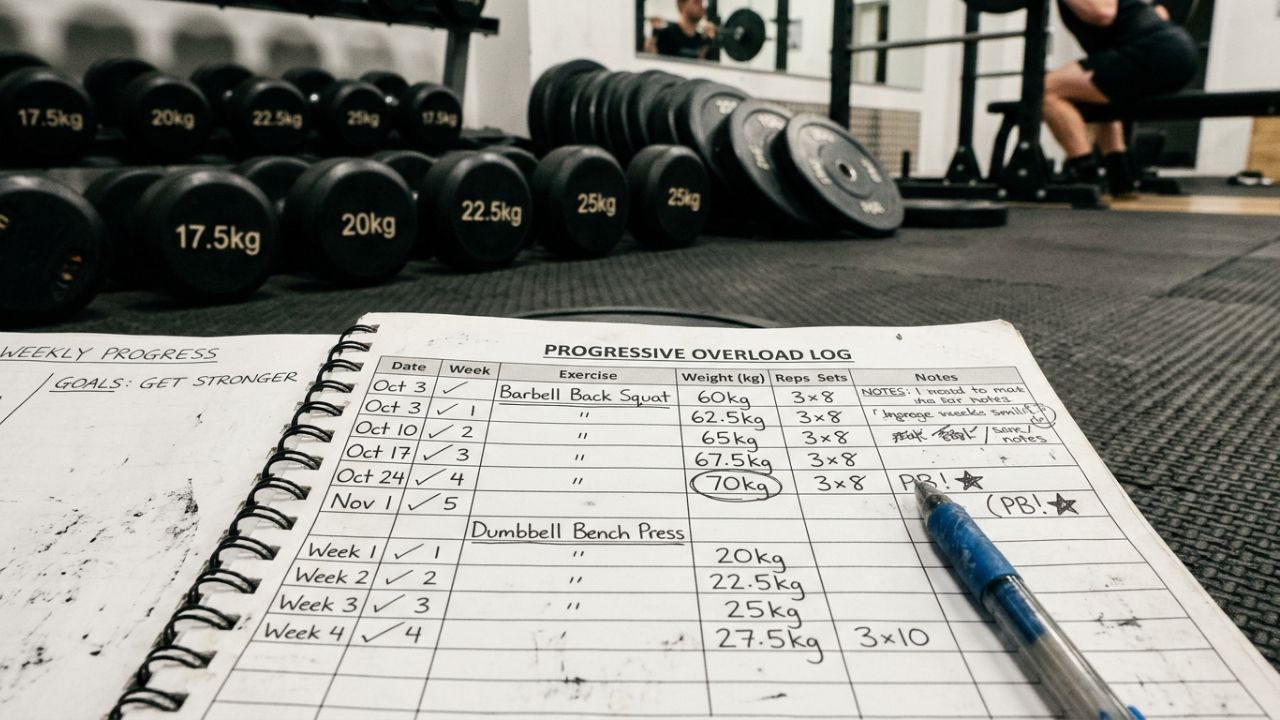
This is where a logbook earns its keep. If you can see what you did last week, you can enter the next session with a concrete target. A lifter who squatted 100 kg for 8, 8 and 7 reps has a simple challenge next time: earn that final eighth rep before rushing to add plates. Small improvements are easy to dismiss in a single workout, but over six months they are the entire game.
Hard training also needs judgment. “Challenging” does not mean turning every compound lift into a technical collapse. Most productive work should be hard enough that the final reps demand focus while still looking like the exercise you intended to perform. The goal is repeatable overload, not one heroic session that wrecks the following week.

3. Discipline and Patience Beat Constant Program Resets
Motivation is useful when it shows up, but it is too volatile to be the operating system for a long-term program. Sleep, workload, stress and mood all change. If every session begins with the question “Do I feel motivated today?”, training frequency becomes a reflection of your week rather than your plan.
A better system reduces the number of decisions. Put training at predictable times, know the first exercise before you arrive, keep a version of the session that can be completed on a busy day, and judge consistency over months rather than demanding perfection every week. The people who make the most progress are rarely fired up for every session; they simply make showing up normal.
The final mistake is expecting the body to change on an internet timeline. Early strength gains can arrive quickly, but substantial muscle, resilient technique and a genuinely strong base accumulate slowly. Six-week transformations are great marketing because six weeks feels close. They are a poor mental model for what years of progressive training can actually build.
That longer horizon changes how you interpret a bad workout. One flat session is not a failed program. A week without a personal best is not a plateau. Look for trends: Are loads or reps rising across several months? Is your technique improving? Are measurements, photos or bodyweight moving in the direction your goal requires? If yes, impatience is not a programming problem.
The practical fix for all five mistakes is simple: pick a measurable outcome, keep the main lifts stable enough to track, train them with appropriate effort, build a routine that survives low-motivation days, and give the process enough time to work. Complexity can be added later. Fundamentals need to be earned first.

Bodybuilding & Gym Collection
Gym shirts, pump covers and lifting designs built around bodybuilding culture.
EXPLORE COLLECTION







