

Buckner Returns for a Fourth — Colts Hand 49ers and Seahawks an NFC West Arms Race
GOATIFYThe San Francisco 49ers have spent much of 2026 trying to protect a winning record while their defensive front changes around them. Now, at 6-1 and entering their bye week, they have reportedly reached back to one of the most important players from their last Super Bowl run. DeForest Buckner is returning to San Francisco in a trade with Indianapolis for a 2027 fourth-round draft pick, pending the veteran defensive tackle passing his physical.
This is a reunion with an unusually clear football purpose. Buckner was San Francisco's seventh overall pick in 2016, became a centerpiece of its 2019 NFC championship team, and left in a costly roster decision the following spring. Six seasons later, he is 32, still generating interior pressure and joining a contender that has lost key defensive linemen to injury. Indianapolis, meanwhile, has traded two of its longest-serving stars in one afternoon. Quenton Nelson is headed to Seattle, turning the Colts' reset into a direct arms race between NFC West rivals.
The fourth-round price makes the move look straightforward. The more interesting questions are how quickly Buckner can change San Francisco's pressure packages, why the 49ers are reversing their old decision, and what Indianapolis is sacrificing to accelerate its next era.
The reunion is about an urgent hole, not a sentimental homecoming

San Francisco did not make this trade because it needed another recognizable name on a roster already full of them. The defense has suffered a specific loss of interior depth. Alfred Collins is out for the season with a knee injury, and C.J. West has also been unavailable. That leaves Osa Odighizuwa, rookie Gracen Halton and a reshuffled rotation responsible for keeping the middle of the pocket from becoming an escape route. A strong record can disguise that problem until an opponent forces the front to win without extra help.
Buckner changes the arithmetic of a pass rush. At 6-foot-7, he can threaten a guard with power and length while still working across a blocker to close a quarterback's throwing lane. The value is not limited to his own sacks. When a defensive tackle can win one-on-one inside, an offense must decide whether to slide protection toward him, help its guards with a running back, or risk pressure arriving before outside rushers have finished their moves. Every choice affects the rest of the front.
Odighizuwa has already given San Francisco an established interior presence after arriving from Dallas. Pairing him with Buckner offers a chance to attack both sides of the center rather than relying on a single disruption point. It could also reduce the pressure on younger linemen to play high-leverage snaps they were not expected to carry in October. The 49ers can still rotate bodies against the run, but their third-down combinations should become considerably more flexible if Buckner remains healthy.
The timing matters as much as the talent. San Francisco lost for the first time this season against Atlanta in Week 7, and its pass rush produced little disruption in that game. A bye gives the coaching staff a full practice cycle to teach terminology, alignments and pressure responsibilities before the November 8 meeting with Las Vegas. Buckner knows the organization, but the current defense is not the one he left in 2020. Familiarity with a building cannot substitute for learning how a new coordinator wants the front to operate.
This is why a fourth-round pick can be a rational price even for a player approaching free agency. The 49ers are buying the opportunity to make a vulnerable position functional in the months that decide seeding and playoff matchups. They are not buying a guarantee that a 32-year-old will reproduce his best season. They are buying better options for every important down.

San Francisco once traded Buckner away to preserve its future

The symmetry of this deal begins with an uncomfortable decision. San Francisco drafted Buckner seventh overall out of Oregon in 2016 and developed him into one of the defense's foundational players. He posted 12 sacks in 2018 and remained a major interior presence as the 49ers reached Super Bowl LIV at the end of the 2019 season. He was not an expendable reserve when the team moved him. He was one of the players who made its championship window possible.
The 2020 trade sent Buckner to Indianapolis for the No. 13 overall draft pick. San Francisco moved down in the draft and selected defensive tackle Javon Kinlaw, attempting to maintain production while redirecting resources elsewhere on a roster with expensive stars. In the abstract, the logic was familiar: exchange a player approaching a major contract for a younger, cheaper replacement and preserve financial flexibility. In practice, finding another defender with Buckner's combination of size, reliability and interior pass-rush skill proved much harder than moving the draft capital around.
That history explains why the reunion feels different from a routine deadline addition. Buckner's first stint was not a forgotten stop early in his career; it included the most significant team success he has experienced. His return also arrives after San Francisco has brought back other familiar faces, including Deebo Samuel and Dre Greenlaw. There is an emotional element for teammates and fans who remember the 2019 group, but nostalgia alone would be a poor roster strategy. The present-day version must earn its place by winning snaps.
There is also an important distinction between the two trades. In 2020, San Francisco was moving a player with a long future ahead of him and seeking years of inexpensive control from the draft. In 2026, it is spending a later selection for a short-term veteran whose contract expires after the season. The economics, expectations and risk are entirely different. A fourth-rounder is not trivial, but it is far less valuable than the first-round return San Francisco received when Buckner was entering his prime.
The best way to judge the move will be by the decisions it allows the coaching staff to make in December and January. If Buckner can hold up against double teams and collapse passing lanes, San Francisco may gain more than his individual box-score production. If age or accumulated wear limits his snap count, the team will have paid for a useful specialist rather than a foundational player. Either outcome should be measured against today's price, not against the player the 49ers traded away six years ago.

Four sacks and 20 pressures: the Bosa effect could be bigger than the stat line
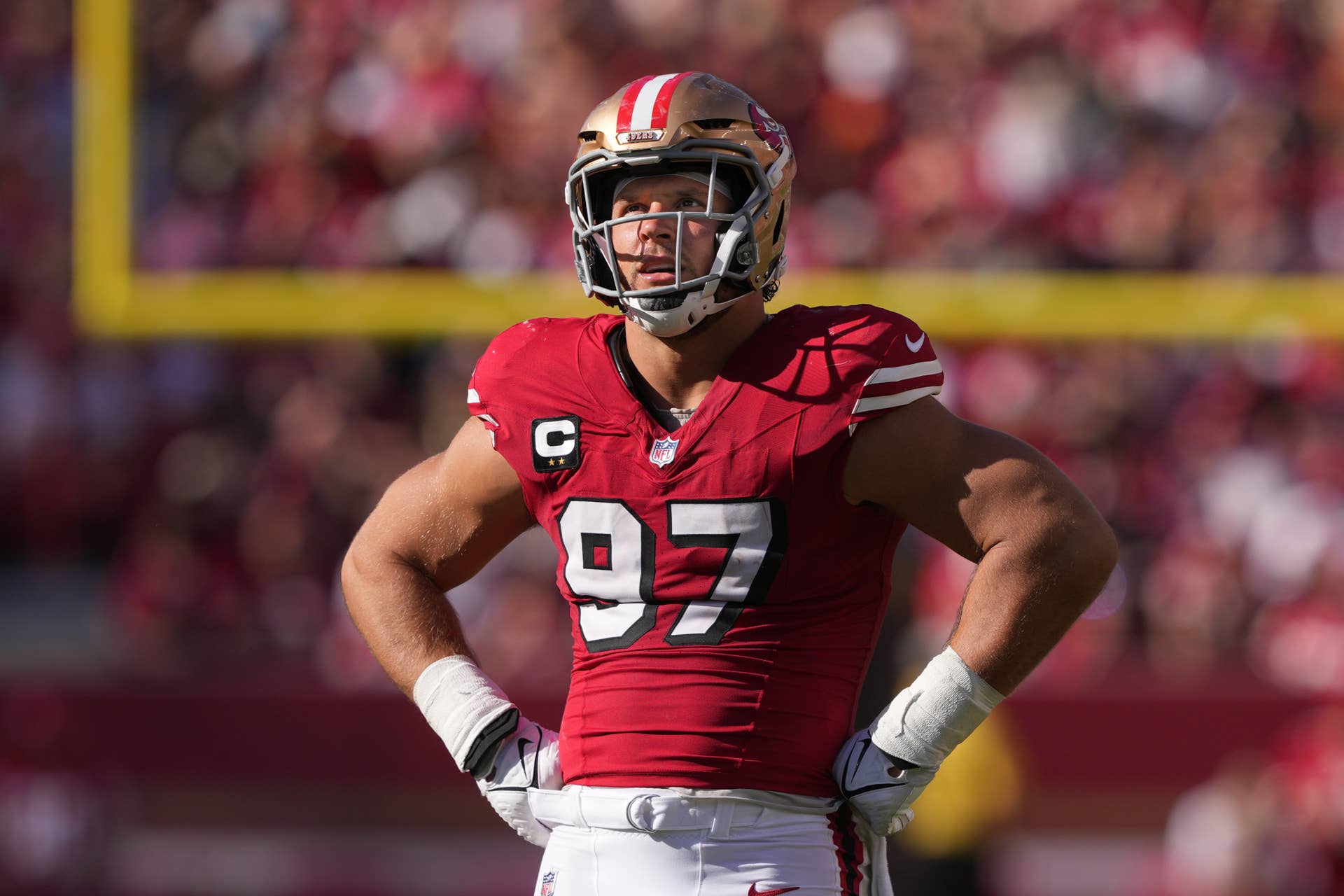
Buckner is not arriving solely on reputation. Through seven games with Indianapolis this season, he has four sacks, eight quarterback hits, three passes defended and a fumble recovery. His 20 pressures place him among the more disruptive interior defenders, and he played roughly 82 percent of the Colts' defensive snaps. That workload is particularly notable for a veteran who dealt with neck problems and surgery in the previous campaign. The production suggests he still has the burst and technique to matter, even if his durability must be managed carefully.
A sack total captures only the most visible part of his job. Interior pressure shortens a quarterback's room to step forward, forcing passes to come out earlier or pushing a passer toward the edge. That can make an outside rusher more effective without awarding the defensive tackle a statistical assist. It can also make a four-man rush more viable, freeing linebackers and defensive backs to cover rather than repeatedly blitz. The trade's real test will be whether opponents have to alter protection plans when Buckner is on the field.
Nick Bosa is central to that calculation. The 49ers' premier edge defender has been sidelined by a calf problem, and the club has been navigating the season without its preferred combination of front-line stars. A healthy Bosa working outside Buckner and Odighizuwa would present a very different protection challenge from the patchwork line San Francisco has used during parts of October. But projecting all three together every week would be premature. Bosa's return schedule and Buckner's physical are still practical conditions, not details to wave away.
The scheme also matters. Defensive coordinator Raheem Morris has to decide whether to use Buckner as a penetrating three-technique, move him across the front on passing downs, or protect his legs with a narrower package of high-value snaps. A veteran with a history of handling heavy workloads may want to stay on the field, but a playoff contender benefits more from effective late-season snaps than from winning an October endurance contest. The bye provides a rare opportunity to build that plan without preparing for a Sunday opponent.
For San Francisco, the upside is not that one trade automatically transforms an imperfect defense into a championship unit. The upside is that offenses lose the easy answer of sliding protection toward one threat while treating the opposite interior gap as manageable. Buckner's presence could force harder choices, especially when the 49ers need a stop on third-and-long. That is the kind of marginal improvement that can matter enormously in a close postseason game.
Indianapolis has turned a rebuild into an NFC West arms race

Indianapolis is not simply trading a defensive tackle. Earlier on the same Tuesday, the Colts reportedly agreed to send All-Pro guard Quenton Nelson to the Seattle Seahawks for a 2027 third-round pick and a 2028 fifth-round selection. Buckner's move adds a fourth-round pick in 2027. Two veteran pillars of the roster are therefore being converted into future selections within hours, and both are headed to teams competing in the NFC West. The geography is almost as striking as the speed of the sell-off.
The Colts are 2-5, have lost three consecutive games and recently dismissed general manager Chris Ballard. That combination makes a broader reassessment understandable. Players on expiring contracts can walk away after a lost season without delivering draft compensation, and the organization needs resources for its next leadership group. Yet draft picks are possibilities, not ready-made replacements. Nelson and Buckner were established leaders who shaped both lines of scrimmage. Losing them creates immediate weaknesses that cannot be solved simply by pointing to a future selection board.
There is a human dimension, too. Buckner spent six-plus seasons in Indianapolis, remained productive during disappointing stretches and was regarded as a standard-setter. Nelson supplied a similar identity on offense. Trading both says the franchise has chosen the next roster cycle over trying to rescue this one with the same veteran core. That can be the right long-term decision and still be painful for the players, coaches and supporters who expected those two to anchor a return to contention.
The other side of the transactions makes the stakes unusually vivid. Seattle has acquired an elite guard to strengthen its offense. San Francisco has acquired a proven interior defender to reinforce its pass rush. They are scheduled to meet later in the season, and the two trades may influence the protection-versus-pressure battle in that matchup. It would be excessive to declare either team a trade winner before the players suit up, but the Colts have undeniably given two divisional rivals immediate opportunities to improve.
What comes next is a test of organizational clarity. Indianapolis must use the extra draft capital well, evaluate the players remaining on the roster and establish a coherent direction after its front-office change. San Francisco must get Buckner through his physical, integrate him quickly and decide whether his impact justifies extending the relationship beyond this season. Seattle has its own challenge of folding Nelson into a line with championship expectations. The deals connect three different timelines: a rebuild, a reunion and a contender trying to seize the present.

The Buckner trade is the rare deadline move that explains two franchises at once. The 49ers are paying a modest future asset to address a specific problem on a 6-1 team. The Colts are surrendering proven veterans because the future they once planned around them has slipped out of reach. Neither side can be graded on the press release alone.
If Buckner passes his physical and gives San Francisco consistent interior pressure, the 49ers will have corrected an old roster loss at a fraction of the original draft price. If the defense remains fragile or his workload becomes a problem, the reunion will be remembered more for its symbolism than its results. The answer begins after the bye, but the larger message is already clear: San Francisco is acting like a team that believes its Super Bowl window is open right now.
Shop GOATIFY NFL and American football shirts, hoodies and stickers.

















