

Charlie Woods and Miles Russell Signed at FSU. Their Paths Couldn't Be More Different.
GOATIFYOn signing day, Florida State did more than turn two famous junior-golf commitments into paperwork. The Seminoles made official a partnership between Miles Russell, a teenage record-breaker already testing himself against professionals, and Charlie Woods, a talented prospect whose last name guarantees attention before he strikes a shot. Both are expected in Tallahassee for the 2027 college season. They arrive with entirely different résumés, expectations and potential timelines.
Wednesday's announcement mattered because neither move was a fresh verbal decision. Russell had committed earlier, and Woods had announced Florida State in February. On November 11, 2026, they formally joined a four-player signing class coached by Trey Jones. Russell's question is how long the college stage can hold him. Woods' is how high his golf can climb once he is given time to develop away from weekly comparisons with Tiger. Florida State is betting that those two very different stories can strengthen the same lineup.
Russell Could Play Pro Golf Soon. He Chose College Anyway.
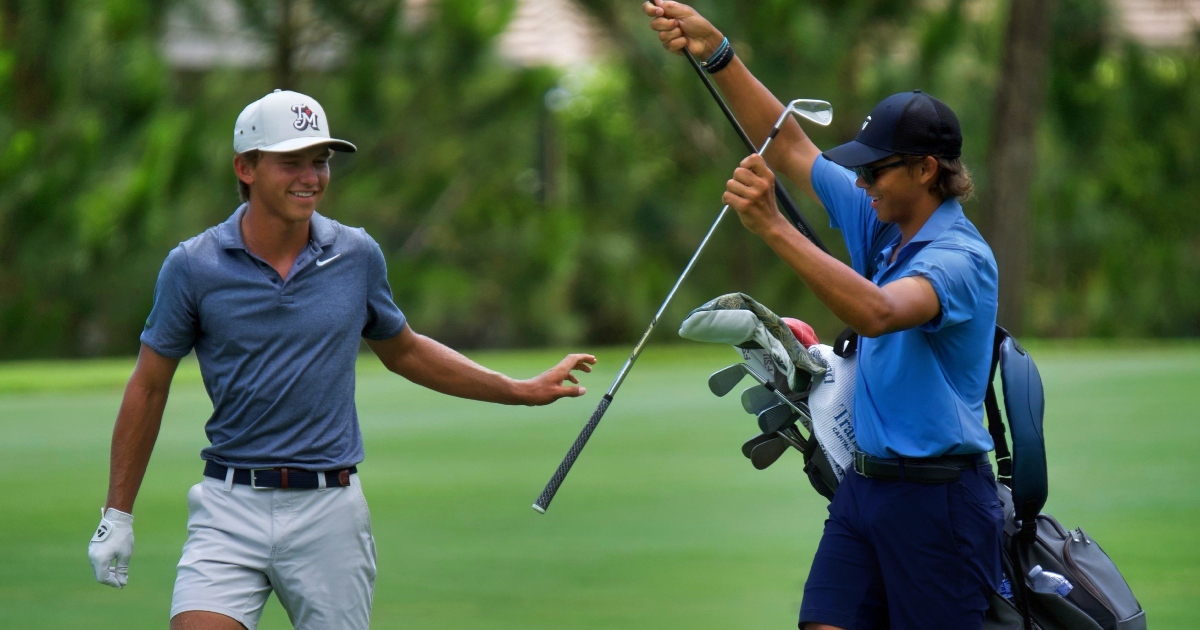
Russell's reputation is the reason Florida State's incoming group is discussed in language usually reserved for professional transfer windows. At 18, the Jacksonville Beach player is already the leading prospect in the 2027 recruiting class. The list of junior titles backs up the excitement: he has won three of the four modern junior majors, captured both the Junior Invitational at Sage Valley and the AJGA Junior Players Championship twice, and reached the U.S. Junior Amateur final in 2026. The missing junior-major title is a reminder that even spectacular young players still have unfinished business.
His latest trophy was historical. On the Monday before signing day, Russell collected his third AJGA Rolex Junior Boys Player of the Year award, matching a mark shared with Phil Mickelson and surpassing the two-time total achieved by Tiger Woods. This is not a ranking built purely on potential; it reflects repeated results over several seasons. The World Amateur Golf Ranking listed him sixth when the new signing class was announced, and he had already spent time in professional fields, including the 2026 U.S. Open at Shinnecock Hills.
That experience makes the college decision more interesting than the usual question of which program secured the No. 1 recruit. Russell has already collected eight PGA Tour University Accelerated points. Under the pathway described ahead of his signing, reaching 20 could eventually make him eligible for a card on the PGA Tour's second-tier Challenger Series, but using that opportunity would require turning professional and navigating activation rules. A possible January start would land in the middle of an NCAA season. Eligibility is a possibility, not an immediate offer or a guarantee that he will abandon his teammates.
He has been explicit about his choice to learn before jumping permanently into professional golf. Russell told reporters that bypassing college was dismissed quickly because he still wants to grow as a person and a golfer. The contrast arrived at a striking moment: Blades Brown, who skipped the college route, had just won a PGA Tour title in Mexico at 19. Brown's success demonstrates that another route can work. It does not establish that the same route would serve Russell better. The next step for Russell is not simply to demonstrate that he belongs among older players; he needs a developmental environment that still challenges him.
GOATIFY
GOATIFY Golf
Miles Russell is taking a high-profile route from junior golf into college competition. Explore GOATIFY Golf fan designs and accessories.


Jones expects the top recruit to have an immediate effect on Florida State's lineup. Yet the bigger question will be how the school balances individual opportunity and a team calendar. A deep postseason run could give Russell something he has not yet won in college, while major professional starts and accelerated eligibility may tug in another direction. The coach does not need to settle that tension on signing day. He does need to build a program good enough that staying is meaningful, rather than merely a pause before a professional debut.
Charlie Woods Has the Name. His Golf Is Becoming Its Own Story.

Charlie Woods' signing carries a different kind of pressure. Many casual fans first saw him as an 11-year-old playing alongside his father at the 2020 PNC Championship. That exposure created a story before Charlie could develop anything resembling an adult competitive record. His formal Florida State signing is therefore worth judging on the golf he has actually played, not on the idea that the son of a 15-time major champion must follow a predetermined path.
His 2025 victory at the Team TaylorMade Invitational at Streamsong was a genuine individual breakthrough. Woods finished ahead of a field that included Russell, demonstrating that friendship with the highest-ranked junior does not mean a fixed competitive hierarchy when they meet. He has qualified for three U.S. Junior Amateurs and came close to match play in 2026 before losing in a playoff. A tie for eighth at the Junior Players was another useful result after earlier top-10 junior finishes, but it is not yet the relentless tournament-winning run Russell has produced.
The rankings underline the distinction. Golf Channel placed Woods 41st among its signings for the class, far below his new teammate. That should not be mistaken for a verdict on his ceiling. Junior rankings describe results at a particular stage; physical development, short-game control and experience can change a college golfer's position significantly. Woods has a better chance of answering questions about his game over several seasons than under a rolling countdown to an imagined professional breakthrough.
The two players also bring a partnership that predates the school uniform. In June, Charlie carried Russell's bag during U.S. Open final qualifying at BallenIsles as his friend fought through the long, exhausting day to earn a major start. Their relationship contains the kind of everyday competition that does not show up in recruiting rankings: practice contests, putting challenges and the refusal to give the other an easy victory. Russell has described Woods as one of his closest friends and favorite people to play with. College offers a chance for those habits to become shared improvement instead of separate headlines.
Jones' assessment of Woods concentrates on tools coaches can build around: balance, rhythm, speed and touch. He has praised the way the swing looks unhurried even while producing fast ball speed, along with Woods' ability to vary a wedge shot. Those observations are more useful than treating every Woods swing as a referendum on his father's career. Charlie may have four or five years at Florida State, while Russell's accelerated pathway could shorten his own stay. They do not have to peak together to make the partnership successful.
GOATIFY
GOATIFY Golf
Charlie Woods' signing puts new attention on college golf. Discover GOATIFY golf shirts, hoodies, hats and stickers for fans.
A Four-Man Signing Class Is Bigger Than Two Familiar Names

Signing day added two more names that deserve a place in the conversation. Sweden's Edwin Askerfors and Orlando-area prospect Kaden Puranik complete the four-player Florida State class. Askerfors brings another international perspective to the lineup, while Puranik adds an in-state recruit alongside Woods and Russell. The Seminoles have not assembled a two-man exhibition; they have recruited a cohort that must survive qualifying, travel, college courses and the pressure of counting scores across entire tournaments.
For Jones, the appeal of Russell is obvious. The coach has spoken of him as the finest junior prospect since Tiger Woods. But college championships are not awarded for reputation at signing day. They require scores from multiple players, week after week, and an ability to perform under match-play pressure at the NCAA Championship. Adding depth is essential even when a star recruit is capable of making the lineup immediately, especially if school and professional opportunities eventually pull that star in different directions.
Florida State has a credible reason to dream big. The program came close to the national title in 2024, finishing runner-up to Auburn. The school has also helped develop future professional names such as Brooks Koepka, Daniel Berger and Luke Clanton. Those are precedents for a strong development culture, not promises about any particular freshman. Recruits still have to adapt to academics, travel, competition for spots and the less glamorous grind of improving one stroke at a time.
The friendship between Russell and Woods may matter most when the cameras leave. Russell can set an elite performance standard in practice; Woods can challenge him without deference. Askerfors and Puranik could turn an attractive pairing into a more balanced class, provided all four find roles in a deeper roster. If Russell moves on sooner than expected, the lasting value of the group will depend on what was built around him, rather than the number of headlines his signing generated.
The timing also protects a useful distinction. Florida State signed them for the Class of 2027; this is not a claim that they are already playing NCAA matches together in November 2026. Between formal signing and the first college event lie months of junior competition and development. That window gives Woods a chance to strengthen his results and Russell a chance to test his game further. Recruiting excitement is real, but the most important scorecards have not yet been written.
Russell arrives with a record that suggests a rapid professional future. Woods arrives with evident talent, a famous surname and a longer runway to discover his best golf. Their signatures make Florida State one of the most compelling programs to watch in the 2027 cycle, not because a college team can reproduce the spotlight of a major championship, but because it can give two very different prospects a place to push each other.
The judgment on this class should come from what happens next: the minutes spent practicing together, the scores that count for the Seminoles, and whether Jones turns four recruits into a contender. A strong signing-day headline is only the opening tee shot.
GOATIFY
GOATIFY Golf
Shop GOATIFY golf shirts, hoodies and stickers.


















