

Dubai P1 Draw Shake-Up: Leal and Guerrero Jump From Qualifying to Sixth Seeds
GOATIFYA few days ago, Javi Leal and Fran Guerrero were facing the prospect of a far less comfortable route into the Dubai P1. A missed entry deadline had put their tournament plans in doubt. Now they are directly in the men's main draw as the sixth seeds, an extraordinary reversal driven by another pair's misfortune. Alejandro Galán's injured right hand has taken him and Federico Chingotto out of the event, and the vacancies have changed who gets a place, who gets a protected position and who might face the biggest names before the semifinals.
Dubai runs from November 8 to 15 at the Hamdan Sports Complex, with the main draw beginning November 10. Arturo Coello and Agustín Tapia arrive as secured year-end world No. 1s, but the real intrigue is in the new routes around them. Leal and Guerrero have a chance to turn an administrative mistake into a major late-season result; Juan Lebrón and Leo Augsburger inherit the second seeding; and a full-strength women's field offers a striking contrast to the disruption on the men's side.
Galán's Injury Didn't Just Remove a Contender — It Changed the Seeding
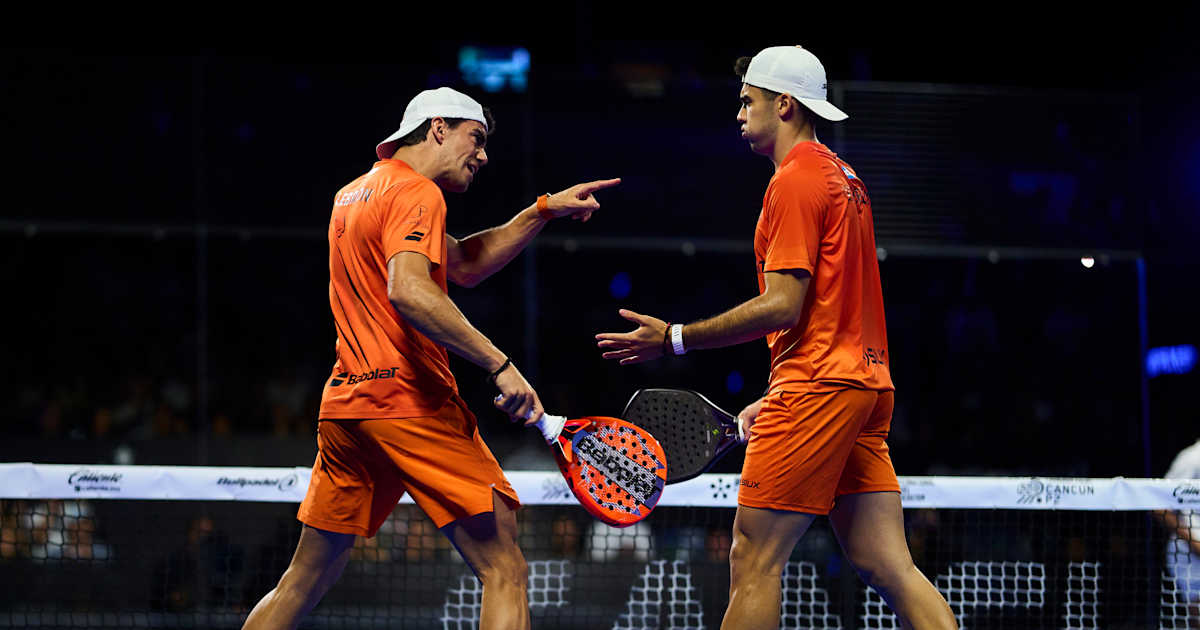
The most consequential player at Dubai may be the one who cannot take the court. Galán has not recovered sufficiently from his right-hand problem, which also kept him out of the Kuwait Major and the world championships in Doha. Chingotto is absent alongside him rather than entering with a replacement. Removing the world's second-ranked partnership from a seeded draw does much more than create one empty slot: it changes the structure that is supposed to keep the strongest pairs apart until the late rounds.
Coello and Tapia retain the top line. They have already secured the year-end No. 1 ranking, so Dubai is not an emergency title-defense mission to protect the summit. It is another opportunity to impose the standard that won them the Kuwait Major and the 2025 Dubai title. Their absence from the opposite side of a possible final is not new; what changes is the identity of the team most likely to emerge from that side.
Lebrón and Augsburger rise to second seeds, while Franco Stupaczuk and Jon Sanz occupy the third position and Paquito Navarro and Martín Di Nenno the fourth. This is significant for a partnership as attack-minded as Lebrón and Augsburger. Their aggressive patterns can dismantle opponents quickly, but they have also experienced abrupt swings during the season. A higher seeding provides a potentially better path, not a guarantee that those fluctuations disappear.
The distinction matters when reading a bracket before a ball is struck. Seeded positions influence the matches that are possible, not the outcomes. Galán and Chingotto were credible obstacles to several contenders; removing them opens one side while concentrating attention on whether another pair can seize the space. Dubai may produce a familiar champion, yet it is far less certain who will earn the right to challenge that champion.
Leal and Guerrero's Registration Error Has Become a Barcelona Finals Lifeline

For Leal and Guerrero, the reshuffle has a more personal meaning. The Spaniards missed the registration cutoff and initially looked set for a qualifying route instead of the direct main-draw position their ranking would normally merit. Once Galán and Chingotto pulled out, the regulations allowed a vacant main-draw place to be assigned to the highest-ranked eligible qualifying pair. Leal and Guerrero moved straight in and were installed as sixth seeds. That is not a wildcard fairy tale; it is a rules-driven second chance.
The difference between qualifying and beginning as a sixth seed can be substantial during an exhausting closing stretch. A protected entry reduces the number of early hurdles and gives the pair more control over preparation. It does not award free ranking points or make a deep run automatic, but it changes the balance of risk. Instead of having to earn the right to join the biggest matches, they can focus on winning the matches already in front of them.
Leal's position in the race for the Barcelona Premier Padel Finals gives every round an additional edge. The season does not end in Dubai: the Mexico Major in Acapulco follows later in November, with Barcelona scheduled for December. That creates a narrow runway rather than an endless chance to recover lost opportunities. A draw that seemed to punish the Spaniards for a missed deadline now gives them room to improve their qualification outlook.
Their ability to trouble the favorites is more than theoretical. Leal and Guerrero reunited during 2026 and produced significant results, including a high-profile win over Coello and Tapia in Pretoria in August. Their aggressive net play and willingness to attack the return can make even elite opponents uncomfortable. But those same instincts can turn into rushed decisions under pressure. Dubai is a test of whether the pair can channel their second chance into steady, repeatable performance rather than one spectacular afternoon.
Their first target is straightforward: survive the opening assignment without getting distracted by the quarterfinal opponent penciled into a projected bracket. Only then does a possible collision with the top seeds become a real story.
GOATIFY
GOATIFY Padel
A surprise sixth seeding sets up a fresh late-season padel storyline—browse GOATIFY Padel fan gear.


The Projected Men's Quarterfinals Reveal Where Dubai Could Break Open

A seed list is a map of possible pressure points, not a set of confirmed fixtures. If the higher-ranked pairs advance, Dubai could feature Coello and Tapia against Leal and Guerrero in one quarterfinal, Mike Yanguas and Coki Nieto against Stupaczuk and Sanz in another, Navarro and Di Nenno against Momo González and Lucas Campagnolo, and Juan Tello and Edu Arce against Lebrón and Augsburger. Each pairing remains conditional on the earlier rounds.
The Coello-Tapia versus Leal-Guerrero possibility is the obvious headline. The world leaders are exceptionally efficient at covering the middle, recovering from awkward defensive positions and turning one loose ball into a decisive attack. Leal and Guerrero have the pace to disrupt that rhythm, as their Pretoria result demonstrated. To do it again, they would need discipline with lobs and placement as much as raw power. A highlight-reel smash is less useful if the next three points invite counterattacks.
The projected Yanguas-Nieto versus Stupaczuk-Sanz match carries a different fascination: former partnerships and familiar tactical habits. Players who have spent long periods practicing together often know which exchanges the other side prefers. That can make the first few games unusually strategic, with both teams looking for a pattern that has changed since those partnerships ended.
On the lower side, Lebrón and Augsburger have been given a more favorable seeding, but Tello and Arce arrive with evidence they can damage stronger pairs, having reached the Kuwait Major final. Navarro and Di Nenno, meanwhile, cannot assume that their projected path past González and Campagnolo is routine. The draw is less predictable because several pairs now believe that the route to the final is genuinely open.
One more ingredient is the indoor setting at Hamdan Sports Complex. Conditions can shape how freely attackers finish points and how well defenders absorb pace, so adaptability matters. The favorites are still favorites, but a compressed run of matches punishes teams that rely on one pattern. The new bracket has created opportunity; execution decides who uses it.
While the Men Recalculate, the Women's Draw Brings Every Major Rival

The women's competition offers almost the mirror image of the men's uncertainty. Its four leading partnerships have made the trip: Gemma Triay and Delfi Brea are top seeds, Paula Josemaría and Bea González are second, Ari Sánchez and Andrea Ustero third, and Claudia Fernández and Martina Calvo fourth. Rather than asking how a major withdrawal transforms the bracket, the question is which complete partnership can impose its strengths on a stacked field.
Triay and Brea arrive with the momentum of their Kuwait Major triumph and a chance to tighten their hold on the rankings. They have shown a capacity to control long rallies without surrendering the attacking initiative, an especially useful combination against opponents who can defend several consecutive volleys. Yet the strength of this draw means their first major examination may arrive before the final.
The projected quarterfinal lineup illustrates the danger. Triay and Brea could meet Tamara Icardo and Claudia Jensen; Sánchez and Ustero could face Marta Ortega and Sofi Araújo; Fernández and Calvo might encounter Alejandra Salazar and Aranza Osoro; and Josemaría and González could draw Marina Guinart and Ale Alonso. These are potential matchups, not scheduled results. They underscore how quickly an ostensibly comfortable seeding can lead to a tactical battle.
González has an extra personal incentive. She won Dubai in both 2024 and 2025 with different partners; trying to make it three consecutive titles alongside Josemaría adds a subplot to the No. 2 pair's campaign. Sánchez and Ustero, meanwhile, bring confidence from Spain's world championship success in Doha. Winning the next tournament requires translating national-team momentum back into the distinct decision-making of a regular tour partnership.
The early rounds also contain difficult tests for players outside the title-favorite group. Frenchwoman Alix Collombon and Ksenia Sharifova draw Martina Fassio and Vero Virseda, and a victory would send them toward the Josemaría-González section. Dylan Guichard and Belgian partner Clément Geens face Javier Martínez and Luis Hernández Quesada on the men's side. Their matches remind us that the draw's most consequential result need not wait for a famous quarterfinal.
For both competitions, the reward is real: the event carries €479,068 in total prize money and 1,000 ranking points for each champion. The outcomes can reshape the final weeks before Mexico and Barcelona even though the men's year-end top ranking is already decided.
GOATIFY
GOATIFY Padel
The women's field is as competitive as ever—explore GOATIFY Padel designs while the title battle unfolds.
Dubai's bracket now has two separate races. Coello and Tapia are pursuing another title from a position of established dominance, while several challengers see an opening created by Galán and Chingotto's absence. Leal and Guerrero have the clearest reversal of fortune: a missed registration deadline turned into sixth-seed protection, with vital Finals points still available.
The right way to read the draw is as possibility rather than prediction. Nothing has been won by the teams promoted in the seedings, and the best projected quarterfinals may never materialize. But Dubai has become more interesting before its first main-draw ball: one withdrawal altered the hierarchy, one pair regained its opportunity, and the women still have a full field of contenders ready to test each other.
Shop GOATIFY padel products from the Padel-filtered collection scope.

















