

Mike Perry Is Back in the UFC. The King of Violence Still Needs a Fight.
GOATIFYMike Perry has a UFC contract again. That much is settled: manager Malki Kawa confirmed his return on Friday, November 13, more than five years after a defeat to Daniel Rodriguez ended Perry's first stint in the organization. Yet the detail people most want—the next opponent—has not been announced. Nor has a date, a division or a disclosed fight count. The fighter nicknamed the King of Violence is returning to the promotion where he first became a cult favorite, but nobody has publicly booked the comeback fight.
The signing is compelling precisely because Perry's career since 2021 has been anything but an ordinary absence. He went from a UFC record below .500 to a leading attraction in bare-knuckle boxing, collected high-profile wins over established former MMA names, and then returned to mixed martial arts twice this year. One 2026 bout ended with him stopping Nate Diaz. The other ended with Brandon Jenkins handing him a first-round loss after a shoulder injury. Those results make a comeback plausible and uncertain at the same time.
Here's what is confirmed, how Perry rebuilt his value outside the octagon, and the competitive questions his first new UFC opponent will have to answer.
The Deal Is Real. The Return Fight Is Not Booked.
Friday's announcement came from a source closer to the deal than an anonymous matchmaking rumor. Manager Malki Kawa confirmed that Perry had signed again with the UFC in a November 13 Instagram message. Perry's account was involved in that announcement. It moves the story from speculation about a return to a confirmed promotional agreement, but the scope of that agreement remains considerably narrower than an actual fight booking. There is no announced opponent, weight class, event, number of contracted bouts or disclosed payday.
That distinction matters because a familiar fighter's name can spread across fight calendars before a promotion has publicly paired him with anyone. In Perry's case, the UFC's 2026 anti-doping testing history also generated interest on Friday. It showed one recorded testing session next to his name. Testing activity is one useful piece of the comeback picture, but the listing does not specify a future bout, announce a contract or establish a timetable for medical or competitive clearance. It counts sessions rather than the number of individual samples collected. A calendar date attached to an administrative record should not be converted into a guaranteed cage-return date.
Ariel Helwani also reported Friday that Perry had re-signed and said a return-fight date had not been set. Those two statements can coexist without contradiction: the fighter and promotion may have an agreement while the opponent and event remain to be determined. For now the story is that the UFC has brought back one of its most recognizable former action fighters, not that it has announced a marquee main event.
GOATIFY
GOATIFY UFC & MMA
Explore GOATIFY UFC and MMA gear as Perry re-enters the octagon after five years.


Rogainz Joe Rogan UFC MMA Martial Arts Sticker
Add MMA personality to your favourite gear.
Shop Now ↗


The new chapter also puts an old record back into focus. Perry entered the UFC in August 2016 with a first-round stoppage of Hyun Gyu Lim and built an early reputation for aggressive exchanges, finishing Danny Roberts, Jake Ellenberger and Alex Reyes. He could be effective over a full distance, too, earning decisions over Paul Felder, Alex Oliveira and Mickey Gall. Four performance bonuses reflected how regularly his bouts drew attention even when the results were unpredictable.
The results eventually became the central weakness of his first tenure. Perry exited after a unanimous-decision loss to Daniel Rodriguez in April 2021, completing a 15-fight UFC run at 7-8. Losses to Vicente Luque, Geoff Neal, Donald Cerrone and Tim Means were a reminder that demanding striking exchanges against skilled opponents are not guaranteed to favor the more visibly aggressive fighter. The final stretch provided both a reason for his departure and a measuring stick for what he must improve in a second run.
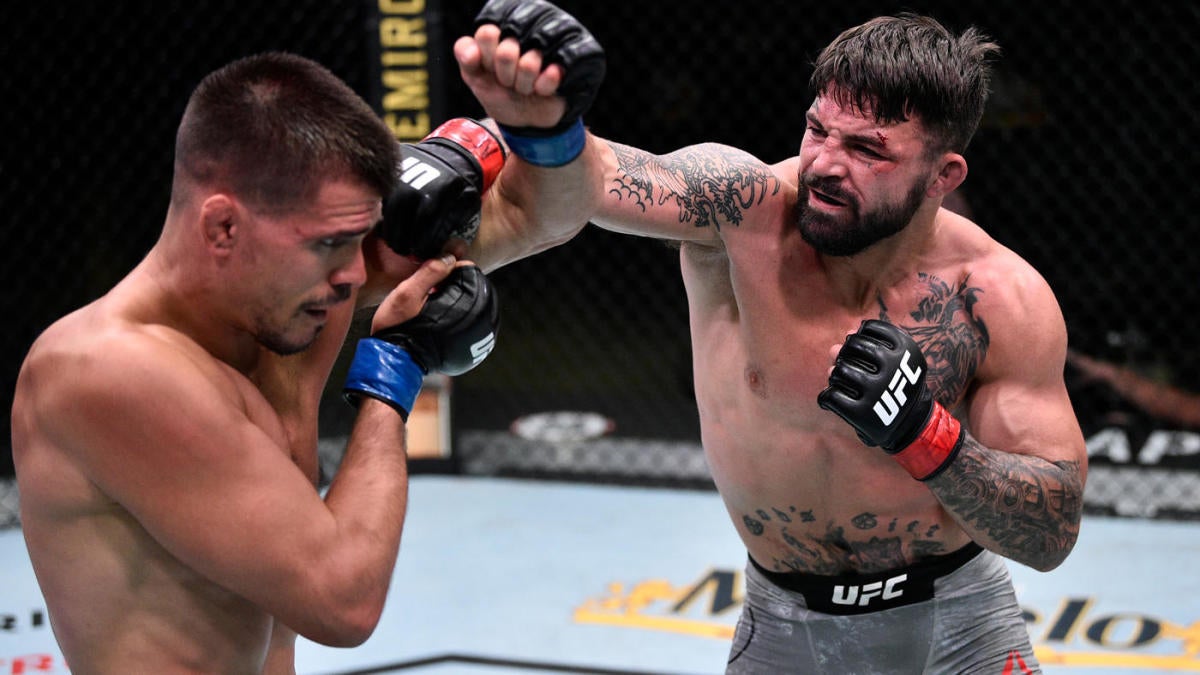
The image from his 2020 meeting with Gall illustrates a specific period, not the present day. The version of Perry coming back is older, has several years of bare-knuckle experience and has already competed in MMA twice in 2026. His history explains why UFC audiences know him; the still-unbooked opponent will begin to answer whether the promotion is treating this as a one-off attraction or a sustained comeback.
Bare-Knuckle Turned a UFC Castoff Into a Headliner
Five years away from the octagon did not mean five years away from competition. Perry moved into Bare Knuckle Fighting Championship and found a format that magnified his most marketable qualities: pressure, resilience, short-range punching and the willingness to keep exchanging while the fight grew uncomfortable. He became an unbeaten attraction there and captured the promotion's King of Violence distinction. Suddenly his name sold a combat-sports event on its own rather than merely promising an entertaining contest on somebody else's UFC card.
His bare-knuckle opposition was not anonymous. Luke Rockhold and Eddie Alvarez brought championship histories from MMA, Michael Page arrived with an established striking identity, and Jeremy Stephens had built a long career around aggressive stand-up. Perry's successes against recognizable names helped transform an apparent career detour into a second competitive identity. The BKFC chapter is why his UFC signing is more than a routine contract for a former roster member.
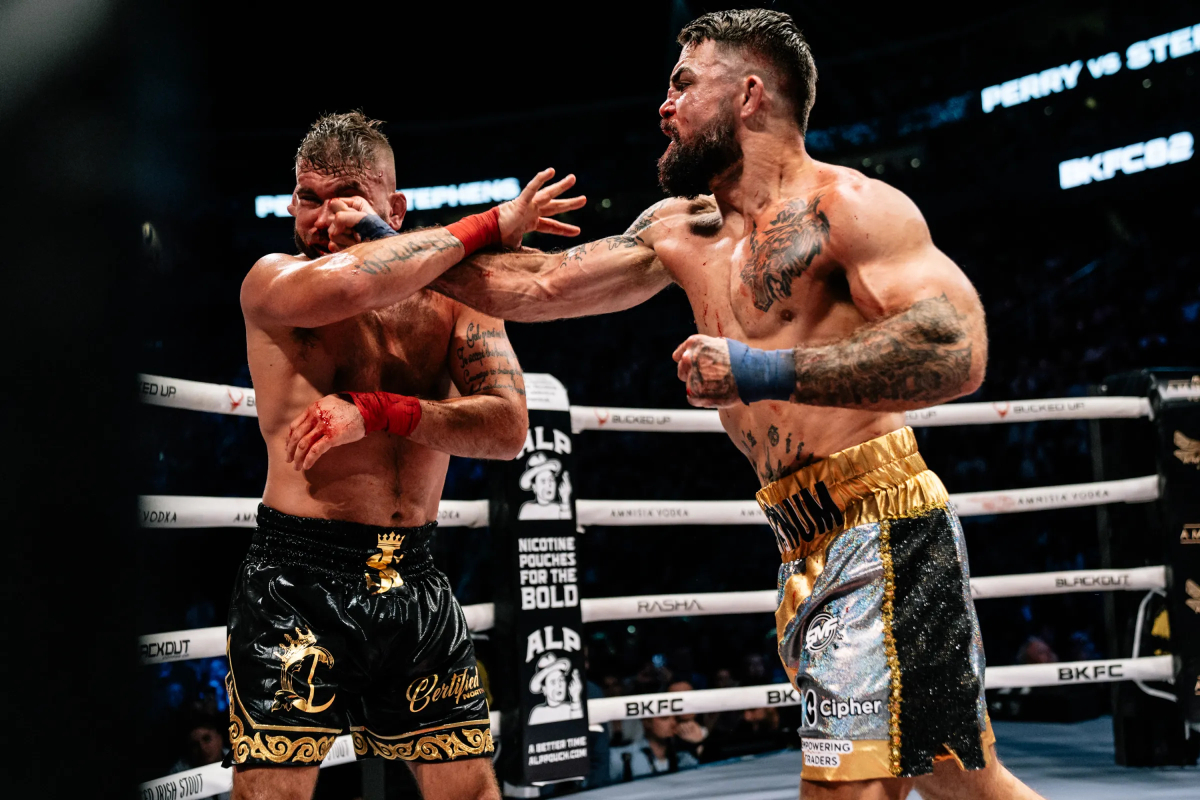
October 2025's meeting with Stephens is a useful illustration. Perry was willing to stay close, work behind hard punches and absorb the risk that comes with trading at short range. In bare-knuckle boxing, small mistakes show on the face immediately and the shorter rounds reward fighters who can seize momentum quickly. Perry made that environment feel natural. He also collected the kind of footage and reactions that kept his name relevant to viewers who no longer followed his original UFC career.
GOATIFY
GOATIFY UFC & MMA
Browse fight-fan gear from the GOATIFY UFC and MMA collection after Perry's bare-knuckle reinvention.


UFC GOAT Gold Middle Finger Fight Decal Sticker
Add MMA personality to your favourite gear.
Shop Now ↗

MMA GOAT Gold Middle Finger Fight Crewneck Sweatshirt
A MMA fan design for everyday wear.
Shop Now ↗
The appeal, however, cuts two ways. Two-minute bare-knuckle rounds are not five-minute mixed-martial-arts rounds. The absence of kicks, submissions, chain wrestling and extended grappling changes the choices a defender must make. A fighter who can plant his feet and hunt for a finish in a boxing-only contest may have to think twice when a low kick, level change or clinch entry can interrupt the same combination. Winning a sequence in one sport is not a technical proof that every part of it will transfer unchanged.
That is not to discount what Perry learned. Timing, punch selection, composure under pressure and the ability to draw a crowd remain valuable across rulesets. One reason the UFC reunion makes commercial sense is that he can bring all of those strengths back without requiring audiences to rediscover him. What must be tested is the adaptation around them: defending takedowns after committing to punches, exiting clinches safely, pacing a longer round and judging when to accept a brawl rather than manufacturing one.
His time outside the UFC also included a conventional boxing outing against Jake Paul in July 2024, another example of his willingness to compete on a prominent stage under different rules. But changing gloves or the name above the arena does not eliminate the underlying question. At 35, Perry is returning to the organization that once measured him against the deepest weekly schedule of specialist MMA competition. The bare-knuckle success raised his profile; it did not automatically erase his earlier UFC losses.
Two MMA Fights in 2026 Show Both the Upside and the Risk
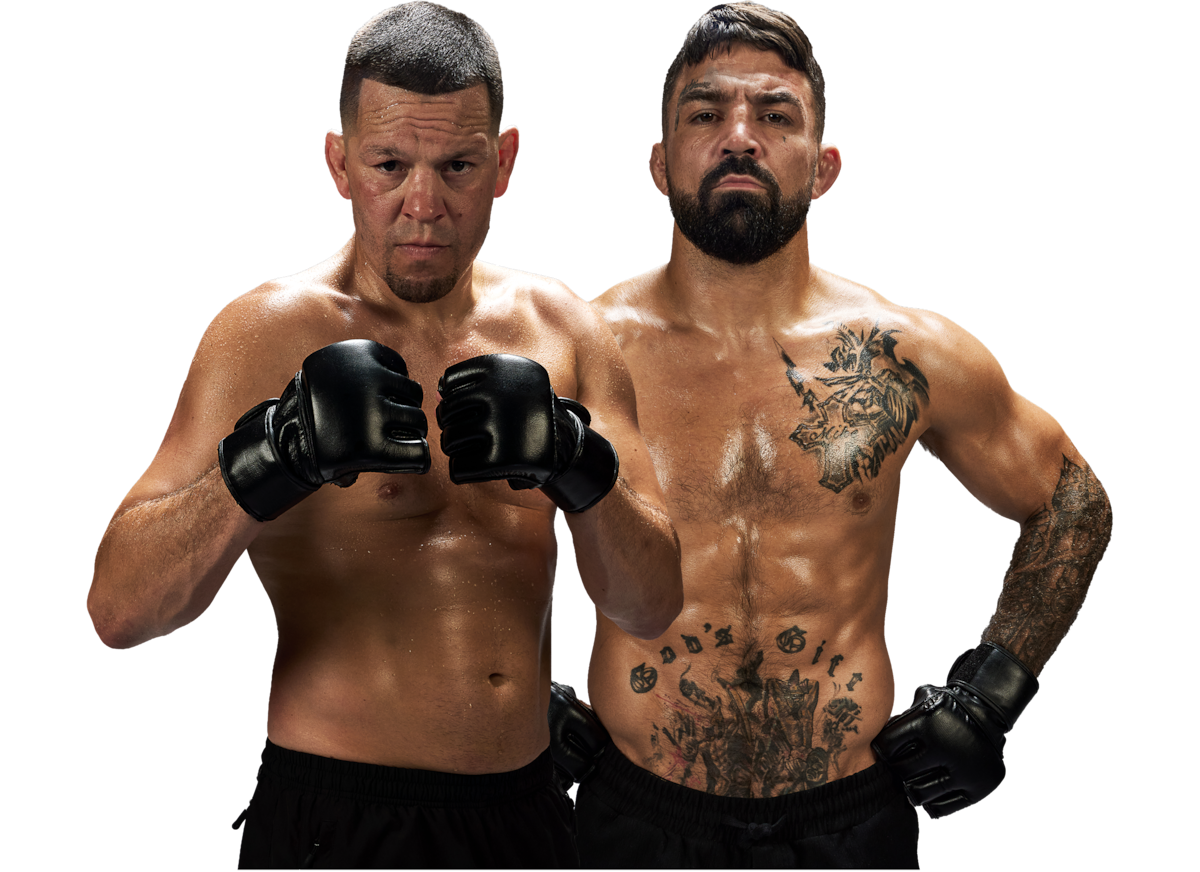
Perry's UFC return will not be his first mixed-martial-arts appearance since the Rodriguez loss. He already tested the transition twice in 2026, with results that resist the simplest comeback narrative. In May he fought Nate Diaz on the Ronda Rousey–Gina Carano card at Intuit Dome in California. It was a high-visibility return to a cage, and Perry made it count by forcing a stoppage at the end of the second round.
The Diaz fight showed that his forward pressure still had an MMA application. Perry mixed heavy punches with elbows, knees and other attacks that bare-knuckle rules had denied him. Diaz continued to respond and briefly presented a submission threat, but his accumulated cuts led to the bout being stopped between rounds. It was a victory over a famous former UFC contender and useful evidence that Perry could compete under MMA rules again, although a particular matchup against a fellow veteran should not be mistaken for a comprehensive survey of the current welterweight division.
August supplied the opposite reminder. Perry was due to meet Dillon Danis at Duel Arena 1. Danis withdrew during fight week, and Brandon Jenkins accepted the replacement opportunity on short notice. Instead of another celebratory outing, Perry suffered a first-round TKO defeat after a shoulder injury during the contest. The circumstance made the result unusually difficult to use as a clean measure of skill, but the loss remains part of his recent MMA record. A short-notice opponent is not automatically a safe opponent; Jenkins took advantage of the opening he was given.
GOATIFY
GOATIFY UFC & MMA
Find GOATIFY UFC and MMA styles while the date and opponent of Perry's return remain open.

UFC GOAT Gold Middle Finger Fight Decal Sticker
Add MMA personality to your favourite gear.
Shop Now ↗MMA GOAT Gold Middle Finger Fight Crewneck Sweatshirt
A MMA fan design for everyday wear.
Shop Now ↗That injury is particularly relevant now because the contract announcement was not accompanied by a disclosed medical timetable. Perry had indicated in October that he did not expect to require shoulder surgery. That is his assessment at that time, not an official confirmation of present fitness or a guaranteed return date. Fans can reasonably watch for a medical update and a formal bout announcement without pretending either has already happened.
The right first opponent will tell us more than the contract itself. A striker willing to stand at range could produce an immediate action fight. A more patient wrestler or a high-volume kickboxer would create a different technical test. There is no reason to attach the name of an available fighter to Perry's deal without an actual booking, and no meaningful ranking prediction can be made until the division, opponent, number of rounds and recovery status are known. Those details shape the competitive challenge more than the slogan attached to his return.
Perry also faces the familiar balancing act for athletes who become bigger personalities outside their original sport. The UFC can use his popularity to sell a bout, yet Perry has stated he wants a serious MMA challenge rather than another extended run in bare-knuckle boxing. There is an audience for violent exchanges, but at the highest level he will be judged on the ability to solve threats that do not begin or end with punching. Managing those moments will decide whether this signing is the beginning of another durable run or a brief reunion.
The responsible takeaway is therefore neither that his BKFC success guarantees a UFC resurgence nor that the Jenkins defeat makes the venture pointless. Friday confirmed a deal; his previous UFC run provides the historical baseline; the Diaz and Jenkins fights provide fresher but conflicting evidence; and an actual new opponent will finally determine the level of the next examination. For now, the UFC has a familiar attraction back on its books, and Perry has another chance to make an entirely different version of his name inside the octagon.
The headline is a contract, not a comeback result. Perry's camp has confirmed the agreement and outside reporting says no first fight is scheduled. The UFC receives a 35-year-old personality with a proven ability to attract an audience; Perry receives another chance to compete in the sport and promotion where his professional reputation first grew.
The meaningful unknowns are still ahead: the condition of his shoulder following August's loss, the agreed weight class, the first opponent and the date. A fighter who dominated in a different ruleset should not be judged solely by the last UFC scorecard or by a highlight reel from BKFC. The fairest measure will be whether his evolved offense can function over full MMA rounds while defending the threats that bare-knuckle bouts never posed.
For now, Perry has completed the contract part of the return. The fighting part remains to be written.
GOATIFY
GOATIFY UFC & MMA
Shop GOATIFY UFC and MMA apparel and fight-fan designs.



















