

Poirier Saw Makhachev Transform Overnight — UFC Weight Cutting Has a Bigger Problem
GOATIFYAt a weigh-in, two fighters can look almost interchangeable on the scale. A day later, one can appear to have grown into a different division. Dustin Poirier and Chris Weidman have now described that unsettling change from the perspective of the person standing across the cage. Their memories involve two of the sport's most recognizable physical specimens: Islam Makhachev and Yoel Romero.
During a recent conversation about cutting weight, Weidman recalled being taken aback by Romero's imposing presence when their 2016 fight actually began. Poirier remembered Makhachev looking drained before their 2024 lightweight championship fight, then dramatically fuller by the time the cage door closed. Neither recollection proves an exact fight-night weight or establishes that size decided either result. Together, though, they reveal the awkward bargain at the center of modern MMA: athletes sacrifice comfort and potentially performance to make a number that can stop reflecting their physical condition almost immediately.
There is an even more interesting twist. Makhachev has since moved from lightweight to welterweight and defended a second UFC title. The same athlete whose 155-pound cut became a talking point now offers a live example of what competing closer to a natural fighting weight can look like.
Weidman's Romero Memory Shows Why the Scale Can Be Misleading

Weidman's account begins with a familiar pre-fight trap: sizing up an opponent at the weigh-in and mentally projecting that version of him into the cage. Romero did not look quite as overwhelming at the earlier encounter. Once they were standing opposite each other on fight night, Weidman remembered a startlingly different impression. The physical contrast affected his usual sense of certainty before a fight.
The bout itself took place at UFC 205 in November 2016, with Romero stopping Weidman in the third round. That finish is part of the historical record, but it would be simplistic to reduce it to a story about pounds regained. Romero's timing, explosiveness and technique mattered, and Weidman's memory describes a psychological reaction rather than a measured physiological explanation. The more revealing point is that even a former UFC champion, someone deeply familiar with weight cuts, could be surprised by the body in front of him.
Din Thomas offered a useful counterargument in the same conversation. A fighter who cuts a tremendous amount of weight does not necessarily arrive better equipped to fight. Rapid weight reduction can leave someone struggling to restore fluid balance, energy and the capacity to maintain a high pace. A larger silhouette can create intimidation without guaranteeing better endurance or sharper decisions. The question is not simply who can become biggest between Friday and Saturday; it is who can recover enough to use that size effectively.
Romero's case also explains why weigh-in images are a poor shortcut for comparing opponents. The official limit controls who is eligible to compete in a division, not the precise mass or hydration of either athlete at the opening bell. Fans may see the same number on the scale and assume physical parity. Fighters know the reality is more complicated, but knowing the rule in theory is different from experiencing the contrast in the cage.

Poirier's UFC 302 Surprise Was About the Transformation, Not a Number

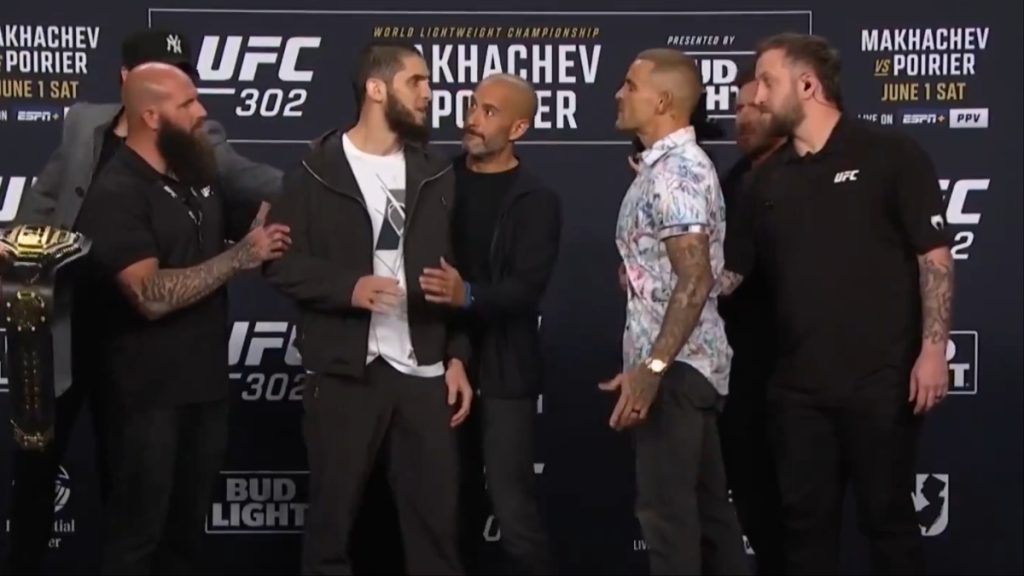
Poirier supplied the modern parallel. When he challenged Makhachev for the lightweight championship at UFC 302 in June 2024, he saw a man who appeared badly depleted around the weigh-in. By the time they entered the cage, the champion looked visibly more muscular and energetic. Poirier's reaction was not an accusation that Makhachev had broken the rules. It was astonishment at the change a fighter can undergo in the short window between making 155 pounds and competing.
The fight went deep. Poirier made Makhachev work through extended exchanges and defensive grappling sequences before the champion secured a D'Arce choke in the fifth round. That matters because the matchup was not a simple demonstration of a bigger man steamrolling a smaller one. Poirier's boxing and resilience kept the contest competitive, while Makhachev's wrestling, positional transitions and submission skill ultimately settled it. Size may influence individual exchanges; it cannot substitute for analyzing what actually happened.
Claims about Makhachev's precise weight inside the cage have circulated separately. Poirier previously suggested an exceptionally large rehydration figure, while Makhachev publicly disputed the account. Without an independently verified fight-night measurement for that contest, repeating a disputed number as fact would distort the story. The eyewitness observation is strong enough on its own: the athlete who appeared exhausted on the scale looked substantially different by fight time.
For Poirier, that difference was especially striking because both men had extensive experience at lightweight. The division's 155-pound limit was not a surprise to either camp. What changes from athlete to athlete is the size of the cut, the recovery response, and the performance that follows. A fighter can feel strong after rehydrating and still carry hidden fatigue; another can be lighter but faster over five rounds. Poirier's recollection captures the spectacle, not a laboratory result.
The Real Weight-Cutting Trade-Off Is Recovery Versus Usable Size
Why do fighters continue to cut so aggressively? The incentive is obvious: if two athletes can both make a division's limit, the one who enters the cage physically larger may have advantages in clinches, scrambles and certain grappling positions. Those possibilities encourage competitors to seek a margin wherever the rules allow it. Once enough athletes make the same calculation, a large cut can begin to feel less like a choice and more like the cost of keeping up.
But there is a fundamental difference between regaining weight and recovering performance. A fighter must replenish fluids and fuel, restore comfort and prepare for an intense contest, all within a limited interval. That process is individual. Two athletes might regain similar amounts of weight and feel very different. One may retain explosive strength while another struggles with pace, concentration or repeated wrestling exchanges. Thomas's argument about diminishing returns is therefore a serious competitive point, not merely a safety slogan.
The weigh-in also distorts how spectators think about fairness. A 155-pound contest is defined by a weigh-in threshold, not a promise that both athletes will be 155 pounds when they fight. This distinction is lawful under the rules used for the event, yet it can produce very different fight-night bodies. That is why a single photograph, a reported rehydration figure or a dramatic before-and-after comparison cannot settle whether one competitor had a meaningful advantage.
Any reform would have to confront incentives, not just appearances. Additional monitoring, different weigh-in timing or tighter hydration rules could change how fighters prepare, but each approach would need reliable enforcement and safeguards against unintended consequences. The important distinction is between a rule that looks strict on paper and one that actually discourages dangerous last-minute practices. A system that merely shifts the timing of the same extreme cut would solve little.

Makhachev's Move to 170 Pounds Gives the Debate a Real-World Test

Makhachev's career since UFC 302 makes Poirier's memory especially timely. Rather than remaining at lightweight, he moved up to the 170-pound welterweight division, defeated Jack Della Maddalena to capture a second UFC title in November 2025, and defended it against Ian Machado Garry in August 2026. The latter victory extended his UFC winning streak to 17, a promotional record. Whatever the visual impression at 155, his effectiveness has clearly survived the move up.
That does not mean every fighter who cuts heavily should automatically change divisions. At 170, Makhachev encounters opponents with different reach, leverage and natural frames. Garry, for example, presented a longer physical profile and made the champion work through difficult stretches before Makhachev secured a unanimous decision. The challenge shifted from shrinking enough to make a lower limit to solving opponents who are naturally comfortable in a larger class.
There is an important tactical difference, too. A fighter who no longer faces the same severe pre-fight reduction may be able to allocate more camp attention to skill work and consistent conditioning. But that is a potential benefit, not a measured explanation for Makhachev's recent victories. His success still rests on exceptionally developed grappling, timing, decision-making and the ability to change tactics during a fight. The 2026 title defense illustrated that technical adaptability matters as much as physical dimensions.
For fans, the contrast is instructive. The champion Poirier remembered from the 155-pound scale is now the champion defending at 170. Neither version can be reduced to a weight-cut headline. Yet the transition invites a fair question for every contender facing a brutal final week: how much of the supposed size advantage is worth the preparation cost? In a sport decided by fractions of seconds and small positional errors, the answer may be less obvious than the mirror suggests.
Weidman and Poirier were not making identical claims. One recalled how an opponent's presence changed his mindset; the other described the astonishing difference between Makhachev at weigh-in and at fight time. Both stories expose the same blind spot in MMA's familiar ritual: the scale establishes eligibility, but it does not tell us what physical state a fighter will bring into the cage.
The strongest lesson is not that the heaviest rehydrated athlete wins. Romero's finishing ability, Makhachev's grappling and Poirier's resistance all deserve more specific explanations than that. The lesson is that extreme cutting creates a strategic gamble with potential costs, and fighters may continue taking it as long as they believe their rivals will do the same. Makhachev's championship run at welterweight now offers a compelling reason to ask whether a less punishing cut can be a competitive advantage in its own right.

















