

Rogan Wants a Point Taken. Gane’s 48–47 Win Shows Why It Matters.
GOATIFYThe controversy around Ciryl Gane's heavyweight title defense is no longer confined to whether Josh Hokit deserved another round on the judges' cards. On November 18, UFC commentator Joe Rogan raised a more precise and potentially more consequential question: why was an apparent eye poke not punished when all three judges ultimately had the champion winning by a single point?
Gane defeated Hokit by unanimous decision at UFC 334 on November 14, with identical 48-47 scorecards across the board. Hokit had forced the sort of breathless, uncomfortable fight that the champion ordinarily tries to avoid. Yet Gane rallied with cleaner, more sustained offense down the stretch, kept his belt, and left Madison Square Garden with the official result. The referee's handling of an alleged first-round foul has now complicated an otherwise straightforward win.
Rogan's criticism matters for more than its celebrity amplification. A properly imposed one-point deduction would change the arithmetic of those cards, even if it would not automatically establish Hokit as the better fighter. The controversy also arrives only a year after Gane's eye poke against Tom Aspinall ended another heavyweight championship fight and contributed to a chain of serious consequences. Those are separate incidents, not proof of intent, but they make consistency from officials a legitimate issue.
There are three questions worth separating rather than collapsing into one social-media argument: what the referee should have done, what the judges actually saw over 25 minutes, and whether the UFC has a competitive reason to book a rematch. Rogan's reaction has revived all three, but the answers are not necessarily the same.
One Uncalled Foul, Three 48–47 Cards, and a Real Scoring Question

The scorecards explain why this story has traveled so far. All three judges gave Gane a 48-47 victory, meaning that—assuming no other scoring changes—a single point deducted from the champion would have transformed each 48-47 card into a 47-47 draw. That is hypothetical arithmetic, not a retroactive ruling. No such point was deducted at UFC 334, and the official result remains a unanimous decision for Gane.
That distinction matters because an alleged foul and a scored round answer different questions. Judges are supposed to evaluate legal offense under the scoring criteria. Referees separately decide whether a foul occurred, whether to interrupt the action, whether a warning is sufficient and whether a point should be removed. The judges cannot simply invent a penalty because spectators later believe one was warranted. At the same time, a referee's decision can alter the eventual outcome without changing anything about who landed the cleaner shots.
Hokit has argued that Gane caught him in the eye roughly 40 seconds into the opening round, that he complained and that he received no meaningful intervention. Those details are the challenger's account, not a finding that the referee intentionally ignored a confirmed foul. Video interpretation and medical effects can be disputed, particularly during a frantic exchange in which fingers and gloves move quickly. Rogan nevertheless believes the incident merited a pause and closer scrutiny, and he has argued for stronger deductions when a fighter extends an open hand toward an opponent's eyes.
That proposed standard is not the same as declaring every accidental contact worthy of an automatic point. Officials still have to assess the action, context, severity and applicable rules. A glancing contact created when a fighter suddenly changes levels is different from a repeated straight-arm frame with extended fingers. That is precisely why timely intervention matters: a referee can explain the warning, examine the affected fighter and establish what will trigger a deduction next time. Leaving the incident unresolved invites both sides to litigate the meaning afterward.
GOATIFY
GOATIFY UFC & MMA
The controversy over one point has UFC fans arguing. Explore GOATIFY's MMA apparel and fight-night designs while the heavyweight debate rolls on.


UFC GOAT Gold Middle Finger Fight Decal Sticker
Add MMA personality to your favourite gear.
Shop Now ↗


The eye-poke debate should not erase Gane's win on the existing cards. The official scoring came from five rounds of legal action, and the champion improved dramatically as Hokit slowed. It is entirely coherent to believe Gane landed the more effective offense and simultaneously believe that a foul should have drawn a penalty. Those positions are not contradictory. They address different layers of competition, and treating them as a single question makes the discussion needlessly partisan.
There is also a less obvious consequence for future opponents. When a one-point decision determines a world title, the perceived threshold for enforcing fouls becomes part of game planning. Athletes should not have to calculate whether they can absorb questionable contact because officials might be reluctant to influence a championship result. A point deduction does influence a result, but so can refusing to enforce a violation. The appropriate principle is consistent enforcement rather than artificially protecting close scorecards.
Hokit can therefore make a legitimate request for review of the incident without being awarded a moral victory or having the belt reassigned in public opinion. The commission record stands unless the appropriate authorities take an action that changes it. The stronger argument for the challenger's camp is procedural: demonstrate precisely what happened, seek a clear explanation, and make future expectations unambiguous for both corners.
Aspinall's Injury Made This More Than a One-Night Argument
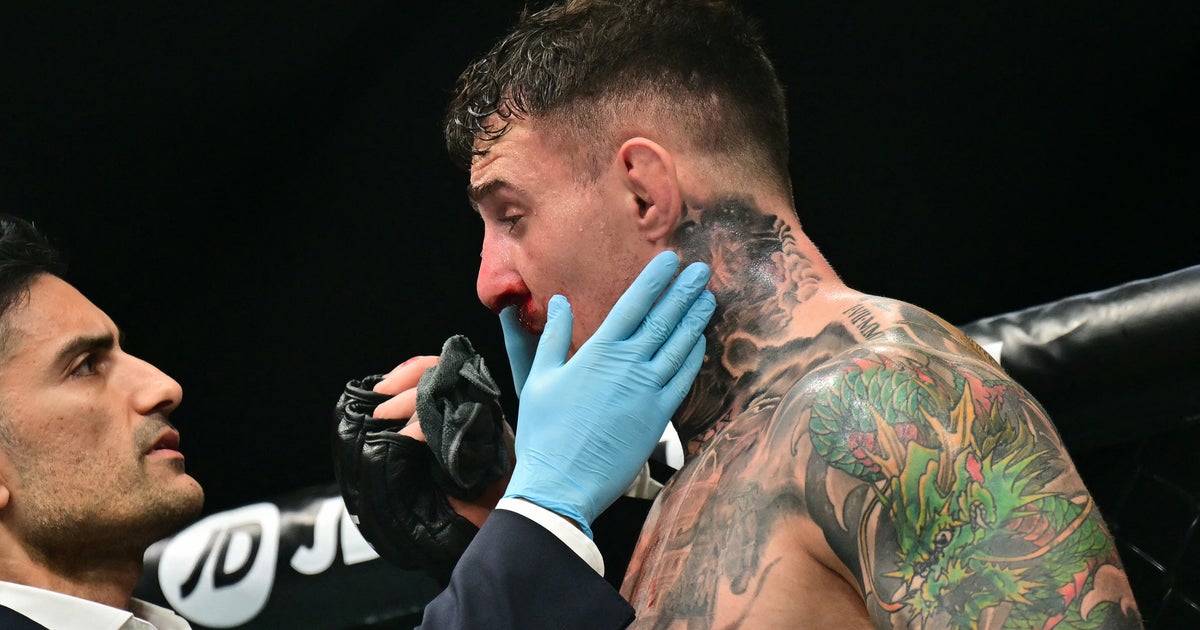
Gane's previous meeting with Tom Aspinall is the reason this did not land as just another postfight officiating complaint. At UFC 321 in October 2025, an eye poke by Gane left the then-heavyweight champion unable to continue, producing a no-contest rather than a successful title challenge. The incident was not an ordinary foul absorbed and forgotten before the next round. It stopped a major fight and became part of a prolonged absence at the top of the division.
Aspinall subsequently faced continuing eye problems and surgeries, delaying his return while the heavyweight championship picture moved on without him. Gane later defeated Alex Pereira to secure an interim belt and was elevated to undisputed champion in September 2026 as Aspinall remained sidelined. The chronology gives the latest complaint unusual emotional force: the same fighter associated with an earlier championship-ending eye injury has now retained a belt in another bout in which an opponent says he was poked.
That history should raise the demand for careful refereeing, but it does not establish that Gane deliberately tried to injure either opponent. Accidental and reckless actions can carry real consequences without requiring a finding of malicious intent. Equally, a fighter's previous violation should not be used to manufacture proof that an unrelated incident happened exactly as a new complainant describes it. The fair response is better examination and consistent in-fight enforcement, not a shortcut from reputation to guilt.
Eye pokes pose an especially difficult problem in MMA because they can instantly compromise a fighter's ability to track movement, judge range and defend against strikes. An athlete cannot simply treat an impaired eye like a bruised thigh; depth perception and reaction timing affect almost every exchange. Even a brief interruption may have competitive consequences, but continuing with compromised vision can have much greater ones. Officials therefore need to balance legitimate assessment against preserving the contest's flow.
Rogan's reasoning emphasizes prevention as much as punishment. Open-hand framing can be a normal range-management habit in other striking environments, yet mixed martial arts gloves expose the fingers, and pointing them toward an approaching opponent's face creates avoidable danger. Coaches can adapt those habits: close the fist, orient the palm differently, or establish distance with footwork instead of relying on a fence of extended fingertips. Repeatedly asking referees to solve a technique problem after somebody is hurt is a poor long-term substitute for changing the technique.
GOATIFY
GOATIFY UFC & MMA
Gane and Aspinall's history puts fighter safety in the spotlight. Browse GOATIFY UFC-inspired shirts, hoodies and accessories.


MMA GOAT Gold Middle Finger Fight Crewneck Sweatshirt
A MMA fan design for everyday wear.
Shop Now ↗


Rogainz Joe Rogan UFC MMA Martial Arts Sticker
Add MMA personality to your favourite gear.
Shop Now ↗There is a parallel responsibility for the promotion and commission to communicate what happened. A transparent explanation of whether the referee saw contact, issued a warning, assessed the athlete or concluded a deduction was unwarranted would not necessarily end the debate, but it would make it more informed. Instead, the public is left comparing a close scorecard with postfight clips and emotionally charged statements. That is exactly the information vacuum in which every close decision becomes an accusation of special treatment.
Aspinall's situation also highlights why the stakes should not be reduced to whether a point might have saved Hokit from defeat. The health of a fighter and the competitive integrity of a bout are separate protections that ought to reinforce each other. A future title fight should not need to end in a no-contest before everyone agrees that finger positioning and prompt intervention deserve attention. The practical lesson of this history is not to rewrite the Gane-Hokit result by reputation; it is to insist on clearer execution of the rules from the opening minute.
The Fight Itself: Hokit Disrupted Gane but Could Not Sustain It

The refereeing dispute is substantial, but the fight beneath it deserves a proper tactical reading. Hokit did not arrive at Madison Square Garden as a passive opponent waiting for Gane to choose the distance. He walked forward, challenged the champion's space, threatened to wrestle and tried to turn every exchange into a recovery test. That approach exposed the most interesting weakness in Gane's otherwise refined striking: he is at his best when he can set a rhythm, see the entry coming and decide when to accelerate.
For much of the first three rounds, Hokit made that rhythm uncomfortable. The challenger was willing to stay close enough to force repeated decisions and keep Gane moving backward. He also made the early grappling exchanges matter psychologically, even when they did not produce a sustained finish. A fighter who can repeatedly convince a technician that a level change or clinch is coming will often restrict the freedom with which that technician throws kicks. That dynamic helped make the contest feel much closer than a simple description of Gane's striking pedigree would suggest.
There is, however, a crucial difference between disrupting an opponent and consistently winning exchanges. Hokit treated forward pressure as evidence of control, and his corner plainly believed his pace was paying off. The judging criteria give effective striking and grappling the highest priority, with effective aggression and fighting-area control becoming important when the primary actions are otherwise close. Moving toward an opponent is not by itself equivalent to landing the most effective offense. An exhausting pursuit can be tactically impressive without producing the decisive damage needed to win a round.
Official fight analysis credited Gane with more landed strikes, while Hokit argued that the challenger delivered the heavier individual blows and that sheer volume should not settle the cards. Both observations can be considered without pretending punch counts are a perfect scoring algorithm. A jab that maintains distance may be less damaging than a clean power shot; a succession of accurate shots can also accumulate meaningful impact and prevent an opponent from establishing his own offense. A careful round-by-round review asks which fighter's successful actions actually changed the contest, not which fighter appeared busier during a particular minute.
GOATIFY
GOATIFY UFC & MMA
Hokit's pressure and Gane's striking made UFC 334 a classic. Find fight-fan gear for the next heavyweight showdown.

MMA GOAT Gold Middle Finger Fight Crewneck Sweatshirt
A MMA fan design for everyday wear.
Shop Now ↗UFC GOAT Gold Middle Finger Fight Decal Sticker
Add MMA personality to your favourite gear.
Shop Now ↗The championship rounds gave Gane a clearer claim. As the challenger slowed, the champion began landing body knees and kicks with more freedom, interrupted entries with straight shots and found openings that had been unavailable while Hokit was throwing at full speed. The official recap identifies the fourth round as a turning point and the fifth as a stronger Gane round, with the Frenchman delivering the more significant work as the challenger's output declined. Rogan, despite criticizing the eye-poke handling, also praised the champion's ability to settle into his technique late.
Gane's adjustment is meaningful because Hokit presented a rare physical and stylistic stress test. The challenger did not win by simply making a fight untidy. He still had to bank rounds against a heavyweight who can combine movement, timing and accurate counters over 25 minutes. Once Gane started meeting forward entries with body attacks, Hokit's most important weapon—his persistent forward momentum—became a source of opportunities for the champion. The same aggression that denied Gane space early also required Hokit to walk through increasingly clean offense late.
One strong piece of evidence for the champion's effectiveness is that Gane prevented Hokit from converting a large number of takedown attempts into lasting positional success. That is not a claim that Hokit never established top control; he did argue that his first-round grappling should have earned more respect. It is a reminder that threatening a takedown and completing a fight-changing sequence are not the same event. Against an agile heavyweight who can regain distance, failed entries can consume energy that becomes expensive in the last two rounds.
The best account of UFC 334 therefore has room for both fighters. Hokit pushed Gane into an unfamiliar endurance problem and made the first half difficult; Gane solved enough of it to win the last stages convincingly and retained his championship on three official cards. An officiating review should be pursued on its own merits, not as a device for erasing everything the champion accomplished after the disputed contact.
What Happens Next: A Rematch, a Contender, or a Refereeing Reset?

Hokit wants a rematch and has argued that his performance warrants one. From a promotional standpoint, the case is easy to understand. A highly entertaining heavyweight championship fight ended on three one-point scorecards, and the challenger's allegation gives a second meeting an instantly recognizable storyline. A repeat contest could also reveal whether Gane's late adjustments are durable or whether Hokit can improve his own approach enough to take away those final rounds.
The sporting case is more complicated. Hokit lost the decision, and the official record has not been changed. A close result does not automatically create a rematch obligation, especially when other contenders have been waiting for the title picture to move. Alexander Volkov remains relevant in discussions about the next heavyweight opportunity, while Alex Pereira's future can depend on upcoming results and promotional priorities. Neither matchup should be described as booked merely because a fighter, analyst or fan prefers it. As of the November 18 reaction, the UFC had not announced a new Gane-Hokit title fight.
Hokit's argument for another chance would be stronger if he turns the controversy into a specific tactical proposal. He must show how he can sustain the extraordinary early pressure without paying for it in rounds four and five. More efficient entries, fewer wasted rushes and targeted offense to the body are plausible priorities. If he can make Gane defend fewer explosive but more threatening wrestling attacks, he might preserve the energy required to win a full five-round match. Simply promising to walk forward even harder is unlikely to solve the problem exposed at the end of UFC 334.
GOATIFY
GOATIFY UFC & MMA
From a rematch to the next contender, heavyweight talk never stops. Shop the GOATIFY UFC collection while the title picture develops.
Rogainz Joe Rogan UFC MMA Martial Arts Sticker
Add MMA personality to your favourite gear.
Shop Now ↗For Gane, the preparation question is almost the reverse. His corner will want to develop earlier answers to pressure rather than rely on a late correction. The champion's movement, body kicks and timing remain elite tools, but Hokit found stretches where denying space also denied Gane his preferred offense. A rematch camp could emphasize immediate punishment for crowded entries, more reliable exits off the fence and earlier investment in body attacks. It should also address defensive hand position. Whatever one thinks of the latest allegation, the repeated public controversy makes cleaner framing mechanically and competitively important.
Rogan's intervention also hands regulators and officials a chance to do something more useful than adjudicate the internet's winner. They can clarify how they apply the foul rules to extended fingers, when a fight must be stopped for examination and how repeated or severe conduct affects the deduction decision. Fighters should know those thresholds before their bout, not discover them afterward from a pundit's interpretation. Consistency is particularly important in title fights because a single point on a close card can determine the belt, the next payday and the entire contender queue.
There is a temptation to frame stricter enforcement as a choice between fighter safety and entertaining combat. That is the wrong trade-off. A fighter who trusts the official to respond promptly can continue competing instead of deciding whether to complain at the cost of his momentum. Opponents who know open-finger contact will be treated seriously have an incentive to adjust their technique. Viewers get a contest decided as much as possible by lawful combat rather than by allegations about what the referee did or did not see.
One hypothetical deduction would have produced a remarkable mathematical symmetry: three 47-47 cards, no decision victory and no clean answer about the belt's next chapter. But fights are not decided by hypothetical scorecards. The real task for Hokit is to put forward a specific account of the incident and a better plan for the final ten minutes. The task for Gane is to show that his championship-round superiority survives another opponent who refuses to give him comfortable space. And the task for officials is to make sure that the next discussion is about the fighters' skills, not a disputed finger near an eye.
For now, Gane is the recognized heavyweight champion and Hokit is a formidable challenger who remains without the victory he sought. A rematch would sell, but it should be justified with competitive reasoning rather than treated as an automatic correction to a result that still stands. The November 18 argument is most valuable if it forces the sport to be clearer about fouls before the next close fight, not merely louder about them afterward.
Joe Rogan's criticism landed because the gap between a 48-47 victory and a hypothetical 47-47 draw is exactly one point. That makes the alleged eye poke a serious officiating question. It does not erase Ciryl Gane's late-round tactical recovery, establish that Josh Hokit won, or automatically rewrite a completed championship bout.
The heavier lesson comes from the broader context. Tom Aspinall's earlier injury showed how consequential eye contact can become, while UFC 334 illustrated why clear referee decisions matter even when a fight continues for all five rounds. Hokit deserves a proper explanation of the incident and a route back toward contention. Gane deserves recognition for retaining the belt under relentless pressure. Neither interest conflicts with tighter, more transparent enforcement.
The next heavyweight title fight will answer sporting questions of its own. The sport should try to enter it with fewer unanswered questions about where the rules begin, where discretion ends and why a single point can still dominate the conversation days after the champion's hand was raised.
GOATIFY
GOATIFY UFC & MMA
Explore six GOATIFY UFC and MMA favorites before the next fight story.
UFC GOAT Gold Middle Finger Fight Decal Sticker
Add MMA personality to your favourite gear.
Shop Now ↗MMA GOAT Gold Middle Finger Fight Crewneck Sweatshirt
A MMA fan design for everyday wear.
Shop Now ↗


















