Boston Erased 22 Points. Queta's Block Finished a Perfect Road Trip.
GOATIFYWith 5:24 left in the first half on November 11, the Toronto Raptors led the Boston Celtics 59-37. Toronto had rained in ten first-quarter three-pointers, Boston had barely slept after its previous victory in Philadelphia, and the visitors were missing an ill Paul George. By the final buzzer, the score was Boston 98, Toronto 93. The 22-point deficit was gone, the Celtics had won five straight, and their four-game road trip ended without a loss.
The comeback had several authors. Jayson Tatum pulled Boston back into contention before halftime even though his own shooting was uneven. Derrick White supplied scoring and remarkable perimeter rim protection. Neemias Queta collected 13 rebounds and made the weak-side block that mattered most, then calmly hit the free throws that protected the lead. The result was less a tale of sudden offensive firepower than a team refusing to abandon its defense after a miserable opening. Here is how Boston changed the contest, and what the finish tells us about its early-season identity.
Ten Toronto threes turned a tired road trip into a 22-point hole
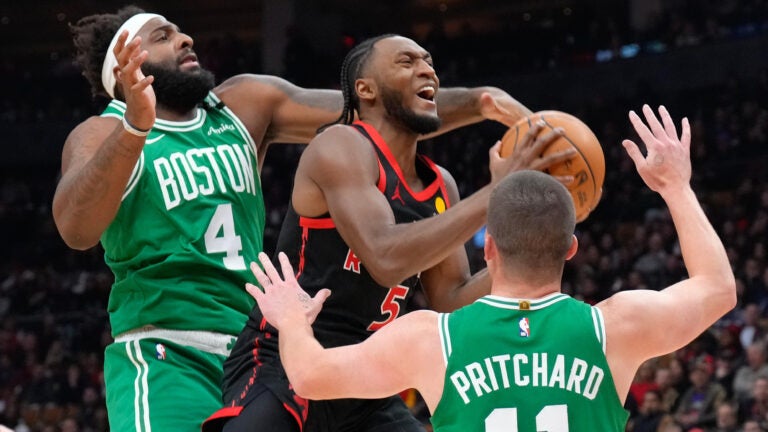
Boston did not arrive in Toronto with the usual advantages of a team on a winning streak. The Celtics had played a high-emotion game in Philadelphia on Tuesday, traveled across the border and, according to Jayson Tatum, reached their hotel at roughly 3 a.m. The next tip was less than a day away. Paul George, who had scored 36 in the victory over his former team, was unavailable because of illness. A squad that had looked in command against Philadelphia suddenly had to find another source of energy without one of its most important scorers.
Toronto was hardly at full strength either. Scottie Barnes and Kawhi Leonard remained unavailable, and the Raptors entered the matchup with an injury-complicated rotation. But the home team did not spend the opening quarter playing like an opponent waiting to be beaten. It pushed the ball, attacked Boston's defensive attention and repeatedly found the perimeter. Toronto converted 10 of 18 three-point attempts in the first 12 minutes, matching a franchise mark for makes in a quarter. That volume of accurate outside shooting can make even a small defensive mistake look catastrophic.
The score after one quarter was 38-29 to Toronto. That nine-point margin was uncomfortable rather than decisive, but the second period quickly became more dangerous. Boston's offense stalled when Tatum sat, Toronto kept forcing uncomfortable possessions and the margin widened to 22 at 59-37 with 5:24 before halftime. For the Celtics, there were at least three overlapping problems: legs tired from travel, a cold shooting rhythm and a defense arriving half a beat late to Raptors shooters. Simply telling the starters to play harder would not have addressed all three.
The sequence that rescued Boston began long before the final minute. Instead of responding with desperate three-point attempts, Tatum found ways to put pressure on the basket and create decisions for Toronto defenders. He scored the first ten points of a Boston surge, including a forceful finish and a perimeter play that became part of a seven-point possession after a flagrant foul and Baylor Scheierman's additional three. The larger burst was described as a 17-2 turnaround, with Tatum scoring or assisting on 14 of those points.
The distinction matters. Tatum was not merely collecting points while everyone else watched. His drives bent the defense, his passing punished the extra help and his presence restored a reliable decision-maker to possessions that had begun to feel rushed. Boston was still down at halftime, 61-54. That seven-point deficit was not a comeback completed, but it was a very different proposition from 22. It also gave Joe Mazzulla room to coach a real second half instead of asking his team to chase an increasingly remote score.
GOATIFY
GOATIFY Basketball
Toronto's early three-point explosion put Boston in a hole. Browse GOATIFY's basketball designs as the Celtics find their way back into this NBA thriller.

Vince Carter G.O.A.T. - Greatest of All Sweatshirt
A basketball fan design for everyday wear.
Shop Now ↗

Vince Carter G.O.A.T. - Greatest of All Hoodie
A basketball fan design for everyday wear.
Shop Now ↗
Kawhi Leonard G.O.A.T. - Basketball Decal
Add basketball personality to your favourite gear.
Shop Now ↗

Kawhi Leonard G.O.A.T. - Basketball Pullover Sweatshirt
A basketball fan design for everyday wear.
Shop Now ↗The Raptors' early accuracy created its own challenge. Ten first-quarter triples are a terrific return, yet repeating that pace for 48 minutes would have required an extraordinary shooting night. Boston could not assume Toronto would simply go cold; the Celtics had to contest without overreacting, recover missed shots and keep turnovers from turning into fresh Raptors attempts. Their late-second-quarter reset accomplished the first essential task: it brought the game back inside a range where stops could have immediate value.
That is why the Celtics' response is more instructive than the size of the opening deficit. They absorbed a stretch when nearly every bounce favored Toronto, then made the next five minutes coherent. On the second night of a back-to-back, a team can lose its organization before it loses its effort. Boston rediscovered the organization first. The points followed, and a game that looked finished while still in the first half entered the break genuinely alive.
Boston changed the game with stops, not a shooting miracle
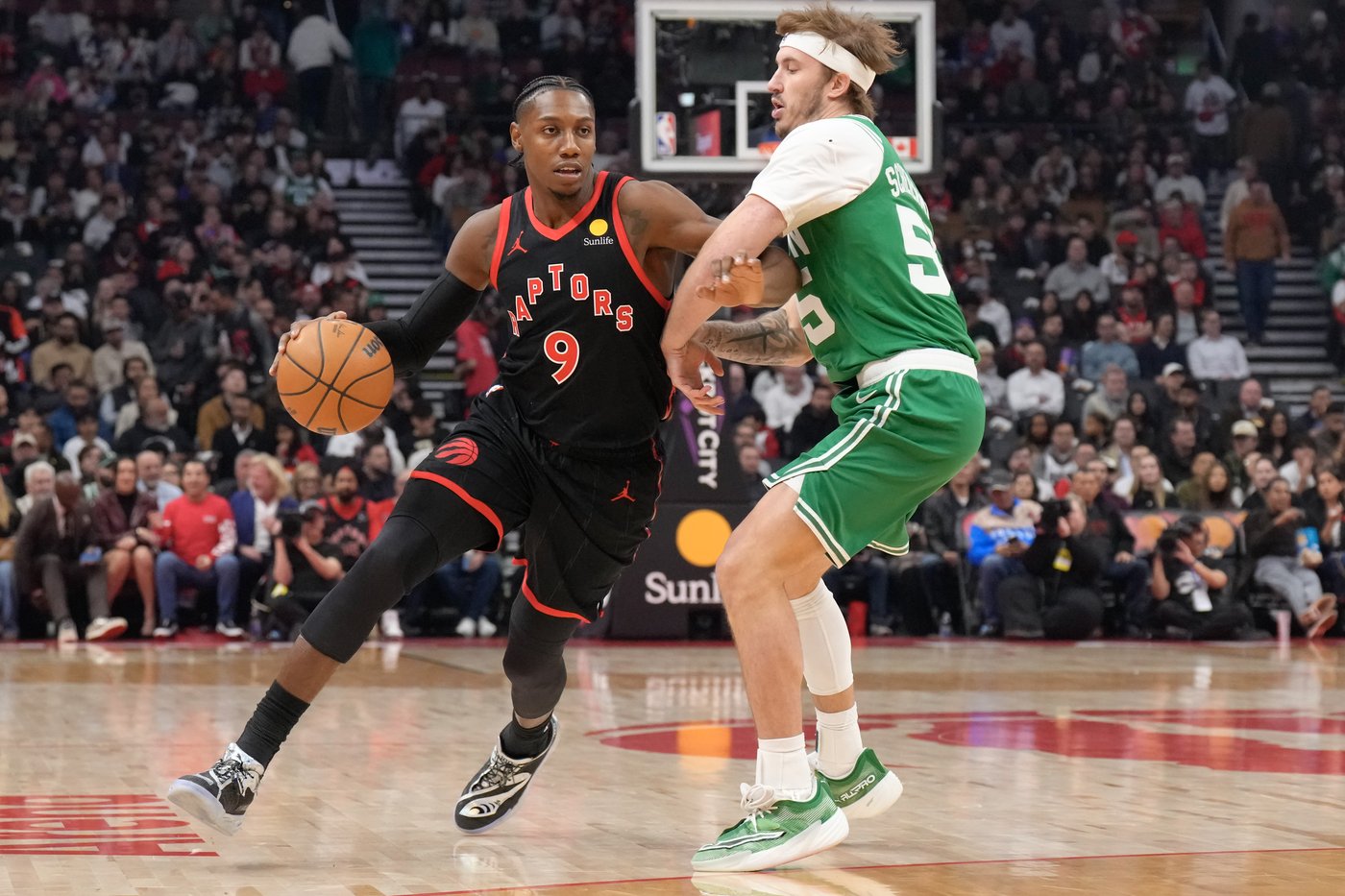
There is a temptation to describe any 22-point comeback as a sudden offensive explosion. Boston's Wednesday win does not fit that simple script. The Celtics finished with 98 points, not a dazzling total in the modern NBA. They did not need to match Toronto's first-quarter three-point barrage. What mattered was that the Raptors produced just 32 points in the entire second half, 19 in the third quarter and only 13 in the fourth. The game flipped because Boston made scoring hard for long enough to survive its own missed shots.
Derrick White was at the heart of that shift. His final line of 19 points, seven assists and four blocks is unusual for a guard because it captures both how much offense flowed through him and how much protection he supplied behind the point of attack. White helped close the gap early after halftime, finding a three and contesting finishes when Toronto tried to restore control. One block of RJ Barrett's layup attempt demonstrated the timing Boston needed: rather than turning a dribble into an uncontested shot, a late defender arrived with an answer.
The Raptors had made ten threes in the first period; after that opening wave, they went just six for 25 from deep across the remaining three quarters. Some of that difference reflects the natural variability of jump shooting, but treating it as luck alone would miss Boston's more convincing second-half possessions. The Celtics stayed more connected between ball and weak-side defenders, pursued the next pass and forced Toronto into tougher decisions later in the clock. Good defense does not guarantee a miss. It makes the miss a more realistic outcome and gives teammates a chance to finish the possession.
Finishing the possession was another story. Toronto kept creating opportunities on the offensive glass, and its ability to extend plays prevented Boston from simply running away with the game. That is where Neemias Queta's 13 rebounds became more than an attractive line in the box score. Rebounds shorten an opponent's possession and stop the repeated effort that can wear down a tired defense. Queta's size and timing also changed the geometry of drives. A shooter who sees a big man rotating toward the rim must decide earlier whether to finish, pass or pull up.
GOATIFY
GOATIFY Basketball
White and Queta helped turn the game with defense and determination. Explore more GOATIFY basketball styles for fans of the NBA's hardest-fought moments.

LeBron James – LeGOAT Streetwear Pullover Gift Hoodie
A basketball fan design for everyday wear.
Shop Now ↗
Michael Jordan – GOAT Cigar Celebration Decal Sticker
Add basketball personality to your favourite gear.
Shop Now ↗
Crying LeBron – Emotional NBA Basketball Sweatshirt
A basketball fan design for everyday wear.
Shop Now ↗


Boston did not get every detail right. There were sloppy stretches and turnovers before halftime; there were fourth-quarter offensive possessions that still looked strained. Payton Pritchard supplied 14 points and the steady presence of another ballhandler, while Baylor Scheierman's timely outside shooting helped prevent a defense focused on Tatum from collapsing entirely. The supporting cast did not have to dominate. Their contributions were enough to create more than one way to score, just as White and Queta were creating more than one way to stop Toronto.
The score entering the fourth quarter was still Toronto 80, Boston 75. That five-point deficit is revealing: the Celtics had spent most of the third rebuilding their defensive base, not trying to erase everything in a minute. A team trailing by five with 12 minutes left has many possibilities. A team trailing by 22 because it is still conceding wide-open attempts has almost none. Boston's patience changed the range of outcomes long before it took the lead.
Toronto's circumstances should not be erased from the account. Missing Barnes and Leonard reduced its available offensive solutions, especially when the jumpers stopped falling. Ja'Kobe Walter nonetheless contributed 17 points, and the Raptors' early ball movement showed why Boston could not simply coast through the fixture. The Celtics deserve credit for the defensive answer without pretending their opponent was at full strength. Good analysis can hold both truths together: Toronto created the first-half crisis, and Boston solved enough of it to earn a comeback.
White's four blocks and Queta's work near the rim made the defensive identity tangible. Those numbers are not substitutes for possession-by-possession evidence, but they align with the way the second half unfolded. Boston closed passing angles, contested the basket and kept working even when its own shooting failed to reward the effort immediately. By the time the last minute arrived, the game had become a question of which team could execute under the heaviest pressure. That was a test Boston was prepared to answer.
Queta's final stop turned a survival act into a statement

Great comebacks are remembered for the last decisive possession, but those moments usually require a lot of quieter work to become possible. Boston had clawed its way back from a 22-point hole without ever making the fourth quarter comfortable. Toronto was still ahead 93-90 in the closing stretch. For a team whose legs were heavy, whose opponent had been ahead most of the night and whose leading scorer had missed 15 of his 21 shots, the possibility of a painful loss was very real.
Tatum's response was not a spectacular contested three. It was control. He kept the ball moving, attacked space and reached the line when Boston needed points it could trust. With 25.2 seconds left, he converted the free throws that put the Celtics ahead 94-93. He finished with 24 points, eight assists, seven rebounds and two blocks. The field-goal number, six makes in 21 attempts, underscores why this cannot be judged as an effortless superstar takeover. Tatum's contribution was broader: he helped manufacture good possessions when efficient jump shooting was unavailable.
That lead left Toronto with one of the game's most important chances. RJ Barrett drove toward the basket, looking for a way to answer without relying on another rushed three. White remained involved at the point of attack, but Queta read the play from the weak side and met the shot with the block. It was the sort of help-defense play that disappears if a big man takes one step too early, arrives one beat too late or fails to trust that a teammate is controlling the first part of the drive.
GOATIFY
GOATIFY Basketball
A late block capped Boston's four-game road sweep. Celebrate the league's big rivalries and breakout plays with GOATIFY basketball gear.

Lauri Markkanen GOAT - Basketball Decal Sticker
Add basketball personality to your favourite gear.
Shop Now ↗
Kobe Bryant G.O.A.T. - Settle the Debate Hoodie
A basketball fan design for everyday wear.
Shop Now ↗
Tyrese Haliburton G.O.A.T. - Basketball - Sweatshirt
A basketball fan design for everyday wear.
Shop Now ↗


Fat Luka Doncic Los Angeles Lakers NBA Mug
Add basketball personality to your coffee break.
Shop Now ↗The block would have been memorable regardless of the outcome. What followed made it decisive. Queta drew a foul, went to the free-throw line in a loud road building and made both attempts with about 15 seconds to play. The Celtics now had a three-point cushion instead of a precarious one-point lead. Sam Hauser then intercepted Toronto's ensuing inbounds pass, a final piece of defensive execution that removed the Raptors' best chance to steal the result. Boston closed on an eight-point run and the final score settled at 98-93. Queta's 11 points and 13 rebounds hardly describe the emotional weight of those few seconds, but they help explain why he was positioned to make the play.
His role also says something about how the current Celtics are constructed. Boston can ask Tatum to anchor the offense without demanding that every big play come from him. White can direct possessions and act as a back-line disruptor despite being a guard. Queta can do the unglamorous work on the glass for most of the night and then decide a game in the air. Mitchell Robinson can give the defense a different physical look. The combination does not eliminate the need for star talent; it makes that talent less isolated when the favorite is out of rhythm.
The context makes the win more interesting than a routine November box score. Boston completed a four-game sweep away from home, beating Charlotte, Milwaukee, Philadelphia and Toronto in succession. The trip included a convincing performance in Philadelphia, then a much less glamorous test in Toronto with a short turnaround and an important scorer missing. The Celtics emerged with five consecutive victories overall and nine wins in ten games since their opening loss to Detroit, a run that placed them among the early pace-setters in the East.
There is an important limit to the conclusion. A November comeback does not prove Boston will stay healthy or that this defensive form will survive every matchup. Toronto had its own injury concerns, and the Celtics were fortunate the home team's extraordinary early accuracy cooled. Future opponents may be better equipped to punish Boston's stagnant spells. The performance offers evidence of adaptability, not a guarantee of domination. That is still valuable evidence for a group expected to contend deep into the season.
Joe Mazzulla's team now gets a few days away from the nightly grind before welcoming Dallas on Sunday. The rest is useful, but so is the example from Toronto. Boston did not solve the night by finding an easy opponent or waiting for perfect conditions. It had to live through a disastrous opening, cut the deficit, produce stops and execute at the line while the game remained undecided. Queta supplied the image that will be replayed. The more durable lesson is how much work had to happen before he could make that block matter.
One night will not settle a season, and the Celtics should not need a 22-point deficit to discover their defensive urgency. But the Toronto escape showed why a winning streak is built from more than effortless victories. The stars established the comeback, the rotation kept Boston alive, and Queta supplied the final piece. The Celtics leave the road with four wins in four attempts, an example of what connected defense looks like when the jumpers are not falling, and a few days to recover before facing Dallas at home.
GOATIFY
GOATIFY Basketball
Shop GOATIFY basketball shirts, hoodies and stickers.

Anthony Edwards G.O.A.T. - Basketball Casual Tee
A basketball fan design for everyday wear.
Shop Now ↗
Devin Booker GOAT - Basketball Decal Sticker
Add basketball personality to your favourite gear.
Shop Now ↗


Victor Wembanyama Alien Wemby NBA Basketball Mug
Add basketball personality to your coffee break.
Shop Now ↗