

Zone Blitzes Explained: The Five-Man Gamble Behind NFL Pressure
GOATIFYA defensive end takes two steps as if he is coming for the quarterback, then turns into the throwing lane. At the same instant, a linebacker or safety who looked ready to cover a receiver bursts through the protection. The offensive line blocks the front it expected. The quarterback looks for the quick answer he prepared. Neither prediction is quite right. That is the basic trick behind a zone blitz: the defense exchanges the players who rush and cover, using the quarterback's and blockers' assumptions against them.
The famous version is the fire zone, traditionally rushing five defenders while keeping three deep and three underneath in zone coverage. It is a gamble, not a cheat code. The extra rusher can cause a sack or a hurried pass, but removing an underneath coverage player creates space that a prepared offense can attack. The art is to make the quarterback notice that space too late.
To understand zone blitzes, forget the idea that every blitzer is simply an additional person running forward. The more important question is who replaces the blitzer in coverage, how that changes the line's blocking count and whether the defense can survive if the ball comes out immediately. The following breakdown traces the exchange, the coverage math, the ideal situations and the offensive answers that have pushed coaches toward four-man simulated pressures.
The exchange: why a pass rusher suddenly becomes a coverage defender

The easiest way to recognize a zone blitz is to stop counting helmets near the line of scrimmage and start asking which helmets will actually cross it. The offense sees a defensive end with his hand down and naturally budgets a blocker for him. It also sees a linebacker or nickel defender several steps off the ball and treats that player as a likely coverage threat. At the snap the two jobs reverse. The end retreats toward a passing lane; the linebacker or defensive back attacks an open rushing gap. The offensive line can make a technically sound decision against the wrong picture.
That exchange is the heart of the concept, but not every coordinator uses the words in exactly the same way. Zone blitz describes pressure married to zone coverage; the classic fire zone is the five-rusher, three-deep, three-underneath version. Some modern exchange calls rush only four, preserve seven coverage players and are more precisely described as simulated pressures or creepers. They borrow the deceptive look without paying the same numerical coverage cost. The distinction matters when a broadcast calls every surprising rush a blitz.
Think of a familiar four-down-lineman front. A tackle and guard may set toward the defensive end, expecting him to rush. A safety creeps toward the box while a linebacker threatens an inside gap. If the end drops and those defenders attack, the offense must sort out new threats within the brief interval between snap and quarterback throw. A protection sliding to the original threat can leave a free runner at the opposite edge or an unfavorable one-on-one block inside. No magical pass-rushing talent is required: a defense is creating a counting and timing problem.
The coverage player who replaces the rush is not meant to transform into an elite cornerback. A defensive end dropping into a curl or flat window needs to get enough width, maintain his vision on the quarterback and obstruct the immediate route that a pressured passer expects to be available. That can mean taking away a slant or quick sit route for a beat, forcing the ball to be held until the pressure arrives. The technique is modest; the effect can be dramatic because the offense anticipated empty grass.
GOATIFY
GOATIFY NFL
See the GOATIFY NFL collection while exploring the disguise that makes football defense so fascinating.


There is also a historical reason this tactic has such a distinctive identity. Dick LeBeau made fire-zone packages central to his defenses in Cincinnati and Pittsburgh, combining unexpected rush paths with structured zone rotations as an answer to offenses that punished conventional blitzes with fast throws. The enduring lesson is not that a 300-pound defender should be asked to chase a slot receiver. It is that moving the expected rusher into the expected hot window may be more valuable than sending one additional fast player into a crowded rush lane.
Five rushers, three deep and three underneath: the geometry behind a fire zone
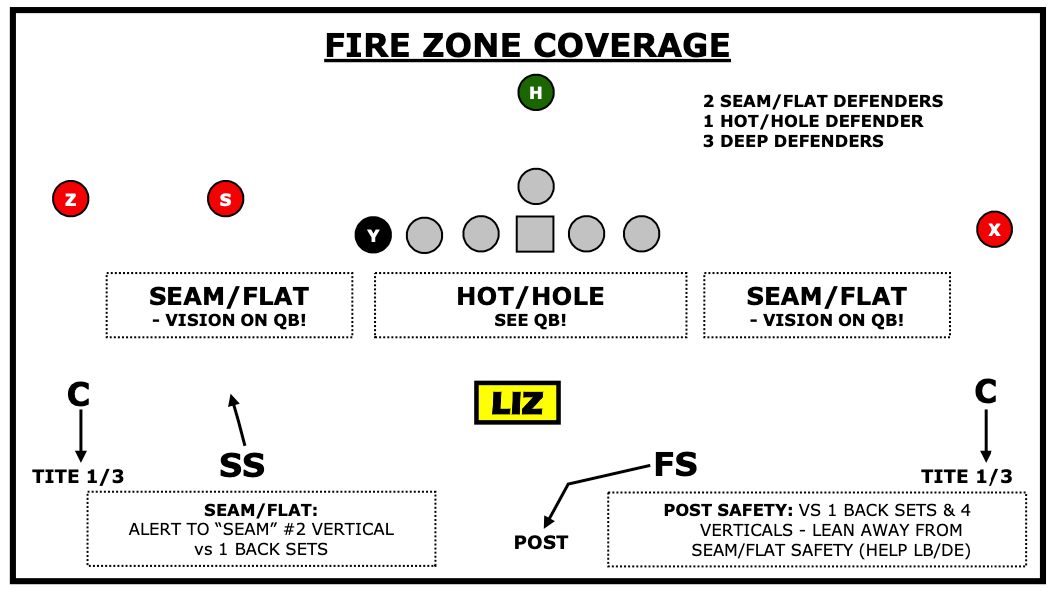
The arithmetic explains both the attraction and the risk. Football gives the defense eleven players. Send five and six remain in coverage. A traditional fire-zone structure places three defenders in the deep thirds and three in underneath zones. You can write the call as 5 + 3 + 3 = 11. That looks close to ordinary Cover 3, but a conventional four-man rush can leave seven in coverage: three deep and four underneath. The fire zone has voluntarily removed one underneath defender to buy a fifth rusher.
The three deep defenders usually resemble a familiar single-high coverage: two outside-third players and one middle-third player, though rotations and pattern-match details vary by team. Their primary responsibility is to keep vertical routes from turning into uncontested explosives. That layer is why a fire zone can be less dangerous than a six-man Cover 0 rush, in which the defense may be counting on every individual matchup to hold up without a free safety waiting over the top. But three deep does not guarantee a safe play; a blown rotation or badly leveraged seam still creates a huge opening.
Underneath, the scheme needs players who understand routes rather than simply sprinting to painted landmarks. Two defenders commonly handle seam-to-flat responsibilities. They must influence the release of the inside receiver, recognize whether that receiver stretches vertically, breaks inside or shoots toward the sideline, and move toward the threat according to the particular coverage call. One player occupies the middle hook or third-receiver area. These responsibilities can change against two-by-two and three-by-one receiver sets, especially when multiple inside receivers threaten the same seam.
The hard part is that three underneath bodies cannot occupy four ordinary underneath zones at once. A quarterback can threaten the flat with a running back while pushing a tight end vertically into the seam; the defender in between has a conflict. If he widens quickly, the inside window opens. If he sits inside, the flat becomes available. The coordinator is accepting a potential short completion in exchange for a greater chance of an immediate hit or hurried decision. Sound tackling turns that concession into a manageable gain; a missed tackle turns it into the reason the call failed.
The defense must also handle the running game. When an end drops and a linebacker leaves his normal run fit, the slanting defensive linemen and remaining second-level defenders must replace those gaps. A five-man call that creates a free pass rusher but loses its edge against a draw or inside zone is not a coherent defense. Good fire-zone systems therefore pair the pass rush paths, underneath coverage landmarks and run-fit replacements as one installation, not three unrelated drawings.
One more wrinkle matters to knowledgeable viewers: a deep-third label does not mean a player drops blindly backward and guards an empty square. Many versions use match rules that carry certain vertical routes or adjust to formations. Terminology differs across coaching trees, but the universal requirement is communication. The defense must know which rusher has been removed from coverage and who inherits his former area before the ball is snapped.
GOATIFY
GOATIFY NFL
Coverage math tells the story. Browse NFL-inspired GOATIFY designs for fans who love the strategic game.
How a zone blitz defeats protection and attacks the quarterback's hot read
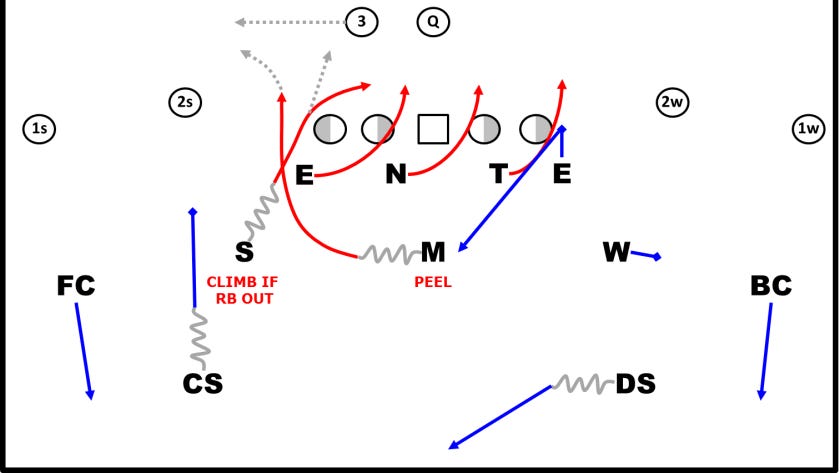
A zone blitz succeeds when the rush and coverage manipulate the same offensive decision. Imagine third-and-seven. The offensive line identifies a possible overload to the quarterback's right and slides its protection in that direction. The running back prepares to help with the most dangerous extra rusher. The defense then slants its linemen away, sends a linebacker through the vacated interior and drops a defender who appeared to be certain to rush. The slide has protected one location while the real threat develops in another. A rusher can arrive before a long route reaches its break.
The quarterback's standard answer against pressure is to deliver the ball quickly to the receiver replacing the departing blitzer. That is a hot read: a fast route designed to exploit the space that pressure seems to abandon. The zone blitz attacks this habit. Instead of leaving the hot window empty, the defense puts a dropping end, linebacker or rotating safety near it. The passer sees a flash of pressure, anticipates the slant and discovers a defender where the easy completion should have been. He must hitch, reset or work to another receiver while the rush closes.
This is why the pass rush cannot be separated from the coverage. A free-running nickel defender is useful only if the ball stays in the quarterback's hands. If the replacement drop arrives late or the receiver breaks outside the defender's leverage, the supposed trap is a simple completion. Conversely, perfect coverage for two seconds does not rescue a five-man rush that never forces the quarterback off his spot. Timing is the product, not sacks alone.
Coordinators can vary the entry point. A boundary pressure uses the shorter side of the field to reduce the blitzer's travel distance. A field pressure stresses protection on the wider side and may ask the secondary to rotate differently. Interior cross-dogs threaten the A and B gaps and make the center and running back exchange blocking assignments on the fly. Line slants and twists can create the illusion of a rush through one lane before a second rusher breaks through another. These are families of calls, not a guarantee that every defense uses identical names or landmarks.
The most natural situations involve predictable passing downs and protection tendencies that have been studied on film. Third-and-medium can be attractive because the quarterback needs a route beyond the sticks but pressure arrives before slow-developing combinations have time to uncover. Second-and-long after a negative run can work for similar reasons. Yet a coordinator should not confuse aggressiveness with randomness. If a team already has a reliable quick-game answer, the offense may happily take six yards, put itself ahead of the chains and make the next call much harder.
The film-room test is practical. Before the snap, identify the players who look like rushers. After the snap, find the one who drops and the player who replaces him. Then look at the offensive line's first steps and the quarterback's first read. Did the line block the wrong count? Did a replacement defender occupy the throw the passer expected? Did the rush close before the routes reached their breaks? If none of those happened, the scheme may have looked clever on a telestrator without actually changing the offense's choices.
Where zone blitzes break—and why four-man simulated pressures changed the tradeoff

The same numbers that explain the fire zone's appeal reveal its weakness. Five rushers mean one fewer player under the deep zone than in standard four-man Cover 3. An offense that recognizes the rotation can stretch the three underneath defenders horizontally or force one into two simultaneous responsibilities. Flood concepts put multiple receivers at different depths on one side. Mesh and shallow crossers ask defenders to pass routes cleanly through traffic. A back releasing late into the flat can appear after the nearest seam player has already carried a tight end upfield. The quarterback does not have to beat the entire coverage; he has to find the one player being asked to defend two places.
GOATIFY
GOATIFY NFL
From pass protection to pass rush, football is a chess match. Explore the GOATIFY NFL fan collection.
Empty formations and quick motion can make life especially uncomfortable. Spread sets force the defense to declare who is responsible for wide receivers while a potential rusher is still showing near the line. Motion changes the strength of the formation, sometimes requiring a late change of who handles the seam, who owns the third receiver and which safety rotates down. If the defense is slow to adjust, the offense can create a favorable matchup or send a fast throw into an uncovered window before the rush arrives. These are teaching and communication problems as much as athletic problems.
There are physical counters, too. Protection can account for the late blitzer with a back, a tight end or a change in the slide. A run called into the vacated front can punish a missing edge or second-level defender. Screens and draws can use overaggressive rush angles against the defense, although an alert dropping end can also happen to be waiting in the screen lane. No single counter wins automatically. Personnel, down and distance, alignment and the timing of the call determine whether the offense has actually gained an advantage.
That reality explains the rise of simulated pressure. In a four-man creeper, the defense still creates a surprising rush source but normally exchanges one apparent lineman rusher for one linebacker, nickel or safety. Four rush, seven cover. It can retain a fuller underneath shell while confusing the protection's first steps. The tradeoff is obvious: four rushers may provide less immediate numerical stress, and a quarterback with good protection can still find a normal zone window. The defense is hoping surprise and rush-path design make four defenders feel like five.
The labels can mislead. Some coaching systems use "sim" and "creeper" with different structural rules, and a concept called Fire 3 by one staff might be a four-man simulation rather than a traditional five-man fire zone. A coach needs to count actual rushers and coverage bodies after the snap, not rely on the name of the call. Five rushed with three-deep/three-under coverage is the classic fire-zone bargain; four rushed with seven covering is a different balance. Both may include a lineman dropping out of what looked like a conventional front.
For a defensive coordinator, the best call is the one that changes what the quarterback trusts. If a team has trained itself to release the ball instantly against every pressure look, an occasional dropper in the hot window can create a turnover opportunity. If the offense has adjusted to five-man fire zones and attacks the vacated underneath area, a four-man simulated look can restore an extra coverage defender. And if the offensive line has started protecting every exotic pressure, a conventional four-man rush may suddenly be the answer. The goal is a credible family of pictures rather than a favorite blitz repeated until it becomes predictable.
A good zone blitz makes the offense solve two problems at once: locate the actual rushers and identify the coverage that has rotated behind them. The classic fire zone sends five, keeps three deep and spreads only three defenders across the underneath lanes. Its upside is a protection mistake and a hurried throw into a defender the passer did not expect. Its cost is less short-area coverage and more pressure on communication, route leverage and open-field tackling.
It is neither an obsolete trick nor a universal answer to passing offenses. The best defenses vary fire zones, four-man simulated pressures and ordinary rushes until the quarterback cannot comfortably predict which picture will appear after the snap. When watching your next NFL game, track the defensive end who unexpectedly drops and the second-level defender who replaces him. That exchange tells you more about the call than the number of players crowding the line before the snap.
GOATIFY
GOATIFY NFL
Enjoyed the tactical breakdown? Explore GOATIFY NFL shirts, hoodies, hats, stickers and more fan favourites.


















