Jeremy Ethier Tested the “World’s Most Filling Diet” for 30 Days—Here’s What Actually Worked
UPLIFT IRON CLUBCan a diet make fat loss easier without asking you to count every calorie? Jeremy Ethier recently tested that idea with two experienced lifters for 30 days. The setup was deliberately simple: build enormous meals around lean protein and high-volume foods, measure the calorie-dense fat component, eliminate snacks, and keep the bowls so physically large that hunger had less room to dictate the day.
The result was eye-catching. Both participants lost meaningful weight and fat over the month, despite not tracking calories. But the interesting part is not that a special bowl somehow beat the laws of energy balance. It is that the rules made a calorie deficit easier to create without constantly thinking about the deficit. For lifters, that distinction matters.
What the 30-Day “Most Filling Diet” Experiment Actually Did

The experiment involved two trained participants, Manson and Melody. Manson began at a reported 24.7% body fat and Melody at 32.5%. Instead of receiving a calorie target, each used a large designated bowl and filled it to the top at every meal.
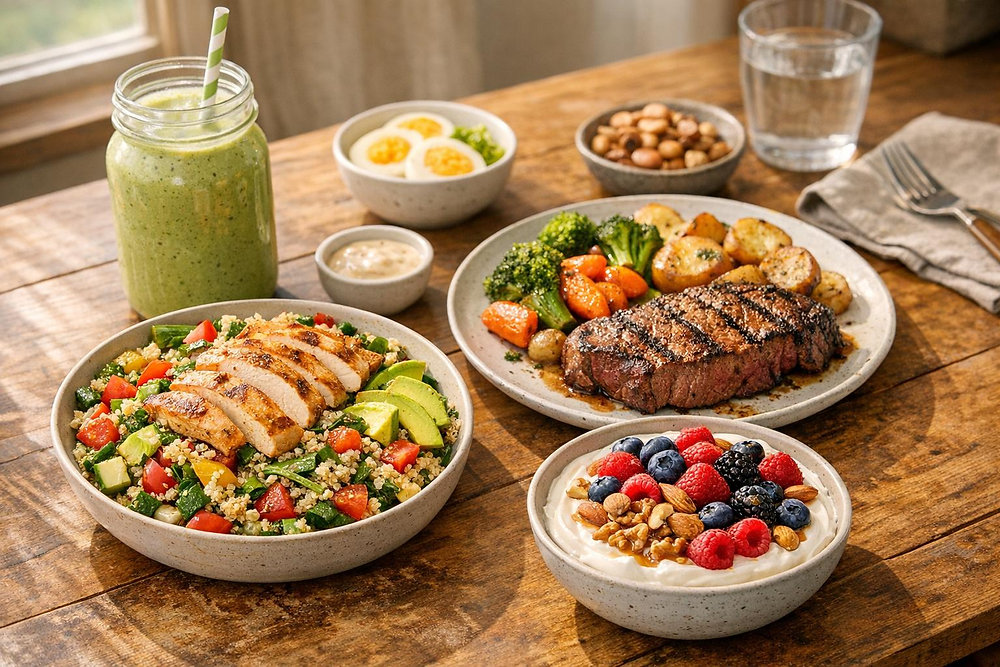
Each meal had three anchors: a lean protein source, a high-volume food, and a measured serving of fat. Snacks were removed. Zero-calorie seasonings, sauces and sweeteners were allowed. The intent was to keep the physical amount of food high while controlling the ingredients most likely to drive calorie density upward.
That is an important distinction. “No calorie counting” did not mean calories stopped mattering. It meant the diet was engineered so that the participants could eat a lot of food while still tending to consume less energy. In week one, both were already down roughly three pounds. By day 15, Manson was about six pounds down and Melody about five.
Why High-Volume Eating Can Create a Deficit Without Tiny Portions

The core mechanism is not mysterious: energy density changes how many calories fit into a given amount of food. Vegetables, many fruits, lean proteins and broth-heavy meals contain substantial water and food mass relative to their calorie content. Oils, fatty sauces, pastries and many snack foods pack far more energy into a much smaller volume.
Controlled research supports the basic principle. A meta-analysis of randomized trials found that lowering food energy density substantially reduced energy intake while the amount of food eaten stayed broadly similar. In other words, people can often keep the reassuring experience of a full plate or bowl while consuming less energy.
For a lifter cutting, that can be psychologically easier than trying to make every meal look miniature. A plate with lean chicken, potatoes, vegetables and fruit can look and feel more substantial than a calorie-equivalent portion built around oil-heavy sauces, cheese and snack foods.
But volume is not a free pass. A “healthy” giant bowl can still become calorie-dense if it is loaded with oils, nut butters, nuts, avocado, dressings or fatty cuts. That is why the experiment measured the fat component instead of leaving every ingredient unlimited.
Protein Was Doing More Work Than the Giant Bowl Alone

The most sensible part of the setup for someone who trains is the protein anchor. Higher-protein diets often improve fullness, although the strength of that effect varies between people and studies. During an energy-restricted phase, protein also helps give the body a reason and the raw materials to retain lean tissue when combined with resistance training.
That does not mean “more protein equals more fat loss” indefinitely. The major driver remains the energy deficit. Protein is useful because it can make the deficit easier to tolerate and because preserving muscle is especially important when the goal is to look better rather than simply weigh less.
For most lifters, a practical version is to choose a meaningful protein serving first—chicken, lean beef, fish, eggs or egg whites, Greek yogurt, cottage cheese, tofu, tempeh or another preferred source—then build the bulk of the meal around produce and a sensible carbohydrate source.

Carbonation, Broth and Tiny Utensils: Useful Tricks, Not Magic

Ethier added three extra fullness tactics during the month. Participants drank a carbonated zero-calorie beverage with meals, later added roughly one to two cups of broth to one meal per day, and eventually swapped normal cutlery for tiny utensils to slow the pace of eating.
These are best viewed as optional behavior tools, not fat-loss mechanisms. Broth can increase the water-rich volume of a meal. Slower eating may give appetite signals more time to catch up with the food being consumed. Carbonation can make some people feel temporarily fuller. None of those techniques overrides total energy intake, and none is required.
In fact, if diet soda makes you bloated, tiny forks make you irrationally annoyed, or soup leaves you hungry an hour later, there is no prize for forcing the tactic. The valuable principle is to find low-cost ways to increase satisfaction and slow automatic eating.
What the DEXA Results Show—and What They Do Not Prove

At the end of the month, Melody had lost just over eight pounds and her reported body-fat percentage moved from 32.5% to 29.7%. Manson lost 10.4 pounds, with 10.2 pounds reported as fat, and his body-fat percentage moved from 24.7% to 20.7%. The final presentation reported no muscle loss.
Those results are impressive, but they deserve the right level of confidence. This was a two-person experiment, not a randomized trial. There was no control group, no blinded food intake measurement and no way to know how closely the experience would generalize to everyone. DEXA is useful for tracking body composition, but hydration, glycogen and measurement conditions can affect estimates. Early scale loss can also include water and glycogen changes.
The defensible conclusion is simpler: the participants lost substantial weight over 30 days while following a diet intentionally built to keep food volume and protein high. That is consistent with the established idea that lower-energy-density meals can reduce energy intake. It does not prove that giant bowls are uniquely superior to every other well-designed diet.
Why the scale moved so quickly in the first week
One detail worth keeping in perspective is the speed of the early change. Losing around three pounds in a week does not mean three pounds of body fat disappeared in seven days. When someone changes food choices, carbohydrate intake, sodium, fibre, meal timing and total calories at the same time, body water and stored glycogen can shift quickly. That is normal. The later 30-day trend and body-composition measurements are more informative than treating the first week as a repeatable weekly fat-loss rate.
For a normal lifter, this is also why a single weigh-in is weak feedback. Use several morning weigh-ins to form a weekly average and compare trends over multiple weeks. If the average is moving gradually while gym performance is mostly stable, the plan is probably doing its job. If body weight crashes and training quality, mood and recovery fall with it, “faster” is not automatically better.
The Biggest Problem Wasn’t Hunger—It Was Adherence

Manson eventually craved foods such as beef, rice and fried chicken after repeatedly leaning on a narrow set of convenient foods. Melody found family barbecues awkward because she had to bring food that fit the rules. That may be the most useful part of the entire experiment.
A diet can be physiologically filling and still fail because it is boring, inconvenient or socially isolating. Hunger is only one reason people abandon a cut. The plan also has to survive Friday night, travel, birthdays, restaurants and the moment you are tired of eating the same “perfect” meal.
This is where a less rigid version can outperform the pure experiment. Keep most meals high in protein and lower in energy density, but deliberately budget room for foods you actually enjoy. If you want pizza on Saturday, the answer does not have to be pretending pizza is forbidden forever; it can be making the rest of the day easier to manage and eating an amount that still fits the goal.

A Better Version for Lifters: Use the Principle, Not the Gimmick

If you want to borrow the experiment without turning your kitchen into a 30-day challenge, the useful version is straightforward:
- Anchor every main meal with protein. This supports training and makes the meal more filling.
- Use fruit, vegetables, potatoes, soups and other water-rich foods for volume. Choose foods you genuinely like rather than forcing vegetables you hate.
- Measure the easy-to-overeat calorie-dense extras. Oils, dressings, nut butters, nuts and cheese are nutritious in many contexts, but they can quietly double a meal’s calories.
- Keep a carbohydrate source around training. Cutting should not automatically mean training on fumes.
- Leave room for normal life. A plan that survives restaurants and social events is more valuable than a theoretically perfect plan you can follow only at home.
- Track outcomes even if you do not track calories. Body weight trends, waist measurement, gym performance and hunger tell you whether the structure is actually working.
If weight is not trending in the intended direction for several weeks, the answer is not to insist that the bowl is magical. Adjust portions or energy-dense ingredients. If strength and recovery collapse, the deficit may be too aggressive. The system is a way to simplify decisions, not escape physiology.

The Real Lesson From the “World’s Most Filling Diet”
The 30-day test is interesting because it reframes dieting around what you can add rather than only what you must remove: more lean protein, more fruit and vegetables, more water-rich foods, more deliberate meal structure. The participants still lost fat because the structure reduced energy intake, but they did not have to spend the month staring at tiny portions.
For lifters, the best takeaway is not to copy every rule. It is to build meals that make the desired calorie intake easier to live with, preserve protein and training quality, and remain flexible enough that you do not need a separate life just to stay on the diet.

Gym T-Shirts & Workout Tees
Browse gym shirts for lifters who take training seriously without taking gym culture too seriously.
EXPLORE COLLECTION