Aaron Judge Is Back — Now the Yankees Need October to Look Different
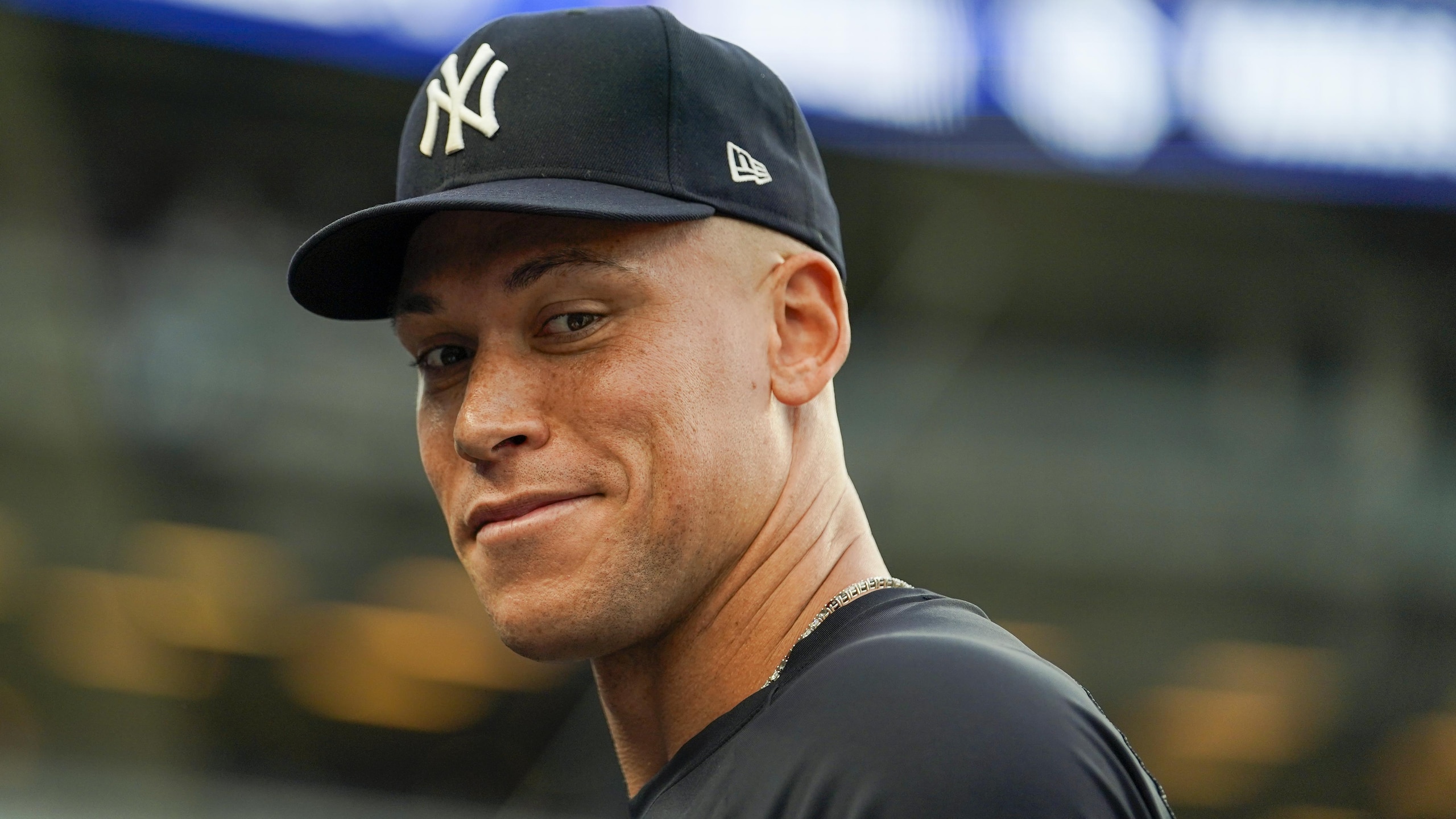
GOATIFYAaron Judge is back in the New York Yankees lineup, and that sounds like a simple September injury update. It is not.
New York activated its captain after more than three months away with a right-rib injury, putting the most dangerous hitter in the organization back into a team that already looks built for October. Judge returned without a minor-league rehab assignment after taking live batting practice at Yankee Stadium, a move that says the Yankees believe the final phase of his comeback can happen in major-league games rather than somewhere else.
The timing makes the stakes unusually clean. New York has enough separation in the Wild Card race that Judge does not have to rescue the season. The Yankees can use the remaining regular-season games as a runway: rebuild his timing, restore his feel against premium velocity, manage his workload and try to make sure the player walking into October resembles the one who has spent the last half-decade terrorizing American League pitching.
But this return is about much more than getting a superstar bat back. Judge already owns three MVP awards and a résumé that places him among the greatest right-handed hitters ever. What he does not have is a World Series championship, and the contrast between his overwhelming regular-season production and his more uneven postseason history has become impossible to ignore. With the Yankees strong enough on the mound and powerful enough at the plate to imagine a real championship run, this September may be one of the most important stretches of Judge's career.
Judge Changes the Yankees' Ceiling, Not Just the Lineup

The first thing Judge gives New York is obvious: force. Before his injury, he had 17 home runs despite playing only part of the season, and his presence changes the way an opposing staff has to navigate the entire Yankees order. There is no comfortable version of attacking a lineup when one mistake to Judge can turn a close game into a two-run deficit in a few seconds.
The broader numbers make his importance even clearer. The Yankees played at a .610 winning percentage with Judge available and .536 without him. Their team OPS fell from .770 with him to .681 in the games he missed. That is not a small dip created by one player disappearing from a box score; it is the difference between an offense that consistently applies pressure and one that asks too much of the rest of the order.
Yet New York survived. That may be the best part of the story for the Yankees. Judge is not walking back into a collapsing team that spent the summer waiting for him. He is joining a club that remained firmly in postseason position and had built a nine-game Wild Card cushion around the time of his activation. Tampa Bay was still within reach in the AL East, but qualifying for October no longer looked like the immediate crisis.
That changes the purpose of September. Manager Aaron Boone can protect Judge from unnecessary early overload. The Yankees can give him shorter nights, use the designated hitter spot when useful and avoid turning every hitless game into a referendum on whether the comeback has worked. In his first game back against Colorado, Judge went hitless in three at-bats and struck out twice before leaving after six innings. New York still won 5-3. That is almost an ideal illustration of the situation: Judge can work his way back while the team keeps winning around him.
The pitching staff gives New York even more room. The Yankees entered this stretch with a major-league-best 3.34 ERA from their starting rotation and a 3.05 bullpen ERA that also led the majors. Their offense, even without a full season from Judge, led the American League with 193 home runs. There are weaknesses every contender can pick at, but the basic postseason formula is already there: power, starting pitching and a bullpen capable of protecting narrow leads.
Judge raises the ceiling of all three simply because he can reduce the amount of perfection required elsewhere. A starter no longer has to protect one run for seven innings if the middle of the order can create three with one swing. A reliever gets more breathing room. Hitters around Judge see different sequences and more favorable situations because pitchers cannot attack the lineup as if every spot carries the same risk.
That is why the Yankees can reasonably think beyond merely reaching October. Their run differential has separated them from much of the American League field, and the league has not produced an untouchable juggernaut. If Judge gets close to full speed, New York will enter the postseason with a roster that can win in several different ways.
The Missing Piece in Judge's Résumé Is Still October

Judge does not need another regular season to prove that he is historically great. At 34, he is already one of only a small group of players to win three MVP awards, and the underlying offensive record is absurd even by Hall of Fame standards. Among right-handed hitters with at least 5,000 plate appearances, his .611 slugging percentage and 176 wRC+ put him at the very top of the historical conversation.
Inside Yankees history, the company is even more intimidating. By Baseball Reference wins above replacement, Judge trails only Babe Ruth, Lou Gehrig, Mickey Mantle, Joe DiMaggio and Derek Jeter among the franchise's hitters. That is not a list a player reaches by having a few spectacular peak seasons. It is a list that says Judge has already built a Yankees career worthy of monuments, plaques and arguments that last for generations.
The difference is jewelry. Ruth, Gehrig, Mantle, DiMaggio and Jeter each won at least five World Series championships. Judge has none.
It would be lazy to treat that as a one-player failure. Modern postseason baseball is far harder to control than the eras in which league champions advanced straight to the World Series, and even Jeter's Yankees navigated smaller playoff fields than today's contenders face. A superstar can dominate for six months and still watch a short series turn on a bullpen mistake, a defensive misplay or three cold nights from the entire lineup.
Still, Judge's own October numbers leave room for criticism. His career regular-season OPS sits around 1.022. In the postseason, it is roughly .822. For almost any hitter, an .822 playoff OPS is useful production. For Judge, a drop of about 200 points feels enormous because his regular-season standard is so extreme.
That gap has become part of his story whether it is fair or not. The dropped fly ball in the 2024 World Series remains attached to the postseason conversation because it happened on the sport's biggest stage. So do stretches in which elite pitchers expanded the strike zone against him and turned his aggressiveness into strikeouts. The only clean way to erase those images is to replace them with better ones.
This Yankees team may give him that chance. There is a reasonable argument that New York is as well positioned as any American League contender to reach the World Series. The rotation has been excellent, the bullpen has been excellent and the lineup already produced elite home-run totals while missing its best hitter for months. Tampa Bay may still control the division race, but the broader AL path does not feature an opponent so dominant that the Yankees should feel overmatched before a series begins.
Even the National League landscape looks less forbidding than it did when the Dodgers were operating like a machine. Los Angeles has spent much of the second half looking more human, and Shohei Ohtani's pitching status has added uncertainty to the defending champions. None of that guarantees New York anything. It simply reinforces the point: championship windows are rare, and this one is open enough that Judge cannot assume a better opportunity will arrive next year.
That is what makes his return different from a normal late-season activation. The Yankees are not simply restoring an All-Star for a playoff push. They are putting one of the greatest players in franchise history back on the field with a chance to reshape the one part of his legacy that still feels unfinished.
The Four-Seam Fastball Test Will Show Whether Judge Is Really Back

There is a practical way to judge the comeback that is more useful than batting average over the next five games: watch what happens when pitchers challenge Judge with four-seam fastballs.
From 2022 through 2025, nobody in baseball punished that pitch like he did. Judge produced a run value of plus-110 against four-seamers during that span. Juan Soto, the next-best hitter against the pitch, was at plus-83. The separation is remarkable because elite velocity is supposed to be the weapon pitchers use to control power hitters. Against a healthy Judge, it often became the pitch most likely to disappear into the seats.
That skill also provides a useful window into how much the rib injury affected him before he finally left the lineup. Judge originally hurt the rib on April 26 while playing defense and tried to continue. Before May 7, he slugged .818 against four-seam fastballs and missed them on 23.2 percent of his swings. After that point, his slugging percentage against the pitch fell to .250 while his whiff rate jumped to 35.1 percent.
That is the kind of split that suggests more than ordinary fluctuation. A rib injury can interfere with the rotational violence that makes Judge's swing special. If he cannot fire the body through the hitting zone without hesitation, the fastest pitch in baseball exposes the problem immediately. A hitter can sometimes survive by hunting breaking balls or taking walks, but the version of Judge who can carry a championship offense has to punish velocity.
So the Yankees should care less about whether he hits a home run tomorrow than whether his reactions against good fastballs begin to look normal. Is he on time at 96 mph? Can he drive the ball to right-center rather than merely foul it away? Are pitchers becoming reluctant to challenge him in the zone? Those are better indicators than one night's line in the box score.
History also argues for patience. Judge has returned from several long injured-list stints before, and his production dipped immediately after each of them to varying degrees. In 2018, his OPS fell sharply in a small sample after a wrist fracture. In 2019, he returned from an oblique strain and essentially resumed his previous level over a much larger stretch. In 2023, he came back from a toe injury and produced a .965 OPS — lower than his pre-injury mark but still superstar output.
The point is not that another decline is inevitable. It is that a three-month absence changes the expectations for the first week. Judge has not spent the summer seeing major-league sequencing every night. Live batting practice can approximate velocity, but it cannot reproduce the layered decisions of a real at-bat: fastball above the zone, slider off the plate, changeup under the hands, then 98 mph when the hitter has adjusted to everything else.
New York has enough standings cushion to let those repetitions happen now. That is an advantage. The Yankees can treat the final weeks as a compressed spring training without the luxury of meaningless games. Each at-bat matters, but the largest objective is to make Judge more dangerous on Oct. 1 than he is on Sept. 9.
Boone's early workload management fits that plan. Pulling Judge after six innings in his first game back may have frustrated the player, but a manager's job in this spot is not to win an argument about one September plate appearance. It is to get the captain through the month healthy enough to play every inning that matters in October.
If the four-seam damage returns, the rest of the Yankees lineup becomes much harder to pitch. If it does not, New York will have to determine whether Judge is simply rusty or whether the rib has taken something from his swing that cannot be restored on the regular-season calendar. That is the real suspense of the next few weeks.
Judge's first game back does not need to look like an MVP montage. The Yankees have already done the difficult part by remaining a serious contender while their best player healed. Now they need to convert that survival into something bigger.
If Judge rediscovers his timing, if the fastball damage comes back and if his body holds up through the ramp-up, New York will enter October with one of baseball's most complete rosters and its most intimidating individual hitter. Then the conversation changes from whether Judge can save the Yankees' regular season to whether he can finally own a postseason.
For a player whose regular-season résumé is already Cooperstown quality, that is the part of 2026 that can still change how the entire career is remembered.