Tapia Admitted He Was Struggling — Coello Saved Their Milan Final at 0–40
GOATIFYAgustín Tapia and Arturo Coello left Milan with another trophy, but their account of the final was anything but a victory lap. After beating Juan Lebrón and Leo Augsburger 4–6, 6–3, 6–2 on October 18, Tapia acknowledged that he had struggled to reach his usual level and credited his partner with carrying them through the most dangerous stretch. The decisive moment came with the world No. 1 pair trailing 0–40 on serve at 1–1 in the second set, already one set down.
They escaped, broke immediately afterward and eventually collected a fourth straight title and a twelfth tournament win of 2026. The result is another entry in an extraordinary season; the manner of it explains more. Milan showed how the best partnership on tour can survive when one player is not functioning at his best—and why a challenger can dominate long passages yet still leave without the trophy.
Lebrón and Augsburger exposed the leaders before the comeback began

The opening set was not a case of the favorites casually dropping their intensity before waking up. Lebrón and Augsburger imposed a specific problem. Their early movement toward the net took time away from Coello, while Lebrón's ability to change pace and direction forced the Spaniard into less comfortable decisions. Augsburger supplied the attacking speed that made those openings dangerous. The pair earned the first meaningful advantage, protected it and closed the set 6–4.
That performance mattered because the challengers arrived with evidence that their partnership could withstand a bad spell. In the semifinal, they had lost the opening set 6–0 to Alejandro Galán and Federico Chingotto, then won the next two 6–2, 6–2. It was a striking reversal against the No. 2 pair, but it was also a reminder that Lebrón and Augsburger can alter a match rather than simply play one explosive set. Their Milan final began with the same sense of urgency.
Their tactical challenge was especially uncomfortable for Coello and Tapia after three consecutive weeks of title-winning work. Long tournament runs bring repeated matches, travel and preparation, even when the results look effortless on paper. A slight delay in moving forward or recovering court position can transform an ordinary exchange into a defensive scramble. Lebrón's variations and Augsburger's power punished those fractions of a second. The leaders were still dangerous, but they were being asked to solve a contest on their opponents' terms.
That is why the first set cannot be dismissed as a temporary wobble. The underdogs had earned their advantage, and they had beaten this pair before, taking the Brussels P2 final in April. They knew the world No. 1s were not invincible. The challenge was maintaining the same accuracy and discipline once the match began to turn. In Milan, their best stretch created a genuine route to the title—but not enough separation to make the route safe.
The 0–40 escape revealed what Coello gives Tapia when rhythm disappears
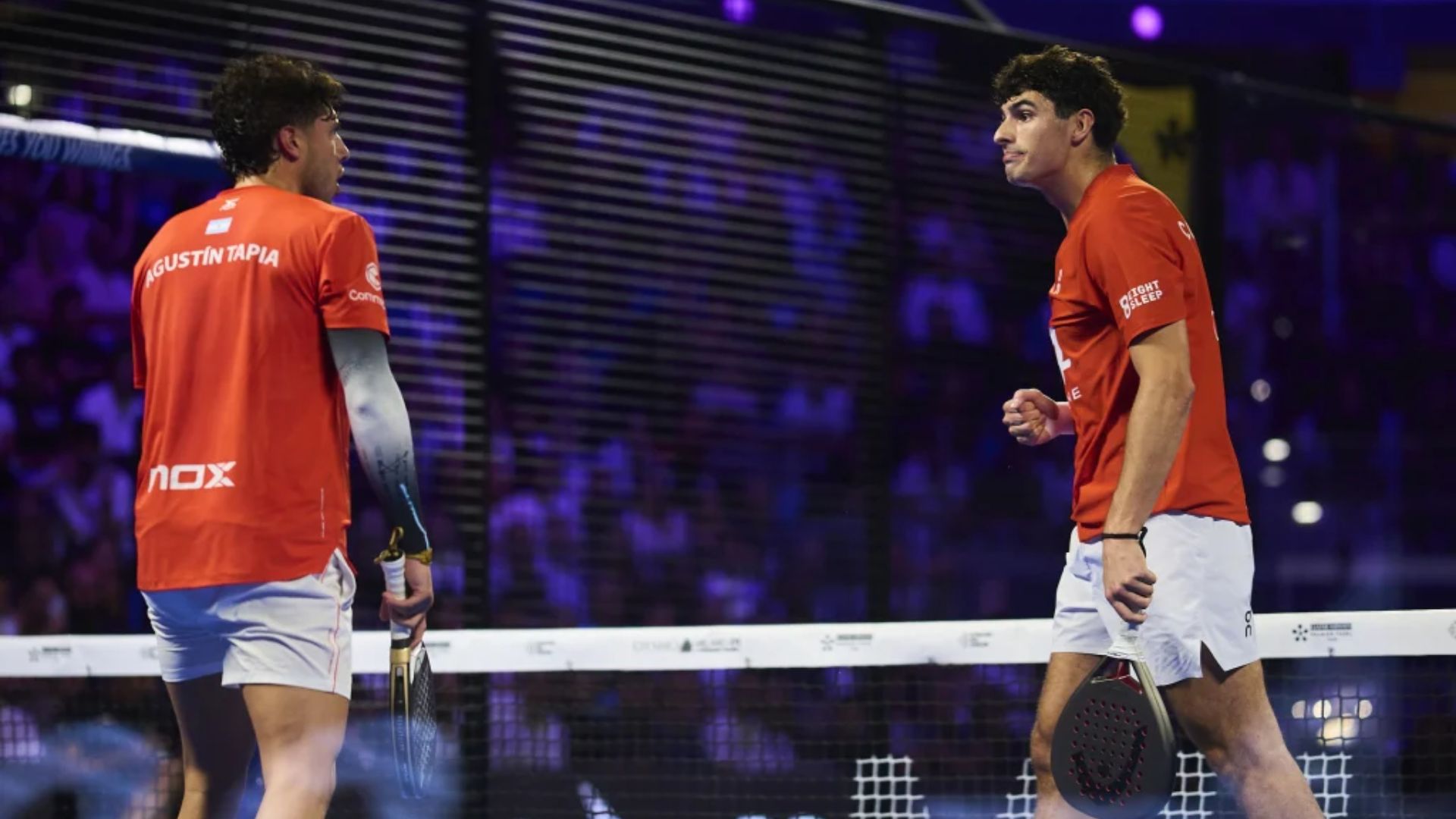
At 1–1 in the second set, Lebrón and Augsburger had three consecutive break points on the leaders' serve. With a set already secured, converting even one would have left them serving with an early advantage in the second. This was not a decorative statistic in a comfortable victory. It was the moment when the final might have moved beyond the champions' control.
Tapia later described feeling overwhelmed after errors at the net. His explanation made the escape more revealing than the scoreboard alone: he was struggling to find the timing expected of him in a final, and Coello was supplying much of the stability. Tapia said, “Arturo helped me a lot at that point.” That is a rare, specific admission from a player whose imagination and shot-making often make the pair look untouchable.
The third break point became the defining missed chance. Augsburger found an inviting overhead close to the net, but failed to finish it. The leaders held. In the next game they broke the challengers' serve, turning a possible deficit into a position from which they could dictate the set. A single missed smash did not explain the entire result, yet it changed the available choices. The underdogs went from trying to consolidate a break to having to chase the scoreboard again.
Coello's contribution should not be confused with a demand that one partner always rescue the other. Successful doubles teams distribute pressure differently as a match develops. Sometimes the more fluent player attacks; sometimes he steadies service games, absorbs difficult balls and keeps the pair in a position to recover. Coello gave Tapia time to rebuild his rhythm. Once Tapia began finding better positions and selecting his accelerations more cleanly, the partnership could return to a shared offensive plan.
That flexibility is harder to copy than a spectacular smash. The best teams do not need both players to peak simultaneously. They need one to prevent a difficult phase from becoming terminal while the other searches for his level. Milan supplied a particularly sharp example because the rescue happened with three break points on the line, not in a low-pressure game.

The score flipped because the champions changed the pressure, not just the mood

Once the leaders survived 0–40, their improvement was visible in the decisions that followed. Coello became more assertive around the net, while Tapia began choosing attacking moments rather than trying to manufacture a winner from every uncomfortable ball. The pair broke in the next game and took the second set 6–3. By the start of the third, the challengers were no longer imposing the tempo that had carried them through the opening set.
Coello acknowledged afterward that Lebrón and Augsburger had been the better pair early. That matters because it rules out an easy explanation in which the favorites simply needed to start trying. The opponents had created real tactical problems. The comeback required the champions to reduce the frequency of rushed exchanges, defend more effectively when pushed back and convert the small windows that opened on the other side of the net.
In the deciding set, an early break gave Tapia and Coello the scoreboard advantage. Their opponents continued to earn opportunities, but the champions protected the lead and found another break to close it 6–2. The final result therefore looks more comfortable than the match felt for much of its first hour. The score records a three-set victory; the turning point shows how close the contest came to a very different outcome.
There was a mental element, too, but it should not be treated as magic. The challengers had spent the semifinal recovering from a disastrous first set and then carried that energy into the final. When the 0–40 opening disappeared, their next task was to reset immediately and accept that the match remained even. Against a pair as experienced as Tapia and Coello, frustration can be expensive because it changes shot selection, communication and the willingness to construct one more ball before attacking.
The champions made the practical response. Rather than chasing a perfect version of themselves, they used the game they had available. Their ability to win the points that mattered most is the measurable part of their reputation for resilience. It is not that they never struggle; Milan proved the opposite. It is that they repeatedly survive long enough for their strengths to matter again.
Four titles in a row make the exhaustion warning impossible to ignore
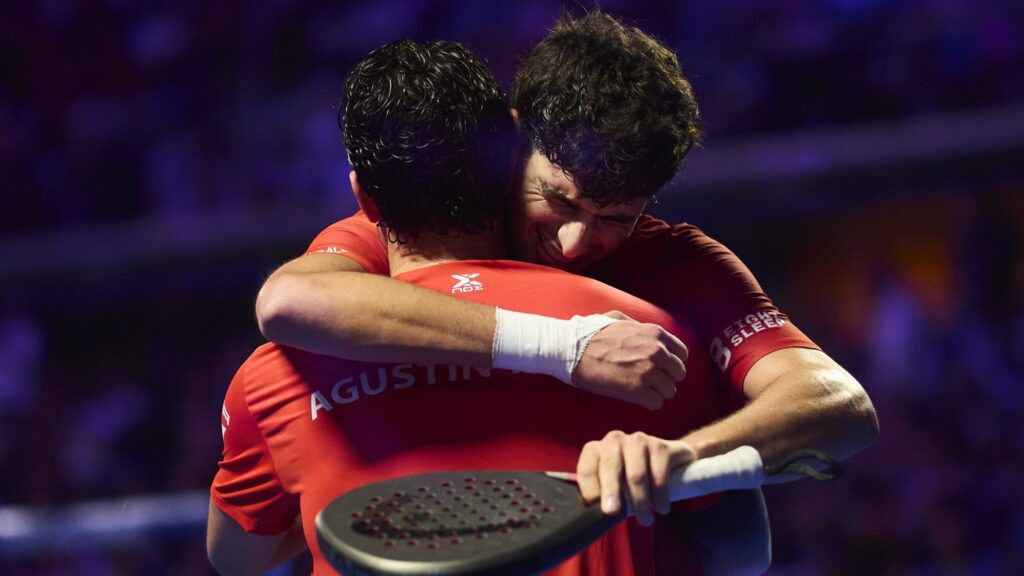
Milan completed an imposing sequence: the Paris Major, Rotterdam P2, Düsseldorf P2 and Milan P1, four trophies in succession. The run reached 18 consecutive match victories and brought Tapia and Coello to 12 titles in 2026. Numbers like those naturally encourage talk of dominance, especially with Galán and Chingotto trying to close the gap at the top of the rankings. Yet the post-final discussion sounded more like a report from a team that had used almost everything it had.
Both champions described the accumulated strain of consecutive weeks on tour. The important distinction is between physical fatigue and the mental cost of maintaining championship standards. A pair can still win while running below its usual sharpness, but each additional event increases the likelihood that a rival will find a vulnerable window. The Milan first set and the second-set break points were evidence of that vulnerability, not a contradiction of the winning streak.
Coello and Tapia have also had to beat different types of opponents in this run. Their semifinal victory over Franco Stupaczuk and Jon Sanz continued one rivalry; the final presented Lebrón's variety and Augsburger's direct attacking power. Across a season, that range of tactical demands is as significant as the number of trophies. Staying No. 1 means solving unfamiliar matchups while every opponent studies the ways previous challengers nearly succeeded.
The next major test comes after a short pause, with the Kuwait Major scheduled for October 26–31. That break is not simply a reward. It is a chance to restore the movement, concentration and shared timing that were missing early in Milan. A longer tournament with more ranking points at stake will not become easier merely because the leaders have added another title. If anything, their success ensures that the next opponents will approach the match with a detailed plan to exploit the same pressure points.
For Lebrón and Augsburger, the lesson is demanding but useful: they have the weapons to trouble the best pair, and they created opportunities that might have decided a final. Turning those opportunities into a title requires sustaining precision through the moments after a missed chance. For Tapia and Coello, Milan offered a different proof of quality. They did not win because both played brilliantly throughout. They won because their partnership kept working when one of them could not.

Tapia's candid account of Milan makes the champions more interesting, not less formidable. Their 4–6, 6–3, 6–2 comeback was built around a single high-pressure hold, a partner who kept the team alive and a gradual recovery of the attacking patterns that have made them the circuit's benchmark. Lebrón and Augsburger were close enough to expose the margin, but not clinical enough to cross it.
The next challenge is recovery as much as another opponent. Twelve titles and four consecutive trophies are remarkable; arriving in Kuwait refreshed enough to keep solving these problems may be even more important than the streak itself.
Shop GOATIFY padel products from the Padel-filtered collection scope.