

Davis Drops 34 in Wizards Debut — But Washington's 6-for-28 Warning Remains
GOATIFYAnthony Davis waited nine months to make his Washington Wizards debut. When the moment finally arrived, he gave the crowd 34 points, 12 rebounds, four assists and a reason to imagine that this rebuild might move faster than expected. Washington beat Milwaukee 128-116 on October 21, but the result was much less comfortable than the final margin suggests.
The Wizards trailed for long stretches, missed 22 of their 28 three-point attempts and entered the last quarter only three points ahead. Davis kept them close with an 18-point third quarter before a collective fourth-quarter burst turned a tense opener into a statement win. Trae Young supplied 20 points and 13 assists; Kyshawn George, Bilal Coulibaly and Deandre Ayton supplied the finishing touches.
The victory is encouraging precisely because it was imperfect. Washington looked like a team with an elite interior star, an experienced organizer and young players capable of decisive plays. It also looked like a team that will struggle whenever its outside shooting disappears. One opening-night win cannot answer the biggest questions about Davis's durability or the franchise's ceiling, but it offered unusually clear evidence of what both the promise and the problems look like.
Davis turned a rough shooting night into a 34-point debut

Davis had not appeared in a regular-season game for Washington after arriving injured in the previous season's trade. That gap gave his first night unusual weight. The Wizards had acquired an accomplished two-way star without knowing how his game would look next to their new guards and developing frontcourt. Against Milwaukee, he immediately established that his ability to create efficient offense around the basket remains the most reliable part of the equation.
He opened with 10 points and six rebounds in the first quarter, then had a quieter second period as Milwaukee found a rhythm. The Bucks took a 56-51 halftime lead while Washington struggled from deep. Davis changed the game's balance after the break. He scored 18 of the Wizards' 39 third-quarter points, attacking from the elbows, drawing contact and making Milwaukee defend him through multiple actions rather than simply waiting for outside shots to fall.
The final line — 34 points on 11-of-20 shooting, 11-of-14 at the foul line and 12 rebounds — is impressive, but its timing matters more. Washington needed nearly every one of those third-quarter possessions to prevent Milwaukee from separating. Davis also contributed four assists, including opportunities created when defenders collapsed toward his scoring areas. Those reads hint at how he can support a lineup that includes another ball-dominant creator in Young.
The home crowd responded with early MVP chants, yet the most useful lesson is less dramatic. A healthy Davis gives Washington a stable source of paint pressure and rim protection even when its perimeter game goes cold. His first outing does not erase the health questions that surrounded his arrival or settle his long-term contract future. It does show why the Wizards are reluctant to treat him as just another veteran on a rebuilding roster.

The fourth-quarter surge showed how Washington can win without threes

Milwaukee was still in the contest after three quarters, with Washington ahead 93-90. The turning point was not a sudden barrage of three-pointers. It was the Wizards finally stringing together stops, strong cuts and decisive finishes. Ayton's dunk gave Washington a 97-96 lead, and the home team extended the burst into a 21-2 run that opened a 111-98 advantage with 7:26 remaining.
Washington began the fourth quarter by converting its first nine field-goal attempts. Seven players scored at least four points during the period, a useful sign that the attack did not have to run through Davis on every possession. The Wizards outscored the Bucks 38-23 in the quarter and 77-60 across the second half. The comeback became a team performance rather than an isolated star rescue.
The details matter for a team that finished the previous season with only 17 wins. Justin Champagnie made a basket through contact during the decisive stretch. Coulibaly finished a forceful dunk after a Davis miss. George, who scored 18 points overall, capped the night with a late dunk that brought the crowd to its feet. Ayton scored 11 points in reserve minutes and gave Washington a second strong interior finisher when Davis rested.
The obvious warning is that 6-for-28 three-point shooting is not a dependable formula for a long season. Washington cannot assume it will convert 63 percent of its second-half field-goal attempts every night, especially against opponents with more imposing rim protection. But the game also supplied an alternative route to offense: pressure the paint, generate free throws, use the big men as passers and turn defensive energy into close-range chances. Those are more repeatable building blocks than hoping a cold jump-shooting team suddenly becomes hot.
Trae Young and the young wings made Davis more than a one-man show
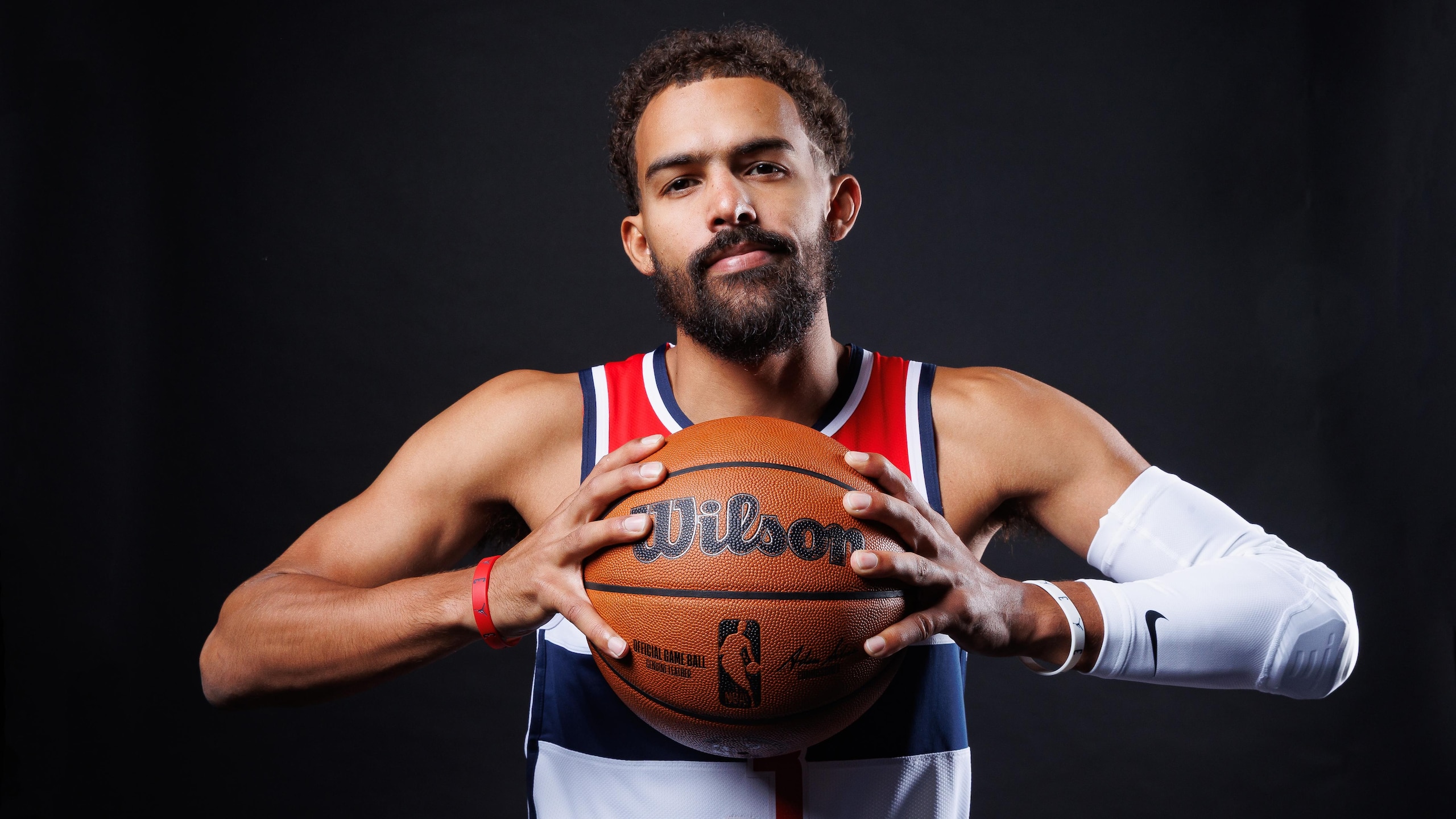
Young's 20 points and 13 assists were an essential complement to Davis's interior scoring. The guard missed all six of his three-point attempts, yet his passing helped the Wizards survive the cold perimeter shooting. He turned the ball over only once, an important improvement on a preseason in which his decision-making had been questioned. His ability to create organized possessions while Davis commands defensive attention is the clearest reason Washington's veteran acquisitions might fit together.
The combination is still in its infancy. Young prefers to probe high pick-and-roll coverage and force a defense to choose between his pull-up threat and a rolling big man. Davis can screen, finish, pop into the midrange and pass out of a crowd. Against Milwaukee, the Wizards saw enough of those possibilities to imagine an offense that does not depend entirely on one creator. The challenge is to maintain spacing around both players when the outside shots are not falling.
The development story was just as important. No. 1 pick AJ Dybantsa missed the opener with an ankle injury, pushing George and Coulibaly into larger responsibilities. George finished with 18 points, five rebounds and three assists; Coulibaly added 11 points and four steals. Their activity made the fourth-quarter turnaround possible. George supplied scoring without needing every play designed for him, while Coulibaly offered defensive disruption and transition finishing.
Dybantsa's absence also means the Wizards have not yet tested their complete projected core. The rookie's return should bring another talented shot creator, but it will also require a fresh division of touches and defensive responsibilities. Alex Sarr, Ayton and Davis give Washington unusual size options, and coach Brian Keefe will need to balance that advantage against the need for enough shooting. The opener was a promising demonstration of shared contributions, not proof that every rotation question is solved.

Milwaukee's post-Giannis era began with promise — and a costly collapse

The other side of Washington's breakthrough was a difficult introduction to Milwaukee's new era. The Bucks traded Giannis Antetokounmpo to Miami in the offseason, and the opener featured several of the players acquired in that deal. Tyler Herro led Milwaukee with 24 points, Jaime Jaquez Jr. scored 22, and Kasparas Jakucionis supplied 15 off the bench. There were real stretches when the reworked offense looked comfortable.
Milwaukee outscored Washington 33-26 in the second quarter and carried a five-point lead into halftime. Herro's shot-making helped sustain that advantage, and Jaquez scored 10 in the third period as the Bucks hit six of 11 threes in the quarter. The visitors were not overwhelmed from the start. They had the lead for much of the evening and enough perimeter scoring to force Washington into a long comeback.
The collapse arrived when the Wizards started attacking the interior more directly. Milwaukee surrendered a 21-2 run in the fourth and allowed Washington to score 38 points in the final period. The Bucks committed 32 fouls and sent the Wizards to the free-throw line 41 times. That is a difficult defensive foundation for any team, especially one still learning how to replace the length and versatility of its departed franchise player.
It was also Taylor Jenkins's first regular-season game coaching Milwaukee. The early results should not be treated as a final judgment on his system or the new roster, but the film will identify clear priorities: reduce fouling, protect the paint without surrendering uncontested jumpers and build a late-game offense that can withstand physical defensive pressure. Herro and Jaquez gave the Bucks a credible scoring base. Washington showed how quickly that base can be undermined when the defense cannot get a stop.
The Wizards left their opener with a victory, a star who looked comfortable after a long wait and a much clearer picture of the partnership they are trying to build. Davis's 34 points mattered; the collective fourth-quarter response mattered almost as much. Young controlled the ball, George and Coulibaly made consequential plays, and Ayton gave Washington another way to score inside.
The next test comes Friday against Toronto, potentially with Dybantsa closer to a return. Washington should enjoy the opening-night statement without ignoring the warning signs. Six made threes and a late comeback are not a sustainable offensive identity by themselves. But an available Davis, supported by Young and active young wings, gives the Wizards a foundation that was missing for much of their recent rebuild. Milwaukee, meanwhile, must prove its promising new scorers can be matched by reliable late-game defense.
Opening night is a sample, not a forecast. The useful question for Washington is whether the same defensive pressure, interior passing and timely contributions can survive nights when Davis does not score 34. For Milwaukee, the answer must start with fewer fouls and a defense that holds together through the final quarter. Both teams left Capital One Arena knowing much more about their new identities, even if the season has barely begun.



















