

Jaylen Brown Saved the Sixers' Win. His Hamstring Now Holds the Question.
GOATIFYJaylen Brown walked out of Brooklyn with a winning box score and an unanswered medical question. His 31 points, 13 rebounds and four assists helped the Philadelphia 76ers survive the Nets 135–123 on November 16, but the final minutes were defined by two separate problems: a cut to his forehead after a collision and tightness in his left hamstring. The distinction matters. One injury produced the dramatic scene on the floor; the other ultimately persuaded him to stop playing.
Philadelphia is 12–3, has the talent to overpower opponents without every star available, and still almost allowed a comfortable lead to disappear. Brown's second consecutive 31-point game suggested that his fit in an unusually crowded attack is improving. Yet, with Orlando next on Wednesday, even a short interruption would test how coach Nick Nurse balances creation, defensive pressure and the team's already complex availability decisions.
Here is what was confirmed after the game, what the scoring numbers actually reveal and why the next medical update matters more than any guess about a return date.
Two exits, two issues: what is known about Brown's health
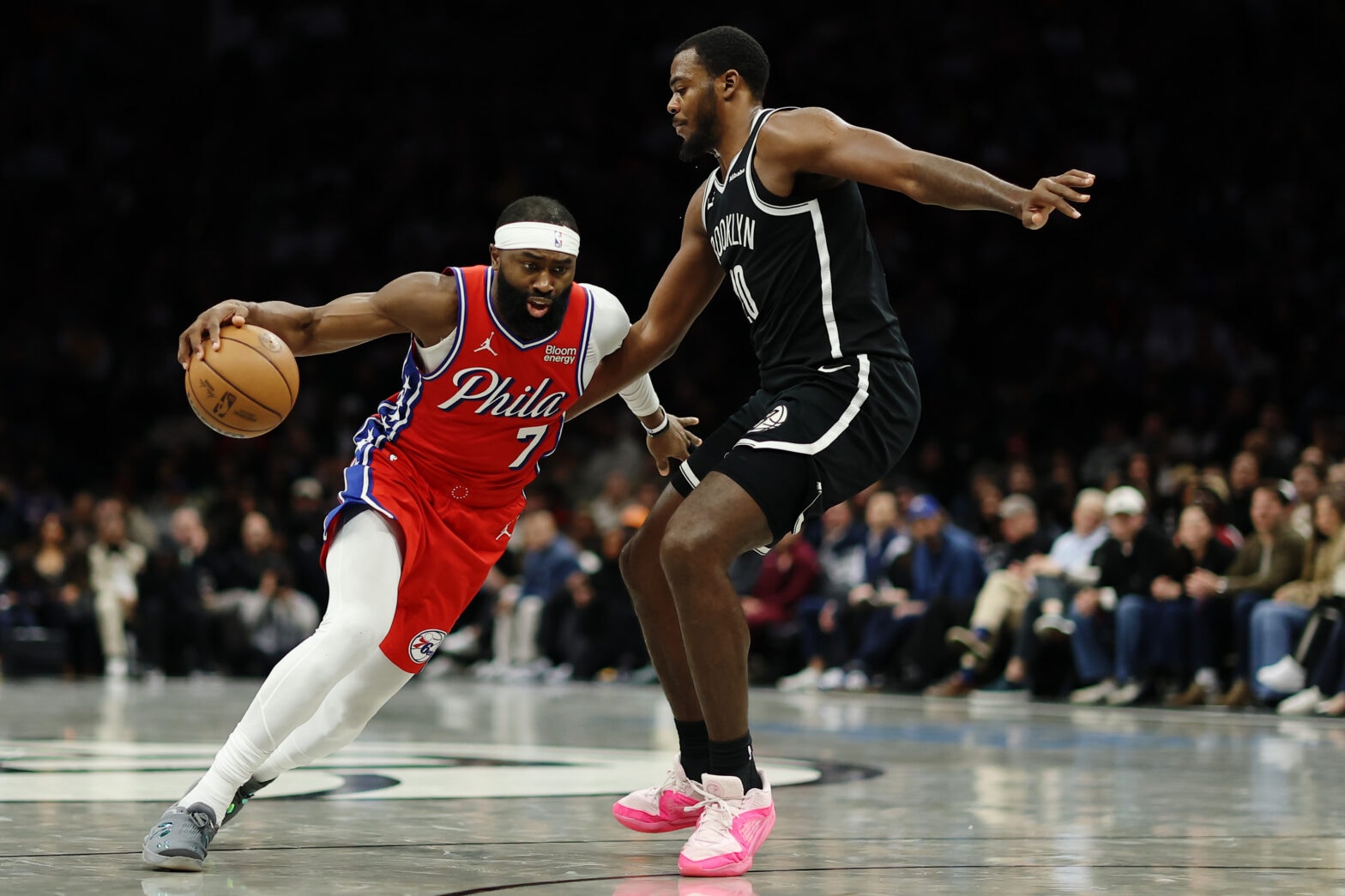
Brown's frightening moment came in the fourth quarter as he tried to make a quick attacking move. Contact with Brooklyn forward Julius Randle left him on the court with a bleeding forehead, prompting attention from players and Philadelphia staff. Teammate VJ Edgecombe helped as trainers addressed the cut. When Brown eventually returned wearing a headband, the visual impression was that the immediate emergency had been handled. That did not resolve everything that happened next.
He remained involved during Brooklyn's comeback before leaving again with less than two minutes remaining. This second departure was associated with hamstring tightness rather than the initial head collision, according to Nurse and Brown's comments afterward. Treating the events as one injury would muddle the central question. The cut could be visible and dramatic while the muscle discomfort, harder to judge from the television picture, could carry the greater short-term availability implications.
Brown said he had already been examined after the game and expected the medical staff to look again Tuesday. He described an MRI as a possibility, not an appointment that had definitely happened. He also indicated that prior hamstring experiences made him familiar with the sensation and did not express immediate alarm. None of those remarks proves there is a strain, rules one out, or tells fans whether he can play Wednesday. An injury report, examination findings or team announcement would be needed for that.
There is a meaningful difference between an athlete saying something does not feel especially concerning and a medical assessment confirming that a return is safe. Hamstrings are involved in accelerating, stopping and changing direction, precisely the explosive movements that underpin Brown's two-way game. Without a confirmed grade or diagnosis, speculation about a recovery timetable adds little. Philadelphia can be optimistic about Brown's own reaction while still managing the risk of turning uncertainty into a more consequential absence.
His decision to return after the forehead treatment also reflected the state of the contest. The Sixers had been ahead by as many as 24, but Brooklyn had cut the margin sharply, and LeBron James was resting on the second night of a back-to-back. Brown wanted to help secure a win that had suddenly become competitive. Once he judged Philadelphia to be in a safer position, he voluntarily checked out. That explanation captures his competitive instinct but should not be confused with a medical clearance for the next game.
GOATIFY
GOATIFY Basketball
Basketball apparel for fans following Philadelphia's 2026 season and Brown's health news.


Michael Jordan - Crying Jordan GOAT Pullover Hoodie
A basketball fan design for everyday wear.
Shop Now ↗
Allen Iverson G.O.A.T. - Basketball Decal Sticker
Add basketball personality to your favourite gear.
Shop Now ↗
Wemby G.O.A.T. - Victor Wembanyama Basketball Mug
Add basketball personality to your coffee break.
Shop Now ↗Brown finished with 33 minutes and 15 seconds, so this was not simply a night on which an incident erased most of his contribution. His final box score includes 9-of-19 shooting, three made triples, 10 free throws made and only one turnover. The team could acknowledge his hard work without making his availability a referendum on toughness. Nurse's more important task now is to establish exactly how much he can do rather than rewarding a dramatic return with unnecessary minutes.
The next reliable milestones are straightforward: the team's next injury report, any publicly confirmed medical evaluation, and Brown's participation or limitation during preparations for Orlando. Until then, 'hamstring tightness' is the reported symptom and 'under evaluation' is the appropriate status. Calling it a tear, guaranteeing a Wednesday return or implying an MRI has found anything would go beyond the available evidence.
The 31 points were useful; the decisions behind them were bigger
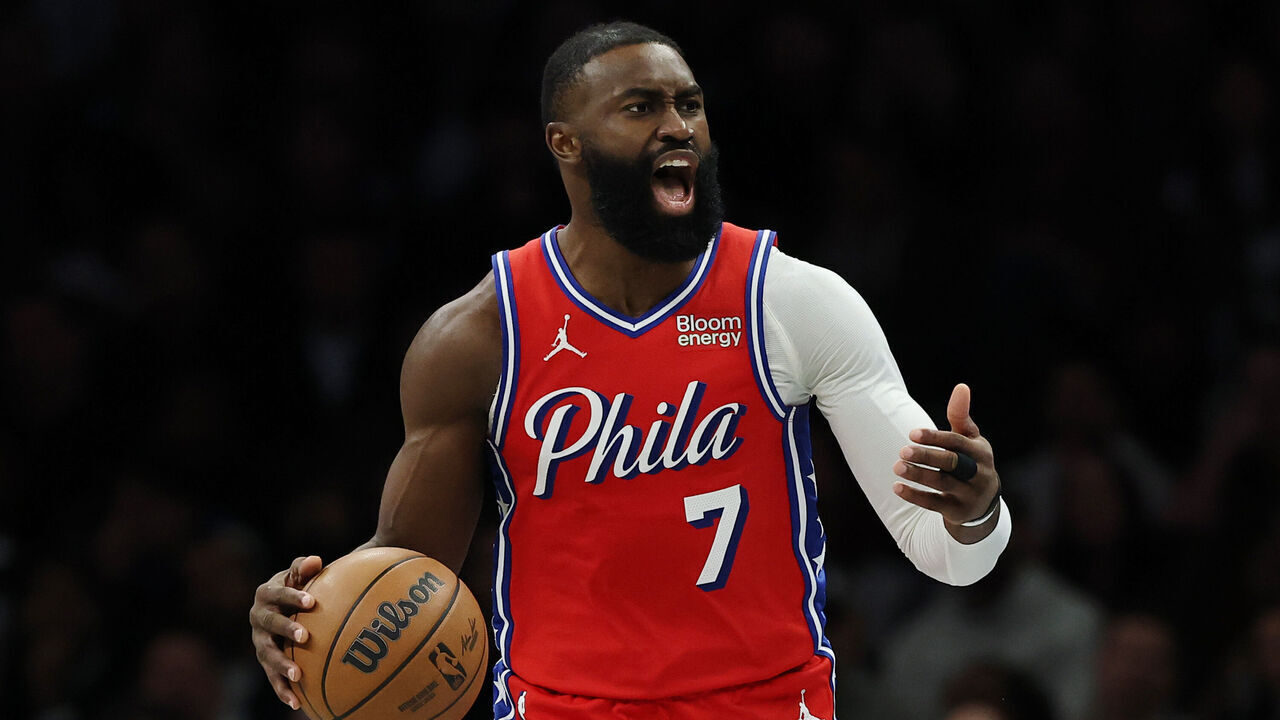
The most revealing part of Brown's performance came before his jumper started falling. He missed all five of his shots in the opening period, a beginning that could have pushed a high-usage player into impatient attempts. Instead, he kept reaching the foul line, collecting rebounds and moving the ball. He went 5-for-6 on first-quarter free throws, hauled in five boards and supplied two assists. That is an important blueprint for a Philadelphia team with several established scorers: a bad shooting stretch cannot become permission to stop creating value.
The scoring swing arrived in the second quarter. Brown put up 14 points on 5-of-7 shooting in the period as Philadelphia's lead expanded. Drives that forced Brooklyn's defense to collapse were followed by more deliberate pull-up choices, including a late-half three. Rather than only counting his jumpers, the meaningful change was the speed with which he identified a lane or a defender's compromised angle. Nurse highlighted that quickness of decision afterward; it reduced the possessions where Brown dribbled in place and allowed help defenders to reset.
His final 31 came on 9-of-19 shooting and 10-of-13 at the line. That combination shows why counting field goals alone misses the shape of a strong attacking night. The free throws gave him efficient scoring during the cold opening, while the eventual perimeter production punished Brooklyn for protecting the paint. Three makes from eight attempts beyond the arc are not a reason to project a dramatic long-term shooting trend, but they broadened the defensive problem the Nets had to solve in this particular game.
Brown also collected 13 rebounds, his season high. For a wing, that total can have the same practical impact as an extra burst of scoring: securing possession ends the opponent's opportunity and can immediately start a transition chance. VJ Edgecombe added nine boards. The combined work on the glass mattered because the Sixers were protecting an advantage against a Brooklyn lineup willing to attack second chances and push the pace. Brown's 13 should not be filed away as a decorative double-double.
That wider contribution speaks directly to how Philadelphia's unusually star-heavy roster can function. Maxey is a primary initiator, Embiid needs touches in the areas where he remains a mismatch and James is a natural organizer when active. Brown's best version here is not one that demands to run every possession. It is the wing who can recognize when to attack before the defense is organized, finish in traffic and remain influential on the glass without owning the ball for an entire shot clock.
GOATIFY
GOATIFY Basketball
Shop basketball designs inspired by aggressive scoring, hustle and star-wing performances.


Crying LeBron – Emotional NBA Basketball Decal Sticker
Add basketball personality to your favourite gear.
Shop Now ↗


LeBron James G.O.A.T. - Greatest of All Mug
Add basketball personality to your coffee break.
Shop Now ↗The contrast with his earlier performance against his former Boston teammates is instructive, without being proof of a permanent change. That night, Brown managed 13 points and as many turnovers as made shots. He followed with 18 against Toronto, then delivered 31 against Indiana before matching that number against Brooklyn. This sequence provides evidence that his comfort may be growing, but it remains a small set of games. The value is in the repeatable decisions, not in declaring that a new peak has already arrived.
An overlooked detail from Monday is that Brown committed only one turnover while scoring 31 and delivering four assists. A scorer can generate eye-catching volume and still drain an offense by wasting possessions. Philadelphia instead got assertive creation with relatively little direct ball security cost. That profile is especially valuable when teammates with high usage already create enough tactical complexity. The immediate injury concern is real, but the basketball performance offered a persuasive reason to want him available.
If Brown must sit or be limited, replacing 31 points is the wrong way to describe the adjustment. Philadelphia would need to replace his downhill gravity, contested-shot ability, rebounding and defense against physical wings. Those contributions come from different parts of a rotation. The best response might be shared responsibility rather than demanding that one reserve replicate an All-NBA player's box score.
Embiid rescued the lead after Brooklyn exposed the cracks

A 135-point output looks comfortable until the scoreboard history is examined. Philadelphia led 78–59 at halftime after a 45-point second quarter and at one stage stretched its advantage to 24. It had three players capable of bending the defense and a strong first-half rhythm. Yet Brooklyn responded by winning the third quarter 36–27, trimming the deficit to ten entering the fourth. A lead that once felt decisive became a late-game possession problem.
Brooklyn's counterattack had credible sources. Julius Randle finished with 33 points on 13-of-20 shooting, Michael Porter Jr. produced 25, and Nolan Traoré added 23. Those numbers help explain why Philadelphia could not simply turn its attention to the next trip after halftime. The Nets forced the visitors to defend multiple types of scorers, and their ability to convert quick possessions exposed how fragile a large advantage becomes if a team stops controlling pace and defensive rebounds.
That comeback turned Embiid's season-high 37 points into something more meaningful than a large total accumulated in an easy win. He scored 24 before the break, but his decisive stretch came late, when Brooklyn had regained momentum. Six consecutive Philadelphia points from Embiid pushed a shrinking advantage back into double figures. When the Nets closed again, his three-pointer with roughly 51 seconds remaining put the lead at 128–121 and took much of the suspense away.
The center finished 13-for-22 from the field, with five rebounds, a steal and two blocks in just over 32 minutes. His performance answered a different question from Brown's: could Philadelphia rely on its center to generate tough, consequential points instead of asking the perimeter stars to resolve every broken possession? In Brooklyn, the answer was yes. Embiid's scoring mattered most because it was available exactly when the early offensive machine had become less reliable.
GOATIFY
GOATIFY Basketball
Explore NBA and Philadelphia-inspired GOATIFY basketball styles after a dramatic 135–123 win.

Joel Embiid G.O.A.T. - Basketball - Greatest Hoodie
A basketball fan design for everyday wear.
Shop Now ↗
Ben Simmons GOAT - Basketball - Greatest Sweatshirt
A basketball fan design for everyday wear.
Shop Now ↗
Joel Embiid G.O.A.T. - Basketball Casual Top Tee
A basketball fan design for everyday wear.
Shop Now ↗

Joel Embiid G.O.A.T. - Basketball Decal Sticker
Add basketball personality to your favourite gear.
Shop Now ↗
Michael Jordan G.O.A.T. - Basketball Coffee Mug
Add basketball personality to your coffee break.
Shop Now ↗Maxey's 24 points and nine assists were the third part of the equation. His shooting and ability to feed others kept Philadelphia from becoming a two-man offense built entirely around Brown and Embiid. The late Embiid triple came from a Maxey pass, a compact example of what this roster looks like when an initiating guard and a scoring big complement each other rather than taking turns forcing attempts. An extra creator becomes vital when injuries force a rotation to change midway through the night.
LeBron James did not play. His absence was part of the team's planned management of his sciatica on the back end of a back-to-back, not a consequence of Brown's collision. The Sixers improved to 4–0 in games without James, which demonstrates their depth of top-end talent more convincingly than it proves they are better without him. Brown helped cover the missing production on Monday, but Philadelphia should not assume it can remove another high-level player with no effect against stronger or better-rested opponents.
The game also reinforced the limits of evaluating teams through offensive firepower alone. Philadelphia produced a healthy 52 points in the paint and shot 13-of-35 from three, but Brooklyn managed 60 paint points and pushed its fast-break scoring advantage. The Nets missed a dozen free throws, a detail that made the final margin look more definitive than portions of the second half had felt. A favorite cannot consistently depend on opponents missing opportunities to preserve comfortable leads.
That is where Brown's uncertain hamstring status intersects with a larger basketball issue. He is both a transition threat and a physical wing defender, capable of creating offense without sacrificing size on the perimeter. A possible absence would not just alter who takes nineteen shots. It could change which matchups Nurse can cover, how often he can use small or big lineups and whether the Sixers have enough fresh legs to maintain their preferred defensive intensity into the fourth quarter.
Orlando is next, and Nurse has choices but no medical shortcut

Philadelphia visits the Orlando Magic on Wednesday, November 18. On Tuesday, the club's most immediate question is not how many points Brown could score if healthy; it is whether he is healthy enough to participate. An examination or an optional MRI may clarify that, but a public timeline had not been confirmed when this report was prepared. If Brown is questionable, unavailable or cleared with no restriction, Nurse's choices would be meaningfully different. Those scenarios should not be collapsed into one prediction.
If Brown plays and feels normal, the Sixers can continue testing the improving partnership that produced his second consecutive 31-point outing. More reps alongside Embiid and Maxey offer a chance to refine spacing, particularly when multiple stars prefer to attack from similar areas. The coaching staff would still have to watch the physical demands of sharp cuts and full-speed defense. There is nothing heroic about asking a player to prove his toughness when a muscle symptom needs monitoring.
If he cannot play, Maxey becomes a clear candidate to handle more on-ball creation, with Embiid functioning as a reliable half-court scoring hub if available. James could restore a different form of playmaking after sitting out Monday, but that depends on the team's own availability management; his participation should not be assumed solely because he rested. A combination of creators and off-ball finishers is more realistic than simply handing Brown's entire offensive workload to one substitute.
GOATIFY
GOATIFY Basketball
Browse basketball gifts and fan apparel while the 76ers prepare for Orlando.

Shaquille O’Neal GOAT - Shaq Basketball Sweatshirt
A basketball fan design for everyday wear.
Shop Now ↗
Dwight Howard GOAT - Basketball Casual Top Tee
A basketball fan design for everyday wear.
Shop Now ↗
Shaquille O’Neal GOAT - Shaq Basketball Decal Sticker
Add basketball personality to your favourite gear.
Shop Now ↗
Dwight Howard GOAT - Basketball - Greatest Hoodie
A basketball fan design for everyday wear.
Shop Now ↗
Shaquille O’Neal GOAT - Shaq Basketball Muscle Tank
A basketball fan design for everyday wear.
Shop Now ↗
Dwight Howard GOAT - Basketball - Greatest Sweatshirt
A basketball fan design for everyday wear.
Shop Now ↗Edgecombe's nine rebounds against Brooklyn offered an encouraging hint of where younger wings can help. He and Brown combined for 22 boards, supplying a layer of possession control that helps a roster built around highly skilled scorers. If the veteran wing is unavailable, the club may ask Edgecombe to box out more consistently, defend larger opponents for additional stretches and sprint into opportunities that previously came from Brown's pressure on the rim. These are jobs that appear less dramatic in a highlight clip but can reshape the game.
Nurse also has to decide how far he wants to stretch the supporting cast. Dean Wade contributed eight points and 11 rebounds in Brooklyn; Anfernee Simons and Kentavious Caldwell-Pope offered bench and wing options. Their exact roles depend on who is cleared and on the matchup in Orlando. A shortened rotation may maximize top-level skill for a few minutes, but a November schedule rewards sustainable management as well as clever late-game combinations. Injuries magnify the cost of every poorly spaced lineup.
The Sixers should also treat the Nets' comeback as a teaching opportunity independent of Brown's status. A 24-point lead does not license a passive third quarter, and the pressure of losing an important wing can reveal whether a team's defensive communication is a real foundation or mostly a consequence of scoring at will. Philadelphia has shown it can protect difficult late situations, but the aim should be to make those scrambles less frequent rather than congratulate itself for surviving them.
Availability matters particularly because this roster has players on different maintenance schedules. Embiid sat out Sunday with a foot issue before scoring 37 on Monday; James rested against Brooklyn to manage sciatica. That makes the absence or limitation of a third star harder to compensate for on a purely tactical basis. A carefully designed rotation can ease the load, but it cannot make an injured hamstring healthy or guarantee that an opponent will miss the shots it receives.
Until Tuesday's check produces a concrete update, fans should separate three ideas: Brown's head cut was treated sufficiently for him to return Monday, his hamstring tightness prompted another exit, and his Orlando availability has not been established. The good news is the Sixers banked another victory and received promising signs about his evolving offensive fit. The caution is that November wins are worth less if a player is rushed into a longer problem. The medical facts—not the box score—must set the next step.
The Sixers did not need to choose between appreciating Brown's courage and assessing his health carefully. They needed his 31 points, his work on the glass and his willingness to make quick decisions while Brooklyn threatened to overturn a massive deficit. Embiid and Maxey helped ensure those efforts became a victory rather than an expensive footnote.
Now the relevant numbers are not points and rebounds but the contents of the next injury report. Philadelphia's 12–3 start offers some breathing room, and its depth offers options. Until a medical update confirms the nature of the hamstring issue and Brown's ability to play, any definitive Orlando prediction would be less informed than the restraint the team should exercise.
GOATIFY
GOATIFY Basketball
Shop GOATIFY basketball shirts, hoodies and stickers.

Basketball Alien Wemby UFO Abduction Graphic Tee
A basketball fan design for everyday wear.
Shop Now ↗
Shai Gilgeous-Alexander G.O.A.T. - Basketball Sticker
Add basketball personality to your favourite gear.
Shop Now ↗
Victor Wembanyama Alien Wemby NBA Basketball Hoodie
A basketball fan design for everyday wear.
Shop Now ↗
Kristaps Porzingis GOAT - Basketball - Sweatshirt
A basketball fan design for everyday wear.
Shop Now ↗

Kevin Durant G.O.A.T. - Basketball Coffee Cup Mug
Add basketball personality to your coffee break.
Shop Now ↗















