

Kmet Is Out for the Season — Chicago's 5–2 Surge Now Has a Tight End Test
GOATIFYThe Chicago Bears escaped Thursday night with a 30-24 win over the New England Patriots, another sign that their 2026 season is gathering momentum. But the victory came with a loss that will shape how Ben Johnson calls plays for months: tight end Cole Kmet suffered a right-knee injury late in the fourth quarter, and the coach confirmed Friday that his season is over.
For a team sitting at 5-2, this is not primarily about replacing ten catches or one touchdown. Kmet has been the dependable connective tissue in an offense that asks its tight ends to block, disguise intentions and give Caleb Williams workable answers before the ball is snapped. Colston Loveland is emerging as a receiving weapon, and rookie Sam Roush has a bigger opportunity. The question is whether Chicago can keep the same tactical variety without the veteran who helped make it possible.
Kmet's value was never captured by his receiving line
Kmet was hurt with roughly five and a half minutes left against New England. After taking an eight-yard pass from Williams toward the sideline, he absorbed contact from Patriots defenders and immediately reached for his right knee. He needed assistance to stand and was taken off on a cart. The image of a veteran giving the crowd a thumbs-up was reassuring in the moment; the following day's confirmation was not. Chicago now has to finish the season without its longest-serving player.
His 2026 receiving totals — ten catches, 87 yards and one touchdown through seven games — might suggest a manageable absence. That would confuse the box score with the job description. Johnson's offense uses tight ends as more than extra wide receivers. A reliable inline blocker can sell a run before releasing into a route, secure the edge on outside runs, help a tackle against a difficult pass rush and force defenses to respect both possibilities from the same personnel. Remove that player and the defense may get a cleaner read on what is coming.
There is also the locker-room component. Kmet, a 2020 second-round pick and Chicago-area native, has stayed through coaching changes, quarterback changes and years when optimism rarely survived autumn. Johnson described him as one of the people he trusted to understand the mood of the team. That is not a statistic, and it cannot be transferred to the next man on the depth chart. The Bears can replace individual assignments; replacing the experienced voice that keeps those assignments connected is harder.
The immediate tactical issue is therefore broader than which tight end catches Kmet's next target. It is whether the Bears can still run their full menu from two-tight-end looks without tipping the play. When a defense can distinguish a blocking package from a passing package before the snap, even good play design becomes less effective. Chicago's staff will have to protect that uncertainty.
Loveland is breaking out, but he cannot simply become two tight ends
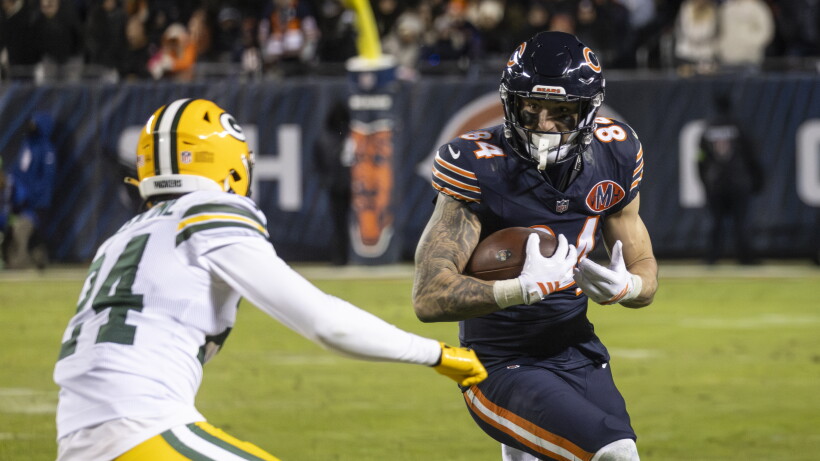
Colston Loveland has the profile of a player ready to become a centerpiece. The second-year tight end recorded 13 receptions for 134 yards and two touchdowns across Chicago's last two games, including seven catches for 69 yards and a score against the Patriots. His growing connection with Williams gives the Bears a credible middle-of-the-field answer at precisely the moment the offense needs one.
That progress, however, is not proof that Loveland can inherit every part of Kmet's workload. A receiving-first tight end creates value by stretching seams, separating from linebackers and making defenders choose between protecting the middle and helping against wide receivers. If he is routinely kept attached to the line to do the blocking that Kmet handled, Chicago could reduce the very route-running opportunities that make him dangerous. The smarter adjustment is to preserve Loveland's receiving role while finding other ways to cover the missing physical work.
The distinction matters because two-tight-end football is built around complementary skills. With Kmet and Loveland on the field together, Johnson could present a run-heavy look and still release two legitimate targets. With only Loveland as a proven receiving threat, opponents may be quicker to send extra attention his way, especially in the red zone and on third down. That could open opportunities for receivers such as Rome Odunze and Luther Burden III, but only if the Bears are willing to vary their formations and protection plans rather than force Loveland into a rigid replacement role.
Loveland's recent production is encouraging for another reason: Williams is returning to rhythm after a hamstring absence, and a trusted tight end can help a quarterback make quick decisions. Against New England, Williams completed 22 of 33 passes for 308 yards and two touchdowns. Loveland should remain a central part of that efficiency. Chicago does not need him to imitate Kmet; it needs him to keep getting open while the rest of the position group handles more of the dirty work.

Sam Roush gets his chance — and a demanding first assignment
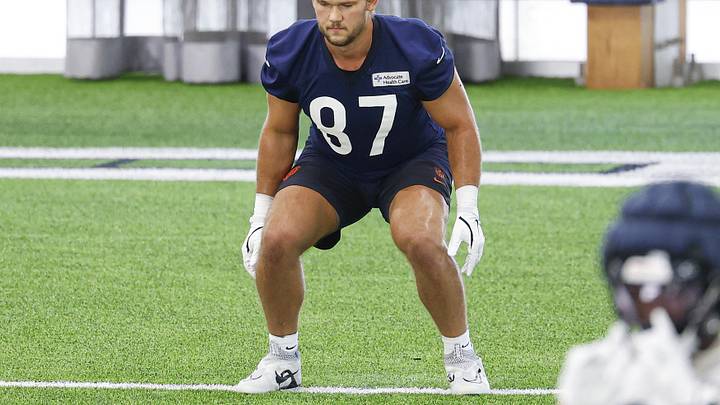
The obvious next name is Sam Roush, Chicago's third-round pick from Stanford. He has three receptions for 33 yards in seven appearances, a tiny statistical sample from which to project a much larger responsibility. Johnson said the rookie's development has pleased the staff and that his snap count is likely to rise. The coach also acknowledged early rookie mistakes while praising Roush's ability to learn from them.
That is the right way to frame the opportunity: not as an instant promotion to Kmet's old status, but as a carefully managed increase in responsibility. The Bears need Roush to understand leverage in the running game, identify defensive movement before the snap and avoid protection mistakes that can turn a routine second down into a drive-killing sack. Catching a few passes would help, yet dependable blocking and assignment discipline may determine how often Johnson can leave him on the field.
There are alternatives on the edges of the roster. Chicago has Stephen Carlson and Qadir Ismail on its practice squad, while Hayden Large has been working toward a possible return after beginning the season on injured reserve. Those names provide flexibility, but none is a direct replacement for the combined experience, durability and system knowledge Kmet offered. If the Bears need a heavier formation, they may lean on a specialist; if they want speed and receiving upside, Loveland remains the clear centerpiece.
Roush's development also affects personnel strategy. Chicago could pursue outside depth, but importing a veteran midseason means teaching terminology, timing and blocking rules on a compressed schedule. There is no guarantee a newcomer would be more trustworthy than the rookie already learning Johnson's offense. With the Bears' next game not until November 2, the coaching staff has valuable preparation time to test combinations and decide which packages can survive intact. That makes the coming practices more important than any immediate headline-grabbing signing.
Ben Johnson's real test is keeping a 5–2 offense unpredictable
Chicago's record makes this a problem worth solving rather than an excuse for retreat. The Bears are 5-2, Williams is completing passes at a much stronger rate than a year ago, and the offense has shown it can recover from difficult stretches. Against the Patriots, the quarterback threw for 308 yards and two scores, while D'Andre Swift supplied 78 rushing yards and a touchdown on 22 carries. Those are the ingredients of a balanced attack, but the recipe depends on avoiding predictable personnel tells.
Kmet helped Chicago run the ball without abandoning its passing threats. Without him, Johnson may need to ask his offensive line to handle more of the edge work, use a sixth lineman in selected situations or move Loveland around to change the defensive picture. Each option has a trade-off. Extra protection can reduce the number of eligible receivers in a route, while a spread formation may make life harder for the running game. The best response is likely a mix of adjustments rather than a single substitute.
There is also a cautionary note from the other side of Thursday's win. New England quarterback Drake Maye threw for 321 yards and two touchdowns, highlighting a Chicago secondary that has not been consistently secure. If the defense continues to give up chunk plays, the offense will face more pressure to score quickly. That increases the value of reliable tight-end blocking and efficient early-down runs: long possessions keep opposing quarterbacks off the field and make a defense's difficult night shorter.
Rome Odunze's late catches against the Patriots illustrated how the offense can respond when it has to. He produced three fourth-quarter receptions for 63 yards, including key gains that helped set up Cairo Santos' long field goal. Loveland, Burden and the receiving group give Williams multiple ways to move the ball. But relying on individual late-game rescue acts every week is not a sustainable substitute for a structure that creates manageable downs from the start.
The next test is at Seattle on November 2, followed by a home date with Tampa Bay on November 8. That gap gives Johnson a rare opportunity to rebuild packages around the available tight ends before another game forces decisions in real time. The result will not be judged only by Loveland's receiving totals. Watch whether the Bears can still run from passing looks, protect Williams against pressure and convert short-yardage situations without signaling their intentions.

Kmet's season-ending injury changes Chicago's offense in ways that a box score will not show. Loveland has the talent to become a featured target, Roush has a genuine opening, and Johnson has enough skill-position depth to design around the loss. None of that guarantees the Bears will preserve the same balance or communication without their most experienced tight end.
At 5-2, Chicago has earned the right to think bigger than merely surviving the next game. The measure of this coaching staff will be whether it can turn an unwelcome personnel change into a workable new structure before the schedule gets harder. The Bears' rise is real; keeping it going without Kmet is the next proof.
Shop GOATIFY NFL and American football shirts, hoodies and stickers.

















