

The World Series Moves Under a Different Roof — and the Rules Can Flip a Game
GOATIFYIn a World Series defined by narrow margins, the strangest potential game-changer is hanging over the field. Milwaukee and Tampa Bay both play beneath roofs, but a baseball striking the structure above American Family Field can produce a completely different result from one striking a catwalk at Tropicana Field. A catch, a live ball, a ground-rule double or even a home run can hinge on precisely where the ball makes contact.
That distinction matters as the Brewers take a 2–0 lead into Monday's Game 3 in St. Petersburg. Both parks have already produced extraordinary roof-related outs this postseason, and the Rays' fixed dome puts unfamiliar geometry directly above Milwaukee's hitters and outfielders. The rules are established rather than improvised, yet the reactions they demand are anything but routine. With each team chasing its first championship, a ball that never reaches the seats could still change the series.
Milwaukee has already won a playoff game with help from a roof cable

The warning arrived before the World Series. In Game 1 of Milwaukee's Division Series against San Diego, Ty France launched a high drive toward deep left field with the Padres threatening to take the lead in the ninth. The ball hit a roof cable or supporting structure and came down into Jackson Chourio's glove. What initially looked capable of becoming a go-ahead home run was instead the second out of the inning. Milwaukee held on for a 3–2 victory.
The important detail is that touching the roof does not automatically kill a play in Milwaukee. When a batted ball strikes a roof panel, truss or cable above fair territory, it generally remains live. If a defender catches it before it touches the ground, the batter is out and runners must judge whether to advance. A ball striking the structure above foul territory is dead, while a ball that hits overhead structure above fair ground and eventually lands foul is treated as foul. The point of contact and where the ball finishes can both matter.
That is why San Diego sought a review of the France play. The question was not whether a roof cable had been involved; it was whether the relevant contact occurred above fair or foul territory. The call stood, leaving Chourio with an out that might never have existed in an open-air park. Milwaukee's manager Pat Murphy and infielder Joey Ortiz believed the ball would have carried foul, but nobody can know the uninterrupted flight path with certainty. The rule resolves the play without asking officials to invent a hypothetical landing spot.
Milwaukee has seen similar oddities before. In the 2008 postseason, Jayson Werth hit a ball that deflected off the structure and Craig Counsell made a diving catch. In 2018, Scooter Gennett struck a truss and Eric Sogard secured another unusual out. Such episodes are rare enough to become ballpark folklore, but the France play is fresh evidence that rarity offers no protection in October. A defender who keeps tracking the ball can turn an architectural surprise into a season-saving play.
The competitive lesson is practical rather than mystical. Brewers fielders know which overhead surfaces can redirect a ball, and visiting teams must learn the same boundaries quickly. Neither side can control the ricochet, but the club that reacts cleanly and understands whether the ball is still alive has a better chance of profiting from it. In a tight championship game, that is a real form of preparation.

At Tropicana Field, the difference between two catwalks can be four bases

Tropicana Field presents an even more distinctive challenge. Its four suspended catwalk rings are identified from highest to lowest as A, B, C and D. A fair ball striking either of the two upper rings, A or B, stays in play. If a fielder catches the rebound before it lands, the batter is out. If the ball remains stuck on an upper ring, the batter receives a ground-rule double. A fair ball striking either of the two lower rings, C or D, is ruled a home run. Foul contact with a catwalk produces a dead ball.
That creates a remarkable contrast: two drives that look similar from the batter's box may have radically different outcomes depending on the ring they hit. A high popup can become an ordinary out after an awkward deflection, while a ball touching a lower catwalk in fair territory is awarded four bases without ever crossing the outfield wall. These are stadium-specific ground rules, not a fresh interpretation created for the World Series.
The Yankees learned the upper-ring version earlier this month. In Game 2 of their Division Series against Tampa Bay, Spencer Jones sent a towering popup toward shallow right-center. The ball stayed aloft for roughly ten seconds, struck the B-ring and fell to Victor Mesa Jr., who made the catch. The play remained live and Jones was retired. A less alert fielder might have let the ball fall while expecting an automatic dead-ball ruling. At the Trop, watching the ball until the play is unmistakably over is essential.
The catwalks are not merely decorative curiosities. The Rays' ballpark records counted 200 fair balls hitting them before the 2026 season. Five postseason fair-ball contacts had been classified as home runs, including Nelson Cruz's shot off the C-ring during the 2021 Division Series. Those numbers are modest compared with the total number of balls put in play, but they establish that this is a recurring baseball condition rather than a once-in-a-lifetime accident.
For Milwaukee's hitters, the challenge is to avoid assuming that every towering fly has a predictable destination. For Tampa Bay's defense, the task is to use familiarity without becoming complacent. The white dome can complicate tracking, the catwalks can interrupt a flight path, and the artificial turf adds another distinctive surface once the ball reaches the ground. None of those factors guarantees the Rays an advantage. They simply increase the value of rehearsing the unusual before a World Series game makes it decisive.

The Rays' rebuilt dome gives this World Series an unusual comeback story
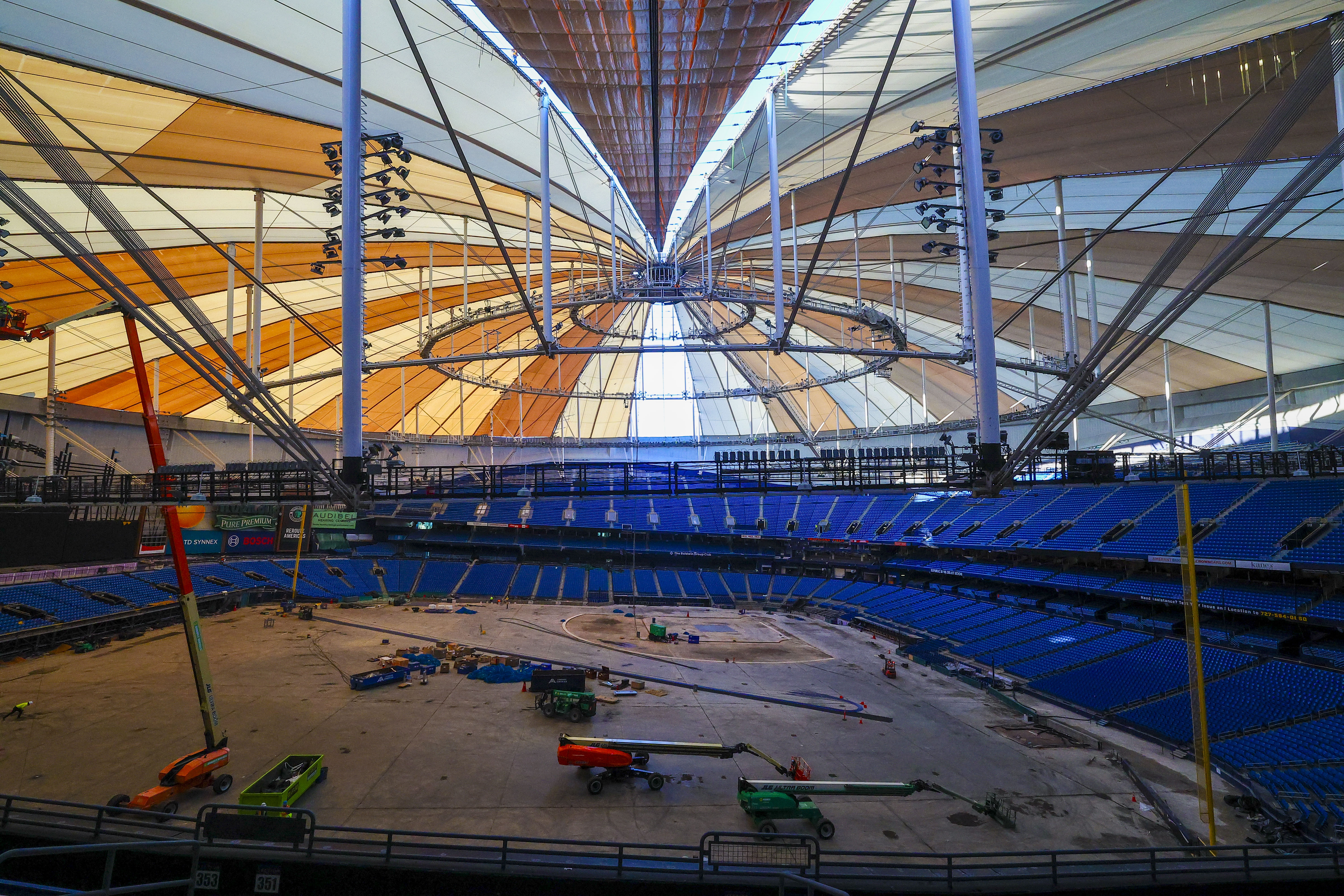
There is a larger reason the roof is part of this championship story. Hurricane Milton ripped away much of Tropicana Field's fabric roof in October 2024, leaving the ballpark unusable for the following season. The Rays played their 2025 home schedule across Tampa Bay at George M. Steinbrenner Field, an outdoor facility with very different dimensions, atmosphere and weather exposure. The restored dome reopened for Tampa Bay's 2026 home season, returning the club to its familiar indoor environment.
The rebuilt roof brought back the distinctive overhead network of catwalks and support structures that makes the Trop recognizable. Restoring the fabric covering did not erase the baseball-specific ground rules associated with the rings. The Rays have therefore spent this season reacquainting themselves with a home field where a ball can vanish briefly into the ceiling geometry before dropping back into play. Milwaukee, by contrast, is arriving for the biggest games of its season with far less recent experience in that setting.
That difference is most important on defense. Outfielders must choose their initial routes while tracking a white baseball against a bright roof, then adjust if the ball contacts a ring or changes speed. The ordinary cues of distance, spin and carry are already difficult under pressure; a potential deflection adds another decision. An infielder moving into shallow outfield territory also has to know when to yield to a teammate with the better angle. Miscommunication can be costly even when the ruling itself is straightforward.
For the Rays, coming home down 2–0 changes the emotional meaning of the venue. The club needs a win, not a ceremony about its restored stadium. Yet the building's return is part of why this series feels distinctive: a franchise that temporarily lost its home has brought the World Series back beneath the repaired roof. If Tampa Bay can make the familiar conditions count, it has an opportunity to turn a difficult series back into a contest. If not, the venue will be remembered mainly as the place where Milwaukee moved closer to a first title.
There is no credible way to predict a roof deflection in advance. The smarter question is which team has prepared for one. Tampa Bay's experience should help its fielders understand the rings instinctively; Milwaukee can reduce the gap through scouting, pregame work and clear communication. In October, the difference between surprise and preparedness can be a single clean catch.

A first all-indoor World Series is possible — but only if Milwaukee keeps the roof shut

The architectural contrast creates a historical possibility. Milwaukee kept its retractable roof closed for Games 1 and 2. Tropicana Field's roof cannot open, so Games 3 and 4 — and Game 5, if needed — will take place indoors. If the remaining games scheduled for Milwaukee also proceed with the roof closed, this could become the first World Series played entirely under roofs. The condition is important: an indoor opening weekend does not, by itself, establish the record.
The 2020 championship was staged entirely at the Rangers' Globe Life Field, but its roof was open for several games. The 2023 matchup involved two clubs with roofed ballparks, yet Chase Field opened its roof for the Arizona games. Having a retractable roof is not the same as using it throughout a series. Milwaukee's roof status is therefore the variable that determines whether 2026 belongs in that particular record book.
Postseason control also differs from the regular season. Clubs normally decide whether to open their own retractable roofs during the regular schedule, subject to local procedures. In October, the Commissioner's office or a designated official makes the roof-movement decision in consultation with the home team and umpire crew chief. That distinction matters because no team should assume it can simply change the overhead conditions at will in the middle of a championship series.
The baseball stakes are much more immediate than the trivia. Milwaukee arrived in St. Petersburg after winning the first two games, including a 5–4 comeback from four runs down in Game 2. The Brewers have repeatedly shown that a deficit does not automatically change their approach. Tampa Bay must respond with cleaner execution and better protection of leads; allowing a manageable fly ball to become a confusion-filled adventure would be especially damaging with little margin left.
Game 3 will be decided primarily by pitching, plate discipline, fielding and timely hitting, not by the ceiling. But the rules above the field are part of those fundamentals. A ball striking Milwaukee's roof cable can remain catchable. A ball striking Tampa Bay's lower catwalk can become a home run. The teams know the distinction before first pitch. The one that responds correctly when the unexpected happens will have earned its advantage rather than stumbled into it.
The roofs are not a gimmick added to the World Series; they are part of the playing fields, with precise rules that can transform a single batted ball. Milwaukee has already benefited from a roof-assisted postseason out, while Tampa Bay has seen the catwalks intervene in its own playoff run. Now the championship moves to a fixed dome where the same contact can mean an out, two bases or a home run depending on its location.
The Brewers lead 2–0, the Rays are back in their restored home, and both teams have enough to worry about without guessing what a ball will do overhead. That is exactly why knowing the ground rules matters. A title can swing on a detail that looks bizarre to everyone except the players prepared for it.

















