

Russell Climbed From 19th to Ninth — Then Singapore Exposed Mercedes’ Bigger Problem
GOATIFYGeorge Russell gained ten places in the Singapore Grand Prix and still left Marina Bay with the feeling that his weekend had slipped away. Ninth place from nineteenth on the grid sounds like an impressive recovery until the rest of the picture comes into focus: a Sprint crash, an engine penalty, a Virtual Safety Car that ended at precisely the wrong moment, and a long final stint trapped behind Nico Hülkenberg. Every step forward came with another reminder of how far Russell had fallen from the fight at the front.
The contrast inside Mercedes made the result sting more. Kimi Antonelli finished third and stretched his championship advantage over Russell to 102 points. The teammates were also testing different specifications of the Mercedes, giving the team a valuable comparison but leaving its two drivers with very different Sundays. Russell's drive was not a disaster on the timing screens; it was a case study in how one difficult weekend can magnify problems with reliability, strategy, development and a title challenge all at once.
From sixth in qualifying to nineteenth on the grid, the damage came before lights out
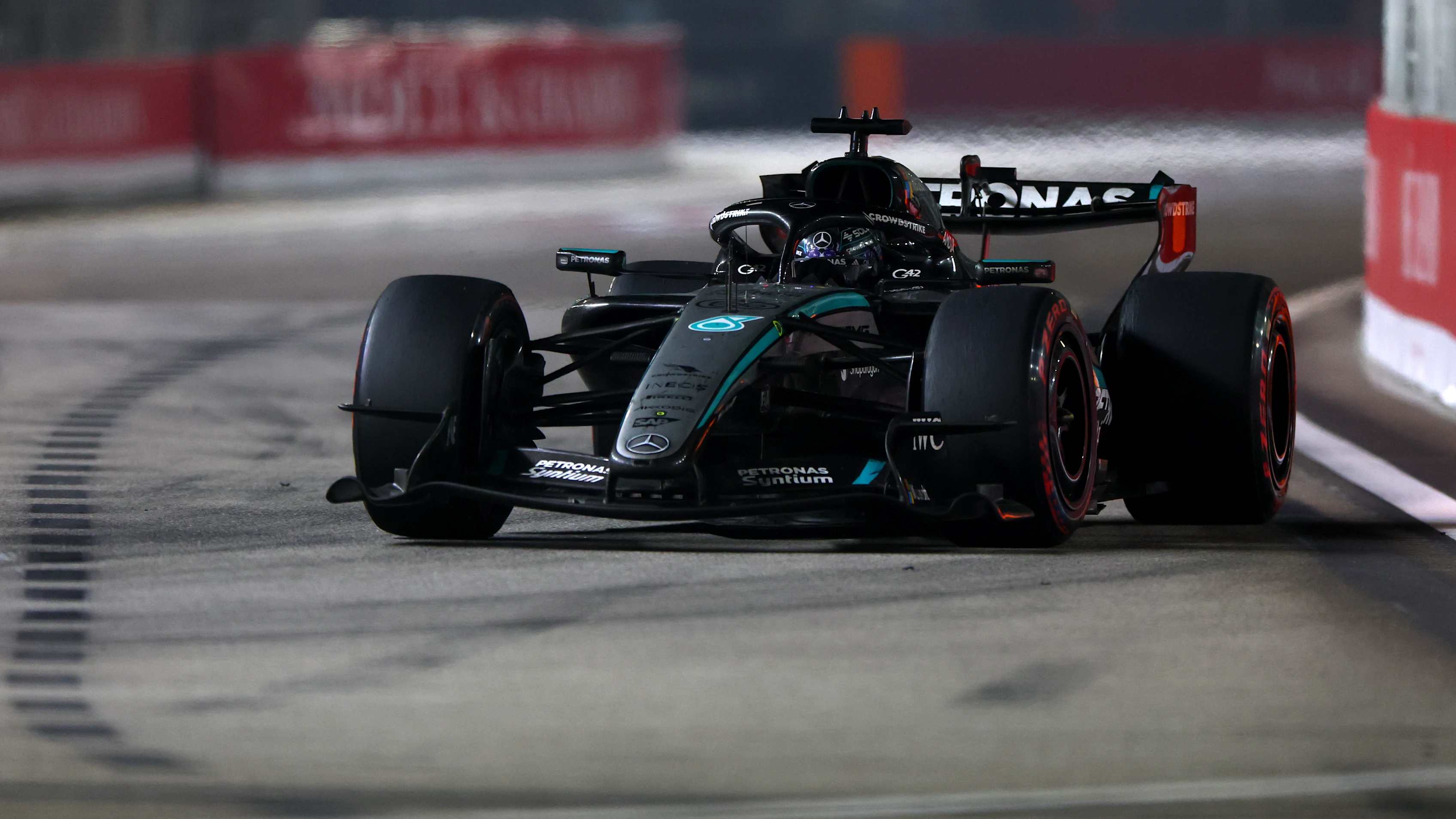
Russell was quick enough to qualify sixth for the Grand Prix, a position that would ordinarily have offered a realistic chance to race near the front on a circuit where passing is notoriously difficult. But his Sunday starting position was nineteenth. Mercedes had to take additional power-unit components following his retirement in Malaysia, and the resulting grid penalty erased the value of his qualifying performance. The gap between the pace he showed and the place he occupied when the lights went out defined his race before the first corner.
Singapore had already punished him on Saturday. Russell crashed while leading the Sprint, losing the chance to bank points at a weekend when every result mattered against Antonelli. That error did not cause the Sunday grid penalty—the engine situation did—but the two setbacks compounded each other. A driver who had been within striking distance of the championship leader earlier in the season was now spending his weekend recovering rather than attacking.
The circumstances also changed what a good result could mean. On an open circuit with long straights, a front-running Mercedes starting near the back might expect to make rapid progress. Marina Bay is different. The walls are close, the corners arrive quickly, and even a car with superior pace can become stuck in another driver's dirty air. Russell could not simply drive at the speed suggested by his qualifying lap. He needed traffic to separate, strategy to cooperate and his tyres to stay in the right window.
There was a further complication in the garage. Mercedes was using Russell's older car specification as a comparison against Antonelli's newer upgrade package. That decision was useful for engineering evaluation, but it also meant Russell's recovery was being attempted with a different technical baseline from his teammate's podium challenge. The race would therefore answer two questions at once: how much could Russell rescue from a compromised start, and which version of the car would Mercedes want for the final six rounds?
The Virtual Safety Car almost rescued Russell — then Hülkenberg became the roadblock

Russell made the first part of the recovery work. Starting on the medium compound, he picked his way through the field and reached the fringes of the top ten. That opening stint was the strongest argument that his ninth-place finish should not be dismissed as a lack of pace. He was able to move forward when overtaking opportunities appeared, but every position cost time and tyre life that the leaders did not have to spend.
The decisive strategic moment came with a Virtual Safety Car. Under reduced speeds, a pit stop can be cheaper relative to cars remaining on track, making the timing of the neutralisation especially important. Russell entered the pits for his first stop just as the VSC period was ending. Instead of receiving the full time-saving advantage he had hoped for, he rejoined having lost much of the opportunity. It was not a conventional pit-stop error; the timing of the race-control phase simply left him on the wrong side of the calculation.
Mercedes switched him to the soft tyre for the closing phase. The compound offered useful pace, and Russell overtook Pierre Gasly's Alpine on his way into the points. But the final step proved stubborn. Hülkenberg's Audi occupied eighth place and defended effectively as Russell closed the gap. At Singapore, arriving on a faster tyre does not guarantee a clean pass. A driver needs a strong exit, sufficient battery deployment and a mistake-free opportunity in the braking zone; otherwise the laps disappear without the position changing.
Russell eventually settled for ninth, just behind Hülkenberg, rather than force a low-percentage move that could have thrown away the points he had recovered. That restraint made sense for the team's constructors' score, but it did little to improve the driver's championship situation. Ninth brought two Grand Prix points. Antonelli's third place brought fifteen, a thirteen-point difference on Sunday alone, on top of the points Antonelli had already gained in the Sprint.
What makes the result revealing is that Russell did many of the things a driver is supposed to do in a recovery race: he made early progress, managed the stint, took the available overtakes and avoided a late incident. The result was still limited. His Singapore problem was not one single dramatic mistake on Sunday. It was a chain of small disadvantages, with the VSC timing and Hülkenberg's defence turning a potentially stronger recovery into damage limitation.

Antonelli's podium made Mercedes' split-spec upgrade experiment harder to ignore

On the other side of the Mercedes garage, Antonelli turned fourth on the grid into third at the flag. He had his own difficult moments on the medium tyre, but the team brought him in for fresh softs during the later neutralisation. The Italian then capitalised on the fight between Lando Norris and Lewis Hamilton to move forward and secure another podium. That result extended his lead over Russell to 102 points with six races remaining, putting the championship leader within mathematical reach of clinching the title at the next round in Austin.
Those results should not be read as a perfect laboratory comparison between the two Mercedes specifications. Russell and Antonelli started in radically different places, ran different races and encountered different traffic. The grid penalty and the failed VSC advantage were major variables. Even so, the weekend provided information the team could not ignore. Antonelli's updated car appeared more competitive as the engineers refined its operating window, while Russell's older configuration was left to prove itself from deep in the field.
Mercedes' trackside assessment was that the newer package offered encouraging potential, even if its ideal set-up remained difficult to find. That distinction matters. An upgrade is not successful merely because it adds theoretical downforce or improves a simulator number. It must work across track surfaces, tyre temperatures and race conditions, and the team has to understand how to set it up consistently. The Singapore data gives Mercedes a clearer direction before Austin, but it does not automatically guarantee the same performance at a very different circuit.
The wider competitive picture is changing too. Max Verstappen won both the Singapore Sprint and Grand Prix, completing another powerful weekend for Red Bull after its recent resurgence. Russell acknowledged that Red Bull has been setting the pace over the past two events. Mercedes spent much of 2026 looking like the benchmark; now it is being forced to investigate upgrades while its main rivals are finding speed. The title leader is still in a commanding position, but the team's development urgency is real.
Russell also expects another power-unit-related penalty later in the season. He suggested Las Vegas as a possible place to take it, because a circuit with more overtaking opportunities would be less punishing than Singapore. That is not a confirmed penalty date, but it shows the strategic planning Mercedes must juggle. The immediate question is no longer only whether Russell can claw back points. It is how Mercedes gives both drivers a competitive, reliable package while avoiding more weekends spent recovering from the back.

Russell's climb from nineteenth to ninth demonstrated persistence, but the numbers tell the harder story. He gained ten positions in the Grand Prix and lost thirteen points to Antonelli on Sunday, while the gap in the championship reached 102. The late VSC, the Audi he could not pass and the contrast between Mercedes' two car specifications turned an apparently respectable recovery into another frustrating result.
Austin will provide the next test of whether Mercedes has understood its upgrade and whether Russell can return to fighting near the front rather than counting the positions he has recovered. Singapore offered useful data and two points. For a driver trying to close a championship deficit, neither was nearly enough.
















