

Benn's 1,000th Point Won the Game. Oettinger's 22 Saves Saved the Night.
GOATIFYFor 36 minutes, Dallas and Buffalo were locked at 0–0. Then Jamie Benn turned a loose puck beside the net into his 1,000th career NHL point. The captain's second-period goal put the Stars ahead, and Dallas protected the moment with a 2–0 win on November 14, 2026.
The night also belonged to Jake Oettinger. Pulled two days earlier against Winnipeg, he answered with 22 saves and his fourth shutout of the season. Wyatt Johnston added a late power-play goal, leaving Buffalo frustrated and Dallas celebrating two very different kinds of resilience. The numbers explain the result; the way the goals and saves unfolded explains why it mattered.
A rebound, a thousand points and the difference from a thousand games

The puck did not arrive as a gift. Dallas had been trying to force Buffalo out of a scoreless game for nearly 37 minutes when Nils Lundkvist sent a puck toward traffic from the right point. Justin Hryckowian got a piece of it, the deflection hit the left post, and the rebound slid into the space that every experienced net-front player is trained to hunt. Jamie Benn was already there. His finish into an open net at 16:23 of the second period was the first goal of the night, the eventual winner, and point number 1,000 of his NHL career.
That combination made the milestone unusually appropriate. Benn has scored spectacular goals in Dallas, won a scoring title and spent years as the face of a team with championship ambitions. This one was a simpler piece of veteran craft: arriving at the right post, reading a ricochet and doing the work before a defender could reset. The scoreboard was still close enough that every possession mattered. It was not a late goal piled onto a comfortable lead, and not an assist attached to another teammate's decisive finish.
The Stars emptied their bench to celebrate. Yet the most revealing part of the scene may have been what happened afterward: Dallas still had to defend the lead for an entire third period. Benn had earned the milestone, but he had also handed his teammates a very practical assignment. Their captain's landmark would be remembered as a game-winner only if Buffalo never tied it. A milestone that required a team effort after the celebration carried more competitive weight than the number alone.
By the official league breakdown, Benn reached 1,000 with 418 goals and 582 assists. He became the 104th player to reach the NHL mark and the 53rd to do so entirely with one franchise. In the Stars and former North Stars lineage, only Mike Modano had previously cleared 1,000 points. Modano's 1,359 remain the higher franchise standard. Benn belongs in the same sentence now, even if the two careers reached their totals in different eras and in different roles.
The route makes the comparison more interesting. Benn was the 129th selection in the 2007 draft, a fifth-round pick who was not introduced to Dallas as an inevitable franchise superstar. He made the opening-night roster in 2009, grew into the captaincy and won the 2014–15 Art Ross Trophy with 87 points. He followed it with a 41-goal season in 2015–16. Those scoring peaks are part of the record, but so is the much longer process of finding new ways to contribute as his speed, deployment and physical demands changed.
A photograph from March 2023, when Benn received a silver stick for his 1,000th NHL game, captures an earlier milestone rather than Saturday's 1,000th point. The distinction matters. One thousand appearances proved longevity; 1,000 points required that longevity to remain productive. In July 2026, after a previous season disrupted by a serious lung injury, Dallas brought him back on a one-year agreement. The extension signaled that the captain's value was not being measured solely by his old scoring pace.
GOATIFY
GOATIFY Hockey
One thousand points is an NHL milestone worth celebrating. Explore GOATIFY Hockey apparel and fan-ready designs inspired by the sport's greats.


The week also supplied a hard reminder of what captaincy means when the results are ugly. Dallas had been beaten 8–3 by Winnipeg on Thursday, and the team held a players-only meeting. Saturday offered a response in the only language that matters on the ice: a tighter defensive performance, five killed penalties and a win. Benn's goal framed the story beautifully, but the response did not begin and end with the captain. Dallas earned its celebration by making the rest of the game difficult for Buffalo.
It is tempting to look at 1,000 points as a career's closing statement. That is too tidy. Dallas still has a long 2026–27 season to play, and the Stanley Cup remains absent from Benn's collection of individual achievements. The stronger interpretation is that this was a marker inside an active pursuit, not a curtain call. His job did not end when the bench emptied. He still needed his teammates to finish the night, and the Stars delivered.
Oettinger's response: six goals against Winnipeg, none against Buffalo
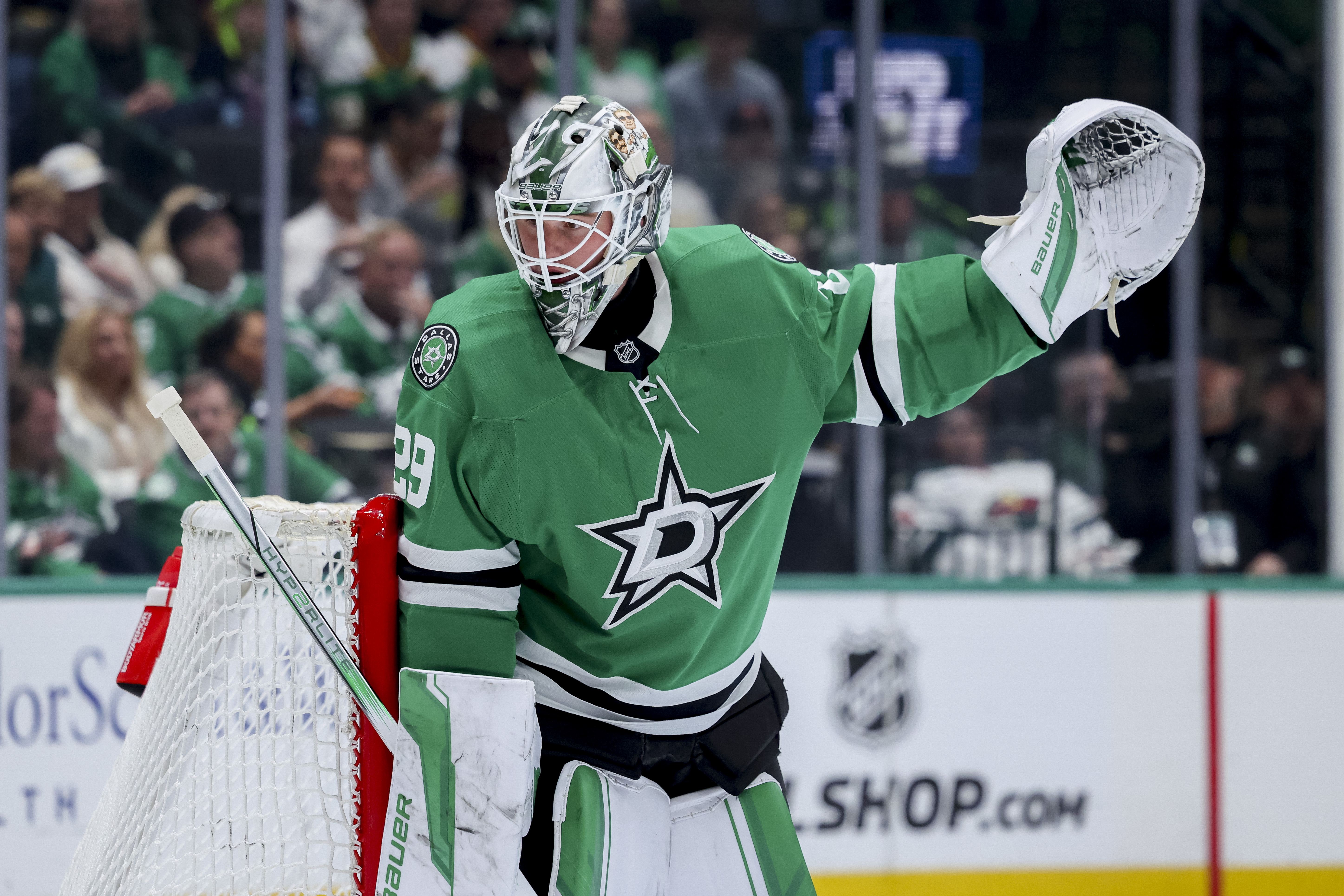
Jake Oettinger faced a different kind of milestone. Two nights before Benn's landmark, the Dallas goaltender had been pulled during an 8–3 defeat to Winnipeg after allowing six goals. A goalie can spend a week being defined by one rough game, particularly when expectations are already high. The fastest way out of that conversation is not a press conference. It is to play again and give opponents nothing. Oettinger's answer against Buffalo was 22 saves, zero goals and his fourth shutout of the season.
The sequence is unusually sharp. Oettinger recorded shutouts in three of Dallas' first six contests, including a 4–0 win in Buffalo on October 8, and then moved through a more turbulent stretch. The 2026–27 Stars are capable of generating offensive chances in bunches, but their goaltender has still had to absorb the cost of defensive mistakes. In his three starts preceding Saturday, he had conceded 14 goals. The difference between Thursday's early exit and Saturday's clean sheet was not a new player in the crease; it was a more disciplined game in front of him and better execution when chances got through.
Dallas killed all five Buffalo power plays. That fact deserves nearly as much attention as the shutout number. A team defending a 1–0 lead cannot afford the kind of breakdown that turns a frustrating but ordinary penalty into an equalizer. The Sabres had opportunities to get set in the offensive zone and later produced pressure while skating with the extra man. Their failure to convert kept Benn's goal intact, and it gave Oettinger the chance to dictate the next save rather than scramble through an escalating deficit.
The tense stretch came in the third period. Buffalo made a serious push while Dallas was nursing the single-goal margin, including a dangerous five-on-four passage. Jack Quinn found his way into high-quality chances, but Oettinger was able to extend his right leg and get across the shooting lane. The saves were not simply additions to a final tally of 22. One goal at that moment would have changed the narrative of both the milestone and the bounce-back. Instead, Dallas kept its lead and forced Buffalo to chase a game that had become less forgiving with every shift.
GOATIFY
GOATIFY Hockey
A goalie can change a game without scoring. Find GOATIFY Hockey graphics and gear for fans who live for a hard-fought shutout.
Shot counts add an important correction to the mythology of a shutout. Buffalo registered 22 attempts on goal, while Dallas put 30 on Alex Lyon. Oettinger had less overall volume than his opposite number, but the situation demanded perfection. The only difference between a 1–0 win and a tie was one puck. It is possible for a goalie to win a game with 40 saves and still have moments of uneven positioning; it is equally possible for a 22-save shutout to depend on two or three high-pressure stops. Saturday belongs to the latter category.
For Dallas, the special-teams split was also revealing. The Stars went one-for-five with the extra skater, but their winning goal came at even strength. Their own power play produced the insurance goal only near the finish. That is a more balanced way to think about the result: their penalty killers protected the advantage, their goaltender erased Buffalo's chances, and their power-play unit finally found the one extra goal that ended the argument. No single line on the scoresheet describes the entire defensive improvement.
Saturday was Oettinger's 20th career NHL shutout and, at that point, his league-leading fourth of the season. Reaching that mark in mid-November gives Dallas something tangible on which to build. It does not mean the inconsistency of the preceding starts has vanished. One excellent night can answer the immediate criticism; a month of predictable performances is what changes a team's outlook. The schedule will offer more tests, beginning with a quick turnaround against Florida.
There is another reason the response matters. When a captain reaches 1,000 points, the instinct is to present the victory as a tribute to him. The more useful read is that his teammates made the tribute real. Oettinger did not have to score the winner or speak to what Benn means to the organization. He simply had to refuse every Buffalo opportunity. On a night designed to celebrate longevity, Dallas' goalie reminded everyone that championships are built from repeatable details, not just the milestones that earn standing ovations.
Johnston finished the job, and Buffalo ran out of answers

Wyatt Johnston's goal did not create the night's central story. By the time he tapped home Dallas' second with 42 seconds left in regulation, Benn had already made history and Oettinger had spent nearly three periods protecting it. But the insurance marker revealed something important about how the Stars closed a game that had been uncomfortably tight for most of the evening. When Buffalo had to chase, Dallas found the space and the composure to end the chase.
The final goal came on a power play at 19:18 of the third period. Mikko Rantanen worked the puck across the offensive zone and found Johnston at the backdoor, with Roope Hintz also involved in the passing sequence. Johnston had the simple-looking task of tapping home the final pass, which is exactly why the setup mattered. A goalie can handle a straightforward shot from distance; a clean lateral pass followed by a close-range finish asks him to cover far more ice in far less time. Dallas' movement turned its fifth opportunity with the extra skater into the one that finally paid off.
The timing matters as much as the execution. Buffalo had been trying to pry open a 1–0 game all period. A Sabres penalty with 1:21 remaining narrowed their remaining paths to a comeback. Instead of allowing the visitors to turn a desperate final push into a sustained six-on-five siege, Dallas used the new man advantage to make the scoreboard definitive. Johnston's goal was not needed for a regulation win in the end. It was needed to remove the possibility of a last-second twist.
GOATIFY
GOATIFY Hockey
From veteran captains to the next wave of goal scorers, hockey gives fans something to talk about. See the GOATIFY Hockey collection.
Buffalo's goaltender Alex Lyon deserved a better attacking result than he received. He made 28 saves on 30 Dallas shots and kept his team within a goal until the final minute. That is the kind of performance that lets a team steal a point if its special teams or top line supply one decisive moment. The Sabres got neither. They generated enough opportunities to threaten but converted none of five power plays, a damaging combination against a Dallas team that was prepared to play a patient, low-event game after Thursday's collapse.
There is a difference between being outplayed and being unable to finish. Dallas held a 10–6 shots advantage in the opening period despite spending time shorthanded. Buffalo later produced dangerous third-period looks, yet could not solve the goaltender when the margin was still one. The visitors finished with 22 shots and their fourth consecutive game without a victory, sitting at 8–8–4 after the loss. That early-season record is not a verdict on the entire campaign, but the way the Sabres let a winnable, one-goal contest escape is a problem worth studying before the next face-off.
For Dallas, there is a counterargument to treating 2–0 as a fully convincing offensive night. The Stars had five power plays and scored on only the late one. Their primary breakthrough required a rebound and Benn's quick read, not a succession of clean passing plays. A scoreless game midway through the second period is still a warning that chances are not being converted at a comfortable rate. The important positive was that Dallas did not chase offense so aggressively that it reopened the kind of odd-man looks that had contributed to an ugly defeat earlier in the week.
The broader form line is encouraging when placed in context. Dallas improved to 11–6–2, had won two of three games, and was 9–3–1 over its preceding 13. It had also shut out Buffalo twice in the young season: Oettinger's 4–0 win on October 8 and Saturday's 2–0 result. That pattern does not mean the Stars have discovered a universal solution to every opponent. It does show that their defensive structure and goaltending can smother a team across different nights without demanding a spectacular scoring output.
Johnston's role also tells a longer story about this Dallas roster. Benn, the captain who has carried the identity through many versions of the franchise, supplied the opening goal. Johnston, part of a younger scoring core, supplied the final one. Rantanen and Hintz connected the play. A successful season requires those generations and roles to work together, not compete for the spotlight. Dallas cannot ask a 37-year-old captain to solve every difficult game by himself, and it should not have to.
The Stars were due to host Florida the following night, so the opportunity to enjoy the moment was brief. Buffalo, meanwhile, had Philadelphia next on its schedule and a special-teams problem to address. The immediate result was beautifully simple—two goals for Dallas, zero for Buffalo—but its lessons were not. One great rebound created the lead, a goaltender's concentration protected it, and a late passing play sealed it. That is a more durable winning formula than relying on the emotional charge of a thousand-point celebration alone.
Benn's 1,000th point was the headline and the winning goal, but Dallas' 2–0 response to its Winnipeg defeat required more than an iconic rebound. Oettinger recovered with 22 saves, the Stars killed five Buffalo power plays, and Johnston converted the late chance that stopped a comeback from becoming possible.
The milestone links Benn to Modano in franchise history. What happens next will depend on the teammates around him: repeat the structure, keep the penalty kill reliable and translate nights like this into consistency against tougher opposition. A ceremony lasts minutes. A contender needs the habits that survive after it.
GOATIFY
GOATIFY Hockey
Shop GOATIFY NHL and hockey shirts, hoodies and stickers.


















