

Cuylle Stole the Rangers' Centennial. Montreal Handed Him the Chance.
GOATIFYOne hundred years after their first NHL game, the New York Rangers could have treated Monday night as a museum exhibit. Madison Square Garden had the old names, the familiar rivalry and the perfect occasion. It also had a very contemporary problem: Montreal controlled enough of the early play to score first, and the visitors had a collection of dangerous players who should have made a one-goal lead uncomfortable to chase.
Instead, the Rangers' 3-1 win over the Canadiens on November 16, 2026, became a reminder that hockey games do not award style points for maintaining possession. They reward teams that win the decisive exchanges. Will Cuylle scored twice in the second period, first by getting to the crease for a deflection and then by turning a Montreal power play into a shorthanded breakaway. Scott Morrow supplied the third-period cushion; Joonas Korpisalo stopped 24 of 25 shots. New York left its centennial celebration with a third consecutive victory and six wins in seven games.
The flattering version is that the Rangers are discovering an identity. The more revealing version is that their opponent helped make that discovery possible. Montreal's power play went 0-for-4, surrendered the game-winning goal and made the Canadiens' best skill players look surprisingly ordinary when given extra space. For a team built around Nick Suzuki, Cole Caufield and Lane Hutson, that reversal is more than one rough night. It is the central warning from a game the Rangers will remember fondly and the Canadiens should study painfully.
The century belonged to the players who refused to admire it

The centennial scene offered an unusually clear contrast between memory and the present. A hundred years earlier, on November 16, 1926, the Rangers opened their NHL history by beating the Montreal Maroons 1-0. This time the building celebrated a very different collection of legends before the puck dropped: Henrik Lundqvist, Mark Messier, Brian Leetch, Mike Richter and Adam Graves were among the familiar faces. A full century of reputation framed a game that the current roster still had to earn.
For stretches, Montreal made that celebration feel premature. The Canadiens carried the puck into threatening positions and took the first lead at 7:59 of the second period. Lane Hutson worked along the blue line to escape a challenge from Matt Rempe, then put a shot toward the crease that Phillip Danault redirected home. It was an economical goal: movement at the point, a screen, a purposeful touch and almost nothing a goaltender could do after the change of direction.
The Rangers did not respond with an elaborate passing exhibition. They responded with a basic attacking principle. J.T. Miller collected the puck high in the offensive zone, found Marcus Pettersson arriving with space, and Pettersson sent it toward the net. Cuylle went to the dirty area; the puck struck his skate and found its way past Jacob Fowler at 9:47. The equalizer arrived less than two minutes after Danault's opener. What mattered was not whose shot looked better, but which team put a body where a rebound or redirected puck could become a goal.
That sequence is part of the reason Cuylle is an interesting answer to New York's current questions. He is not supposed to be an exact replacement for the missing creativity elsewhere in the lineup. He can, however, be the kind of forward who makes an otherwise ordinary rush harder to defend. He moves directly toward the crease, stays involved in board battles and gives the defense fewer easy clearances. On this night, his two goals came from dramatically different situations, but both rewarded decisiveness.
GOATIFY
GOATIFY Hockey
Every anniversary needs new heroes. Explore GOATIFY hockey fan shirts, hats and stickers for nights like this one.


It also matters that Morrow contributed. The defenseman converted in the third period for his first goal with the Rangers, his second in the NHL, after a Montreal penalty to Noah Dobson shortened another Canadiens advantage. That insurance goal changed the risk calculation. Instead of defending a one-goal lead to the final horn, New York could make Montreal chase two. It was a valuable contribution on an evening when the franchise's history could easily have overshadowed the young players shaping its immediate future.
The game was not proof that New York can outplay every serious opponent at five-on-five. It was proof that the Rangers can survive a period in which the other team feels dangerous, respond quickly when they are behind and capitalize when their opponent gives them a narrow opening. Those are foundations worth retaining. A century's worth of banners cannot take a defensive-zone faceoff or finish a shorthanded rush. Cuylle and Morrow did the work themselves.
Montreal gave away the one advantage it was supposed to own

Montreal's problem cannot be explained by a single missed shot, because the failures are beginning to form a pattern. The Canadiens finished the game 0-for-4 on the power play. Their man advantage had gone 0-for-12 over the previous four games, and the team entered the wider discussion near the bottom of the league, 31st at 12.5 percent. That is a strange position for a roster whose primary selling point includes exceptional puck-moving talent.
Hutson can evade pressure and manufacture shooting lanes from the blue line. Suzuki processes defensive coverage quickly. Caufield poses a constant scoring threat when a passing seam opens. Juraj Slafkovský brings size and access to the interior. The ingredients look persuasive when presented on a line-combination graphic. They looked much less persuasive against the Rangers once the puck had to move through actual sticks, bodies and clearing attempts.
The defining breakdown arrived late in the second period. An Alex Newhook attempt missed the target and traveled around the boards; Adam Fox recognized the transition opportunity and pushed the puck ahead. Cuylle accelerated down the ice with Mika Zibanejad available on the left, watched the recovering defenders and decided the shot was there. He beat Fowler short side from the right circle with 57 seconds remaining. In the official scoresheet, it counts as a shorthanded goal. Tactically, it is a complete reversal of what the Canadiens were supposed to create with the extra skater.
A power play is not automatically successful because it holds possession for forty seconds. It succeeds when the defending four are forced to rotate, when a goaltender must move laterally and when players in scoring positions receive the puck with enough time to execute. New York resisted those conditions. Montreal managed only four shots on goal during its four opportunities and missed the net on seven other attempts. That combination suggests a team creating motion without reliably turning it into controlled, dangerous finishes.
The psychological problem is real, but it is not a substitute for technical explanation. As the streak grows, a power-play unit can begin treating every entry as a must-score shift. The puck moves an extra time, shots are deferred, and an impatient player tries to force a pass through an obvious lane. A penalty kill can read that hesitation. Montreal's answer has to be more specific than simply telling talented players to relax. They need quicker recovery routes after misses, an obvious low-risk option at the wall and more decisive choices when the first option disappears.
There is also a personnel responsibility. If a player is the last reliable defender at the top of a setup, leaving that position without coverage opens the type of rush Cuylle exploited. Teams cannot eliminate every counterattack, but they can reduce the chances that a single errant shot becomes an uncontested drive on their goalie. The Canadiens paid the maximum price here. A sequence designed to put them ahead instead gave New York the winner and altered the entire complexion of the third period.
GOATIFY
GOATIFY Hockey
Montreal's power play needs a reset. Discover GOATIFY hockey gifts and fan gear while the Original Six rivalry keeps rolling.
Korpisalo's return gives Sullivan a defensive identity to trust
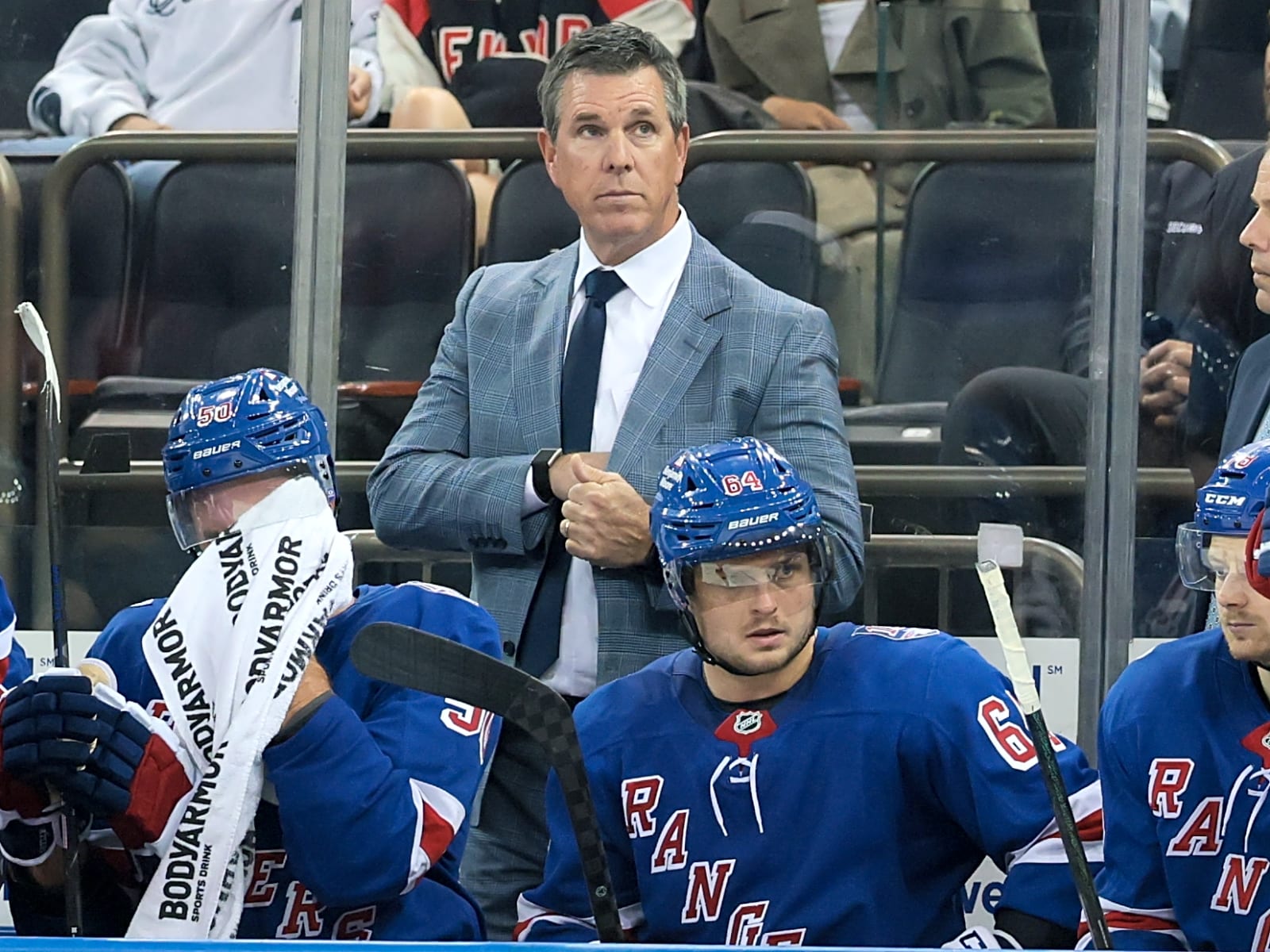
The temptation after a centennial win is to credit the atmosphere for everything. The Rangers offered a less romantic explanation. Their defensive habits, their goaltender and their ability to make Montreal operate through traffic mattered more than the pregame music or the reunion of old stars. Mike Sullivan has been pushing a version of Rangers hockey built around limiting the opponent's clean looks before relying on highlight-reel offense. Monday supplied an unusually attractive example of why that approach has value.
Joonas Korpisalo made 24 saves on 25 shots in his first home start with New York. The number sounds straightforward until the context is considered. Igor Shesterkin has been ruled out for the season after an October injury. Korpisalo, acquired from Boston in July, began the campaign unavailable himself and only returned in November. Rookie Dylan Garand had carried a heavy share of the starts during the shortage. A veteran showing up and immediately stacking wins does not erase the long-term uncertainty, but it gives the coaching staff something it did not have a few weeks ago: a plausible second route to stability.
The Rangers' recent sequence makes that point. Korpisalo debuted against Seattle on November 7 and helped protect a lead that almost slipped away. By the Canadiens game he had three wins in three starts, and his calmer moments against Montreal gave New York the time needed to turn the match. He did not need to manufacture goals or rescue an offense that had disappeared for three periods. He needed to keep one dangerous team at one goal long enough for Cuylle and the defensemen to work.
There is a danger in turning three games into a verdict on an entire goaltending season. The job will still involve difficult road starts, tired defensive pairs and nights when the Rangers cannot find two goals in the same period. Save percentage over such a tiny sample can change sharply with one bad rebound or deflection. What the Canadiens performance does establish is a baseline of competence under pressure. That matters more than sweeping declarations about a permanent solution in net.
The defensive structure deserves its own accounting. Fox's quick decision on the shorthanded winner was the play of a defenseman who recognized a narrow counterattack. Pettersson's involvement on the equalizer showed how defensemen could join a rush without asking the forwards to manufacture every angle. Morrow's goal confirmed that contribution at the other end. None of those plays requires a team to abandon a checking identity. A sound defensive team can still punish opponents when their spacing breaks down.
New York improved to 13-8-1 and had won six of seven. That is meaningful momentum, particularly at Madison Square Garden, where the Rangers were 9-2-0. But the more sustainable measure will not be whether Cuylle scores twice again. It will be how often the team avoids dangerous odd-man rushes, clears the slot and keeps opponents from converting sustained zone time into uncontested chances. The Canadiens created enough early pressure to expose weaknesses in a looser defensive team. The Rangers resisted, waited and took their opportunities.
One club found an answer; the other needs a power-play reset

The result gives the Rangers an encouraging answer to one question and forces the Canadiens to confront several others. New York can win without its established starting goalie. Montreal, despite an enviable offensive collection, can lose control of a game while it has an extra skater. Those statements are not exact opposites. One team is attempting to manufacture reliability from shortage; the other is trying to convert talent into predictable execution.
GOATIFY
GOATIFY Hockey
A tough defensive night can define a season. Find GOATIFY ice hockey apparel for supporters who appreciate every save.
For Montreal, the special-teams discussion has to begin before the next puck drop. The Canadiens are not short of players capable of entering the zone with control. Their trouble is finding the next decisive action after the entry. A power-play quarterback such as Hutson needs a reliable route when a shot is blocked or misses the net. The forwards away from the puck need to arrive in positions that are useful both for a rebound and for stopping a rush the other way. Defensive coverage on the outside can be frustrating, but repeated turnovers or missed opportunities at the point are precisely how a shorthanded unit turns frustration into a goal.
The penalty kill will never stop every pass, but it can influence the shot an opponent chooses. That is what makes Cuylle's winner such an uncomfortable example for Montreal. The goaltender faced a shot from a dangerous but not impossible angle, the defenders were caught between the puck carrier and an available teammate, and the Canadiens lost the lead before the final minute of the period had expired. A club with aspirations beyond making the playoffs should not need a flawless shooting night to defend one ordinary man-advantage shift.
There is also a larger question of response. Jacob Fowler stopped 23 of 26 shots in the loss, but the game does not fairly reduce to a goalie evaluation. The visitors created their first lead, failed to consolidate it and then surrendered the game-deciding momentum while supposedly in control of the personnel matchup. The team's recent skid, including two consecutive regulation defeats after a long run of earning points, gives Martin St. Louis a clear instructional opportunity: simplify the offensive decisions, protect the puck on special teams and stop allowing a single bad minute to dominate a good period.
For New York, the next tests are about resisting the anniversary hangover. The Rangers are scheduled to face Carolina at home on Sunday, while Montreal heads to New Jersey on Wednesday. The Hurricanes will not necessarily provide the same loose counterattacking lanes or the same power-play errors. The Rangers should not assume another opponent will donate a shorthanded winner. Their real prize is recognizing why the last several games have improved and carrying those principles into a game without the emotional lift of a hundred-year ceremony.
That is why the night was revealing beyond the score. Cuylle's finishing was memorable, Korpisalo's steadiness was necessary and Morrow's goal was reassuring. The broader difference was how each team managed uncertainty. New York's players moved toward the simple actions available to them. Montreal's experienced attacking group looked uncomfortable executing the things it is built to do. A century ago, the Rangers won their first game 1-0. One hundred years later, a two-goal contribution from a direct, hardworking forward offered a much more modern reminder that good hockey is still about turning small moments into the only numbers on the scoreboard that matter.
The Rangers got exactly the anniversary story their fans wanted: a 3-1 victory over an Original Six rival, two goals from Will Cuylle, an important contribution from a young defenseman and a composed evening for a goaltender returning to relevance. Three straight wins and six in seven suggest the recent improvement is not imaginary. But the lesson worth preserving is more practical than celebratory. New York kept the danger manageable, drove the net when the chance came and read the shorthanded counterattack before Montreal could recover.
The Canadiens have the harder assignment because their most obvious problem is not a shortage of talent. Four empty power plays, twelve consecutive failed opportunities across four games and a decisive shorthanded goal against are signs of broken execution. Those numbers can improve quickly, but only if the players turn skill into more direct shots, better puck support and safer decisions after possession breaks down. It is too early to pronounce either team's season from a November result. It is not too early to recognize the difference between an identity being assembled and a strength that has temporarily become a weakness.
GOATIFY
GOATIFY Hockey
Shop GOATIFY NHL and hockey shirts, hoodies and stickers.


















