

Antonelli Has the F1 Title. Vegas Still Hands Him a Five-Place Penalty.
GOATIFYThe Formula 1 world title is already Kimi Antonelli's. A clean start at the Las Vegas Grand Prix is not. Mercedes has installed a sixth internal combustion engine in the Italian's car, and a five-place grid penalty will follow him into Saturday night's race regardless of how fast he is in qualifying. He is not alone: four more drivers face substantial power-unit penalties, turning the starting order into a puzzle before the lights have even gone out.
The awkward part is the timing. A rain-soaked Thursday offered almost no dry-track evidence about who has the best race car, while Mercedes simultaneously brought a turbo upgrade that its other factory driver, George Russell, has declined to take. The sport's newest champion has a new engine, an updated turbo and a guaranteed disadvantage on the grid. Those facts look contradictory only until you consider what the team is trying to protect, what the circuit rewards and how much of this weekend remains unknown.
The world champion's sixth engine still costs five places
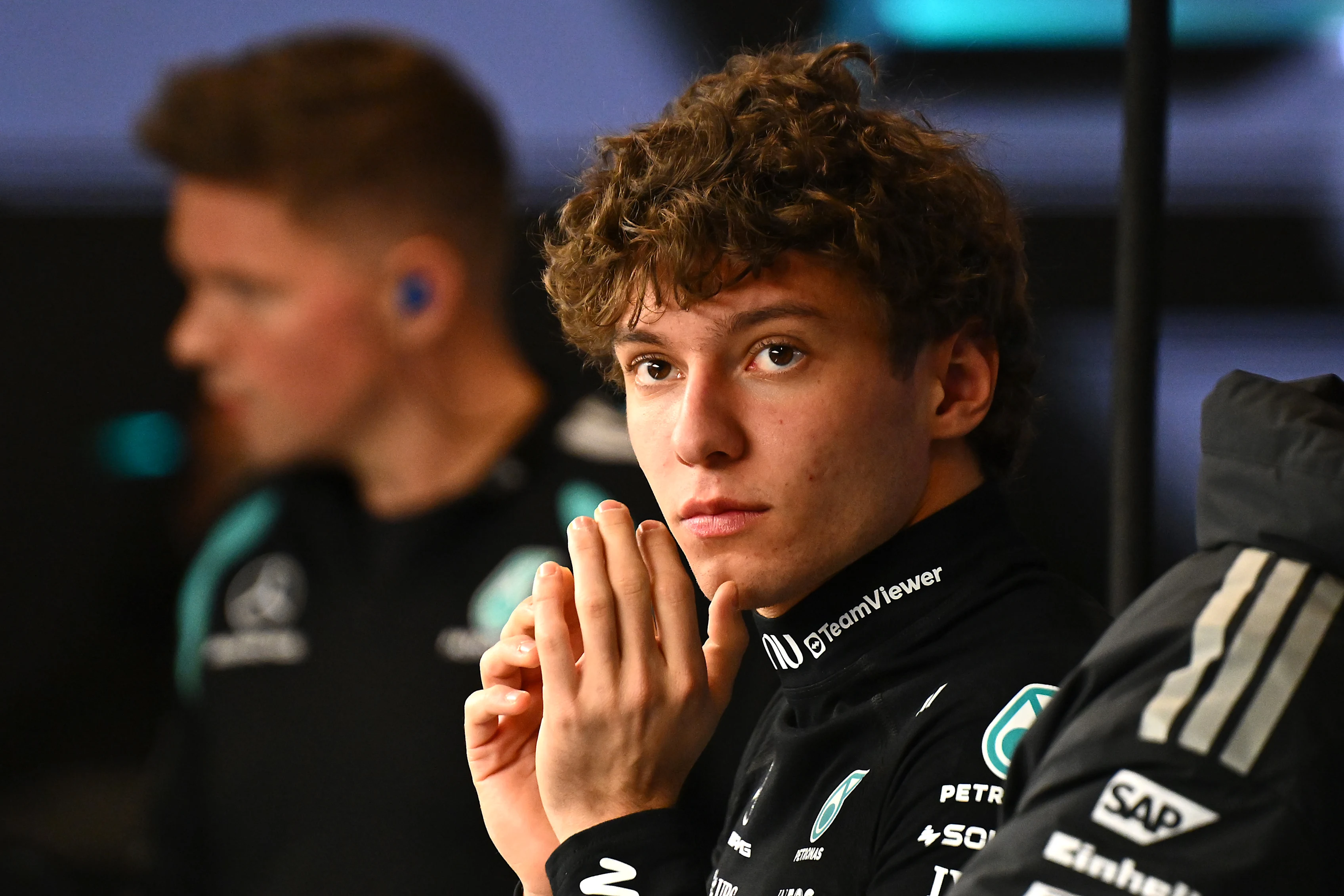
There is a particular irony in a world champion being punished for an engineering allocation while preparing to race under the lights of Las Vegas. Kimi Antonelli arrives with the biggest prize of the season secured, yet the regulations do not distinguish between a driver whose championship is settled and one whose next points finish may determine his future. Mercedes has fitted a sixth internal combustion engine to his car. Four are permitted within the season's standard allocation, so the sixth represents another breach rather than a first one. The result is a five-place drop on the Las Vegas starting grid.
The distinction between a first breach and a repeat matters. Exceed the limit for a power-unit element for the first time and the prescribed penalty is ten grid positions. Exceed it a further time and the additional offense typically costs five. Antonelli has already crossed that threshold. He had an engine-related grid penalty at Monza, when he started 19th and charged back to win his home race. That performance is evidence he can recover positions, not proof he will repeat the exercise on a completely different street circuit. The surfaces, corners, tyre temperatures and rivals here present different problems.
By itself, a five-place drop sounds manageable. Its real price depends on where he qualifies. A pole-position lap would no longer put the Mercedes at the front when the field assembles; qualifying sixth would make an already complicated race more difficult. That is why it is misleading to convert the penalty into a fixed estimate of lost points before the rest of the weekend unfolds. Starting five positions lower is certain. Finishing five positions lower is not.
It also changes the team's Saturday calculations. With a known deduction, Mercedes still has every incentive to send Antonelli out in qualifying, both to establish a competitive underlying lap time and to place him as high as possible after the adjustment. But there is a difference between chasing the absolute quickest lap and accepting needless mechanical or collision risk when the ultimate grid slot is already compromised. The engineer's instruction cannot simply be to drive five places faster than everybody else; the track determines the fastest possible lap, not the arithmetic of the penalties.
GOATIFY
GOATIFY Formula 1
Antonelli's sixth engine changes the grid arithmetic, not his championship. Discover GOATIFY's Formula 1 racing designs.


Antonelli's personal stakes are unusual. His title has made this a victory lap in the broader sense, but Formula 1 does not award an effortless weekend as part of the championship trophy. A clean, aggressive recovery would be another demonstration of his range. A result limited by grid position would say more about allocation management and the race's opportunities than about whether he deserved the crown.
Mercedes has two cars and two very different engine calculations
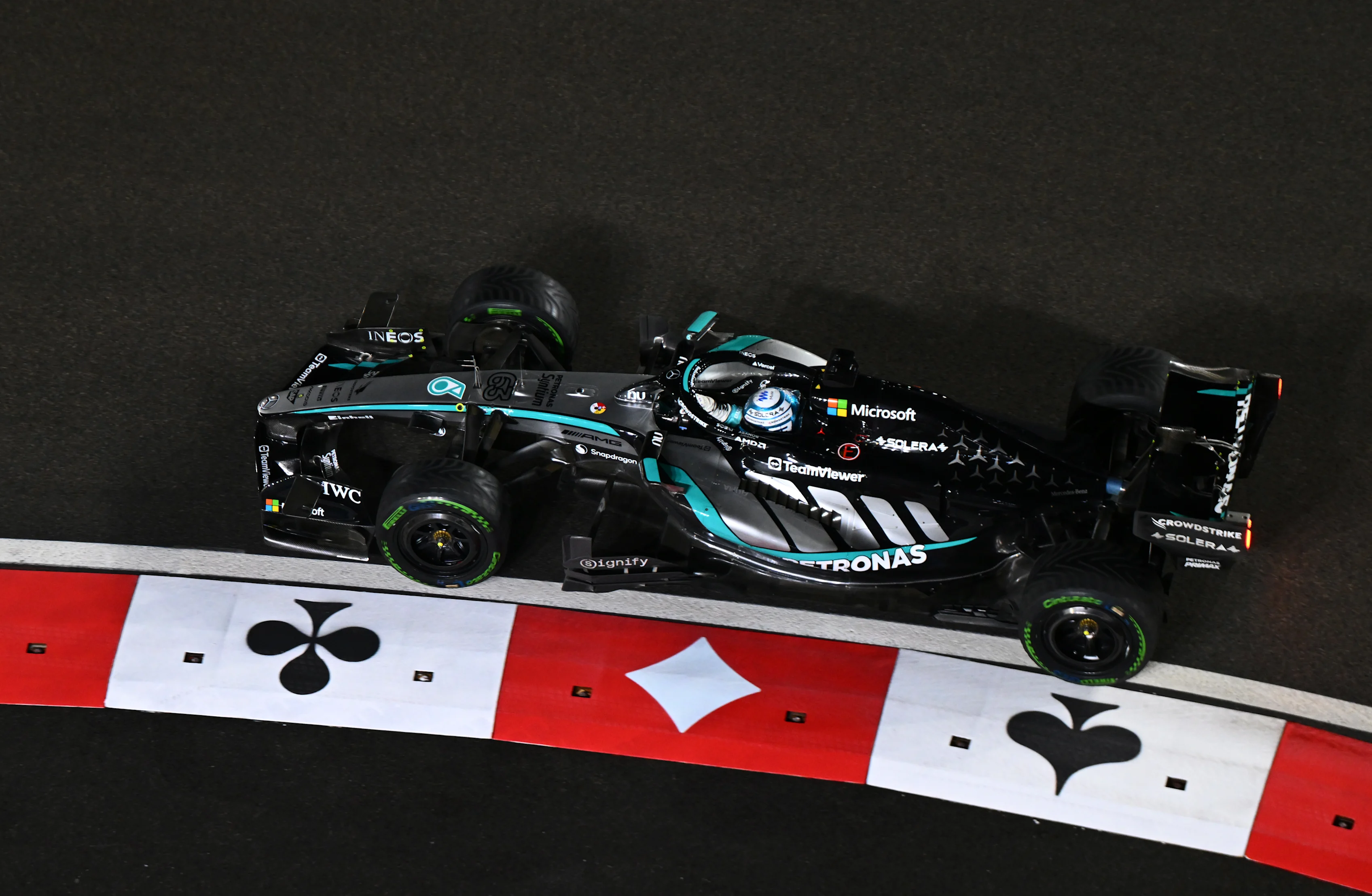
The revised engine allocation tells only part of the Mercedes story. Antonelli's car is also receiving an updated turbocharger, but that component falls within the permitted number for his season. The fresh exhaust set is likewise within its limit. Neither addition is itself responsible for the five-place penalty. That distinction is important because a new part is not automatically an illegal extra part; the count for each regulated element is separate.
George Russell, meanwhile, has taken the opposite approach to the team's latest turbo development. The British driver will not use the upgraded unit in Las Vegas because doing so would carry a fresh allocation penalty for his car. In other words, Mercedes can see technical value in the same hardware without choosing the same race-weekend solution for both drivers. Antonelli has an existing engine-related grid cost to manage. Russell has an opportunity to preserve track position. The apparent inconsistency is a rational consequence of two separate component ledgers.
There is a performance question beyond the accounting. Mercedes can introduce an upgraded turbo because it believes the change has value, but nobody should treat the upgrade as an automatic lap-time dividend. Formula 1 cars are integrated systems. A different turbo can alter the way the power unit delivers energy and responds to demands, but its real-world return depends on calibration, reliability, temperature and how the driver deploys available performance over a lap. A street track that alternates slow corners with long high-speed sections offers an exacting test.
That matters for 2027 as well as this weekend. Teams use late-season races to learn about components, operational procedures and potential development directions. Collecting useful data is not the same as sacrificing every current result to experimentation, however. Russell's decision illustrates a boundary. A potential gain must be large enough to compensate for the guaranteed grid loss, and for his situation the team has not made that trade. Antonelli's situation offers a different laboratory, albeit with the added risk that a race affected by penalties supplies less straightforward performance comparisons.
There is also a strategic trap in comparing the two Mercedes cars directly once qualifying is finished. If Russell lines up ahead of Antonelli, it may reflect the five-place deduction rather than a faster clean qualifying lap. If Antonelli overtakes Russell in the race, that does not automatically establish the upgrade as the cause. Traffic, tyre age, energy deployment, pit timing and a safety car could all become decisive. The only useful technical verdict must look at comparable operating windows rather than the final classification alone.
Mercedes therefore enters Las Vegas with a practical split: protect one driver's starting-grid position and accept a pre-announced handicap on the other's car while learning from the changes. The team can defend that approach even if the finishing order looks awkward. What it cannot control is whether unpredictable weather and traffic make the comparison almost impossible.
GOATIFY
GOATIFY Formula 1
Mercedes is balancing an updated turbo against grid position. Browse GOATIFY's F1 tyre and paddock-humour apparel.


Bearman goes to the back while three more drivers lose ten places
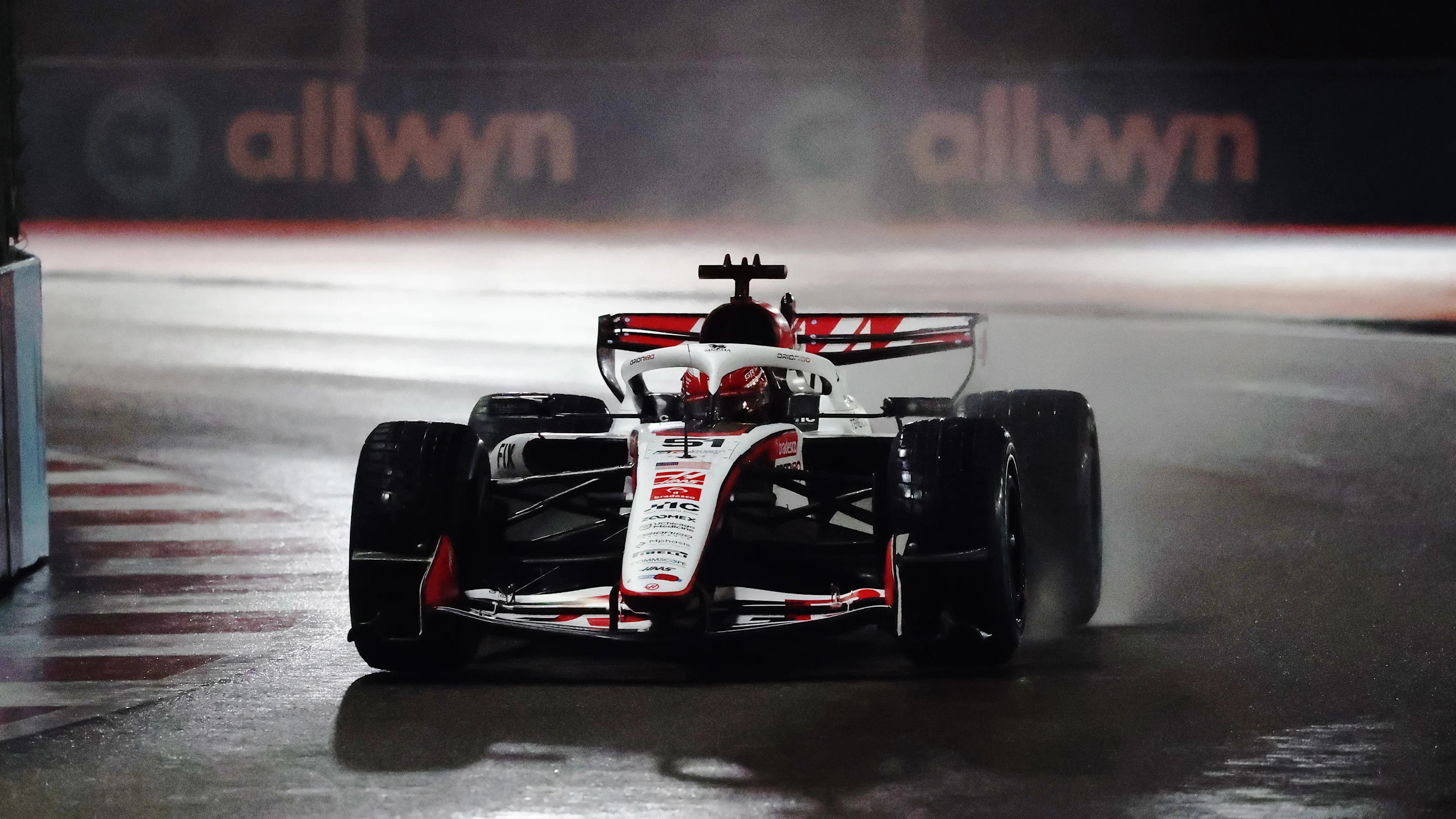
Antonelli's five-place deduction is the gentlest of the five confirmed Las Vegas penalties. Haas driver Oliver Bearman is due to start from the back of the field, Lance Stroll faces a ten-place drop, and Oscar Piastri and Carlos Sainz also have ten-position grid penalties. Together these decisions mean the qualifying order will be unusually misleading as a straightforward prediction of the actual starting grid. Fans following only the timing screen could be forgiven for wondering why several apparently competitive cars are moved away from their qualifying places.
Bearman's case is the most severe because Haas has changed multiple elements beyond the driver's allocation. His car takes a fifth internal combustion engine, turbocharger, exhaust set and motor generator unit-kinetic, together with a new ancillary power-unit component. Each regulated replacement is counted against its own permitted total. Penalties that arise at the same Grand Prix are cumulative, which can turn a series of individual component changes into a sanction larger than one ordinary ten-place drop.
The rules also contain a back-of-grid provision once accumulated grid penalties exceed fifteen places. That is why Bearman cannot necessarily escape the back just by setting a good qualifying time. The sanction follows the combined allocation breaches, not the position earned on the track. It is a stark trade: Haas can give him hardware it believes is necessary or beneficial, but the expense is surrendering much of the track position that qualifying might otherwise earn.
Stroll's problem has a different technical shape. The Aston Martin is receiving a ninth energy store and an eighth control electronics unit, far beyond the normal allowance of three for each of those elements. Although the raw replacement counts sound extraordinary, the confirmed outcome for this event is a ten-place grid drop. The relevant rules apply graduated penalties and calculate how the component changes accumulate; reading a parts inventory as though each line always adds another ten places would produce the wrong answer.
Piastri and Sainz supply an additional dimension. McLaren and Williams enter their own power-unit penalty decisions into the same weekend, each costing ten grid positions. For Piastri, that complicates a McLaren campaign already trying to extract everything from an improved car. For Sainz, a Williams driver, it is another reason that a respectable qualifying effort may not translate into a clear starting position. Different teams have different competitive aims, but every driver pays the grid price up front.
None of this means the lower-starting drivers are automatically out of contention for points. A quick car may pass rivals on the Strip Circuit's long straights; strategy can exploit a safety car or a rival's tyre trouble. But the field will not politely part for a recovery drive. Starting among slower cars exposes a driver to traffic, compromised corner exits and the need to spend tyres or electrical energy to complete overtakes. The penalties guarantee a changed starting order. They do not guarantee a particular finishing order.
Wet practice offered a warning, not a trustworthy dry qualifying order
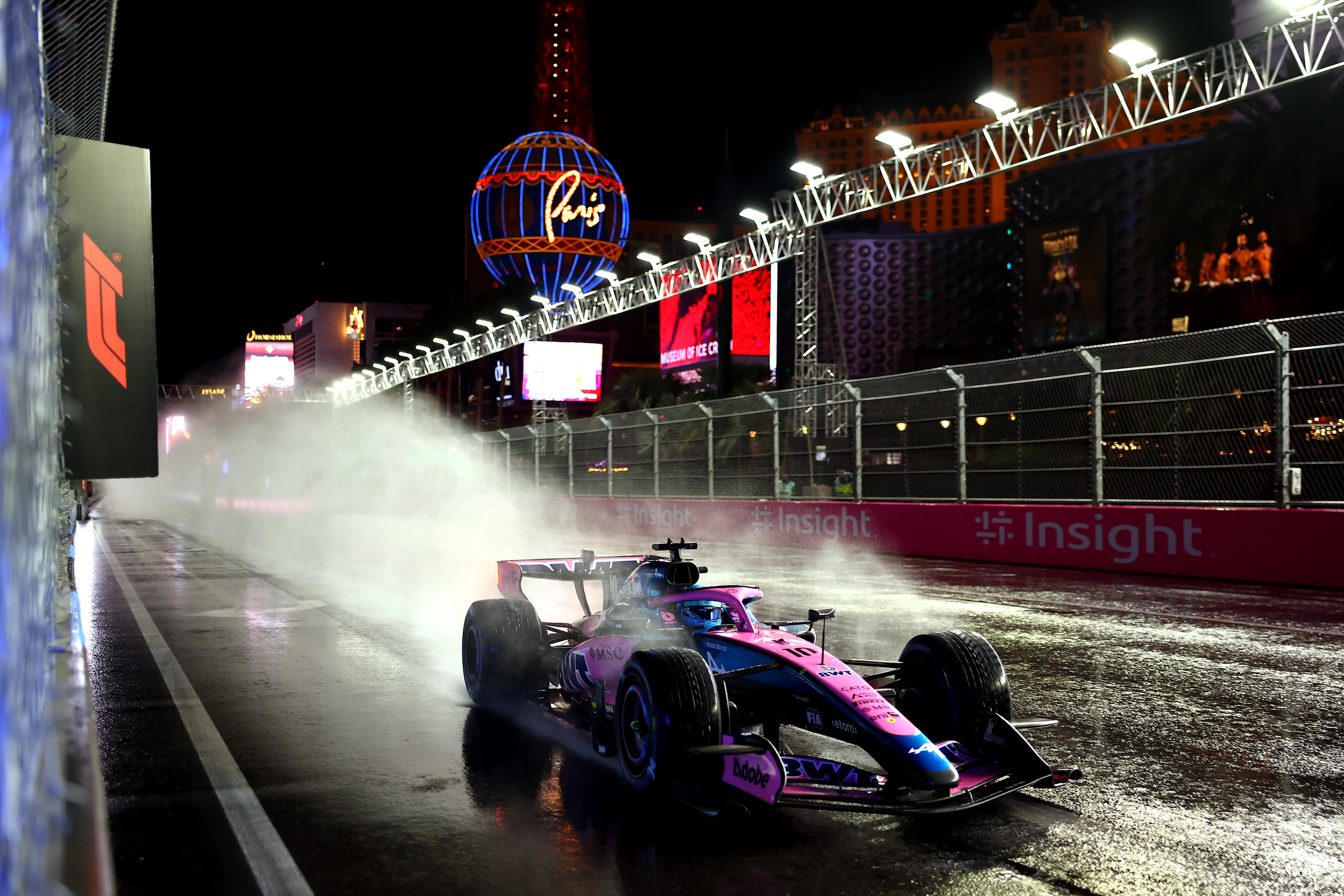
The first clue about the relative pace of the cars came with a sizeable asterisk. Thursday's Las Vegas practice programme was soaked by rain. The first session provided no meaningful running, while the second yielded a wet leaderboard that says much more about the immediate conditions than about any guaranteed dry-weather qualifying order. George Russell went quickest in FP2 with a 1m47.272s lap. Pierre Gasly was only 0.071 seconds behind in the Alpine, and Charles Leclerc placed Ferrari third. Antonelli was eighth in the same session.
GOATIFY
GOATIFY Formula 1
Bearman, Stroll, Piastri and Sainz face a reshuffled grid. Explore racing-inspired GOATIFY shirts and accessories.


Those numbers are useful but easy to misuse. Russell leading wet practice does not establish Mercedes as the fastest car over a dry flying lap, and Antonelli's eighth place does not prove that his updated turbocharger is a failure. Wet tyres, track evolution, fuel loads, when each car went out and which parts of a lap were available at peak grip can all distort comparisons. Russell himself acknowledged that Mercedes may not have been outright quickest despite topping the session. There is no reason to replace that caution with false certainty before qualifying.
Las Vegas compounds the problem because of the circuit's operating window. The night race is held on long, quick roads that can remain cold compared with a conventional daytime Grand Prix. A driver may want tyre temperature for slow braking zones yet must manage heat and wear over the long straights and repeated accelerations. If the track dries, the challenge does not disappear; it changes. A car that generates energy and traction effectively on wet intermediates may not have the same advantage once slicks come into play.
That uncertainty makes the penalties tactically interesting. The leading qualifiers who are not serving grid drops could inherit unexpectedly valuable starting positions. Antonelli, Piastri and Sainz may find themselves behind drivers who would otherwise have qualified outside their usual range. The first lap will then be less about reproducing the timing sheets and more about surviving a mixed-speed pack without damaging the tyres or front wing. A fast car in traffic is still subject to the same narrow braking zones as its slower rivals.
For Bearman at the back, the strategic problem is even more pointed. He may need a different timing of pit stops, a longer opening stint if the tyres permit, or an unusually clean series of overtakes to break out of the pack. None of those options is a guaranteed remedy. Committing early to a recovery strategy can leave a driver stranded if a safety car arrives at the wrong time. A conventional plan can be equally awkward if competitors ahead hold him up.
Mercedes has one final balancing act. Russell's decision to avoid the new turbo penalty protects his grid prospects; Antonelli's updated package and five-place drop offer another set of data and racing variables. Qualifying on Friday will show their underlying lap times more clearly if the weather cooperates. Saturday night's Grand Prix will be the only meaningful test of whether the extra hardware, compromised track position and race strategy add up to a good decision. Until then, the five grid penalties are facts. Any forecast of the five drivers' finishing positions is still speculation.
Las Vegas has given Antonelli an unusually blunt reminder that winning a championship does not exempt anyone from the sport's engineering accounts. He can qualify spectacularly and still be moved down five places. Bearman, Stroll, Piastri and Sainz have much steeper climbs, but each will have to solve a similar problem: make a refreshed package count without allowing a compromised starting position to dictate the entire race.
Thursday did not answer which car will be quickest on a dry lap or which strategy will survive the cold Saturday night. It did establish a starting-grid handicap before Friday's qualifying preparations even begin. The defining question is not merely how far Antonelli can recover. It is whether the teams that accepted those penalties can make the performance and reliability trade worth it over the remaining distance.
GOATIFY
GOATIFY Formula 1
Explore six distinct eligible GOATIFY F1 designs from the Formula 1 collection—tees, layers and accessories.


















