

Hooker Asked for Ortega. A Fourth Straight Loss Could Change Everything.
GOATIFYDan Hooker did not stumble into a rescue fight. With three consecutive defeats behind him and a fourth threatening to turn a career wobble into a genuine crossroads, the New Zealand lightweight made the phone call himself. He wanted Brian Ortega in Doha. Not a prospect with no name, not a soft rebound assignment, but a former two-time featherweight title challenger whose own recent years have been anything but straightforward.
That detail changes the story before either man throws a punch at UFC Qatar on Saturday, November 21. Hooker is not presenting himself as a helpless veteran waiting for his promoter to fix things. He is choosing the person standing opposite him, accepting what the next result may say about his place in the division, and arguing that the tension is exactly what has been missing. There is bravado in the pitch, but also a tactical gamble worth examining.
Ortega is moving into the lightweight picture after years at featherweight, with elite submission instincts and an increasingly complicated competitive record. Hooker has long made chaos a selling point; lately, opponents have turned that same chaos against him. Both need a cleaner answer than another spirited defeat, and neither can borrow a victory from his reputation. Doha is where that negotiation becomes physical.
Three losses have changed the stakes, not Hooker's appetite

Losses are too easily compressed into one number. Hooker's latest stretch has three very different mechanisms behind it, and they do not point toward one magical fix. Arman Tsarukyan submitted him in Qatar in November 2025. Benoît Saint Denis then stopped him at UFC 325 in February 2026. In September, Salahdine Parnasse ended their Paris main event in the opening round. Those are three defeats, but also three separate problems against opponents bringing different weapons.
The Tsarukyan fight exposed the consequences of meeting an elite positional wrestler who can turn a threatening stand-up exchange into a sustained grappling disadvantage. Saint Denis added another form of attrition: pressure that is difficult to discourage merely by volunteering to trade. Parnasse provided the most recent and visually sharpest warning, taking advantage of a moment when damage to the body visibly altered Hooker's reactions and the defensive chain came apart.
Against Parnasse, the end arrived at 2:35 of the first round. A body kick hurt Hooker, follow-up attacks followed, and the referee stopped the contest. Hooker has since framed part of the sequence as a decision made during a southpaw-versus-southpaw striking exchange. That interpretation matters because a veteran can examine a wrong read and develop a different response. It does not automatically prove that every structural flaw is solved.
There is a temptation to treat these defeats as proof the body simply cannot keep up. The evidence is more specific. A fighter who is still capable of hurting opponents can nevertheless fail repeatedly at the exact moments where an opponent forces his second and third choices. Good offense has never been the only relevant metric. Defense under pressure, exits after exchanges and recognizing when to change the geometry of a fight matter as much as willingness to engage.
GOATIFY
GOATIFY UFC & MMA
The cage has kept its receipts: match fight-night energy with GOATIFY UFC apparel.


UFC GOAT Gold Middle Finger Fight Decal Sticker
Add MMA personality to your favourite gear.
Shop Now ↗Hooker's public response has been unusually uncomplicated: he knows the losses happened, is not looking for an elaborate excuse and wants to compete again. In a sport full of explanations about injuries, bad camps and unfair judging, refusing the alibi can sound refreshing. It can also obscure how much work has to happen between accepting responsibility and changing an outcome. The octagon does not grade self-awareness; it measures what a fighter executes.
A fourth straight loss would not legally or automatically end his UFC tenure. There is no universal dismissal rule attached to a four-fight losing streak, and Hooker's action-oriented reputation gives him an identity many fighters never establish. It would, however, complicate matchmaking. Ranking access shrinks, leverage disappears, and another big-name bout becomes harder to justify on recent performance alone rather than drawing power.
That is what makes Ortega appealing as an opponent. If Hooker beats him, he beats a recognizable former title challenger instead of merely interrupting a bad run against an unknown replacement. But that is also what makes the call dangerous. A recognizable opponent has his own route back to relevance. Ortega is not being paid to restore Hooker's confidence, and the matchmaking only helps one man's momentum once the final result is recorded.
Pressure is not automatically a performance enhancer. It can sharpen urgency, or make a fighter swing at opportunities that are not really there. Hooker says he has missed the sensation. The important question is not whether he feels it on Saturday; it is whether he can stop that feeling from making the same tactical decisions that left him exposed during the three fights preceding this one.
Ortega is not an easy rebound simply because he is changing divisions

Brian Ortega's name comes with credentials that do not vanish when a schedule gets messy. He challenged Max Holloway for the featherweight championship in 2018 and Alexander Volkanovski in 2021, creating one of the most memorable submission scares of the latter champion's reign. The fact that he ultimately lost both fights should not flatten what he made an elite opponent survive. His threat is still most serious when an exchange becomes entangled.
At 145 pounds, Ortega could make damaging grappling moments appear from positions other fighters regarded as neutral. A seemingly safe scramble could become a guillotine threat; a hurried defensive posture could expose the back or neck. That historical toolkit is the reason Hooker should be wary of approaching the contest as a contest of confidence alone. One imperfect transition can undo several minutes of clean striking.
Yet Ortega is facing questions of his own. His results since his unbeaten rise have been inconsistent, and the stretch after his Volkanovski opportunity has not brought the sort of sustained momentum that usually creates another title run. In 2024 he was beaten by Diego Lopes, and in 2025 Aljamain Sterling outworked him in Shanghai. It is reasonable to question whether the old offensive threat can be paired with enough continuous output to win rounds against a stubborn lightweight.
His scheduled step to 155 pounds was previously delayed by a fight-week cut that removed him from a planned Renato Moicano meeting. That history deserves accuracy rather than a cheap reliability narrative. Cuts can prevent medical clearance, and athletes cannot always control the timing of an injury. Hooker has explicitly declined to turn Ortega's previous cancellations or weight issues into an excuse to doubt Saturday's booking.
GOATIFY
GOATIFY UFC & MMA
From featherweight history to a new lightweight test, browse GOATIFY UFC fight-fan designs.


MMA GOAT Gold Middle Finger Fight Crewneck Sweatshirt
A MMA fan design for everyday wear.
Shop Now ↗
Rogainz Joe Rogan UFC MMA Martial Arts Sticker
Add MMA personality to your favourite gear.
Shop Now ↗

The weight-class change is the tactical unknown. Leaving the demands of a featherweight cut behind might improve energy, durability and the ability to train consistently. The opposite side is that an opponent who has already fought and absorbed fire at lightweight may be stronger in clinches and harder to move from top position. Neither possibility is a guaranteed advantage; the actual balance becomes visible only when the men begin hand-fighting and wrestling.
Ortega also needs to show how he intends to collect opportunities. Submissions are dangerous, but a grappler cannot simply wait for one mistake at elite level and call that a complete game plan. His entries, range management and willingness to throw meaningful volume will determine whether Hooker has to defend before he can establish his long punches and knees. A measured Ortega who forces Hooker to react might be more dangerous than one chasing heroic finishes.
Hooker, meanwhile, has reason to test how the larger division treats Ortega over three rounds. Making the newcomer work for position, forcing resets and denying the first attack without overcommitting could gradually alter the balance. But the familiar Hooker impulse to turn a close fight into a furious exchange creates windows for an opponent whose best work often begins when another fighter is out of balance.
Neither career will be reduced to a single outcome, even if both are publicly framed as needing a reset. Ortega would be making a lightweight statement against a recognizable veteran; Hooker would be proving he can still execute against a former championship-level opponent. The matchup earns attention precisely because its name value is matched by real uncertainty about each man's current ceiling.
The tactical key is what happens after Hooker's first exchange
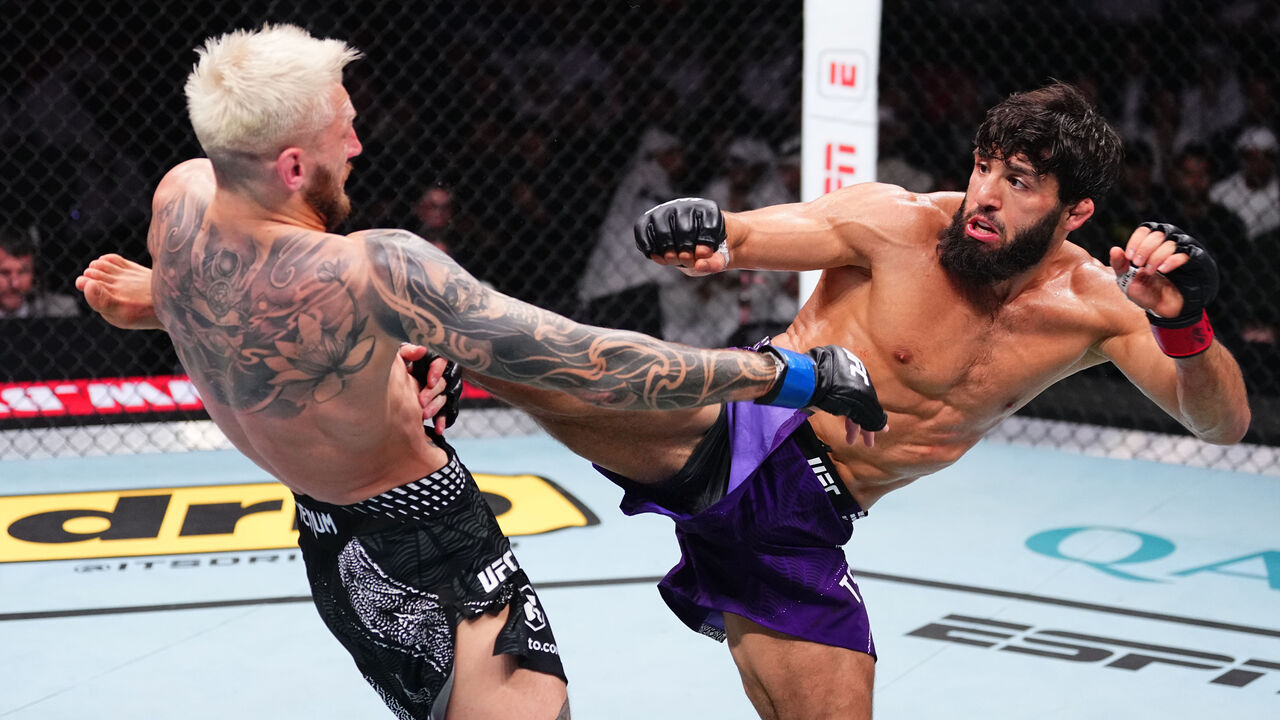
One useful clue about Saturday comes from Hooker's own account of the Parnasse finish. The two southpaws had periods when neither was finding clean opportunities, and Hooker describes choosing the wrong answer as the exchange changed. He has a point about the geometry: closed-stance fights alter the usual relationship between lead feet, back hands and available kicking lanes. But diagnosing the geometry after a loss is simpler than recognizing it while a punch is coming.
Hooker has typically been at his best when height, reach and willingness to throw damaging knees and kicks force an opponent to pay for entering. He does not need to abandon aggression to win. He needs a version of aggression with better exits. A jab that manages distance or a kick that is followed by an immediate defensive reset can do more for him than a dramatic two-way combination that leaves his hips and neck accessible.
Ortega's best opportunities are likely to emerge when Hooker spends too long in contested space. A prolonged clinch against the fence can become a route to a takedown or a scramble. A reactive shot at the wrong moment can transform striking pressure into a submission attack. Even a failed takedown can shift the fight if it makes the striker hesitate before throwing the next combination.
GOATIFY
GOATIFY UFC & MMA
If the exchanges get technical, carry that fight-night focus into your MMA gear.

UFC GOAT Gold Middle Finger Fight Decal Sticker
Add MMA personality to your favourite gear.
Shop Now ↗The distinction between a ground specialist and a fighter who only hunts submissions matters here. Hooker can lose minutes through control without being in immediate danger of tapping, and he can also win striking exchanges without demonstrating he can safely avoid every grappling transition. Scoring is cumulative. A clean defensive wrestling sequence followed by a productive break may be worth far more than a highlight punch that ends with a long clinch in Ortega's favor.
Tsarukyan's victory in 2025 offers a historical warning, not a direct scouting template. Tsarukyan brings a different style of pressure and different wrestling mechanics from Ortega. What connects them is the cost of losing control of the next position. Hooker cannot treat success in the first ten seconds of an exchange as proof he has won the entire sequence.
The Parnasse fight provides the other warning: body damage changes decisions. A fighter hurt downstairs often lowers a hand or narrows attention, and the attacker can move upstairs before the defensive structure is restored. Hooker needs to keep a coherent response when an opponent finds the body or counters a kick. A clean fight for him is one in which isolated errors do not multiply into entire sequences of unanswered offense.
From Ortega's perspective, walking straight into a long striker's preferred rhythm would be an expensive way to search for one signature submission. He needs to make Hooker negotiate range repeatedly: feints, stance adjustments, enough striking to earn reactions and pressure that can be sustained without giving away the center of the cage. His most convincing path is to force uncertainty rather than assume a veteran opponent will volunteer a neck.
The first round should therefore answer more than who looks faster. Watch where each man finishes after a combination, whether Ortega can close the distance without eating the same counter, and whether Hooker uses the fence as a place to escape or a place to trade. Those details are less glamorous than predictions about a knockout or choke, but they tell a more trustworthy story about the actual matchup.
Doha's card puts Hooker under a different kind of spotlight

UFC Qatar is scheduled for Saturday, November 21, at ABHA Arena in Doha, with the main card beginning at 1 p.m. Eastern Time and preliminaries at 10 a.m. Eastern. Procházka versus Navajo Stirling headlines the event; Hooker versus Ortega is an advertised lightweight bout on the main card, not the headliner. That distinction matters because Hooker once occupied the headline slot in Qatar and now returns to share the card under a younger teammate's spotlight.
Stirling's rise gives the New Zealand gym a reason to celebrate even while Hooker's results are being questioned. The undefeated light heavyweight has been given a major opportunity opposite former champion Jiří Procházka. Hooker has talked about taking energy from the younger fighter's momentum rather than treating the change in billing as a slight. It is the language of a veteran who still wants to belong to the next chapter of his gym.
City Kickboxing has built a reputation around high-level camps and fighters who can balance striking ambition with structured preparation. For this particular pairing, the benefit of that environment has to be visible in small decisions: making Ortega reset, recognizing a clinch trap early and having alternatives when a preferred combination does not land. The gym name cannot defend a single takedown on its own.
GOATIFY
GOATIFY UFC & MMA
Doha brings UFC's worldwide spotlight to the lightweight story: explore GOATIFY UFC picks.
MMA GOAT Gold Middle Finger Fight Crewneck Sweatshirt
A MMA fan design for everyday wear.
Shop Now ↗Rogainz Joe Rogan UFC MMA Martial Arts Sticker
Add MMA personality to your favourite gear.
Shop Now ↗Hooker says he called his manager when he noticed another potential opponent, Renato Moicano, was already attached to Tom Nolan. Instead of waiting for a new set of options, he asked about Ortega. That is revealing because it combines agency with an unusually direct reading of the business. A veteran who needs a win against someone recognizable can name the opportunity he believes gives him both.
The promoter also gets a contest with a simple and compelling dilemma. One fighter ends a run of defeats against a known opponent, while the other absorbs another disappointment. There is no need to invent a retirement stipulation or a contractual ultimatum to make it significant. Rankings, future opponents, fan expectations and negotiating leverage are all affected by an athlete's recent results.
There is a different pressure on Ortega. A successful lightweight beginning allows him to argue that his featherweight chapter should not define the rest of his career. A defeat means the questions about activity, volume and finishing consistency travel with him to a new weight class. The move up does not erase earlier wins, but it also provides no automatic competitive reset.
For Hooker the next step is more binary than the broader career story: demonstrate that the willingness to fight still produces an effective performance. He has always been willing to accept hard assignments. The missing evidence is not courage. It is a recent result that rewards selective offense, reliable defense and the ability to change course when a fight demands something other than all-out trading.
A pre-fight preview should not pretend to know what Saturday will deliver. The physical event is still ahead, and the outcome, medical developments and official post-fight rankings cannot be responsibly written in advance. What is already clear is that Hooker volunteered to face the man he believes he can beat, and Ortega accepted a lightweight test that offers his own chance to reopen the conversation.
Hooker's pressure claim is easy to quote, but the harder question is how it changes his fighting. Three consecutive losses have sharpened the consequences, and asking for Ortega has guaranteed that any win will mean something. It has also guaranteed that another defeat will not be easy to dismiss as bad luck against an unknown opponent.
The encouraging version of Hooker's story is not simply that he walks forward with the same fearlessness that made him popular. It is that experience teaches him when to walk forward, when to leave an exchange and when to refuse Ortega the scramble he wants. For Ortega, a new division is only a fresh start if the same old skills can be applied to an opponent who knows he cannot afford another wrong decision.
The stakes are real without being apocalyptic. Neither has been promised a title eliminator, and neither has been handed a career-ending ultimatum. Saturday's result will speak more clearly than another interview about pressure, confidence or the desire to prove people wrong. The next chapter belongs to the fighter whose plan survives contact.
GOATIFY
GOATIFY UFC & MMA
Explore GOATIFY UFC and MMA shirts, hoodies and fight-fan gear.
MMA GOAT Gold Middle Finger Fight Crewneck Sweatshirt
A MMA fan design for everyday wear.
Shop Now ↗


















