

Mercedes Won Both F1 Titles. Toto Wolff Says Another Dynasty Is Unlikely.
GOATIFYMercedes has collected the two prizes every Formula 1 team wants. Kimi Antonelli secured the 2026 drivers' championship in Mexico City, and George Russell's fourth place alongside Antonelli's fifth in Brazil completed the constructors' crown. Twelve victories from the first 20 Grands Prix are hardly the numbers of a struggling operation. Yet Toto Wolff is resisting the most obvious conclusion: that this is the opening chapter of another long Mercedes dynasty.
That contradiction is the interesting story of Mercedes' season. The Silver Arrows started the new regulation cycle with a formidable advantage, but their rivals did not stand still. Ferrari became a serious challenger around June, McLaren found another level in July, and Red Bull was increasingly dangerous by September. What looked like a one-team championship in the opening months became a much more varied contest well before the titles were mathematically settled.
Wolff's argument is not that Mercedes won by accident, or that the trophies matter less because others improved. It is that being first in modern F1 no longer guarantees staying first. The early points cushion brought Mercedes its ninth constructors' title. The closing races are testing whether it can defend that advantage when the rest of the field has had a season to learn.
A championship double built on a lead that outlasted the fastest car
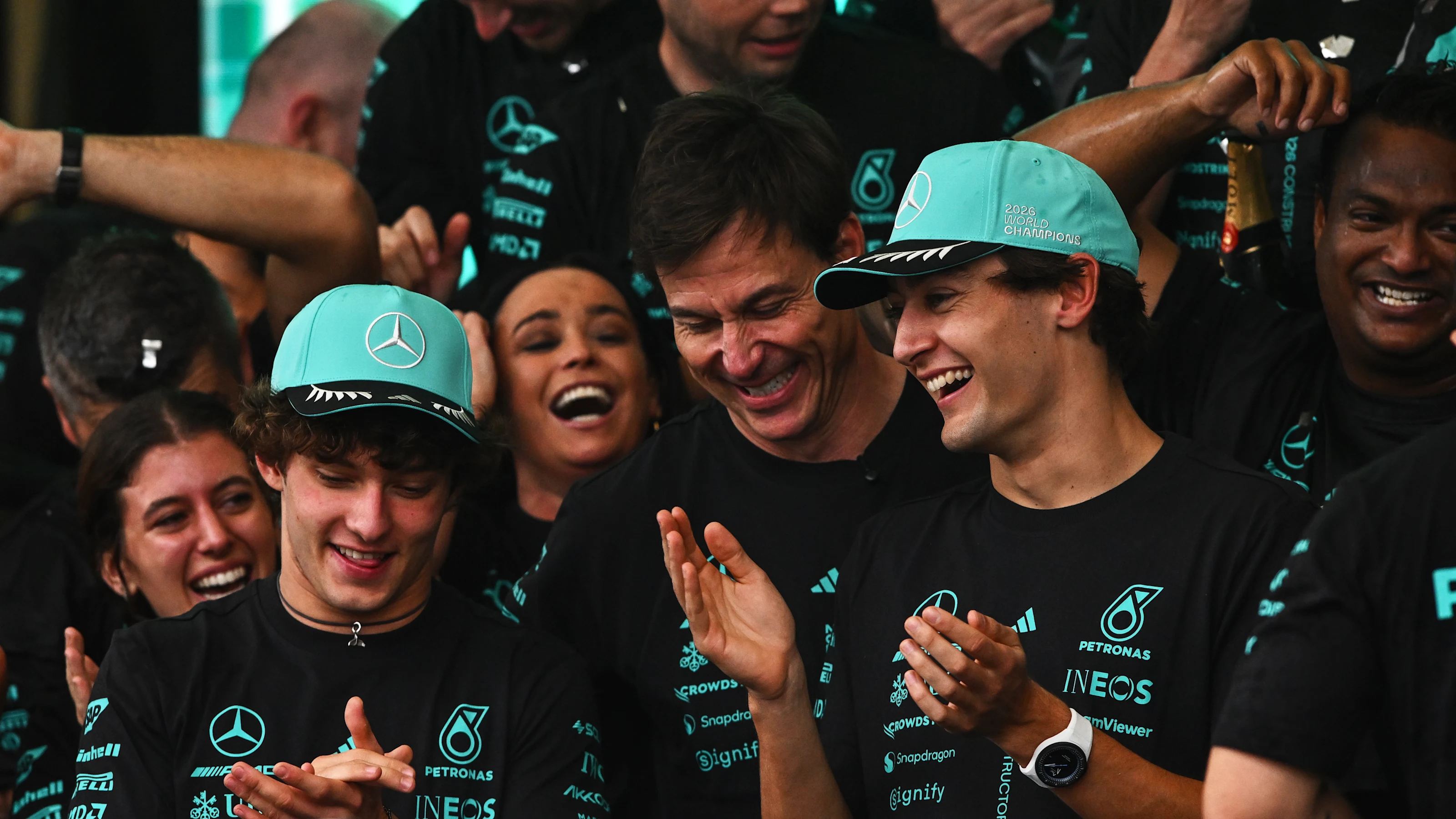
A ninth constructors' championship puts Mercedes level with Williams on the all-time list, behind only Ferrari and McLaren. It is also a return to the top after Red Bull's 2022 and 2023 titles and McLaren's two-year run. That historical perspective makes the celebration in Sao Paulo understandable: the team rebuilt itself for a substantial 2026 rules reset and emerged with both championships in the first year of the new cars.
The raw season totals describe a convincing achievement. Mercedes took 12 victories across 20 races before the final three rounds, while its two drivers combined to carry the team beyond reach in the championship. Antonelli had already completed the drivers' half of the double a round earlier. His record-breaking first world title supplied the sport's major new protagonist; Russell's contributions were just as important to the team championship because constructors' points reward two competitive cars, not one superstar.
At Interlagos, however, the winning team's race performance did not look like an untouchable machine. In difficult, changing conditions, Lando Norris won for McLaren ahead of Max Verstappen, who charged through the field. Mercedes finished fourth with Russell and fifth with Antonelli. That was exactly the kind of result that underlines Wolff's point: the constructors' title could be settled decisively on a weekend when another team was quicker at the front.
Finishing fourth and fifth was not a consolation prize in the championship calculation. Ferrari's weaker result meant that Mercedes added enough to its advantage to put the contest out of reach. The trophy ultimately measured the whole season rather than just the final race. A strong start, sustained points scoring and two capable drivers made an early title possible even when the race-winning momentum shifted elsewhere.
GOATIFY
GOATIFY Formula 1
Mercedes won the 2026 double through a remarkable season-long effort. Browse GOATIFY's Formula 1 designs for every kind of race weekend.


Those facts should not be compressed into a claim that Mercedes somehow stopped being the best team overnight. Winning both crowns requires repeatable excellence across different circuits, tyre conditions and development phases. But there is an important difference between having the strongest full-season record and being the fastest every Sunday in November. The former is now settled; the latter remains open.
The distinction also matters for how 2027 should be judged. If the first months of a rule change create a disproportionate advantage, the opening results can leave a team with a huge championship margin. Competitors may then catch up through upgrades, setup knowledge and a better understanding of new power-unit and aerodynamic interactions. The points table preserves the benefit of that early lead long after an individual qualifying lap or race stint suggests the gap has narrowed.
Why Wolff thinks the eight-year Mercedes era cannot simply restart
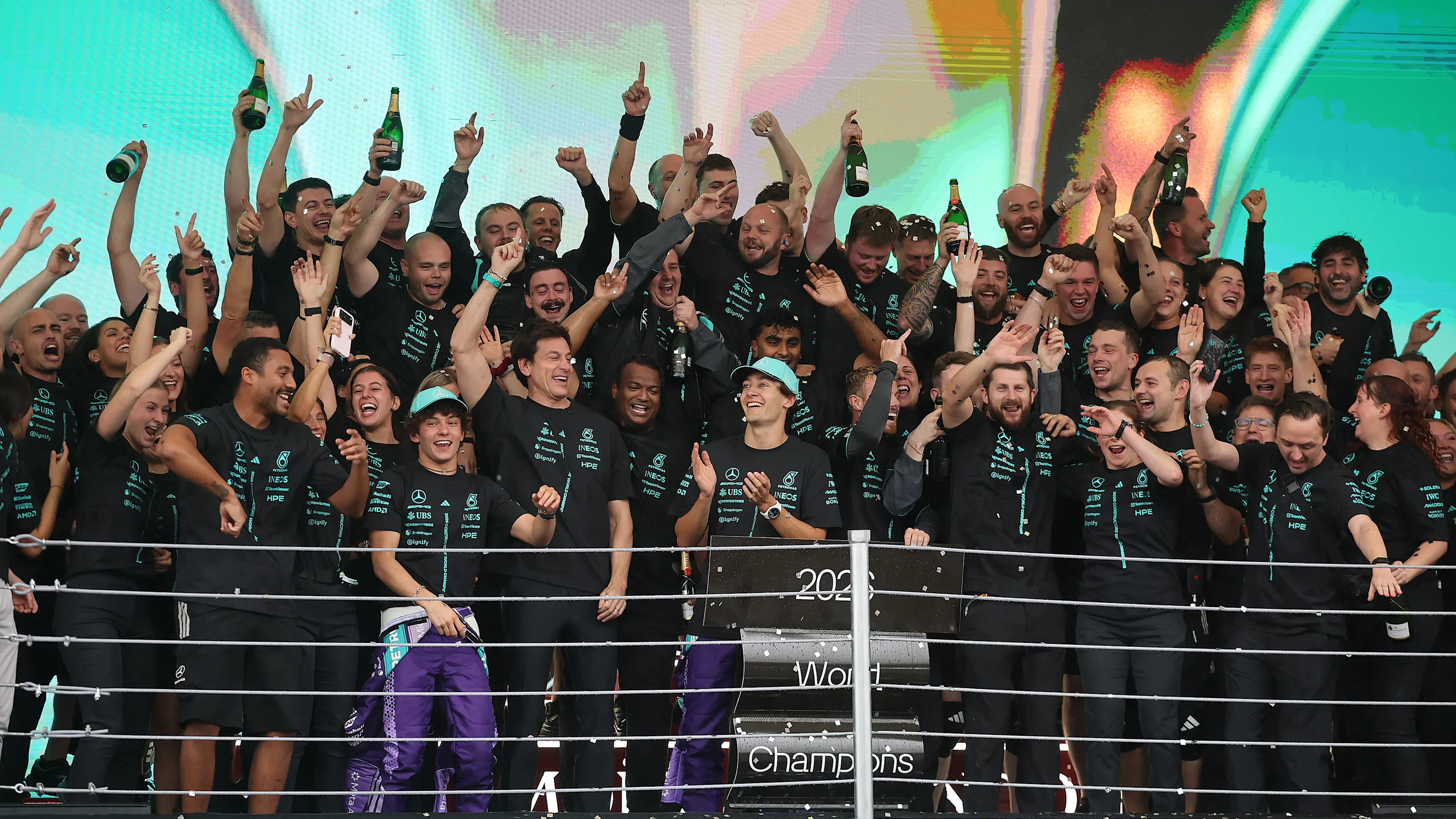
Wolff knows better than almost anyone what sustained technical supremacy looks like. Mercedes won eight consecutive constructors' titles from 2014 through 2021. The 2014 power-unit regulations helped it establish a platform that rivals spent years trying to match, and the team repeatedly turned its initial advantage into another championship-winning campaign. It was an exceptional sequence even by the standards of Formula 1's previous dominant eras.
His latest comments take a different view of what the sport has become. Today's leading organisations have the personnel, analysis, investment and operational discipline to respond much more quickly when a competitor introduces a useful idea. A team can appear comfortable at one event, discover that its next update does not deliver the expected improvement, and find itself fighting for third at the following race. Wolff sees that volatility as healthy for the championship even though, as Mercedes boss, he would naturally prefer to keep winning.
That is not a prediction that the 2027 standings will automatically be close. It is a forecast about the limits of any single team's advantage. The evidence from 2026 supports the possibility: an impressive early Mercedes lead did not prevent several different opponents from having strong competitive phases later in the year. It does not prove that the gap between every team is small, and it certainly does not make the midfield contenders for wins simply because the leading order has shuffled.
The cost cap is a major part of the context, even if it was not the centre of Wolff's remarks. A leading operation cannot simply solve every setback by throwing unlimited development money at multiple options. The distribution and timing of permitted spending matter, and a new technical rulebook can reward a team that has prepared especially effectively before the first race. Mercedes appeared to extract a large early benefit from its approach to the 2026 transition.
GOATIFY
GOATIFY Formula 1
The next F1 dynasty may be harder to build than the last. Explore the GOATIFY Formula 1 collection as the sport's leading teams adapt.


But a strong first iteration and an equally strong second one are different engineering challenges. Once rivals have seen the shapes, behaviours and weak spots of the leading car, they can prioritise the areas that matter most. Meanwhile, the leader must decide which of its existing solutions are worth defending and which require a more fundamental change. The easiest performance gains from an entirely new regulation set may also diminish as teams work toward better-understood design targets.
Power-unit performance adds another uncertainty. New engine rules can separate teams dramatically at the beginning of a cycle, yet experience and reliability lessons tend to spread inside each manufacturer programme. Whether the 2027 grid actually converges depends on the development rules and each constructor's progress; it should not be presented as guaranteed equality. What is clear is that Mercedes cannot assume its initial advantage will recreate the specific conditions that sustained its earlier eight-title run.
That is why this is a notably restrained message from a freshly crowned champion. Wolff is proud of what his team achieved; he is also warning against treating a year's accumulated points as a permanent technical pecking order. There is no contradiction in celebrating the trophy while recognising that the next title defense may demand a different car-development plan and a different level of flexibility.
Ferrari, McLaren and Red Bull turned 2026 into a warning for 2027
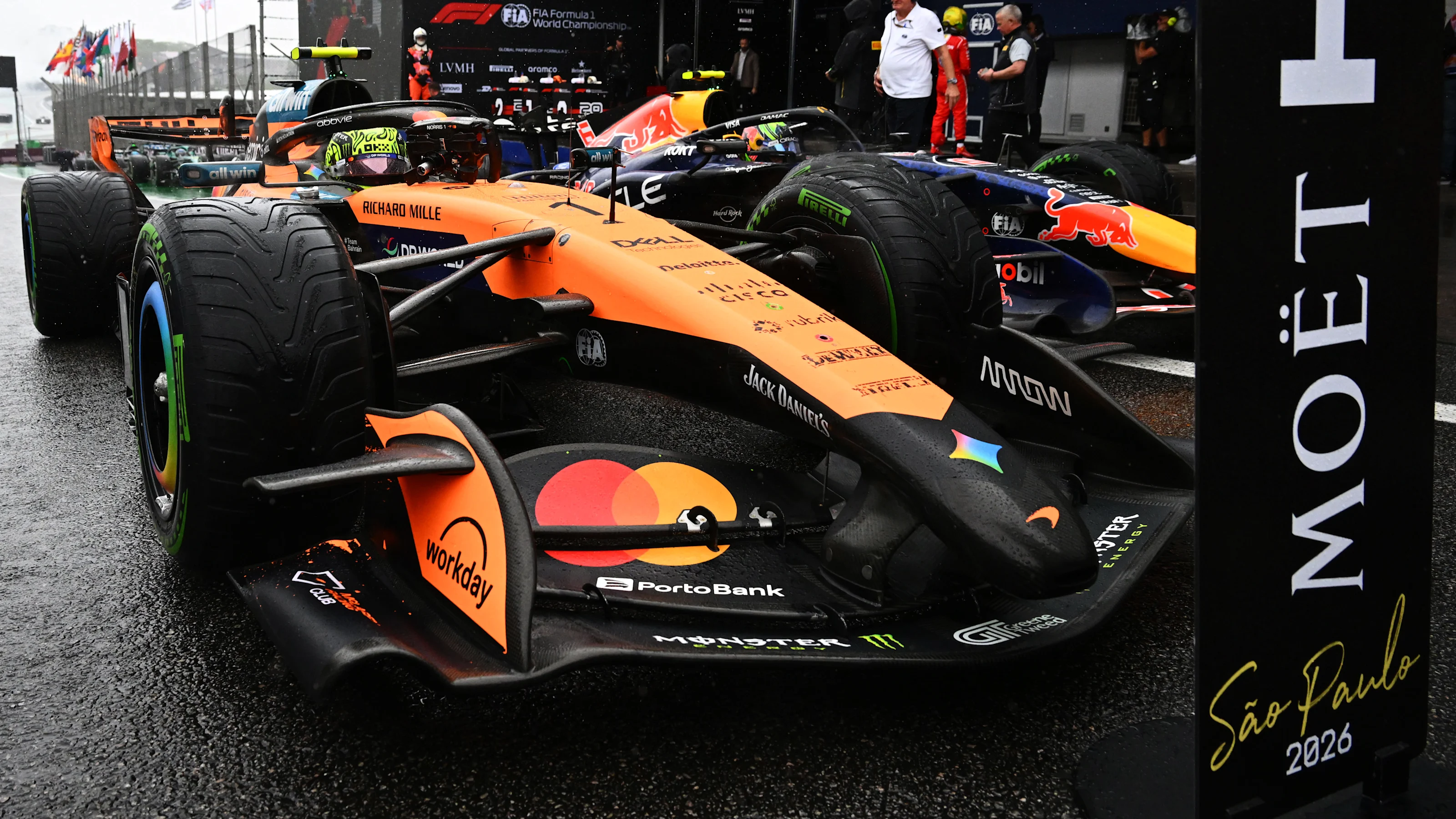
The order in which rival teams became more competitive helps explain the pressure Mercedes expects. Ferrari's stronger form around June suggested that a rival could respond within the same season rather than waiting for the next regulatory cycle. McLaren's improvement in July showed another route to the front. Red Bull's challenge from September brought a third serious pressure point. The sequence is more important than any single headline about which garage had the newest upgrade.
Those phases also prevent a simplistic reading of the constructors' standings. Mercedes leads Ferrari by 142 points at the time of the Brazilian title, with Red Bull and McLaren further behind. That is a large margin and an undeniable season-long achievement. Yet Ferrari is not necessarily 142 points slower in a typical late-season Grand Prix, just as a McLaren win at Interlagos does not erase what Mercedes accomplished from March onward. Championship points and current car performance answer different questions.
Brazil offered a compact demonstration. The slippery circuit created a demanding tyre and timing puzzle, and McLaren executed it well enough for Norris to finish ahead of Verstappen. The Red Bull driver's comeback reinforced the sense that pace and racecraft at the front are no longer monopolised by the championship leader. Mercedes had to make its points where it could. The result was both a successful title-clinching performance and a reminder that its remaining opponents possess genuine speed.
Antonelli is an especially revealing figure in that transition. His first drivers' title at 20 is already in the history books, but his next season will not be a replay of this one. Rivals now have a complete year of data about his strengths and about how Mercedes deploys its car. The championship label also changes the way a driver is judged: fourth and fifth places may become points-saving achievements one week and uncomfortable questions about lost pace the next.
GOATIFY
GOATIFY Formula 1
Ferrari, McLaren, Red Bull and Mercedes each have reasons to believe in 2027. Show your F1 fandom with GOATIFY racing designs.


Russell's role deserves the same scrutiny. A championship-winning pair needs to deliver on circuits that suit neither car perfectly, and his points in Brazil helped seal the team title without needing a podium. In 2027, Mercedes might need that consistency even more if victory is genuinely shared among four contenders. The best outcome for a constructor is not always a spectacular race win; often it is two cars scoring heavily when a faster rival suffers a poor afternoon.
There is a strategic trade-off at the heart of Wolff's caution. Developing aggressively for early races can build a points lead, but it can also leave less room for reaction when competitors identify the biggest later-season opportunities. Holding resources back creates flexibility at the possible cost of early results. Neither approach is universally superior. The right answer depends on how quickly ideas mature, how closely the regulations constrain innovation and whether a team can convert upgrades into reliable race pace.
The next three venues will not decide either 2026 championship, but Las Vegas, Qatar and Abu Dhabi can still supply valuable information about the balance of power. Their different demands should expose whether the best late-season packages are broadly versatile or dependent on particular surfaces and corner profiles. Even then, winter changes will limit how confidently any observer can carry an apparent November hierarchy into a fresh season.
The encouraging possibility for fans is that Mercedes can be a champion without being a certainty. Ferrari, McLaren and Red Bull have each shown enough to challenge the idea of a predictable 2027. But a competitive four-team battle is a hypothesis, not a confirmed outcome. Wolff's message is better understood as a refusal to believe that one successful reset has locked the grid into another decade of Mercedes victories.
The 2026 Mercedes story has two endings depending on which question is being asked. In the record book it is emphatic: Antonelli is world champion, the team has its ninth constructors' crown, and 12 early victories created a cushion that nobody could overcome. On the timing screens of the closing races, the future looks less certain, with Ferrari, McLaren and Red Bull capable of troubling the champions.
Wolff's skepticism about a new dynasty does not diminish the achievement. It gives the achievement a more interesting meaning. Mercedes won the first year of the new rules because it adapted faster and scored better across the season. If its rivals have learned just as quickly, defending the crowns could require another leap rather than merely refining the car that won them. That is a far more compelling challenge than assuming the next eight trophies are already spoken for.
GOATIFY
GOATIFY Formula 1
Shop GOATIFY Formula 1 shirts, hoodies and racing stickers.


















