Tatum Scores 36, Celtics Survive Knicks — New York's Title Defense Starts 0–2
GOATIFYJayson Tatum gave Boston the fourth-quarter answer the defending NBA champions could not match. With New York within one point late on Friday, October 23, Tatum scored seven of the Celtics' final eight points and dragged a tense game over the finish line. Boston won 107–103 at TD Garden, moving to 1–1 while the Knicks fell to 0–2 in their title defense.
The box score was emphatic: 36 points, nine rebounds, seven assists and three steals for Tatum, who scored 25 after halftime. Yet the story was more interesting than one star rescuing a game. The Celtics built a double-digit cushion, watched New York erase almost all of it and then found enough precision to avoid a second straight collapse. The Knicks followed a ring-night defeat to Philadelphia with another narrow loss against an Eastern Conference rival.
Neither result decides a season in October. But the closing possessions revealed why Tatum still changes Boston's ceiling, why its new supporting cast matters and why the champions have some uncomfortable questions before their next game.
Tatum turned a one-point scare into a closing-time takeover

The moment that mattered most arrived with 1:41 left. Brunson's fallaway jumper cut Boston's lead to 99–98, turning a comfortable-looking fourth quarter into a possession-by-possession test. The Celtics had already endured a seven-shot scoring drought while the Knicks attacked the glass and pushed the pace. A team that had surrendered a huge advantage to Detroit earlier in the week suddenly faced a familiar danger: the clock was shrinking, and so was the margin.
Tatum did not respond by forcing an early three. Coming out of a timeout, he found a difficult turnaround over Josh Hart to make it 101–98. When New York's next chance was disrupted by an illegal screen, Tatum attacked again and hit a long corner fallaway over Hart. The two makes mattered for more than their points. They forced the Knicks to defend an individual scorer who could create a usable shot without a perfect screen or an open passing lane.
New York was not finished. OG Anunoby made two free throws to bring the Knicks back within three, but Tatum then buried a three-pointer with roughly 30 seconds remaining. That shot pushed Boston to 106–100 and left the champions needing multiple successful possessions in almost no time. Miles McBride answered from deep, and Payton Pritchard split two free throws to settle the final margin. The decisive sequence belonged to Tatum because he produced the hardest points precisely when Boston's ordinary offense had stalled.
His overall efficiency underlined the scale of the performance: 14 makes on 26 field-goal attempts, five successful free throws and only two turnovers despite carrying so much of the late offense. He was not automatic from long range, making three of ten attempts, but he varied his approach. A turnaround, a long two and a timely three required different defensive answers. The Knicks could crowd him, switch onto him and contest his release, yet none of those responses stopped the final burst.
There is a limit to the lesson. A superstar making contested shots can rescue a night; it cannot be Boston's entire fourth-quarter plan. The Celtics still need to keep the ball moving when Tatum rests and create cleaner looks when opponents load up on him. Friday showed they have an extraordinary emergency option. The next step is making fewer emergencies necessary.

Boston's supporting cast did just enough to make Tatum's finish possible

Tatum supplied the signature moment, but Boston had to build a lead worth protecting. The Celtics were ahead only 50–49 at halftime, then won the third quarter 33–24 to enter the final period up ten. That nine-point swing changed the game from a coin flip into a situation where New York needed a sustained comeback. It also made Boston's supporting contributions more important than their individual scoring totals suggest.
Paul George and Neemias Queta scored 15 points apiece. George, playing his first season in Boston, offered another experienced scoring option and hit three of seven attempts from beyond the arc. His seven rebounds helped a team that had to deal with New York's persistent work on the offensive glass. George is not required to match Tatum shot for shot. Boston benefits most when he punishes defensive attention directed at its primary star and keeps possessions from becoming predictable.
Queta's influence was different. He added six rebounds and three blocks, giving the Celtics an interior presence on a night when New York's frontcourt repeatedly threatened second-chance opportunities. His three-point make in the third quarter was an unusual bonus, but his screening, rim protection and willingness to battle for position were the more repeatable ingredients. Boston's offense looks more flexible when opponents cannot ignore a center rolling toward the basket or assume every useful possession must begin with a perimeter isolation.
Mitchell Robinson's first game against his former Knicks teammates added another layer. He was part of New York's championship rotation last season before moving to Boston, and his reunion was awkward statistically: four points and four rebounds while dealing with foul trouble. Yet one sequence still showed the appeal of his skill set. Robinson rejected a Karl-Anthony Towns attempt near the rim and later finished an alley-oop from Derrick White. Those plays did not define the game, but they illustrated how Boston can manufacture momentum without asking Tatum to take another difficult jumper.
The caution is that the Celtics' bench and secondary creators did not prevent a late drought. New York trimmed a 12-point fourth-quarter lead to three and then one because Boston went cold and the Knicks kept finding extra possessions. George, Queta, White and Pritchard all have ways to make Tatum's job easier, but the team still needs sharper spacing and more decisive ball movement when the game slows down. The third quarter suggested that balance is possible. The final minutes showed how quickly it can disappear.
The Knicks are 0–2, but their real issue is how the offense finishes possessions
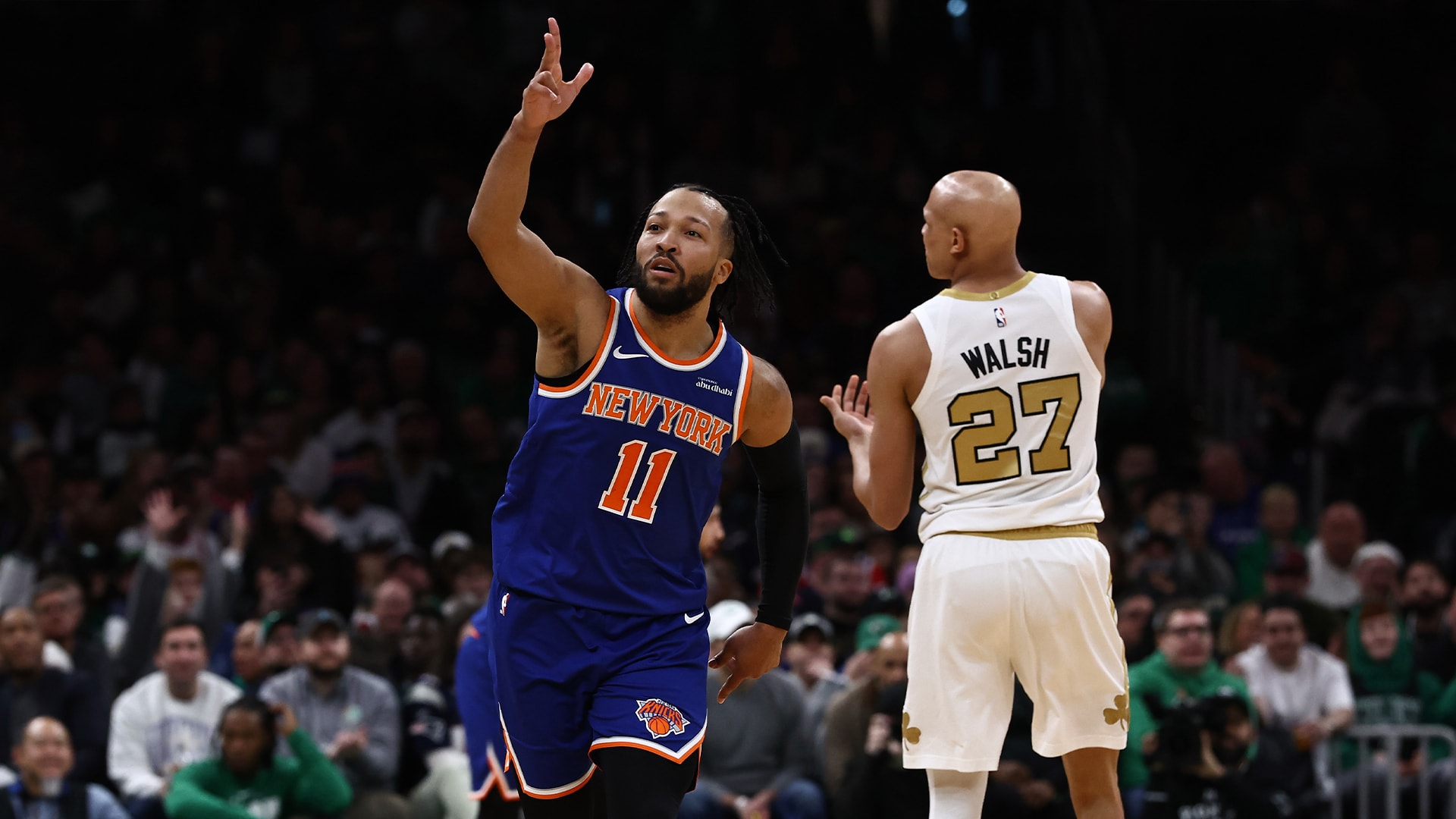
It would be misleading to describe New York's loss as a night when nobody played well. Karl-Anthony Towns scored 22 points on nine makes in 13 attempts and grabbed ten rebounds. Anunoby produced 20 points, ten boards and eight assists, nearly a triple-double. Hart added ten points, 12 rebounds and five assists. McBride supplied 20 points off the bench and went six-for-eight from three-point range. Those are useful contributions from several members of a championship roster.
Still, the Knicks left Boston without a win because productive box-score lines did not translate into enough clean possessions at the end. Brunson scored 19 points but shot seven-for-17. His late jumper gave New York a realistic chance, yet the team could not convert that pressure into a lead. A costly illegal screen on Towns erased one possession at precisely the wrong moment. The offense then needed another stop and another score, but Tatum kept making the math harder.
The larger numbers also reveal an uneven performance. New York won the rebounding battle 44–37, a sign that its size and physicality can create chances even when the first shot misses. But the Knicks committed 16 turnovers to Boston's 10. Six extra lost possessions are expensive in a four-point game, particularly when the opponent has a scorer capable of turning a single mistake into an immediate basket. New York's ability to crash the glass is an asset; the value shrinks when careless decisions give the ball away before a shot is attempted.
There were encouraging signs in the rally. The Knicks scored 30 points in the fourth quarter, compared with Boston's 24, and their 9–0 run forced the home crowd to confront the possibility of another collapse. McBride's shooting gave the second unit a genuine weapon, while Anunoby contributed as a scorer, rebounder and facilitator. Those are not the characteristics of a team that has forgotten how to compete after winning a title.
What is missing is a dependable closing sequence when the first option is challenged. New York cannot expect Brunson to create a perfect answer every time, nor can it assume offensive rebounds will cover every turnover. Mikal Bridges' scoreless night on eight attempts added to the burden on the players who were producing. Two games are far too small a sample to judge a repeat bid, but they are enough to identify a specific problem: the champions need their ball security and late-game execution to catch up with their talent.

Boston has a platform to build on — New York has a fast chance to respond

Boston and New York entered this game with different forms of pressure. The Celtics had lost their opener to Detroit after surrendering a huge advantage, so another late failure would have reinforced concerns about closing games. The Knicks had just celebrated a championship and then lost their home opener to Philadelphia. A second defeat would not erase June's title, but it would invite immediate scrutiny of a team expected to remain near the top of the East.
Friday therefore mattered as an early test of habits rather than as a preview of the final standings. Boston can point to a 33–24 third quarter, a productive Tatum-George pairing and defensive contributions from Queta. New York can point to its rebounding edge and the fact that it nearly erased a double-digit fourth-quarter deficit on the road. Both teams also have obvious film to study: the Celtics' stagnant late possessions and the Knicks' turnovers and shot selection.
The contrast is especially interesting because their rosters changed in meaningful ways. George's arrival gives Boston another proven scorer alongside Tatum, while Mitchell Robinson offers a different interior profile after leaving the Knicks. New York largely kept the core that won the championship, so its challenge is less about teaching new players the identity and more about reproducing the sharpness that made that identity successful. Continuity is valuable only when the habits underneath it survive.
Boston hosts Chicago on Monday. That game should offer a useful follow-up: can the Celtics generate offense throughout the fourth quarter without requiring a run of difficult Tatum jumpers? Can their supporting scorers punish pressure before it turns into a double team? The answer will matter more than whether Tatum scores another 30. A balanced offense is harder to solve over a seven-game series than one that relies on a superstar to escape every late possession.
New York returns home to face Orlando on Sunday. Its immediate priority is simpler: protect the ball, get Bridges more involved and make Brunson's late work less isolated. The Knicks do not need to prove their championship was real; they already did that. They need to show that the same discipline can survive the new season's pressure, even when opponents treat every meeting with the champions as a measuring stick.
There will be many more chapters before either team can claim the Eastern Conference. For now, Boston has a first win and a reminder of Tatum's extraordinary finishing ability. New York has two losses and enough positive signs to avoid panic, but not enough to dismiss the details that cost it Friday night.

Boston's 107–103 victory was both a reassurance and a warning. Tatum looked every bit the late-game star the Celtics need, finishing with 36 points, nine rebounds and seven assists. His shot-making prevented a second painful collapse, and George and Queta supplied valuable support. But the seven-miss drought and the near-surrender of a 12-point lead remain real issues to solve.
For the Knicks, an 0–2 start is a concern, not a verdict on their championship defense. Towns, Anunoby, Hart and McBride all produced; Brunson gave New York a chance in the final two minutes. Turnovers and late execution made those efforts insufficient. The next games against Orlando and Chicago will reveal whether these were opening-week mistakes or patterns opponents can exploit.
Friday's sharpest lesson was simple: Boston has a closer who can manufacture answers under pressure. New York still has the depth and fight to create that pressure. The race between those two qualities is why this rivalry remains compelling long after the final buzzer.