

Zverev Needed Two Breaks. His Serve Did the Rest in Turin.
GOATIFYAlexander Zverev opened the 2026 ATP Finals with a score that looked reassuringly ordinary: 6–4, 6–4. Against 20-year-old Rafael Jódar, the world No. 1 took one break in each set, never surrendered his serve and began the John McEnroe Group with a straight-sets win. But the simple arithmetic hides a more revealing match. A single return game changed the first set; four extraordinary deliveries rescued it when Jódar threatened to undo the damage.
The contest at Turin's Inalpi Arena was not a ceremonial welcome for a teenage debutant. Jódar had raced into the world's top ten in a historically short time, and Zverev was beginning the season-ending championship as its top-ranked player. That gave the matchup two distinct questions: whether the young Spaniard could turn a remarkable first season into another statement, and whether Zverev's big-match experience would hold up under the narrow margins of an indoor court.
The German answered with a serve that repeatedly kept the scoreboard moving and a backhand that struck at precisely the right moment. Those weapons produced ten aces, two breaks and a 1–0 group record. They also left a useful warning for the matches ahead: winning an opener is not the same thing as conquering the round-robin stage.
One break mattered. Saving the set at 15–40 mattered more.
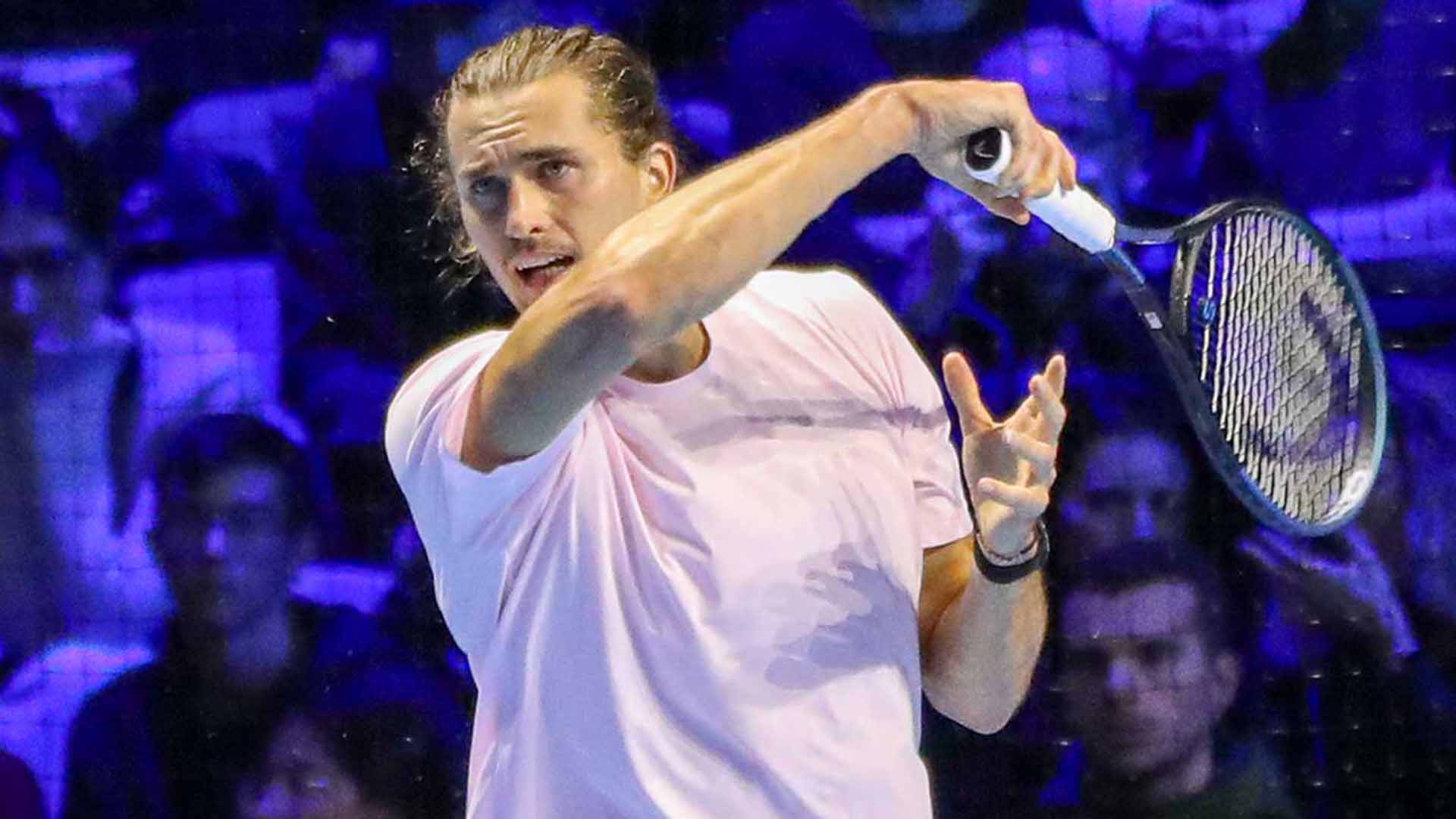
Jódar's challenge did not collapse at the first sign of pressure. Early in the opener, he saved two break points in his third service game, forcing Zverev to keep working for an opening. That mattered because every hold on this surface makes the next return opportunity feel more expensive. The longer a player can protect his own delivery, the more tempting it becomes for the favorite to force a winner before the court has offered one.
At 3–3, Zverev finally found the pressure point. He drew the Spaniard across the baseline, made the court look wider than it really was and finished with a backhand winner down the line. It was not merely a spectacular shot to decorate a highlight package. It converted a break point at a stage when one break could decide the set. The 4–3 lead changed the task from finding an opening to defending one.
That change is easy to underestimate. A returner chasing a break has the freedom to take risks. A server protecting the only break of a set must keep executing while the opponent knows exactly which games matter. Zverev handled most of that responsibility comfortably, but the tenth game showed how quickly a controlled set can become dangerous. Serving at 5–4, he went down 15–40 and suddenly had two break points to erase.
What came next was the most economical answer imaginable: ace, unreturned serve, ace, unreturned serve. Four consecutive first-strike points, with no extended recovery rally required. Jódar had earned his moment. Zverev took the racket out of the contest for long enough to make that moment disappear. The final score records only the hold; the sequence explains why the hold felt decisive.
The first-set service percentage was extraordinary. Zverev landed 88 percent of his first deliveries in the opening set and finished the whole match at 84 percent, according to the available match statistics. That is different from merely hitting a handful of unreturnable bombs. It means the opponent is asked, point after point, to return a fast and well-placed first ball rather than wait for an attackable second serve. Zverev also avoided double faults.
GOATIFY
GOATIFY Tennis
Shop GOATIFY tennis products from the Tennis-filtered collection scope.


Tennis GOAT Golden Racket & Ball Decal Sticker
Add tennis personality to your favourite gear.
Shop Now ↗His ten aces all arrived in the first set. This is a particularly telling detail because the second was not won by suddenly discovering an even bigger serve. It was won by keeping enough first balls in play, preserving efficient holds and applying more pressure to Jódar's delivery. The distribution matters more than the headline total: the German had the luxury of winning in two slightly different ways.
The second set illustrated that flexibility. Zverev broke early, reached a 3–1 lead and then refused to provide a route back. Jódar fought through additional break-point pressure, saving three of four chances in that set, but could not manufacture a break point of his own. Once Zverev had the advantage, the Spaniard needed a service-game failure that never came. A 6–4 scoreline can suggest a single close game; here the difference in returning opportunities was far larger.
Across ten return games apiece, Zverev won 28 points as the receiver while Jódar won only ten. Zverev created seven break points and converted two; Jódar created two and converted none. The German held every one of his ten service games. Those numbers explain why the match could feel more controlled than the score suggests without diminishing the teenager's effort. Jódar defended stubbornly in his own games, but he seldom made Zverev defend for long.
Zverev's backhand winner earned the first lead, but the bigger result came from the balance of serve and return. He could take measured risks returning because his own service games generally demanded little repair. A match built that way is difficult to upset, especially indoors, where first-strike efficiency can reduce the number of long rallies available to a challenger. This was not flawless tennis; it was tennis that made imperfection relatively cheap.
Jódar went from ATP debut to top ten in 287 days

Rafael Jódar arrived in Turin with an unusual kind of pressure: the expectation attached to a breakthrough that had happened almost too quickly to process. The Spaniard made his ATP Tour-level debut in January 2026 and reached the world's top ten just 287 days later, a record for the shortest interval between those milestones. At twenty, he was no longer an unknown prospect hoping to borrow a set from a star. He was a season-ending championship qualifier in his own right.
That distinction changes how Sunday's result should be read. Losing two sets 6–4 to the world No. 1 is not proof that Jódar has reached a ceiling. It is evidence that the demands of facing a fully established elite server remain severe, even for a player whose progress has confounded ordinary development timelines. A young player may already own top-level groundstrokes and still struggle to generate a single uncomfortable return game against this particular opponent.
Jódar's greatest success on Sunday was persistence. He saved early break points, stayed in contention through the first set and made Zverev serve it out under genuine pressure. He also held off three of four break chances against him in the second set, keeping the score from running away. None of those efforts won him a set, but they distinguished a competitive debut from a one-sided lesson in which the underdog was never allowed into the discussion.
The score also exposed where the next improvements could pay off. On his own first serve, Jódar won enough points to remain in games. On return, he captured only ten points across the German's ten service games. That is a brutal imbalance, especially in a round-robin event where sets and games can matter beyond the immediate win-loss record. Improving his first-return depth, finding more neutral rally starts and attacking rare second serves would make future meetings less dependent on a Zverev mistake.
GOATIFY
GOATIFY Tennis
Shop GOATIFY tennis products from the Tennis-filtered collection scope.

Tennis GOAT Golden Racket & Ball Crewneck Sweatshirt
A tennis fan design for everyday wear.
Shop Now ↗


The two men already had history in the same season. At Roland Garros in June, Zverev beat Jódar in straight sets in a quarter-final that included a tight opening tiebreak. The earlier encounter happened on clay, where movement and rally construction create a different set of decisions. Their November meeting occurred indoors on hard court, where Jódar had less time to absorb the first ball and build his own patterns. The accompanying photograph shows that June meeting, not Sunday's Turin match.
The head-to-head now stands at 2–0 to Zverev, but neither occasion should be treated as a timeless verdict. Jódar's game has been changing month by month, and the surfaces have asked different questions. The real indicator for his next phase will be whether he can close the gap in the points that start with his opponent's serve. His own survival in break-point games is already a useful trait; taking pressure back across the net is the unfinished part.
His 2026 rise included the kind of results that make observers impatient for more: a maiden tour title, rapid movement in the rankings and qualification for an event reserved for the season's elite performers. That success brings an unfamiliar schedule, stronger scouting from opponents and a need to adapt without the anonymity enjoyed by most newcomers. Each opponent can now prepare specifically for him. Turin may therefore be the first of many useful examinations rather than the final proof of anything.
At the ATP Finals, even a losing start does not end a player's campaign. Jódar still has group matches to play and a theoretical route to the semi-finals. How he responds to the next opponent will say more about resilience than the shorthand of a 0–1 opening record. The key is not to pretend he should have beaten Zverev today, but to identify which problems are solvable and whether he can solve one or two before the week is over.
Turin is a test of repetition, not a one-day referendum

Zverev has won this tournament twice, in London in 2018 and Turin in 2021. Those victories do not award him a single point in 2026, but they give him practical familiarity with a format that punishes poor recovery as much as it rewards one sharp performance. The group stage asks competitors to produce against several different styles within a compressed schedule. A straight-sets opener is valuable because it creates breathing room in both the standings and the workload.
The German begins the John McEnroe Group at 1–0 with two sets won and none lost. Ben Shelton and Arthur Fils complete the group, and their own meeting changes the picture for the next round of matches. The top two players from each four-man group reach the semi-finals. That means Zverev's win improves his position but does not guarantee qualification. Tiebreak situations may eventually depend on sets and games; there is a reason a clean 6–4, 6–4 is more useful than an exhausting three-set escape.
Both remaining opponents present possibilities Jódar did not fully exploit. Shelton can make first-ball tennis a contest of his own with a left-handed serve and abrupt attacking patterns. Fils is capable of taking time away from the baseline and forcing pace exchanges. Neither matchup can be predicted from Sunday's statistics alone. A return game that looked dominant against one opponent can feel very different against another delivery, and even a strong serve becomes vulnerable when the receiver guesses correctly more often.
GOATIFY
GOATIFY Tennis
Shop GOATIFY tennis products from the Tennis-filtered collection scope.


Zverev's current position at the top of the rankings adds a second layer. This was only his second match since reaching No. 1, and the 2026 season has already delivered maiden major titles at Roland Garros and the US Open, alongside a tour-leading 66 match victories. Those achievements explain why he should be judged as a leading contender rather than simply an experienced finalist. They also explain why opponents can play freely against him: the favorite carries the visible weight of his season.
His reaction after the match was measured. He described a solid opening win while acknowledging that he could improve. That assessment makes more sense than either declaring Turin won or discounting a match that rarely exposed his service games. The serve was exceptionally reliable, yet some return opportunities went unconverted. Against deeper opposition, the difference between seven break chances and two conversions could become consequential if his own hold rate falls even slightly.
One intriguing number is the total-points split: 69 to 53 for Zverev. That is a meaningful cushion in a match settled by two identical 6–4 sets, but it does not suggest every rally was trivial. Jódar forced crucial holds and kept several return games competitive. The gap reflects the frequency with which Zverev started points on his terms. When a player wins such a high proportion behind his first serve, every return point he steals becomes almost a bonus.
The setting contributes to that logic. Turin's indoor hard court removes weather as a variable; the player who gets repeated value from predictable ball tosses, court positioning and aggressive first shots has fewer interruptions to manage. The accompanying image is an illustrative view of the arena from an earlier edition of the event, not a photograph of Sunday's match. The important point is the consistent indoor environment, not a claim that the stadium crowd or lighting in that archival photograph represents November 15, 2026.
There will be a temptation to frame every Zverev result in terms of the absent Jannik Sinner or the title race surrounding Carlos Alcaraz. The immediate task is smaller and clearer. He must find a way through three round-robin opponents, preserve energy and win the matches that actually appear on his schedule. Sunday's performance gave him an excellent platform, especially by allowing him to finish in straight sets without a long final-game struggle.
The more interesting tournament question is not whether Zverev can serve at an elite level once. He has done that for years. It is whether he can keep the first-serve accuracy high, adjust the return position for new opponents and make pressure points look as uncomplicated as the four deliveries that rescued the opening set. If he can repeat that combination, the appeal of a third ATP Finals title becomes more than a statistic from earlier seasons.
Zverev's 6–4, 6–4 win was not a highlight-reel demolition. It was an example of how a mature, efficient game can remove nearly every opening an opponent earns. Jódar did the difficult work required to create two first-set break points; the world No. 1 erased them before the rally could turn into a contest. Then he carried the advantage into the second set.
For Jódar, the remarkable climb of 2026 remains intact despite the defeat, and more group tennis lies ahead. For Zverev, Turin has begun with exactly the kind of result he needed: a clean victory, a strong group position and proof that two timely breaks are enough when the serve refuses to crack. The rest of the week will test whether that economy travels from one opponent to the next.
GOATIFY
GOATIFY Tennis
Shop GOATIFY tennis products from the Tennis-filtered collection scope.
Tennis GOAT Golden Racket & Ball Decal Sticker
Add tennis personality to your favourite gear.
Shop Now ↗


















