

Brown Won at 19. Four Days Later, His 65 Put Austin on Notice.
GOATIFYFour days after the biggest Sunday of his young career, Blades Brown was back on another PGA Tour leaderboard. The 19-year-old did not need a week to decompress from his first victory in Mexico. He arrived at the new Austin Championship, played a course he had never seen and answered with nine birdies and a seven-under-par 65 on Thursday, November 12.
That score put Brown three strokes behind the first-round leader, Trace Crowe, whose bogey-free 62 gave the tournament an immediate benchmark. Erik van Rooyen and Max Greyserman were two behind Crowe with 64s. The contrast was compelling: a teenager already protected by a breakthrough victory was chasing a 30-year-old fighting for the security of his PGA Tour future.
Austin's first stroke-play Tour stop on the Fazio Canyons course has an unusually high concentration of different ambitions. Brown is trying to turn a sensational week into sustained success and a possible Masters invitation. Crowe is chasing a place among the top 100 in the FedExCup Fall standings. And 18-year-old amateur Miles Russell, freshly signed to Florida State, has made a five-under 67 another reason to watch what happens next.
From a Mexico Playoff to Nine Austin Birdies: Brown's Four-Day Reset

Brown's Sunday in Mexico was not the kind of ending that usually makes a smooth turnaround possible. He started the last round seven shots behind leader Ben James, made enough birdies for a closing 63 and needed a playoff to secure the World Wide Technology Championship. James rescued his own chance with an eagle on the last regulation hole, but Brown ultimately converted on the second extra trip down the par-five 18th. The result made Brown the youngest PGA Tour winner in 95 years and one of the youngest champions in the circuit's history.
There was no compelling need for him to chase another start so quickly. A first Tour title had already changed his competitive position: the victory secured playing status through 2028, lifted him in the Official World Golf Ranking and opened the prospect of entering premium events next season. His ranking moved to No. 62 after Mexico, close enough to the top-50 Masters qualification threshold to give the final weeks of 2026 a different significance. An extra good finish could matter, but it was a possibility rather than a guarantee.
He chose the demanding route instead. From Los Cabos he headed to Texas, a city and course he had not previously played, and started again with the attention that follows a teenage winner. The challenge was less about finding a new swing in four days than about being ready to compete as the player everyone wanted to watch. Before the event he admitted the week had been exhausting; by Thursday his scoring suggested he had recovered enough to concentrate on ordinary decisions rather than the celebration.
His opening 65 was built from nine birdies against two bogeys. The arithmetic matters: a seven-under score need not indicate flawless golf, but it can reflect a player who makes enough chances for a couple of mistakes to be harmless. Brown hit all but two fairways while playing alongside Max Homa and Andrew Novak. Approaches repeatedly gave him makeable opportunities, and he rarely had to improvise the kinds of spectacular escapes that become tempting when a young star feels pressure to entertain.
GOATIFY
GOATIFY Golf
Brown's first PGA Tour victory has put a new generation in the spotlight. Explore the GOATIFY Golf collection for golf fans following the next wave.


That preference for controlled golf offers a useful contrast to the comparisons with Tiger Woods and Jordan Spieth. Brown admires Woods, but his first-round plan was uncomplicated: put the ball in the fairway, find the green and trust the putter. It is a blueprint that does not demand the occasional miracle shot. Even on a course where other players were stacking up eagles and long-range putts, Brown kept assembling the more repeatable kind of low round.
The earlier stages of his season help explain why the travel schedule did not overwhelm him. In January he completed a Korn Ferry Tour event in the Bahamas and reached The American Express in California with barely a day between tournaments. There he shot 60 in the second round and contended alongside established players before Scottie Scheffler prevailed. That was an extraordinary preview. Mexico delivered the trophy, while Austin provided the first evidence that the success would not be followed automatically by a letdown.
One round is still one round. A player can make nine birdies Thursday and struggle to control the same driver Saturday. Brown's 65 did not erase a three-shot deficit to Crowe and does not put him on a path to inevitable back-to-back wins. It does change the question around him. The discussion is no longer solely about whether a 19-year-old can catch fire for a weekend. It is about whether he can routinely arrive at a PGA Tour stop expecting to challenge the field.
Crowe's Career-Best 62 Is About More Than the First-Round Lead

Brown supplied the day's easiest headline, but nobody scored better than Trace Crowe. The 30-year-old opened the inaugural Austin Championship with ten birdies, no bogeys and a career-best 10-under 62. He hit 17 of 18 greens in regulation on the par-72 Fazio Canyons layout, keeping the ball in position so consistently that he had a birdie putt on nearly every hole. When he missed the green on a par three, a recovery to short range preserved his clean card.
That is a different achievement from surviving a lucky collection of long putts. Crowe has described finding a setup adjustment with his driver and feeling less threatened by the left side of the course. That improvement creates a chain reaction: more playable tee shots, more approaches from favorable spots and fewer recovery swings. Putts still have to fall for a 62, but the underlying ball-striking makes the number more persuasive than an isolated burst of magic.
His career context adds urgency. In September 2025 Crowe suffered a wrist injury that required months in a cast. He did not begin his 2026 campaign until April. There have been encouraging results, including a strong finish at the Zurich Classic and a tie for third at the Bank of Utah Championship, but the delayed season left little margin in the race to maintain full PGA Tour access. He entered Austin at No. 117 in the FedExCup Fall standings.
The top 100 is not just another line on a graphic. It is the group that secures stronger playing privileges for 2027, which can determine which tournaments a player is able to enter without depending on invitations or limited starts. Crowe has a medical-extension safety net from the wrist layoff, but that is not equivalent to choosing his schedule from a protected position. A high Austin finish would do more than improve his confidence; it could change the practical shape of next season.
GOATIFY
GOATIFY Golf
Crowe's first-round 62 put a high-stakes FedExCup Fall race in focus. Find GOATIFY Golf shirts, headwear and fan accessories alongside the leaderboard.
His opening margin was two strokes, hardly a cushion on a course where low numbers appeared across the field. Erik van Rooyen and Max Greyserman both posted 64. Van Rooyen's score mattered after a difficult stretch that included nine successive missed cuts, while Greyserman punctuated his round with an eagle on the closing par five just ahead of darkness. Each player has his own route back toward more dependable status, making the top of the leaderboard a contest among golfers with very different reasons to press.
Further down, the FedExCup bubble created a second leaderboard inside the first. Kevin Yu, starting the week near the 100th-place cutline, carded a 66. Chandler Phillips, occupying the final protected position by a narrow margin, opened with 67. Max Homa, meanwhile, recovered from a poor early stretch to shoot 69, with important opportunities still at stake in his own schedule. Their scores did not threaten Crowe on Thursday, but a handful of shots over four rounds could carry consequences far beyond the winner's trophy.
Fazio Canyons is making those calculations unusually volatile. The 7,451-yard par-72 course rewards aggressive lines when players can find the correct section of the fairway and leave reasonable angles. It is long enough to punish poor positioning, yet scoring conditions on the first day allowed excellent players to attack repeatedly. Crowe's 62 was remarkable; it also warned everyone else that a merely solid round might not be enough to protect a place near the lead.
Crowe's story is therefore not the convenient role of an outsider delaying Brown's coronation. He has his own case for the trophy, backed by a superb opening round and a legitimate career problem he is trying to solve. If the weekend narrows to Crowe and Brown, one man will be playing to consolidate a breakthrough while the other is trying to secure a new foundation. That is a richer matchup than the numbers 62 and 65 alone suggest.
Miles Russell's 67 Adds a Second Teenager to Austin's Bigger Story
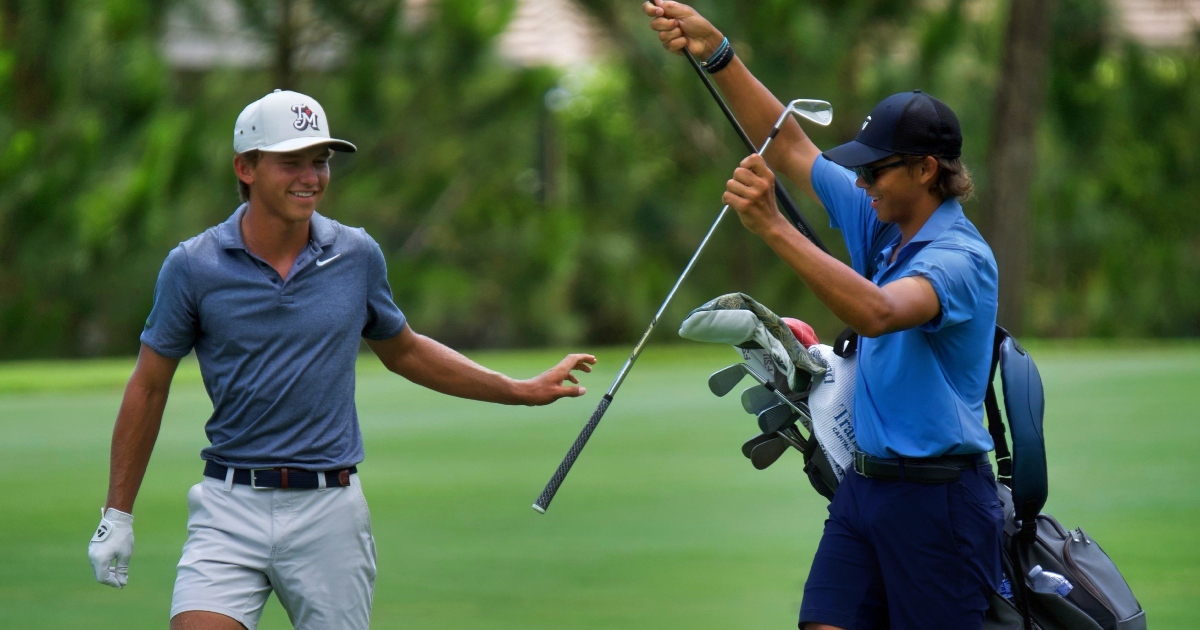
Brown was not the youngest player competing at Omni Barton Creek. Eighteen-year-old Miles Russell, the only amateur in the field, opened with five-under 67. That left him five shots behind Crowe and two behind Brown when the leading scores were established. The simple comparison puts two distinct career choices onto the same scoreboard: Brown has already collected a Tour trophy, while Russell is still preparing for college golf.
Russell had formally signed with Florida State just the day before the opening round, joining a recruiting class that also includes Charlie Woods. His arrival in Austin was therefore not an ordinary high-school tournament week. He moved from a college milestone to a PGA Tour exemption in barely a day and kept the golf sufficiently tidy to place himself in the wider first-round conversation. A 67 does not confer professional status, but it is an encouraging test against the kind of field he hopes to join eventually.
His 2026 résumé is stronger than the label amateur might suggest. Russell played at the U.S. Open at Shinnecock Hills, made the cut and finished inside the top 40. That tournament carried a different kind of pressure, with a major championship course and a national audience, and it gave him experience of the patience demanded when pars can be valuable. At Austin, where the first day rewarded attacking golf, he had to read a different competitive environment.
GOATIFY
GOATIFY Golf
Miles Russell's 67 and Florida State signing spotlight golf's next generation. Browse the GOATIFY Golf collection while following the sport's rising talent.
Those contrasting conditions are particularly useful for a young player. In a major, trying to force birdies can send a round in the wrong direction. On a receptive fall-tour course, the risk is becoming too protective when rivals are shooting 64 or lower. Russell's five-under start shows that he can make scores in an open professional field; his next challenge is to treat Friday as another independent round rather than chase the exact number he needs to climb past established players.
Brown's own early path provides an unusually close comparison. At 18 he was racing between Korn Ferry Tour and PGA Tour commitments, and he later chose the professional route that led to a first title in November. Russell has expressed interest in using college to continue growing before making a permanent jump. These are not competing proofs of one correct decision. Development depends on results, opportunities, support and an individual's readiness for a professional calendar.
Other young competitors complicate the picture still further. Jackson Koivun, already a PGA Tour winner after his time at Auburn, opened Austin with a 70. Ben James, the man Brown beat in Mexico, had almost won as a rookie days earlier. Each represents a different stage of the same movement: amateur expectations, first professional tests, near misses and eventually the task of defending an established place. The important story is not simply that golfers are young; it is how quickly the standards around them change.
At the same time, age is no substitute for a complete four-round performance. Russell must get through the cut, handle whatever Friday's conditions bring and then build the sort of position that allows him to learn from a meaningful weekend. Brown needs to demonstrate he can manage attention without becoming a one-week narrative. Crowe and the other veterans need to make sure the teenagers do not dominate the scoreboard as well as the conversation.
Darkness suspended Thursday's first round before every player finished, so the positions reported at the stoppage were provisional. Organizers planned to resume the remaining holes Friday morning and run the second round on schedule. That detail matters when interpreting a headline claiming a golfer is 'fourth' or 'five behind': the scoring can move before the next full round is under way. The firm facts are that Brown signed for 65, Russell for 67, Crowe for 62, and neither teenager wasted his opening opportunity.
Thursday did not award a trophy. It established three unusually different reasons to care about the next three days: Crowe's fight for full-status security, Brown's first chance to build on an extraordinary victory and Russell's opportunity to learn near the sharp end of a PGA Tour field.
A 62 can disappear from the lead quickly at a course yielding eagles and double-digit birdie totals. A 65 can become the beginning of another charge or merely a strong opening score. The story worth following from Friday onward is not a prediction that the new teenager will win every week. It is whether the young winner, the veteran leader and the promising amateur can make four rounds tell the same story as their first.
GOATIFY
GOATIFY Golf
Shop GOATIFY golf shirts, hoodies and stickers.


















