The Sun Are Gone. Houston Has Two Clear Guards—and a Roster to Rebuild.
GOATIFYThe Connecticut Sun's final season ended 11–33. The next season begins in a different city, with a famous name on the jerseys and almost none of the certainty that usually comes with it. In 2027 the franchise will relaunch as the Houston Comets, reviving the identity of the team that won the WNBA's first four championships. But the roster Houston inherits is the product of a rebuilding Connecticut team, not a championship core waiting to be switched on.
That distinction turns every player evaluation into something bigger than a routine offseason review. A young guard who looked overburdened in Connecticut could be more effective beside a high-end draft pick. A promising athlete who got heavy minutes on a struggling team might have less room to develop when Houston tries to establish its own identity. And being under contract is not the same thing as being indispensable.
Team president Jennifer Rizzotti, general manager Morgan Tuck and head coach Rachid Meziane are staying in place for now, even as the new ownership evaluates the organization. With the 2027 WNBA Draft Lottery scheduled for November 15, the Comets are also waiting to learn where an important first-round pick lands. The lottery could reshape the rebuild; it should not obscure what the 2026 season already revealed.
Our starting point is deliberately selective: Leïla Lacan and Charlisse Leger-Walker offer the clearest young backcourt foundation. Nell Angloma, Gianna Kneepkens and Aaliyah Edwards deserve more careful evaluation. Others, including Saniya Rivers and Diamond Miller, pose uncomfortable questions about development, roles and opportunity cost. These are basketball assessments, not reports of transactions or final decisions by Houston's front office.
Lacan and Leger-Walker can organize a backcourt, not carry one alone
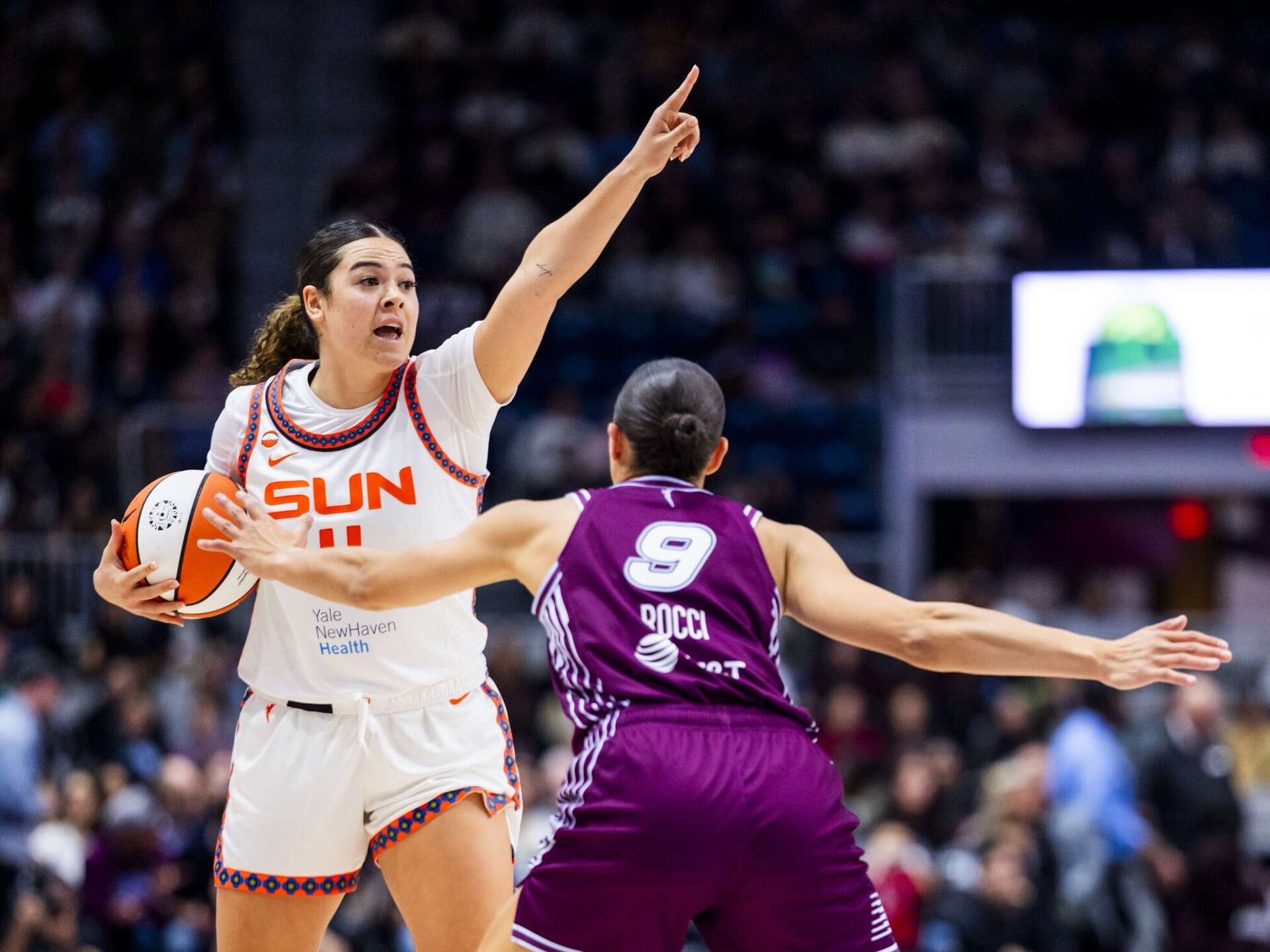
A new franchise identity does not magically create a point guard. Houston already has one player who can bend a defense and another who can keep the offense from unraveling. The case for building around Leïla Lacan and keeping Charlisse Leger-Walker is not that either turned Connecticut into a winning team. It is that they showed complementary skills which can survive changes to the roster around them.
Lacan's second WNBA season was productive without being especially efficient. She averaged 11.4 points and 4.4 assists in 30 games, made 42.2 percent of her field goals and 32.4 percent of her three-pointers, and produced 1.6 steals per appearance. Those numbers support two readings. She was a legitimate scoring and playmaking option on a roster short on reliable creators. She also has real room to improve her decision-making and shot selection if Houston wants to treat her as a long-term lead guard.
The defensive part may be even more important. Lacan's hands, anticipation and willingness to disrupt passing lanes create possessions that a developing offense desperately needs. A player who can contest at the point of attack and immediately turn a steal into transition is a useful building block even when her outside jumper is inconsistent. But the 2026 efficiency questions are not trivial. Houston cannot responsibly pencil in All-Star production before Lacan has shown she can maintain quality when opponents take away her first option.
There is a plausible route to improvement without pretending the weakness has vanished. With a higher-level scoring partner, Lacan would have fewer possessions in which she must manufacture a difficult attempt late in the clock. With more shooters around her, the same driving lanes become more rewarding. With a stable rotation, her defensive gambling could be supported by better collective coverage. The fit is conditional, but that is what makes her more valuable as a cornerstone than as an isolated box-score star.
GOATIFY
GOATIFY WNBA
Lacan and Leger-Walker look like a usable starting point, even if neither can fix a thin roster alone. Explore GOATIFY's WNBA-filtered basketball collection.

Caitlin Clark Golden Goose - Women's Sticker
Add basketball personality to your favourite gear.
Shop Now ↗


BALLERina Girl's Basketball Ballet Air Sticker
Add basketball personality to your favourite gear.
Shop Now ↗
Caitlin Clark G.O.A.T. - Greatest of All Sweatshirt
A basketball fan design for everyday wear.
Shop Now ↗
BALLERina Girl's Basketball Ballet Air Sticker
Add basketball personality to your favourite gear.
Shop Now ↗Leger-Walker's argument is quieter. Selected in the second round of the 2026 draft, she played in all 44 games and collected 161 assists in her rookie season. Her 317 total points and 33.3 percent three-point shooting are not headline material. They also do not tell the whole story of a player who can bring the ball up against pressure, initiate a half-court set and recognize where the next pass ought to go.
Connecticut's August 26 loss to Golden State offered a useful glimpse of both sides of her profile. The Sun lost 89–64, yet Leger-Walker scored a career-high 17 points and went 3-for-4 from deep. One efficient night does not erase a full season of limitations, but it shows why the second-round investment might offer more than the draft slot implied. There is value in someone who can stay organized while the rest of the lineup is changing.
Houston should not confuse that steadiness with evidence that Leger-Walker is ready to carry a contender's offense. She has to become a more credible scorer and maintain enough defensive resistance to remain on court against elite guards. The more sensible projection is a reliable rotation ball-handler who can play beside Lacan or give her a rest. That is a meaningful skill set in the WNBA, and it can be inexpensive relative to the cost of chasing an established veteran distributor.
Neither guard is untouchable in an absolute sense. If the Comets acquire a transformative perimeter player, the rotation will change. But the cleanest planning assumption is to retain both and find out whether their combination can reduce turnovers, create easier looks and help Houston develop an identity more functional than the 2026 record suggests.
Angloma, Kneepkens and Edwards still have cases to make

The easiest mistake in a rebuild is treating a raw rookie as a failed veteran. Houston has three particularly complicated evaluations: Nell Angloma, Gianna Kneepkens and Aaliyah Edwards. Each has a reason to stay, but none should be exempt from a clear development plan. The Comets need to distinguish genuine upside from the comforting habit of keeping everyone who was once a promising draft pick.
Angloma, drafted 12th overall in 2026, has the longest runway of the three. She is still only 20 ahead of the 2027 season. Her mobility, physicality and defensive activity make it possible to imagine her helping without needing the offense built around her. A young wing who sprints back, fights through contact, attacks the glass and earns second possessions can contribute while the ball skills catch up. That is a valuable profile for a roster that cannot afford multiple one-dimensional specialists.
The problem is that athletic potential can become an excuse for everything. Angloma has to improve her handle, finishing judgment and the consistency of her decisions. She cannot just be fast and active; Houston needs to know what her reliable NBA-style equivalent of a WNBA rotation skill actually is. That might be taking tougher defensive assignments, running the floor for easy points or becoming dependable as a cutter and offensive rebounder. The role should be narrow enough to learn and broad enough to expand.
Kneepkens presents almost the inverse problem. A first-round pick whose college reputation was built around shooting, she arrived with an obvious pathway to value: stretch the floor, punish help defenders and make creators' lives easier. Instead, her rookie season raised questions about whether she could generate the necessary separation and defend without becoming a target. The shooting talent is not erased by a difficult transition, but Houston has to determine whether it can translate at WNBA speed.
GOATIFY
GOATIFY WNBA
Angloma, Kneepkens and Edwards have three different development questions. Browse GOATIFY's WNBA fan designs while Houston weighs the upside.

Caitlin Clark G.O.A.T. - Greatest of All Sticker
Add basketball personality to your favourite gear.
Shop Now ↗

BALLERina Girl's Basketball Ballet Air Mug
Add basketball personality to your coffee break.
Shop Now ↗

Caitlin Clark G.O.A.T. - Greatest of All Hoodie
A basketball fan design for everyday wear.
Shop Now ↗
This is where controlled patience matters. A roster as thin as Connecticut's often asks a player to solve too many problems at once. Give Kneepkens a defined catch-and-shoot job, evaluate her movement and release against professional closeouts, and test whether the defense can survive her minutes alongside stronger point-of-attack partners. If the jumper becomes a reliable weapon, it can justify a role. If opponents consistently attack her on one end while denying clean looks on the other, draft status alone should not protect her.
Edwards is a more established player and therefore faces a sharper deadline. The former UConn forward had her best WNBA season by some measures, shooting above 50 percent from the floor and approaching 39 percent from three. But the long-range percentage came on only 18 three-point attempts. That is a sample, not proof of a newly dependable perimeter threat. The modern frontcourt question remains: is she strong and tall enough to play as a conventional interior defender, and is her outside skill package sufficient to play primarily on the wing?
There are matchups in which Edwards can punish a smaller defender, crash the offensive glass and score efficiently around the basket. Her late-season work showed that the talent is real, not just theoretical. The fit becomes less convincing when the opposing team can place a larger athlete on her without sacrificing speed, or force her to defend in space for extended possessions. Houston can still retain her as a situational forward, but should avoid promising starter-level minutes simply to validate a previous investment.
Look at the three together and the trade-off is clear. Angloma offers physical upside, Kneepkens offers theoretical spacing, and Edwards offers a more immediate interior scoring option. All can reasonably earn another evaluation season. Yet a rebuilding team still needs a coherent lineup. Houston must decide which combinations actually function, rather than treating three separate development projects as though they automatically fit side by side.
Rivers and Miller show why draft pedigree is not a plan

Some of the hardest decisions involve players who look the part before a possession even begins. Saniya Rivers and Diamond Miller have the size, movement and draft pedigree to suggest something more than ordinary bench roles. Their 2026 production, however, forces Houston to separate athletic tools from dependable performance. The question is not whether they have talent. It is whether the Comets should keep spending valuable developmental minutes waiting for it to become useful together.
Rivers was selected eighth overall in 2025, and her rookie season created a genuine case for optimism. She could handle multiple defensive jobs, generate steals and blocks, and bring energy to a lineup that often needed it. Yet her second year did not deliver the expected offensive leap. She shot just 34.3 percent from the field and 17.1 percent from three across 38 games, even as she registered 116 assists. The playmaking flashes are there; the jump shot puts real pressure on everything around them.
That matters particularly if Lacan remains the preferred lead creator. Two athletic guards can coexist without both being great shooters, but only if the rest of the lineup provides enough spacing or if one of them becomes unusually effective at creating rim pressure. Otherwise defenders crowd the lane, passing angles shrink and good defensive possessions lead to little reward at the other end. It is a roster-design concern, not an attack on Rivers' effort or personality.
GOATIFY
GOATIFY WNBA
Roster construction is more than keeping former first-round picks. Find GOATIFY WNBA styles as the Comets plan their first Houston season.

BALLERina Girl's Basketball Ballet Air Mug
Add basketball personality to your coffee break.
Shop Now ↗
Caitlin Clark Golden Goose - WNBA Indiana Sticker
Add basketball personality to your favourite gear.
Shop Now ↗


The case for a change of scenery is therefore credible. Rivers might become a more effective player in a system where she is asked to defend the toughest perimeter assignment and attack in transition rather than manufacture half-court offense. Houston might also believe the talent deserves another summer of skill development. Both are defensible positions. What would be difficult to defend is keeping the same role and assuming a different outcome without concrete evidence that the shot and decisions are improving.
Miller's situation comes with a similar warning. A former high draft pick with undeniable movement skills, she received extensive opportunity during the Sun's final Connecticut season. In 43 games she scored 420 points but made only 36.5 percent of her field-goal attempts. Volume without enough efficiency can be especially costly for a young team whose offense already ranks near the bottom of the league. Her status as a restricted free agent adds a separate contractual dimension: Houston must judge the cost and competitive fit, not simply whether the previous draft pedigree remains attractive.
The lower end of the roster requires equally honest consideration. Raegan Beers can provide size and physical rebounding, but a more traditional interior profile needs either strong finishing efficiency or defensive impact to justify minutes in space-heavy lineups. Hailey Van Lith has creativity and a competitive streak, yet size can make it hard to carve out a durable WNBA defensive role. Those are fit questions to solve with film, specific assignments and roster context rather than dismissive labels.
Meanwhile, Ashlon Jackson and Rayah Marshall may offer practical depth even without projecting as future stars. Jackson's size gives the staff defensive options on the perimeter; Marshall offers another young body in the frontcourt. Their development-contract and reserved-player situations need to be distinguished from guaranteed long-term places on the roster. The current team's contract sheet, not an offseason opinion piece, determines what Houston can actually do with each player.
The veterans are a different conversation. Brittney Griner and Kennedy Burke are listed among unrestricted free agents, while Olivia Nelson-Ododa is among the players under contract. Houston will have to decide how much veteran stability a young roster needs, which roles should be filled through free agency and how those decisions affect the chances of the younger group. A smart rebuild is not made entirely of prospects; it requires enough dependable veterans to keep the basketball organized.
The renewed Houston Comets have inherited a franchise history and a future opportunity, but not a settled competitive core. A 2026 record of 11–33 is a warning against romanticizing every familiar name. It is equally a warning against expecting any one young player to look fully formed when the supporting cast has been so unstable.
For now, Lacan and Leger-Walker offer the clearest balance of useful skills, developmental runway and potential fit. Angloma, Kneepkens and Edwards deserve another honest assessment with defined roles and measurable goals. Rivers and Miller may still find their best basketball, but Houston has to decide whether this is the right environment for that to happen. The same disciplined reasoning applies to the final bench places: athletic gifts and draft labels do not substitute for workable combinations.
Above all, the lottery cannot do all the rebuilding for the Comets. A top pick would raise the ceiling; it would not solve shooting, lineup balance, defensive connectivity or player development by itself. The first meaningful act of the new Houston era is not choosing a famous name for the front of the jersey. It is deciding which players have earned the right to wear it in 2027.
GOATIFY
GOATIFY WNBA
Shop GOATIFY WNBA products from the WNBA-filtered basketball collection.


Caitlin Clark Golden Goose - WNBA Indiana Sweatshirt
A basketball fan design for everyday wear.
Shop Now ↗
BALLERina Girl's Basketball Ballet Air Sticker
Add basketball personality to your favourite gear.
Shop Now ↗
BALLERina Girl's Basketball Ballet Air Sticker
Add basketball personality to your favourite gear.
Shop Now ↗