Alonso Rules Out Estêvão Loan — But Chelsea's 172-Minute Problem Remains
GOATIFYChelsea have a 19-year-old Brazilian international who can change the pace of a match, a manager who says he believes in him, and a minutes total that makes those two facts difficult to reconcile. Estêvão Willian has started only twice this season. He watched Wednesday's League Cup elimination at Liverpool from the bench, and the questions about his future have become too loud for Xabi Alonso to ignore.
On Friday, October 30, Alonso ruled out discussions about sending the winger on loan in January and insisted that opportunities would arrive. That is meaningful reassurance, but it is not a team-sheet promise. With Manchester United visiting Stamford Bridge on Saturday, Chelsea's dilemma is suddenly about more than one talented teenager: can Alonso protect Estêvão's long-term development while a battered first team urgently needs another attacking solution?
The timing makes the debate sharper. Chelsea have just lost to Tottenham in the league and Liverpool on penalties in the cup. João Pedro and Reece James are unavailable, Maxence Lacroix has joined the injury list, and the club is trying to steady itself while fifth in the table. Estêvão's situation now sits at the intersection of selection, fitness, tactical fit and the pressure to win immediately.
Alonso has closed the loan door, not the selection debate

The simplest part of Friday's news is also the most definitive. Asked whether Estêvão might leave on loan in January, Xabi Alonso said the club was not having those discussions. The manager also maintained that the season is long and the Brazilian will get games. For a player whose lack of involvement has become a running talking point, the public rejection of an exit matters. It removes one possible short-term answer to a problem that has not gone away.
But Chelsea cannot settle the issue by pointing to a transfer window that is still months away. Estêvão has started only two matches in all competitions this season. He was not used in Wednesday's League Cup elimination at Liverpool, despite Chelsea eventually needing a route back into the tie. Across six Premier League appearances, his league playing time stands at 172 minutes. That is an unusually small platform for a player the club considers a major part of its future.
Alonso has acknowledged the human side of this calculation. Players want to compete, and a manager's choices can leave talented members of the squad unhappy. He has taken responsibility for those choices rather than blaming Estêvão's attitude. That distinction is important: there is no public evidence of a disciplinary dispute, and the coach's words should not be twisted into one.
It is also possible for two things to be true. A club can have no intention of loaning a young player and still be failing to provide the competitive rhythm he needs. Training-ground praise and assurances about a long season are valuable, but they do not replicate the decisions, contact and confidence of playing in meaningful Premier League minutes.
The next stage of the conversation should therefore be concrete. Does Estêvão have a defined position? Is he a first substitute when Chelsea need invention? Is there a planned run of starts after the next international break? Those are questions a loan denial cannot answer by itself. Until Chelsea demonstrate an actual route onto the pitch, the same debate will return after every unused-substitute appearance.

Two starts expose a tactical squeeze that talent alone cannot solve
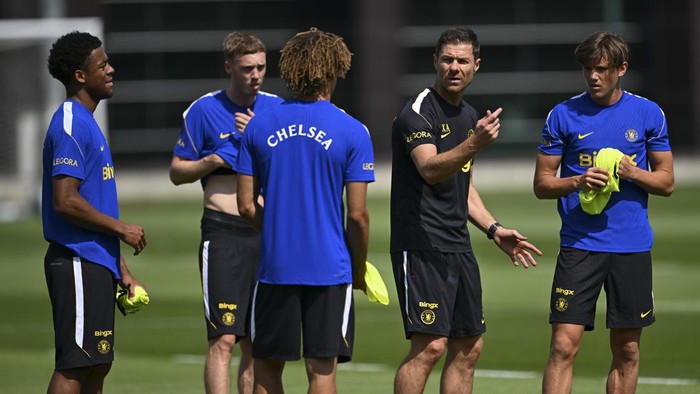
Estêvão's problem is not simply that Chelsea possess too many attacking players. It is that Alonso's preferred structures do not necessarily create a natural, uncontested home for a left-footed creator who likes to receive wide on the right and attack defenders. Cole Palmer can operate in the same creative corridors. Pedro Neto offers direct running and experience. Morgan Rogers has been used in advanced roles that demand physicality and quick combinations. Every selection carries a tactical trade-off, even before the scoreline begins to influence substitutions.
Alonso has previously discussed changing Chelsea's defensive shape according to opponents, including movements between a 4-4-2 and a 5-2-3 without the ball. That flexibility can be useful for a developing team. For a young attacker, though, the key question is whether the position he is asked to play gives him a genuine chance to use his strengths. Estêvão is dangerous when he can face an isolated defender, shift the ball onto his left foot and either create a shot or pull a second opponent out of position. If he is confined to tracking a full-back for a handful of late minutes, the club may learn very little about his attacking ceiling.
The strongest case for caution is physical and tactical adaptation. Premier League transitions are demanding, defensive responsibilities are unforgiving and Alonso is trying to install new habits across the team. Giving a teenager a sequence of controlled appearances can be sensible. The weaker case is treating every difficult match as a reason to delay his introduction indefinitely. The season is already producing enough demanding fixtures that waiting for an easy game could become a strategy with no finish line.
A better approach would distinguish between the kind of minutes Chelsea give him. Ten minutes when a game is settled are not the same as a half-hour against an organized defence. Nor is a start against rotated cup opposition equivalent to sustained league responsibility. Chelsea can protect the player while still testing him in situations that matter: a defined attacking role, a reliable substitute window, and the occasional start with experienced midfield support behind him.
That would also make Alonso's public message easier to believe. He does not need to promise Estêvão an automatic place ahead of Palmer or Neto. He does need to show that the Brazilian is competing for an identifiable role rather than waiting for everyone else to become unavailable.

The injury history matters — and Brazil's faith raises the stakes

The most persuasive reason not to rush Estêvão is the history Chelsea are managing. The winger's previous campaign was interrupted by repeated physical problems, including a serious thigh injury that kept him out of the 2026 World Cup. A teenager returning from that kind of setback is not simply a fully fit player with a low appearance count. Match sharpness, acceleration, confidence in repeated sprints and the ability to tolerate a dense fixture schedule all need to be rebuilt.
That context helps explain why the manager has emphasized adaptation to the intensity of English football. It does not, however, make the minutes question disappear. The challenge is to increase exposure intelligently rather than keep it negligible. Training can restore fitness; competitive football restores the judgment that only appears when an opponent is pressing, a teammate is moving and a split-second decision has consequences.
There is also a striking contrast between Estêvão's club role and his standing with Brazil. Carlo Ancelotti has included him for the November internationals even as Chelsea have used him sparingly. The national team is preparing friendlies against Japan and Singapore on November 14 and 17. That call-up is not proof that Chelsea's coach is wrong, because club and international football ask different things of a player. It does demonstrate that a highly experienced manager still sees value in involving the teenager at the top level.
The comparison with other young Brazilians in Europe is instructive. Their clubs want immediate tactical reliability, while their national team may prioritize long-term development and the ability to produce moments of individual brilliance. Neither approach automatically wins. A player who is not yet a first-choice club starter can still be a valuable international option, just as a talented international can need more work before becoming an automatic Premier League starter.
Expectations have shifted rapidly since Estêvão arrived in England. First came the excitement around his potential, then the difficult reality of injury management, and now a debate over whether Chelsea are giving him enough opportunity to develop. The club's challenge is to avoid turning a sensible recovery process into a permanent reason for postponing his next step.
For Chelsea, the sensible answer is neither an emergency loan nor permanent bench duty. It is an individualized progression that builds from short appearances to substantial, predictable workloads. If Estêvão is physically ready to join Brazil, the club should be able to articulate what competitive steps will follow when he returns.
Manchester United is the first real test of Alonso's promise

Saturday's visit from Manchester United provides an immediate measure of whether Estêvão is moving closer to a meaningful role. Chelsea are fifth in the Premier League, but their recent results have exposed the fragility of Alonso's rebuilding project. Tottenham won 2-0 at Stamford Bridge last weekend, and Liverpool eliminated Chelsea from the League Cup on penalties on Wednesday. These are not conditions in which a manager naturally feels relaxed about experimentation. They are also precisely the conditions in which an underused attacking option can become useful.
The squad picture is complicated. João Pedro is sidelined with a thigh injury and captain Reece James remains out. Centre-back Maxence Lacroix suffered a hamstring problem at Anfield and is expected to miss several weeks, potentially until after the November international break. There is some relief in midfield: Moises Caicedo is available despite leaving the Liverpool match with a minor issue. Goalkeeper Emiliano Martínez, recovering from a jaw injury, may be able to return before the break, possibly with protective equipment.
Those injuries do not create a direct vacancy in Estêvão's preferred position, but they narrow Chelsea's room for tactical improvisation. When a team loses key contributors, the remaining attackers often have to carry more of the creative burden. An opponent can devote extra attention to Palmer or Neto if Chelsea are predictable. A winger with the ability to beat a defender can change that calculation even when he does not score.
United bring their own pressure to Stamford Bridge. Michael Carrick's side are 16th, one point above the relegation zone, and have gone eight matches without a win across competitions. Bruno Fernandes was benched for the 3-0 home defeat to Bournemouth before Carrick said he had spoken with the captain and expected commitment. Chelsea should not mistake United's league position for an invitation to play carelessly. A desperate side can still be dangerous, especially if it finds space against an unsettled back line.
For Alonso, the key is choosing the moment. Estêvão might start, appear as a substantial second-half substitute or remain unused; Friday's comments do not establish a selection decision. But if Chelsea again struggle to create chances and the Brazilian stays seated, the manager will face an obvious question about why his available attacking talent was not used. Conversely, if Estêvão receives meaningful minutes, the club will have an opportunity to judge him on performance rather than speculation.
A single match cannot settle a young player's future. What it can reveal is intent. Chelsea do not have to abandon their structure to make room for Estêvão. They do have to show that their structure is capable of making room for him when the game demands something different.

Alonso has drawn a clear line on the transfer question: Chelsea are not discussing a January loan for Estêvão. He has not, however, answered the harder football question of how and when the winger will play. A promise of future minutes becomes credible only when it turns into a repeatable role rather than an occasional late substitution.
The next few weeks offer a reasonable test. Chelsea need attacking variety against United and beyond, while Estêvão needs a pathway that respects his recovery without leaving him permanently behind established names. The best outcome is not an automatic start in every match or a rushed move elsewhere. It is a deliberate plan: meaningful minutes, a position that suits his strengths, and clear evidence that the manager trusts him when the game is still alive.
For now, the Brazilian stays. Whether he feels central to Chelsea's future will depend less on Friday's reassurance than on what Alonso does with the next team sheet.